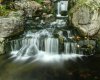
I obviously don't know anything about cameras like this.
Just picked up my latest toy on the DSLR, as I haven't though to check such things on it yet, but like the OP's bridge, smallest aperture I get is f25, @ 16mm but if I wind the zoom to the wide side, that opens up to f22 @ 8mm. Get the same thing on the kit 18-55, and stopped down to the max, at 18mm, I get f22, zoom in to 55m and that tightens up to f32..
Because the f-number is not the size of the aperture, its a ratio, of the aperture diameter to the focal length, so will change with either.
While this, and limited range of f-number settings isn't an issue or quirk of the OP's 'kind' of (bridge) camera, it's a bit of basic camera or lens mechanics that that can effects all cameras / lenses.
Just checked two electric lenses for DSLR, and the kit 18-55 has more available f-no settings, and at the tele end goes a stop or so tighter than the UWA can. Both, though do err towards offering f22 or tighter as smallest aperture, though, which is significantly tighter than the OP's camera does. But, same 'change' with zoom setting is there.
Conveniently to hand, I have my old Zenit 35mm film camera, with it's Helios 44.. confusingly, a 58mm lens, I believe much loved by the MFT folk. This has a nice fast f2 max aperture, but like the OP's Bridge camera, restricted at the other end with a smallest aperture of f16.
Its not the only manual lens I have with a lower smallest aperture, though most, I think go to f22, but sat with the Zenit, is my old fish, whch is a bit of an odd-ball, but that too has pretty restricted aperture settings, just three, f8, f11 and f16. It also doesn't have a leaf-blade 'iris' aperture control. Instead, it has a metal plate, with three perfectly round apertures punched into it, that's moved round to align one hole between elements inside the lens.
Some of the Large-Format film folk possibly use lenses, with a similar if perhaps even cruder (though possibly more 'precise') system, where the aperture is selected by picking a brass disc with a hole in the middle, out of a felt-lined box, probably, and slotting it into a rebate before attaching the lens to the camera!
AND! Lets talk reflector-lenses! Not as common as they used to be, but still available ad being attached to DSLR's; to get a very large focal length, 500 or 1000mm or so, for lots of reach, but without having a meter of metal on the front of the camera, they use 'parabolic mirrors', to make them shorter; light coming through the front element, being reflected off a mirror at the back of the lens, onto another mirror in the front, behind the front element, and then, having travelled three times the length of the lens, inside it, through the aperture and into the camera. Constraints of the construction mean you cant practically put a variable aperture iris to one, the levers to work it would be blocking the mirrors; so these usually have a single fixed aperture, usually about f4 or f8 if its a really big mirror.
So, limited range of aperture settings, isn't a quirk of the OP's bridge camera's lens, its a generic issue to all cameras, but one that is probably less common with the more common of modern lenses, than it was in days past.
Like wise change of f-no with focal length, when most lenses were fixed focal length primes, you got the f-numbers on the aperture ring that was the only thing that changes them. When zooms came along, the change of f-ratio with zoom setting became obvious, BUT most only concerned with maximum apertures, fact that it also changes with zoom at tight apertures, is rarely mentioned or considered..
.
Yes I agree that the OP is trying to do something his camera isn't capable of.
I think that might be a tad unfair to the camera. It would be fairer to say that its not best suited for what he's trying to do.
He has plenty of scope to be more technical with that camera; over fully-automatic snap-shot program, it has a conventional shutter priority mode, an aperture priority mode, and a full manual mode. He has ISO settings from 80 to I think it was 800, shutter speeds from I think it was 1/2000th, down to 30second, Apertures from f3.5 to f8.1 are a tad 'restricted'... bit there is plenty of 'capability' there. Looking at that old Zenit SLR, That has just 5 shutter speeds! 1/30th up to 1/500th. Has two extra stops of aperture at the wide end, and two more at the tight, while its SO settings were limited to the film you stuck it, probably a choice between 100 & 200ASA, you were stuck with for the entire roll. And t doesn't even have an inbuilt meter! THAT is a camera that lacks 'capability'! Wouldn't stop some-one taking waterfall shots with it though, and having a 'Bulb' setting you could use to lock the shutter open, with a cable release, meant many did.
OP's bridge camera the has an awful lot of the capability, and certainly the settings available from, a modern DSLR, but, for this one specific situation, taking long exposures, it does lack that one key feature to make long exposures, the ability to hold the shutter open more than 30s or to lock the shutter open to time independently.
Lack of smaller apertures? Its another limitation and is having influence on this situation, because he cant stop down further to force longer exposure times.
But, its a compound problem; and OP doesn't properly understand exposure; using aperture priority to force longer shutters, he has some idea of it, but he's relying the meter, and getting over exposure, begging the idea fro the little he knows about exposure that he needs tighter apertures or a filter, which is tangential to the 'core' problem. He doesn't understand exposure enough for this situation, or how to compensate to expose for the high-lights rather than the mid-tones, which whether he uses aperture or shutter priority or full manual, all taking the meters suggested exposure settings based on mid-tones, that will err towards over-exposure, and any thought for further compensation, to hold the back where highlight layered on highlight during a long exposure will multiply the local 'exposure' pushing streaks even more into over exposure.
The OP's 'problem' is, like I say compound; there are many factors conspiring against him, and while I agree, the camera isn't helping him much, the camera probably isn't incapable of getting a milky waterfall effect. Should be able to get them at under 1s shutter, and he can get down as low as 30s for plenty of milk, if he has a tripod. It is 'possible', with that camera. It's just not so easy.. but ten wouldn't be an awful lot easier on an DSLR, without better understanding exposure and his subject.