

Exposure Considerations

Barney

Suspended / Banned
Messages
3,043
Name
Wayne
Edit My Images
No
Stephen mentioned something yesterday that has made me consider exposure, adjusting either by F stop of Shutter speed.

I thought about a bucket of light that I need to get into the camera.

I can either slosh it in quickly in one go with a fast shutter and lose a bit splashing about or pour it carefully with a slow shutter and not lose any.

Somehow my most pleasing, to me, photo's are when I have carefully poured in the light with long exposures and not spilled any.

is this analogy incorrect ?and if not how can I get these lazy long exposures.
 
hi wayne are you asking:- If a camera set on a tripod and the subject doesn't move.... will the results be the same on the neg taking a shot at 1000/sec or 1 min with the correct exp for each.
 
hi wayne are you asking:- If a camera set on a tripod and the subject doesn't move.... will the results be the same on the neg taking a shot at 1000/sec or 1 min with the correct exp for each.
Yes, exactly Brian, I know in theory they are the same.
Sorry if I had not made that clear enough, that's happened a couple of times lately. I must try to improve that, but oftentimes I don't know the correct photography terms to make clear my thoughts and ideas. Thanks for helping!
 
Yes, exactly Brian, I know in theory they are the same.
Sorry if I had not made that clear enough, that's happened a couple of times lately. I must try to improve that, but oftentimes I don't know the correct photography terms to make clear my thoughts and ideas. Thanks for helping!
Well I couldn't answer as I don't know o_O as I've never tried it for a comparison.
 
Stephen mentioned something yesterday that has made me consider exposure, adjusting either by F stop of Shutter speed.

I thought about a bucket of light that I need to get into the camera.

I can either slosh it in quickly in one go with a fast shutter and lose a bit splashing about or pour it carefully with a slow shutter and not lose any.

Somehow my most pleasing, to me, photo's are when I have carefully poured in the light with long exposures and not spilled any.

is this analogy incorrect ?and if not how can I get these lazy long exposures.

The correct way is to use the shutter speed that gives you the results you require.

If I'm hand holding my Yashica Mat 124g then sloshing the light in quickly is preferable :) You aren't losing any light sloshing light in quickly, all things equal.
 
Can't resist the urge to be accurate. The rule that doubling the exposure time and halving the amount of light by the aperture (or a neutral density filter, or adjusting the studio lighting etc. etc.) us called the reciprocity law. IT ONLY HOLDS WITH A RANGE OF EXPOSURE TIMES. See the film data for the range, but typically between 1/2 and 1/1000th second. Outside those ranges, more exposure is needed (check threads mentioning Fomapan for extreme corrections). Plus contrast changes.

With those caveats, the results are the same.

I think you're overly complicating things. If I was asked how to get the exposure to give a correctly exposed negative, I'd say to use a hand held meter, stick your hand in the same light that's falling on the subject, take a reading from your palm and open up a stop. And rate the film (if negative) at 2/3 of box ISO. The caveats are of course, this doesn't apply to macro (defined as closer than 1 foot from the camera) or when filters are used.

The method above is basically measuring incident light. Discussion of the finer points can be lengthy, but if you want a 99.9% success rate, that's all you need to know about exposure.
 
Last edited:
The method above is basically measuring incident light.
Indeed.

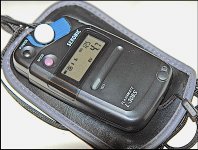
Simpler still is to use an exposure meter with an incident light "dome" (or a Weston meter with an "Invercone" fitted)

Sekonic L308S light meter DSC-R1 07058.jpg
 
I can either slosh it in quickly in one go with a fast shutter and lose a bit splashing about or pour it carefully with a slow shutter and not lose any.
You don't lose any either way... I think the bucket-rain analogy is useful.

Your "bucket" that you need to fill with rain (light/photons) is the film/sensor. And the amount of light is akin to how heavy the rainfall is. I.e. in a downpour you are going to get fully soaked no matter how fast you run to the car... a fast shutter speed in bright light. And how wet you get is akin to shot noise. I.e. in a sprinkle you may remain relatively dry getting to the car... low light, higher noise; needs longer shutter speeds.

I cannot come up with any reason to prefer images taken with a slower SS in terms of exposure (light/noise/etc); actually the opposite. But in terms of aesthetics (motion blur/etc) there can be a benefit situationally. And it's possible/likely that those same images took more care/thought in their creation... i.e. they are less "snapshots."
 
Yes, exactly Brian, I know in theory they are the same.
Sorry if I had not made that clear enough, that's happened a couple of times lately. I must try to improve that, but oftentimes I don't know the correct photography terms to make clear my thoughts and ideas. Thanks for helping!
But not the same in practice . . . I think the term you're looking for is the Schwarzschild effect. I don't know how good this calculator is, but it should help. https://www.denisolivier.com/long-exposure-calculator/en/
 
Back
Top