I don't. I've never seen anything definitive.
I don't have the experience to judge but on Photrio in 2023 Agulliver said “It's not any known version of Fomapan because I use them all regularly and Exeter Pan XX behaves very differently to any of them. Development times are different, more like HP5+. The Exeter Pan film pushes much better than Fomapan 400, which would be the only possible candidate in Foma's range of films to push to 1600. Even if we consider a possible stash of the old Foma 800, that was far more grainy when pushed to 1600. Fomapan 400 is not only far more grainy but develops far more contrast when pushed."
He went on to say "This isn't identical to HP5+ in my opinion. The halation effect is greater with this Exeter Pan film. Otherwise it is certainly similar, though I do not have the time nor equipment to conduct laboratory type tests on it. Development times for HP5+ at 400 and 1600 in Microphen seem pretty much bang on, whereas development times for Fomapan 400 are incorrect - in my opinion and as per my preferences.
"The only solid conclusion I will say is that this isn't any Foma film that we're aware of. It *might* be Harman/Ilford P4 [Surveillance film]. It *might* be something else. I've never had any P4 in my hands to compare directly."
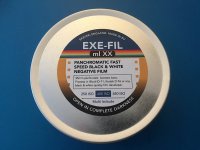
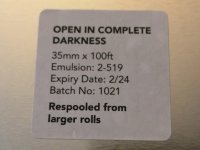
I bought a 100ft roll of Exeter on 20 June (2023) , expiry date 2/24 - the can says 'Made in EU' which, if correct, would seem out of line with the film being made in Mobberley, unless perhaps it was old stock; can items made in the UK still be described as made in the EU if they were made at a time when the UK was in the EU? If the made in EU is correct and it is not pre-Brexit Harman and not Fomapan that points towards it originating from either Inoviscoat or a former Soviet Union plant in one of the countries now in the EU.
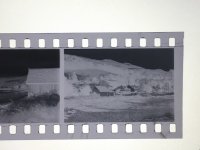
The perforations are KS style perforations which are the norm for Still film, and Motion Picture print film. Movie Cameras in North America and Europe are generaly set to use "Bell and Howell" style perfs which have rounded ends and are slightly narrower. Movie cameras from the former Soviet Union use KS perforations.