EV sales in UK in October surged ahead ! - Despite a fall in Car Sales overall

according to google most IE over 50% of the UK have access to off road charging so while it isn't perfect it is way more than your doom and gloom.

This is a 2019 survey but no reason to believe it isn't accurate
EVs are selling in massive numbers you just don't want one, big deal thats one less :)

Most of those living in detached or semi-detached houses will have access to some sort of driveway, accounting for 57% of the country. That leaves around 43% of the country without the ability to charge at home. In 2019, the population of UK adults over 18 is around 44 million.


That's still a huge number without the ability to charge cheaply at home, or possibly even for free if they have a decent solar system in place.

For quite some time I've been considering an EV and as much as I like petrol I'm also not against EV and it would actually suit me quite well, if I had a driveway. So I don't know where you are getting "your doom and gloom" from, I'm being objective about it all and holding an impartial stance, which is far more than can be said about you.
 
Yes. In fact it's easy to do. You take the kWh and multiply by the cost per kWh.

I just asked an AI to do it for me and it got £992.40. HTH.

On the other hand, my mate ran out of petrol once and a local garage charged him £50 to deliver a gallon to him. Assuming an average of 45 mpg over 9k miles, that's £10,000.

I'm not sure about those numbers, especially £10,000, unless your mate is paying over £10 per litre at the pump.

I've had a quick myself now and come back with the following below. It still seems rather expensive for public charging using rapid chargers, which still take a while. I know there are much faster ones about, although limited to certain cars and presumably very expensive.

Some observations being that if only doing very short journeys then 42mpg may not be achievable depending on the car, however, EV are apparently also not great for very short journeys when the batteries are cold.

That being said, without home charging at approximately 7p per kWh rates, EV still appears to be rather expensive even if using a 7kWh public charger, which would work out at 13p per mile, but would take 10 hours to charge for 222 miles range. According to the ZAPMAP calculator that is. I've not included any EV charging membership/subscription charges either.


Petrol
Audi 35 TFSI with an average of 42.2mpg
9000 miles @ 134.34p per litre is £1,308.72
Cost per mile = 14p

EV
Jaguar i-PACE
50kW - Rapid Charging @ 70p per kWh
Cost to add 54kWh (166 miles) = £38
Time to charge 166 miles = 1.1 hrs
Cost per mile = 23p
 
Last edited:
were the e-paces withdrawn in the USA due to major battery faults ?

They had a couple of recalls but not for battery problems.

I mind there was a pretty huge recall on the Taycan batteries, which I think were also used in other cars including the i-PACE?
 
He specifies the e-pace.
 
I'm not sure about those numbers, especially £10,000, unless your mate is paying over £10 per litre at the pump.

I've had a quick myself now and come back with the following below. It still seems rather expensive for public charging using rapid chargers, which still take a while. I know there are much faster ones about, although limited to certain cars and presumably very expensive.

Some observations being that if only doing very short journeys then 42mpg may not be achievable depending on the car, however, EV are apparently also not great for very short journeys when the batteries are cold.

That being said, without home charging at approximately 7p per kWh rates, EV still appears to be rather expensive even if using a 7kWh public charger, which would work out at 13p per mile, but would take 10 hours to charge for 222 miles range. According to the ZAPMAP calculator that is. I've not included any EV charging membership/subscription charges either.


Petrol
Audi 35 TFSI with an average of 42.2mpg
9000 miles @ 134.34p per litre is £1,308.72
Cost per mile = 14p

EV
Jaguar i-PACE
50kW - Rapid Charging @ 70p per kWh
Cost to add 54kWh (166 miles) = £38
Time to charge 166 miles = 1.1 hrs
Cost per mile = 23p

but no one buys an EV to fast charge at BP Puluse etc
how many times do you need to have this message?

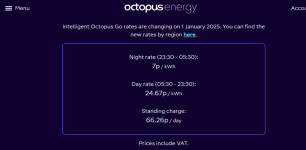
its 7p/kwh which is about 1.85p per mile


1735418637423.png1735418637423.png
 
I'm not sure about those numbers, especially £10,000, unless your mate is paying over £10 per litre at the pump.

I've had a quick myself now and come back with the following below. It still seems rather expensive for public charging using rapid chargers, which still take a while. I know there are much faster ones about, although limited to certain cars and presumably very expensive.

Some observations being that if only doing very short journeys then 42mpg may not be achievable depending on the car, however, EV are apparently also not great for very short journeys when the batteries are cold.

That being said, without home charging at approximately 7p per kWh rates, EV still appears to be rather expensive even if using a 7kWh public charger, which would work out at 13p per mile, but would take 10 hours to charge for 222 miles range. According to the ZAPMAP calculator that is. I've not included any EV charging membership/subscription charges either.


Petrol
Audi 35 TFSI with an average of 42.2mpg
9000 miles @ 134.34p per litre is £1,308.72
Cost per mile = 14p

EV
Jaguar i-PACE
50kW - Rapid Charging @ 70p per kWh
Cost to add 54kWh (166 miles) = £38
Time to charge 166 miles = 1.1 hrs
Cost per mile = 23p

but no one buys an EV to fast charge at BP Puluse etc
how many times do you need to have this message?

its 7p/kwh which is about 1.85p per mile


View attachment 441932View attachment 441932

^ and how many times do you need to have the message that people who don't own an EV aren't necessarily anti-EV :)

@gman has posted a perfect example there of why someone isn't going to own an EV. And that's excluding the extra insurance, possible extra VED and the extra cost/ finance/ loan of actually buying it.

Me, and a lot of other people, drive what best suits our situation we're in.
 
I'm not sure about those numbers, especially £10,000, unless your mate is paying over £10 per litre at the pump.

I've had a quick myself now and come back with the following below. It still seems rather expensive for public charging using rapid chargers, which still take a while. I know there are much faster ones about, although limited to certain cars and presumably very expensive.

Some observations being that if only doing very short journeys then 42mpg may not be achievable depending on the car, however, EV are apparently also not great for very short journeys when the batteries are cold.

That being said, without home charging at approximately 7p per kWh rates, EV still appears to be rather expensive even if using a 7kWh public charger, which would work out at 13p per mile, but would take 10 hours to charge for 222 miles range. According to the ZAPMAP calculator that is. I've not included any EV charging membership/subscription charges either.


Petrol
Audi 35 TFSI with an average of 42.2mpg
9000 miles @ 134.34p per litre is £1,308.72
Cost per mile = 14p

EV
Jaguar i-PACE
50kW - Rapid Charging @ 70p per kWh
Cost to add 54kWh (166 miles) = £38
Time to charge 166 miles = 1.1 hrs
Cost per mile = 23p

I drive an Audi Q2 35 TFSI, and I can tell you that, after 11 months of ownership & 8k miles, my MPG is around 39. Now, the i-Pace is bigger & heavier than a Q2, so if that's based on a Q3 (next size up to a Q2) then I reckon 42 MPG is "poppycock".
 
^ and how many times do you need to have the message that people who don't own an EV aren't necessarily anti-EV :)

An observation made by others as well as myself is that one of the greatest barriers to EV adoption has been EV owners themselves. As more ordinary people are acquiring them the tension between owners of one vehicle type and another are slowly being diluted. It's not just online either - guys I worked with 5 years ago whom I got on well with generally were really arsey about their cars. That's mostly coming to an end now except in little pockets like this.
 
To paraphrase the old vegan gag: You don't need to ask if they have an EV. If they have they will tell you.
 
That's still a huge number without the ability to charge cheaply at home, or possibly even for free if they have a decent solar system in place.
How much does a ‘decent solar system’ cost? At average electricity use how long will it take to negate the install cost and then be free?
 
I'm not sure about those numbers, especially £10,000, unless your mate is paying over £10 per litre at the pump.
As I said, he was charged £50 for the delivery of 1 gallon to the middle of nowhere. At that price it would be £10K for 9k miles.

Of course only an idiot would fill their car this way. It would also be unusual for any EV owner to fuel their car solely from public high speed chargers. Stats on mine say the last time I did this was on a 500 mile trip to Devon on the 12th of April.

Of course if you always have to use public high speed chargers then on purely economic grounds, an EV might not be for you. The newspapers owned by various Oil Barrons will be happy to explain how electricity with negligible tax could theoretically cost more than one of the most heavily taxed products available.
 
How much does a ‘decent solar system’ cost? At average electricity use how long will it take to negate the install cost and then be free?
There's a lengthy thread on this - mine was about 12k (you can see a breakdown in the thread). My electricity bill for the year is slightly negative including standing charge and driving an elderly Tesla. I expected payback to be 10 years or so but it's probably going to be 5 ish.

Depending on your requirements and house, a decent non solar battery system might be more suitable.
 
How much does a ‘decent solar system’ cost? At average electricity use how long will it take to negate the install cost and then be free?

solar systems are much cheaper than they were and integrated into your house to provide electricity and hot water payback is pretty quick according to a quick google

According to the Energy Saving Trust, the average 3.5kW solar panel system would typically require around 10 solar panels (at 350 W each) and cost around £7,000.
However you would need to bear in mind your EV would need to be at home to charge during the day for instance which isn't ideal.
much better technology coming soon will be V2G which allows you to us an EV battery to time shift electricity usage and that can mean massive savings for instance.

you charge your EV to full overnight on an EV tariff (7p/kwh) this generally finishes at 6am
the EV then feeds energy back to the house essentially running the house on super cheap electricity,
if you decide to then use your EV to go to work then yes it might not be fully charged but lets be fair here the average work journey is about 30 miles so its a non issue.
during the time the EV is AWOL from home a small solar system could pick up most of the slack
when you return from work at say 6pm you plug the EV in and once again it feeds the house on that lovely cheap EV electricity
until 11pm when the super cheap EV charging kicks in and repeat........
 
I drive an Audi Q2 35 TFSI, and I can tell you that, after 11 months of ownership & 8k miles, my MPG is around 39. Now, the i-Pace is bigger & heavier than a Q2, so if that's based on a Q3 (next size up to a Q2) then I reckon 42 MPG is "poppycock".

That was actually for an A4 Avant which is similar size and it prefilled the mpg which is what I used, just as I used the prefilled "range" for the i-PACE. I already made a comment about driving style. The weight is irrelevant, because that's the caveat of an EV.

I changed the mpg on the A4 Avant to a "poppycock" busting 30mpg and it returned 20p per mile, so still cheaper than EV.
 
How much does a ‘decent solar system’ cost? At average electricity use how long will it take to negate the install cost and then be free?

I've looked into it a little bit myself and there's quite a few variables from the amount and quality of light you get, how much you use, panel deterioration losses, to what electricity prices will be each year (to determine the saving). The rough estimates seem to be between 7-10 years. I'm sure as the tech improves it could reduce, but then newer and better tech usually costs more as well.
 
As I said, he was charged £50 for the delivery of 1 gallon to the middle of nowhere. At that price it would be £10K for 9k miles.

Of course only an idiot would fill their car this way. It would also be unusual for any EV owner to fuel their car solely from public high speed chargers. Stats on mine say the last time I did this was on a 500 mile trip to Devon on the 12th of April.

Of course if you always have to use public high speed chargers then on purely economic grounds, an EV might not be for you. The newspapers owned by various Oil Barrons will be happy to explain how electricity with negligible tax could theoretically cost more than one of the most heavily taxed products available.

Seemed like a strange comparison to make, but anyway. Regarding high speed chargers, as I noted it would take 10 hours using a lower speed public charger. I'm not sure how feasible that would be. High speed chargers in my opinion are the only alternative if you don't have the ability to charge at home.
 
but no one buys an EV to fast charge at BP Puluse etc
how many times do you need to have this message?

its 7p/kwh which is about 1.85p per mile

So why do these fast chargers exist if nobody uses them?

It appears to be you who is completely missing all of the messages, perhaps this pathological defence mechanism of EV's is preventing you from looking at it objectively. I'm sure things will progress and develop, but at the present EV's have their limitations for a lot of people.
 
Regarding high speed chargers, as I noted it would take 10 hours using a lower speed public charger.
Maybe longer or shorter, depending :) There's a vast variance in both the cost and speed of chargers. In general, the faster they are, the more they cost. There are certainly slow chargers about that would take more than 10 hours to fill an EV.

But you're thinking like an ICEicle :). Since buying petrol is slow, messy and annoying, people tend to fill petrol tanks full every time if they can afford it. If I ran low on power 100 miles from home, I wouldn't consider "filling the tank" - I'd buy enough to get home where power is cheap. If I couldn't charge at home, I'd plan to top up enough to get to the slow cheap charger that's 5 mins walk from my house. I can leave it filling there overnight.

It's worth remembering that on all charge bust especially the quicker ones, charge speed is extremely non linear (just like it is on your phone and any modern device). The last 10% of the battery takes orders of magnitude longer to charge than the first.
 
Maybe longer or shorter, depending :) There's a vast variance in both the cost and speed of chargers. In general, the faster they are, the more they cost. There are certainly slow chargers about that would take more than 10 hours to fill an EV.

But you're thinking like an ICEicle :). Since buying petrol is slow, messy and annoying, people tend to fill petrol tanks full every time if they can afford it. If I ran low on power 100 miles from home, I wouldn't consider "filling the tank" - I'd buy enough to get home where power is cheap. If I couldn't charge at home, I'd plan to top up enough to get to the slow cheap charger that's 5 mins walk from my house. I can leave it filling there overnight.

It's worth remembering that on all charge bust especially the quicker ones, charge speed is extremely non linear (just like it is on your phone and any modern device). The last 10% of the battery takes orders of magnitude longer to charge than the first.

I think the EV calculation (I linked both petrol and EV) was from 20% to 80%. You can see that I noted miles added and it wasn't a full charge, so presumably would be at the fastest speeds.
 
^ and how many times do you need to have the message that people who don't own an EV aren't necessarily anti-EV :)

@gman has posted a perfect example there of why someone isn't going to own an EV. And that's excluding the extra insurance, possible extra VED and the extra cost/ finance/ loan of actually buying it.

Me, and a lot of other people, drive what best suits our situation we're in.

I know and I really don't get this whole defensiveness thing when the slightest bit of individual dependent shortcoming is queried. I've no problem criticising say diesel for individuals who only do short journeys, or petrol if you are doing mega miles.

As you say, it's situation dependent. I've never particularly liked AUDI's - no particular reason, I just didn't gel to them and so I never wanted one. But the spec I needed/wanted meant that I think AUDI was the only option, so that's what I got.
 
solar systems are much cheaper than they were and integrated into your house to provide electricity and hot water payback is pretty quick according to a quick google

According to the Energy Saving Trust, the average 3.5kW solar panel system would typically require around 10 solar panels (at 350 W each) and cost around £7,000.
However you would need to bear in mind your EV would need to be at home to charge during the day for instance which isn't ideal.
much better technology coming soon will be V2G which allows you to us an EV battery to time shift electricity usage and that can mean massive savings for instance.

you charge your EV to full overnight on an EV tariff (7p/kwh) this generally finishes at 6am
the EV then feeds energy back to the house essentially running the house on super cheap electricity,
if you decide to then use your EV to go to work then yes it might not be fully charged but lets be fair here the average work journey is about 30 miles so its a non issue.
during the time the EV is AWOL from home a small solar system could pick up most of the slack
when you return from work at say 6pm you plug the EV in and once again it feeds the house on that lovely cheap EV electricity
until 11pm when the super cheap EV charging kicks in and repeat........
Which is all great, but how many people can afford that sort of outlay?
For EV's to really make it, they (and their infostructure) need to be affordable for everyone just not those with a reasonable income.

Lets be honest none of the above is going to happen on a rental property.
 
Is it possible to work out how much it would have cost using high speed public chargers?
home charging costs 7p per kwh and the high speed public chargers i have used mainly at service stations have been between 70 and 79p per kwh so times the figure by 10 and the answer will be pretty close at £2,000 rather than £180 home charged
 
So why do these fast chargers exist if nobody uses them?

It appears to be you who is completely missing all of the messages, perhaps this pathological defence mechanism of EV's is preventing you from looking at it objectively. I'm sure things will progress and develop, but at the present EV's have their limitations for a lot of people.
They exist because EV users do have to use them occasionally and they are there to reap that high profit per kWh/w no one is saying EVs do not have limitations it's you that simply will not acknowledge they are selling in droves and for a reason. Poeple want them... You don't so what
 
They exist because EV users do have to use them occasionally and they are there to reap that high profit per kWh/w no one is saying EVs do not have limitations it's you that simply will not acknowledge they are selling in droves and for a reason. Poeple want them... You don't so what

No they aren't selling in droves. Just like they aren't surging ahead. EV sales are between 25% and 30% and that has been boosted by subsidies, special offers and the restrictions on how many ICE cars can be sold. Those incentives are being withdrawn and the governments are under pressure to lift the punitive restrictions on ICE vehicles. By this time next year we will know whether EVs are the future or this generation's canal network.
 
It appears to be you who is completely missing all of the messages, perhaps this pathological defence mechanism of EV's is preventing you from looking at it objectively. I'm sure things will progress and develop, but at the present EV's have their limitations for a lot of people.

He misses everything that doesn't fit inside his tunnel vision views ;)

Like purchase cost. People who can't home charge overnight. Depreciation. That most EV sales are fleet sale to businesses. Massive unsustainable discounts. etc etc
 
They exist because EV users do have to use them occasionally and they are there to reap that high profit per kWh/w no one is saying EVs do not have limitations it's you that simply will not acknowledge they are selling in droves and for a reason. Poeple want them... You don't so what
Not sure that statement is strictly true. The biggest sales of EV from what I see are fleet buyers, so not everybody who gets an EV want them.
 
I’ve been watching loads of the comparison/trip videos on YT mainly all EV but they generally chuck in a hybrid or diesel to compare.

Last one I watched was a trip to some where in entrance and back.5/600miles.
All charging was done via Tesla or other public chargers

End of trip the hybrid was about half the cost I believe.
Took the EV around an hour or two longer due to charging each way.
The biggest issue was that in France the uptake is higher and they regularly had to wait for chargers for the same time or longer than it took to charge.

Tesla as expected was the easiest but as there chargers are open to other now they still had issues.

I saw a post above mentioning that accessibility in Scotland is good, maybe in large city’s that’s the case.

Locally we have one slow Tesla wall charger in our town( at a farm cafe)
Two super chargers in the town over in a hotel carpark(30min away)
Publicly there are 6 council chargers and Morrisons have just fitted 2 ionic chargers (all high cost)
Two hotels also have mid speed chargers accessible to residents only.
As I said before Our town is one of the richer/ nicer and most touristy places with the golf clubs and has a population of around 15k I believe and that’s all there is to support those unable to charge at home.
As you can guess there always full.

I expect our next car will be the new model Y but can see why so many are put off.
 
Not sure that statement is strictly true. The biggest sales of EV from what I see are fleet buyers, so not everybody who gets an EV want them.

I never said anything about who were the users , most are business car users as the BIK is so much less , my friend Steve is one and he only home charges and when he is away from home which is rarely he uses the tesla network which is about 60p per kwh
 
I never said anything about who were the users , most are business car users as the BIK is so much less , my friend Steve is one and he only home charges and when he is away from home which is rarely he uses the tesla network which is about 60p per kwh
You ignore the fact that you said they are selling in droves because people love them. That is not true though is it? They are being sold to fleet buyers (in part because of the financial incentives they get) The end users have little choice in what cars they get.

My mate, Mike can't stand his company EV. It proves nothing, just like your friend Steve proves nothing.
 
Last edited:
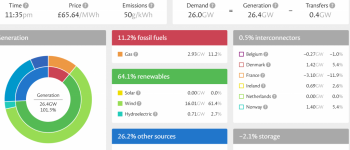
45 mins into the golden 6 hours of cheap EV charging , superb all those super clean renewable electrons :)

1735516228072.png
 
They exist because EV users do have to use them occasionally and they are there to reap that high profit per kWh/w

Oh so they are used lol

no one is saying EVs do not have limitations

That's not the impression you give

it's you that simply will not acknowledge they are selling in droves and for a reason.

I think you may be getting confused because that's not true. I actually acknowledged it and explained one reason why, which you even replied to.

Poeple want them... You don't so what

And there's the real attitude creeping out, also another lie. Try scrolling up and reading what I posted earlier.
 
I’ve been watching loads of the comparison/trip videos on YT mainly all EV but they generally chuck in a hybrid or diesel to compare.

Last one I watched was a trip to some where in entrance and back.5/600miles.
All charging was done via Tesla or other public chargers

End of trip the hybrid was about half the cost I believe.
Took the EV around an hour or two longer due to charging each way.
The biggest issue was that in France the uptake is higher and they regularly had to wait for chargers for the same time or longer than it took to charge.

Tesla as expected was the easiest but as there chargers are open to other now they still had issues.

I saw a post above mentioning that accessibility in Scotland is good, maybe in large city’s that’s the case.

Locally we have one slow Tesla wall charger in our town( at a farm cafe)
Two super chargers in the town over in a hotel carpark(30min away)
Publicly there are 6 council chargers and Morrisons have just fitted 2 ionic chargers (all high cost)
Two hotels also have mid speed chargers accessible to residents only.
As I said before Our town is one of the richer/ nicer and most touristy places with the golf clubs and has a population of around 15k I believe and that’s all there is to support those unable to charge at home.
As you can guess there always full.

I expect our next car will be the new model Y but can see why so many are put off.

The bit about France surprises me. For one thing the sales of EV is no more than average in Europe and there are lots and lots of unused charging points in the area where I live and work. To see an EV in a charging bay is an unusual event.

But you are right in that it is easier and quicker to find a filling station and top up than an EV charging point. Also fuel prices are generally the same so you are not held to ransom buying electricity at 10 times the price out of necessity to complete your journey on time.
 
For some reason the EV vs ICE discussion gets some people very animated. I will be going to an EV at the end of the month to place my comments in context.

What I don't understand is why people decide if an EV works for them then it must be the same for everyone (and vice versa); anyone who holds a contrary opinion then is clearly an **** (insert your own term). I fully accept that an EV doesn't work for everyone for a variety of reasons. Will EVs be the answer? I don't know but that's the technology we currently have.

Wider EV ownership is still relatively new compared to ICE so is still developing as a technology. The use of tax incentives is to shape behaviour as decided by the government of the day and currently that is to encourage EV use by company car drivers. It's no different than the tax break given to encourage saving in an ISA. However you could argue why is there a tax break offered to wealthy people who have spare cash they can put away but this doesn't seem to agitate some people in the same way
 
The bit about France surprises me. For one thing the sales of EV is no more than average in Europe and there are lots and lots of unused charging points in the area where I live and work. To see an EV in a charging bay is an unusual event.

But you are right in that it is easier and quicker to find a filling station and top up than an EV charging point. Also fuel prices are generally the same so you are not held to ransom buying electricity at 10 times the price out of necessity to complete your journey on time.

How hard do you think it is to find a charger? Even google maps will show you where they all are (I can drive to any charger I need to within 200 miles from memory).
Re fuel prices being all the same, how do you know you are not being held to ransom? if a petrol station is the only place you can buy it. Arguments like yours are so typical of the polarised viewpoint people take, i.e. pick a worst case scenario and ignore anything that doesn't agree with your take on it.

Fact is, fossil fuel use is ending sooner rather than later. EV 'issues' will be solved sooner rather than later. Hydrogen issues will be solved sooner rather than later.

No single problem anyone can think up today will still be a problem in 10 years, so buy an EV or don't if it doesn't suit you just now. As long as you know that within the next 10-20 years the use of fossil fuels in cars will be finished, whatever solution or group of solutions is chosen.
 
For some reason the EV vs ICE discussion gets some people very animated. I will be going to an EV at the end of the month to place my comments in context.

What I don't understand is why people decide if an EV works for them then it must be the same for everyone (and vice versa); anyone who holds a contrary opinion then is clearly an **** (insert your own term). I fully accept that an EV doesn't work for everyone for a variety of reasons. Will EVs be the answer? I don't know but that's the technology we currently have.

Wider EV ownership is still relatively new compared to ICE so is still developing as a technology. The use of tax incentives is to shape behaviour as decided by the government of the day and currently that is to encourage EV use by company car drivers. It's no different than the tax break given to encourage saving in an ISA. However you could argue why is there a tax break offered to wealthy people who have spare cash they can put away but this doesn't seem to agitate some people in the same way


Careful! That's dangerously close to good sense!!!
 
How hard do you think it is to find a charger? Even google maps will show you where they all are (I can drive to any charger I need to within 200 miles from memory).
Re fuel prices being all the same, how do you know you are not being held to ransom? if a petrol station is the only place you can buy it. Arguments like yours are so typical of the polarised viewpoint people take, i.e. pick a worst case scenario and ignore anything that doesn't agree with your take on it.

Fact is, fossil fuel use is ending sooner rather than later. EV 'issues' will be solved sooner rather than later. Hydrogen issues will be solved sooner rather than later.

No single problem anyone can think up today will still be a problem in 10 years, so buy an EV or don't if it doesn't suit you just now. As long as you know that within the next 10-20 years the use of fossil fuels in cars will be finished, whatever solution or group of solutions is chosen.

I said that it is easier and quicker to find a filling station and top up. Can you put enough for 200 miles worth of charge in your battery in the time that it takes me to fill a quarter of a tank of diesel? Even if there are two cars queuing at the pump I bet I would beat you off the mark.

The location of filling stations are displayed on advertising boards all over the place. No need for apps. And the price of fuel might vary from one station to another, but 20 pence variation on an average of £1.50 a litre isn't like the 10X examples of electricity charges that have been posted on here.

As said by others: EV suits some. But not all. And my circumstances fit the second option.
 
So why do these fast chargers exist if nobody uses them?

It appears to be you who is completely missing all of the messages, perhaps this pathological defence mechanism of EV's is preventing you from looking at it objectively. I'm sure things will progress and develop, but at the present EV's have their limitations for a lot of people.

For occasional use - I had to fly out from Newcastle (200+ miles each way) - set off fully charged, got 2/3 the way and parked up for 25 mins to have a break/pee/food, almost full again. On way home stopped at same place for the same (was getting very low to be honest as we approached) and then home and charged overnight
 
Back
Top