EV and VED ?

Mr Bump

From under the bridge
Suspended / Banned
Messages
10,944
Name
Sophia aka Paul
Edit My Images
Yes
So my good friend Alistair is just buying an MG EV and he was telling me about changes to VED I wasn't aware of
wow ICE cars are going to get screwed in the next few years while EV owners are way ahead on costs....

so back of a fag packet EV first year £10
ICE first year based on emissions of 131-150 which is about average (googles) £540

2nd+ year EV £0
2nd+ year ICE £190

so say add up 5 years EV £10
ICE about £1300 - £1500 (average small car)


What are the new First Year Rates?​

The new First Year Rates are as follows:

  • Zero emission cars will pay the lowest rate at £10 until 2029-30.
  • Rates for cars emitting 1-50 g/km of CO2, including hybrid vehicles, will increase to £110 for 2025-2026.
  • Rates for cars emitting 51-75 g/km of CO2, including hybrid vehicles, will increase to £130 for 2025-2026.
  • All other rates for cars emitting 76 g/km of CO2 and above will double from their current level for 2025-2026.

Year one VED rates for cars registered on or after 1 April 2025​

This payment covers your car for the first 12 months of its life, from the date it’s first taxed.

CO2 (g/km)Diesel cars (TC49) that meet RDE2 standard and petrol cars (TC48)All other diesel cars (TC49)Alternative fuel cars (TC59)
0£10£10£10
1- 50£110£110 £110
51 – 75£130£130£130
76 – 90£270£350£250
91 – 100£350£390£330
101 – 110£390£440£370
111 – 130£440£540£420
131 – 150£540£1,360£520
151 – 170£1,360£2,190£1,340


Rates for the second year onwards​

This payment comes into effect from year two of the car’s life – in other words, from the second time it’s taxed.

Alternative fuel vehicles include hybrids, bioethanol and liquid petroleum gas.

Fuel typeSingle 12 month payment/by Direct DebitTotal of 12 monthly payments by Direct DebitSingle 6 month payment/by Direct Debit
Petrol or diesel£190/£190£199.50£99.75
Electric £0/N/AN/A £0/N/A
Alternative£180/£180£189£94.50

 
Last edited:
No, EVs will attract it from April, IIRC its around 190 but could be wrong on the amount
 
Your electric car costs are out of date, the VED costs have changed significantly since then.

Electric cars under £40,000 are going onto the standard rate of VED per year so after the first year they will pay £190 a year however electric cars are not exempted from the expensive car supplement so electric cars with a list price of over £40,000 from next year onwards will pay £410 a year VED (which is being increased to £600) until they are five years old. Due to electric cars having comparatively higher list prices this is going to disproportionately affect them and there is talk again about changing this limit for electric cars but it hasn't happened yet and didn't happen before either.

It's also worth bearing in mind insurance costs on electric cars are on average higher than equivalent petrol or diesel cars when working out running costs.

It's difficult to know what's going to happen because the current plan to force more EV sales per manufacturer per year doesn't seem at all viable so either they're going to need to incentivise more electric car purchases or punish petrol/diesel car owners more. In the meantime while second hand electric car prices are cheap and current cars aren't subject to the expensive car supplement plus petrol/diesel car prices are strong, it may be a good window to buy an electric car if petrol/diesel cars are made more expensive to encourage electric car purchases.
 
Last edited:
No, EVs will attract it from April, IIRC its around 190 but could be wrong on the amount

Parkers say not but they may be wrong
in fact yes its £195 i stand corrected
its the first year which is still very low
 
some of the first year ICE emmision charges are frightening

131 – 150£540£1,360£520
151 – 170£1,360£2,190£1,340
171 – 190£2,190£3,300£2,170
191 – 255£3,300£4,680£3,280
226 – 255 £4,680£5,490 £4,660
Over 255 £5,490£5,490£5,490
 
Did I understand correctly that there will just be a single flat rate for petrol/diesel cars after year 1 now? I can't quite believe it, but am happy if true. My diesel campervan is currently £340/year.
 
Did I understand correctly that there will just be a single flat rate for petrol/diesel cars after year 1 now? I can't quite believe it, but am happy if true. My diesel campervan is currently £340/year.
It's a change that came in a few years ago (around 2017-2018 I think?) but it's not backdated so you'll continue to pay the rate you do now. I get massively stung by VED with £350 a year or something for a boring four cylinder petrol engine which was the pre CO2 cheating era which is very annoying.
 
Did I understand correctly that there will just be a single flat rate for petrol/diesel cars after year 1 now? I can't quite believe it, but am happy if true. My diesel campervan is currently £340/year.

only for new vehicles
but also bear in mid the first five year luxury tax if your vehicle cost over £40,000
which is an extra £590 from the 2nd year so I guess £780/year
 
So my £0/year will not change :)
If it's an electric car, you will start paying the standard rate of VED which is £190 after the 1st April 2025. Unusually for VED this change will be backdated but the expensive car supplement will not be.
 
If it's an electric car, you will start paying the standard rate of VED which is £190 after the 1st April 2025. Unusually for VED this change will be backdated but the expensive car supplement will not be.
What do you mean backdated?
 
Cheapest way to tax a new diesel (if you have C1/D1 entitlement) is to get a van plated over 3500kg. Then it qualifies for the £165 flat rate irrespective of emissions.
If it's plated at or under 3500kg then it's £345.

I'm looking at a new Crafter or TGE but need to get by C1 and D1 entitlements back after the DVLA medical panel took them away following my MS diagnosis so I can get it plated to 4000kg (for a motorhome conversion, as I want an auto 4x4 version, which adds a lot of weight to the base model).
 
Strange how Mr Bump's fag packet calculations only include the positive elements and ignore the higher cost price and insurance.

I saw the other day that the UK are going to revise the tariffs that are hobbling the motor trade. At the moment the demand for EVs is lower than expected so the manufacturers can't make enough ICE vehicles to meet demand because of the restrictions so thousands of people will be out out of work. Similarly in Europe there is increasing pressure to scrap the ICE vehicle tariffs to prevent mass redundancies.
 
only for new vehicles
but also bear in mid the first five year luxury tax if your vehicle cost over £40,000
which is an extra £590 from the 2nd year so I guess £780/year
Now you've really confused me. I paid £340 this year, which is the third year of tax for this vehicle (which would have cost over £40k when first registered). I don't think they are backdating the so-called luxury tax are they, as you suggest? For a Transporter van? It might have been converted to a pretty nice camper, but it's still registered as a van, not a luxury vehicle!

I've no particular problem with carrying on at that rate. C'est la vie.
 
Strange how Mr Bump's fag packet calculations only include the positive elements and ignore the higher cost price and insurance.

I saw the other day that the UK are going to revise the tariffs that are hobbling the motor trade. At the moment the demand for EVs is lower than expected so the manufacturers can't make enough ICE vehicles to meet demand because of the restrictions so thousands of people will be out out of work. Similarly in Europe there is increasing pressure to scrap the ICE vehicle tariffs to prevent mass redundancies.
Whether you decide to go EV or ICE, what works best is going to be a personal decision and a whole cost approach will be required. EVs do have lower VED and if charging at home lower pence per mile energy costs ICE will generally have a lower purchase price and possibly lower insurance.
If you are someone who chooses to lease a car there are currently some very good deals out there as manufacturers seek to shift EVs to help meet their quotas.
However for those who want an ICE there will still be a large number of vehicles available on the pre owned market for many years to satisfy their requirements.
I do find it interesting how vociferously many people defend their stance on this issue on essentially what method of propulsion to choose for their personal transport. It is only a perception but I'd hazard a guess those who argue the most against EVs would not be purchasers of a brand new ICE. However I've no objective data to support this contention.
If you are a company car driver then financially an EV is the most beneficial but unless your employer prohibits ICE you could still choose one if you are that wedded to ICE. However I suspect it may be as at election times that people talk with their heart and vote with their wallet
 
Now you've really confused me. I paid £340 this year, which is the third year of tax for this vehicle (which would have cost over £40k when first registered). I don't think they are backdating the so-called luxury tax are they, as you suggest? For a Transporter van? It might have been converted to a pretty nice camper, but it's still registered as a van, not a luxury vehicle!

I've no particular problem with carrying on at that rate. C'est la vie.
Just so I'm understanding you correctly, are you saying the vehicle is currently three years old? If so I can't understand how you are paying £340 as there's no such rate I can find for vehicles registered after 1st April 2017, it's either £190 for vehicles under £40,000 or £410/600 for vehicles over £40,000:

 
Now you've really confused me. I paid £340 this year, which is the third year of tax for this vehicle (which would have cost over £40k when first registered). I don't think they are backdating the so-called luxury tax are they, as you suggest? For a Transporter van? It might have been converted to a pretty nice camper, but it's still registered as a van, not a luxury vehicle!

I've no particular problem with carrying on at that rate. C'est la vie.
how much was your van new? and how old is it?
 
Strange how Mr Bump's fag packet calculations only include the positive elements and ignore the higher cost price and insurance.

I saw the other day that the UK are going to revise the tariffs that are hobbling the motor trade. At the moment the demand for EVs is lower than expected so the manufacturers can't make enough ICE vehicles to meet demand because of the restrictions so thousands of people will be out out of work. Similarly in Europe there is increasing pressure to scrap the ICE vehicle tariffs to prevent mass redundancies.

neither of those are true though an MG EV3 can be had for £19k about the price of a posh Corsa and as for insurance really?
 
Just so I'm understanding you correctly, are you saying the vehicle is currently three years old? If so I can't understand how you are paying £340 as there's no such rate I can find for vehicles registered after 1st April 2017, it's either £190 for vehicles under £40,000 or £410/600 for vehicles over £40,000:

My memory - it was £335 on 1st October by annual DD.

how much was your van new? and how old is it?
As I implied above, it'd now 2.5 years old (72 reg) and I bought it used so I don't know what it cost new, but I'm sure if you look up the price of a VW Transporter 2.0 Highline Automatic van, it'll be higher than £40k, as the conversion was done after it was bought by the previous owner. I paid £60k fwiw as it's a pretty high-end conversion with a number of expensive add-ons. But I think that is beside the point. I think I need to do some digging on the gov website to satisfy my curiosity.
 
neither of those are true though an MG EV3 can be had for £19k about the price of a posh Corsa and as for insurance really?


Generally, electric car insurance premiums are still going to be higher than those for petrol or diesel cars when looking at a direct like for like comparison. However, comparing electric models year on year sees that these premiums are reducing as more electric cars appear.

Also, the MG brand is as yet unproven. Check the What Car review. 25% had serious faults
 
Last edited:
My memory - it was £335 on 1st October by annual DD.


As I implied above, it'd now 2.5 years old (72 reg) and I bought it used so I don't know what it cost new, but I'm sure if you look up the price of a VW Transporter 2.0 Highline Automatic van, it'll be higher than £40k, as the conversion was done after it was bought by the previous owner. I paid £60k fwiw as it's a pretty high-end conversion with a number of expensive add-ons. But I think that is beside the point. I think I need to do some digging on the gov website to satisfy my curiosity.
Interestingly I didn't find this on the government site but there's a separate tax band for vans which is £335 so that explains it:

 
neither of those are true though an MG EV3 can be had for £19k about the price of a posh Corsa and as for insurance really?
He has a point, my insurance is more than double what my sportage was, but the increased cost was more than offset by fuel saving. I just know that when I factor in pcp, fuel, service, insurance I would not have a car as fast or as fun as the model 3
 
This subject is pretty much the same old story to most people.

It's not that people don't care about the environment as such, it's the fact that their wallets come first - especially the past few years since covid/brexit/cost of living crisis.
 
Interestingly, when we decided to buy a camper van, the new electric VW ID Buzz California hadn't been launched, and we may have been tempted by it, but the range is only around 230 miles which is rubbish for such a vehicle. Also it would have failed at the first hurdle for us as the first journey we made in our van was to move from Wellingborough (Northants) to Northern Ireland, which was an overnight journey of circa 450 miles; we couldn't have stopped on the way due to having all our pets in the van with us (4 cats and a dog), and I saw no sign of charging connections on the ferry either. It's a shame, as even now I would consider trading the diesel van for a new Buzz camper, but that range is hopeless given the regular need to camp in out of the way places.

However it seems there would be little VED advantage, so I don't think the case is made for an electric camper van yet.
 
This subject is pretty much the same old story to most people.

It's not that people don't care about the environment as such, it's the fact that their wallets come first - especially the past few years since covid/brexit/cost of living crisis.

spot on mate wallet over the environment
 

Generally, electric car insurance premiums are still going to be higher than those for petrol or diesel cars when looking at a direct like for like comparison. However, comparing electric models year on year sees that these premiums are reducing as more electric cars appear.

Also, the MG brand is as yet unproven. Check the What Car review. 25% had serious faults

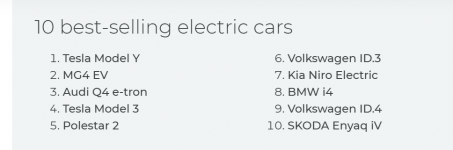
and yet

1732834272495.png
 
And your point is?

They are the best selling electric cars. They don't make the top 10 of all cars sold in the UK. Even with all the discounts and restrictions in ICE vehicle manufacture.
Tesla’s model y was 5th in 2023
 
And your point is?

They are the best selling electric cars. They don't make the top 10 of all cars sold in the UK. Even with all the discounts and restrictions in ICE vehicle manufacture.

my point was you said "Also, the MG brand is as yet unproven. Check the What Car review. 25% had serious faults"

and they are the 2nd best selling EV in Britain behind the best Tesla
 
my point was you said "Also, the MG brand is as yet unproven. Check the What Car review. 25% had serious faults"

and they are the 2nd best selling EV in Britain behind the best Tesla

And also high up on the most faulted vehicles list. Cheap isn't always best.
 
It is clear despite the incentives offered by governments and manufacturers (Incentives driven by targets that have arbitrarily been set) that there is a general reluctance to move away from ICE. Now some of those reasons may be valid and some of them may not be. But there needs to be better communication going forwards. Because just saying it is better for the environment clearly isn't working nor is the argument about it being cheaper.
 
I wonder how many of the best sellers on this list are leased company cars, or cars bought through employee sacrifice salary schemes, both of which offer significant financial benefits to their drivers?

As always, buried among the headline numbers are some interesting trends identified by the SMMT. The first of those, of course, is in the electric car market. September 2024 was actually a record month in the UK for BEVs, with 56,387 new registrations representing a leap of 24.4 per cent; the Year-To-Date figure of 269,931 is up on 2023’s figure of 238,544. Which looks good, but the trend is being driven overwhelmingly by fleet purchases, which accounted for 75.9 per cent of those sales. Furthermore, while private EV purchases were up, it was only by 3.6 per cent after what the SMMT calls ‘unprecedented manufacturer discounting’. Because the private new EV market currently remains so small, that meant only an additional 410 registrations. By contrast, while diesel sales were down overall (17,556 compared to 18,892 last year, down 7.1 per cent), private demand actually increased 17.1 per cent - or another 1,367 units.

 
It is clear despite the incentives offered by governments and manufacturers (Incentives driven by targets that have arbitrarily been set) that there is a general reluctance to move away from ICE. Now some of those reasons may be valid and some of them may not be. But there needs to be better communication going forwards. Because just saying it is better for the environment clearly isn't working nor is the argument about it being cheaper.
I do think the targets were too aggressive.

government should be working out how people living in flats etc can charge at home, as using public chargers all the time is expensive and easily wipes out any savings from what is in most cases a more expensive car. But then most of us are creatures of habit and often don’t change ways until forced.
 
I do think the targets were too aggressive.

government should be working out how people living in flats etc can charge at home, as using public chargers all the time is expensive and easily wipes out any savings from what is in most cases a more expensive car. But then most of us are creatures of habit and often don’t change ways until forced.

Or offered unprecedented discounts and deals as has been the case.
 
Back
Top