


sk66
Suspended / Banned
- Messages
- 9,557
- Name
- Steven
- Edit My Images
- Yes
I have a lot of issues with the ETTR theory.
IMO, correlating DR to file bit depth is problematic at the least... if not entirely wrong. Correlating exposure to "detail" is erroneous. Using ETTR other than at minimum ISO doesn't make sense (for noise). And the whole issue with histograms and jpeg review images. (I will say that I do see a benefit to ETTR with very dark images where there is a lack of *sufficient* information)
But, I've noticed that ETTR also causes (can cause) color shifts. It is erroneous to say that a sensor is RGB... in reality a red photosite has a spectral response curve which is "red centric"... it may also have some sensitivity in the orange/yellow/far reds on either side of "red," but it will be most sensitive to "red." And the same is true for green and blue photosites. If a red photosite is collecting more energy from orange/yellow spectrums than it should due to overexposure, then that light may be determined to have been red instead of orange/yellow. And it may be determined to be red at a lower luminance value (because more energy collected from red wavelengths is the "same exposure" as fewer electrons collected from orange/yellow for a pixel with a greater red sensitivity). These individual spectral response curves/sensitivities are part of the demosaicing algorithms applied and these errors cannot be corrected easily... it's different from a universal WB temp/tint shift.
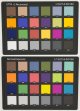
Here is a composite of two test images. Both images were taken in raw and processed exactly the same. The only difference is the top has a 2 stop longer exposure and was recovered with -2 exposure in LR. The overexposed image was not blown/clipped in any channel prior to recovery. WB was set with the picker using the #021 squares. And the minimum ISO for the camera (Nikon1) was used.
As you can see, the colors are not the same... most notable (in this case) in squares like 6/7/11/12... Those are easily apparent to the eye, but none exactly match if you check with a color meter...and more importantly, you will never get them all to match with any universal correction.
Neither image is a 100% color match... but the normal exposure is *much* closer. E.g., block 12 should be RGB 255/164/26, the ETTR image is 255/207/0, the normal exposure is 254/186/29. If I color correct patch 006 as close as possible, then other patches (i.e. patch 012) are even worse. The only way you would ever get every color right would be to adjust them all individually.
Anyone else notice this? Opinions?
IMO, correlating DR to file bit depth is problematic at the least... if not entirely wrong. Correlating exposure to "detail" is erroneous. Using ETTR other than at minimum ISO doesn't make sense (for noise). And the whole issue with histograms and jpeg review images. (I will say that I do see a benefit to ETTR with very dark images where there is a lack of *sufficient* information)
But, I've noticed that ETTR also causes (can cause) color shifts. It is erroneous to say that a sensor is RGB... in reality a red photosite has a spectral response curve which is "red centric"... it may also have some sensitivity in the orange/yellow/far reds on either side of "red," but it will be most sensitive to "red." And the same is true for green and blue photosites. If a red photosite is collecting more energy from orange/yellow spectrums than it should due to overexposure, then that light may be determined to have been red instead of orange/yellow. And it may be determined to be red at a lower luminance value (because more energy collected from red wavelengths is the "same exposure" as fewer electrons collected from orange/yellow for a pixel with a greater red sensitivity). These individual spectral response curves/sensitivities are part of the demosaicing algorithms applied and these errors cannot be corrected easily... it's different from a universal WB temp/tint shift.
Here is a composite of two test images. Both images were taken in raw and processed exactly the same. The only difference is the top has a 2 stop longer exposure and was recovered with -2 exposure in LR. The overexposed image was not blown/clipped in any channel prior to recovery. WB was set with the picker using the #021 squares. And the minimum ISO for the camera (Nikon1) was used.
As you can see, the colors are not the same... most notable (in this case) in squares like 6/7/11/12... Those are easily apparent to the eye, but none exactly match if you check with a color meter...and more importantly, you will never get them all to match with any universal correction.
Neither image is a 100% color match... but the normal exposure is *much* closer. E.g., block 12 should be RGB 255/164/26, the ETTR image is 255/207/0, the normal exposure is 254/186/29. If I color correct patch 006 as close as possible, then other patches (i.e. patch 012) are even worse. The only way you would ever get every color right would be to adjust them all individually.
Anyone else notice this? Opinions?


