Dust disaster

ndwgolf

Suspended / Banned
Messages
4,692
Name
Neil Williams
Edit My Images
No
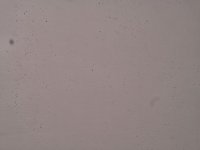
I thought it was the ND filter but after getting home I took a picture of a white wall at F22 and I am shocked of all the dust/crap all over the sensor of my Hasselblad X2D 100c.
I have a rocket blower but I somehow think that isn't going to fix it.........any ideas?????.
In future I think I will use my old film changing bag to change lenses in the field
Thanks in advance
B0004610.jpg
 
Only suggestions I have are a wipe kit from Amazon or similar, or take it into a shop for a clean?
 
Only suggestions I have are a wipe kit from Amazon or similar, or take it into a shop for a clean?
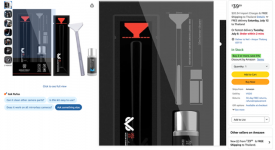
I just ordered this kit from Lazada and the correct size one from amazon
 

Attachments

  • Screenshot 2025-06-30 at 18.11.25.png
    Screenshot 2025-06-30 at 18.11.25.png
    388.3 KB · Views: 14
  • Screenshot 2025-07-01 at 04.12.31.png
    Screenshot 2025-07-01 at 04.12.31.png
    162.8 KB · Views: 13
I just ordered this kit from Lazada and the correct size one from amazon
Nothing like a good wet cleaning activity. Clean twice, (with different swabs) and find your photos squeaky clean.
 
I’ve cleaned a D3s that was far dirtier than that Neil
 
Would it help if I use a film changing bag in future when changing lenses. I still have a brand new one in the cupboard?
 
Would it help if I use a film changing bag in future when changing lenses. I still have a brand new one in the cupboard?

I wouldn't. Aside from the hassle, dust will get in the bag then you have dust in a contained space.

Just good lens changing practice. Point sensor down, change lenses quickly. Perhaps a quick blow of the rear element before putting the lens on.

Sadly, sensor dust is somewhat inevitable with interchangeable cameras, it's just minimising it.

I've even seen sensor dust on fixed lens cameras.
 
Dont use it at f22 for the starters. F7 is around where diffraction may be starting on that sensor, so no more than that
The sensor size is 44 x 33 mm, so diffraction limitation won't start to be a potential problem wider than around f/32. I haven't bothered to work it out from a physics viewpoint, but that figure will be about right.
 
Invert it and claim you have found an amazing semi-circular nebula.
 
Although I have a rocket blower as well, My thought on using it is it is going to stir up more dust within the camera body so I don't use it. you could use an Artic Butterfly (top centre) . Loupe top right

Du00EGj.jpg

Actually sensor cleaning is very easy ,there is no "magic" in it. OK I agree having the right gear may be a bit costly, but consider the cost of sending the camera away and being without it. Even then some moron may not do the job properly and your camera comes back just as bad.

So looking through the loupe no more guessing where the spots on the sensor are ,makes sensor cleaning so much easier, no taking a photo and then looking at the result to see the contamination.
If using sensor cleaning fluid DON'T put the fluid onto the swab direct you will only flood the sensor. What you should do is put a drop onto a clean surface nd dip the swap into it. that way you only put enough fluid onto the swap to do the wipe.

GET A LOUPE IS MY STRONG ADVISE

I have been cleaning my own camera sensors for more years that I can remember. It takes a bit of time- a bit of care- and being a bit gentle.
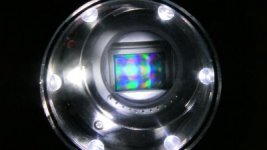
cccc.JPG

you can see 2 dust spots at the5 o'clock position exactly where they are on the sensor

looking through the loupe I saw a couple of dust spot on mine. quickly got rid of using the Artic butterfly which builds up static electricity by spinning fast. then stopping it and just brush across the sensor. Just checked another sensor and a dust particle on it. Artic Butterfly soon picked it up and sensor now clean again,

What it would have cost me to have done professionally heavens knows let alone being without. Now done in less tghan 2 minutes including putting batteries in the Artic Butterfly

 
Last edited:
The sensor size is 44 x 33 mm, so diffraction limitation won't start to be a potential problem wider than around f/32. I haven't bothered to work it out from a physics viewpoint, but that figure will be about right.
Sensor size is irrelevant, pixel size is.... unless you only intend to post web sizes images. That's like driving a Lambo on small emergency wheels!
 
A pressure washer would seem more appropriate in this case. :cautious:
 
Just my 2p.

Yes diffraction can be an issue but ideally kit should be able to show diffraction with the lens wide open but you shouldn't be looking at your pictures at x hundred percent magnification and seeing diffraction as at that sort of viewing it's not a picture anymore. The main worry is if diffraction starts to degrade detail but with todays very good modern high mp count sensors diffraction will be visible at relatively wide apertures but this will probably not degrade the quality of the image during normal viewing or even very close viewing... just avoid multiple hundred percent viewing of a picture which in print would equate to looking at a really massive picture with a magnifying glass.
 
Good luck with it Neil. I hope be very happy with the results.
 
Neal please do not use that kit without a loupe. what can happen is by constantly checking the way you are there is a high risk of damage to the sensor by putting on too much pressure - flooding the sensor with too much fluid = lens on and off several times - even causing damage by dropping. something.
I do have a lot of experience in cleaning sensors on my cameras for over 15 years or more . I refer to my previous post on how to.
Well I have said my piece and can't do any more

What i don't get is buying an expensive camera with expensive lenses costing thousand of pounds , yet skips on a relative cheap bit of kit ie Visible dust loupe around £140 approx
 
Last edited:
@ndwgolf fingers crossed the wet cleaning works. I had a pretty stubborn mark on my gfx recently - which I found by shooting at f22 as well. @LeeRatters recommended lightly “scrubbing” with the cleaning kit and that turned out to be way to get rid of it. Thanks Lee for the tip.
 
@LongLensPhotography is right about softening from diffraction in my experience. Doesn’t mean I don’t sometimes shoot with narrower apertures, but if I choose to do that I know what will happen.
 
That turned out nicely. The full frame K&N swabs arrived and I just followed the instructions by adding a few drops of liquid to one side of the swab then swiping across from right to left at the top half and flipping the swab over and swiping back the other way. I got a new swab and repeated the above on the bottom half of the sensor.
Picture below shot at f22
IMG_8381.jpeg
I have some medium format swabs coming from the US as they don’t have them in Thailand,
But all and all a simple process
 
well done Neil simple init :p
 
yes well done from me also. it is nerve wrecking doing it for the first time but I still suggest you expand your cleaning kit to more than just swabs and fluid
 
@LongLensPhotography is right about softening from diffraction in my experience. Doesn’t mean I don’t sometimes shoot with narrower apertures, but if I choose to do that I know what will happen.

You have to balance any potential hit to IQ against the positives you see in selecting settings to get the end result you are going for. Both avoiding and using different apertures will have a direct effect on the end result.
 
You have to balance any potential hit to IQ against the positives you see in selecting settings to get the end result you are going for. Both avoiding and using different apertures will have a direct effect on the end result.
Indeed. Obsessive sharpness is not needed for lots of photos. The image is more of a factor.
 
@LongLensPhotography is right about softening from diffraction in my experience. Doesn’t mean I don’t sometimes shoot with narrower apertures, but if I choose to do that I know what will happen.
The reality is that diffraction limitation is directly related to sensor/film size. It occurs, and is a real problem, with very small sensors. The safe limit is maybe about f/7 with small point and shoots, f/11 with cropped sensor, f/16 with full-frame, f/32 with a typical medium format and somewhere around the same with the OP's camera.

I've never experienced it on large format, on 5"x4" there was no problem at f/128 and on 10"x8" there was no problem at f/256.

In practice, although the limitation is always there, the better the resolution of the lens, the more apparent it becomes, because the other softness that accompanies a poor lens tends to hide it. Also, the limit isn't a cliff-edge. It doesn't suddenly go from good to bad by stopping down beyond the ideal, and I've often chosen to shoot at f/32 on a full-frame to increase the DOF, with no obvious diffraction limitation.

It's always a good idea to understand the physics but we shouldn't obsess about it.
 
Back
Top