DSLR for scanning, what set up?

RaglanSurf

Suspended / Banned
Messages
11,477
Name
Nick
Edit My Images
Yes
When I have tried I have just used a tripod and a small spirit level to get the camera level with the negative, full frame with a macro lens. That said it is not something I do that often, one of the things that puts me off is that I process in LR and after you have reversed the curves to get negative to positive then all the other sliders are backwards. I guess if you invest in negative lab pro or similar then the processing might be a bit more natural.
 
Thanks Chris, I'm just trying to work out whether its worth it, I already have a a Nikon scanner and a flatbed but could sell those on if I go down this route.
 
As to the type of camera, I don't think it matters that much. What's more important is the ability to fill the frame with the negative. I found a 50mm lens (crop sensor) with a single extension tube did the job (for 35mm). If you're scanning 120, 6x17, 4x5 or anything bigger, your requirements will vary. If you have decent backlighting, you can knock the ISO down, and if you're on a stand the shutter speed can be slow, so low light performance is irrelevant.

I gave it up because of the space requirement, inability to keep the neg flat without another contraption, and the hassle of Lightroom (as Chris mentioned). Neg Lab Pro is well worth the trial if you go down the "try it" route as it's relatively quick compared to the 'curve swap and sliders doing the opposite'. Esp with colour film!
 
To me it partly hinges on what you need to scan. If there's much colour neg film and I had a Nikon scanner, I'd keep the scanner! The slowness of the scan is offset by the auto-removal of the orange mask and the neg-pos reversal.

The above assumes that the scanner is USB, not legacy scsi which is an absolute fiddle. Another influence is the scan software used. My absolute favourite was Nikonscan (v4), followed after a large pause by Silverfast 8, with Vuescan at the bottom of the list.
 
Macro lens, Fuji XT3, tripod, small video light with 96 cri and DIY film holder.

Works so well that I no longer use the Plustek scanner.
 
Following thread with interest.
 
I've not tried DSLR scanning myself; but the copy stand in the link to secondhanddarkroom seems to be a unit marketed by Firstcall Photographic: https://www.firstcall-photographic.co.uk/firstcall-copystand-320/p6802

Firstcall describe this as being suitable "lighter cameras like digital compacts or Compact System cameras". They have a larger model, the 500: "The 500 Copystand is an intermediate unit, inexpensive and rigid like the 320 model, but accommodates SLRs as well as lighter cameras like digital compacts or Compact System cameras." That one costs £65 new.

If I was defo going in to DSLR scanning I might get one - it would give me a use for the entry-level DSLR I never use - but on the other hand my main complaint about using an Epson V700 is the time taken and shortly I will be retired so, in theory, will have no reason to worry about time. Incidentally the time taken by the V700 is only really a problem when using ICE on colour film - without ICE it takes a fraction of the time.
 
Also, is a full frame digital camera preferable?

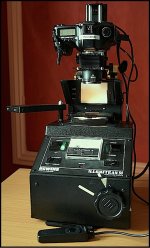
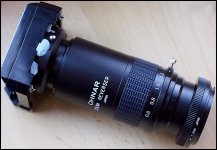
I use a Bowens Illumitran or an Ohnar copier. They'll fit any camera with an appropriate adapter but the Ohnar will only work properly with full frame or APS because of the magnification range.

The Illumitran has it's support built in, while the Ohnar is hand held and just needs to be pointed at a light source. I find the Ohnar easiest to use by pointing it at the sky on a bright cloudy day...

Bowens Lumitran with Canon 5 mounted 9521.jpg

Ohnar slide copier E-PL1 10183.JPG
 
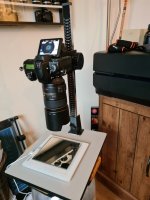
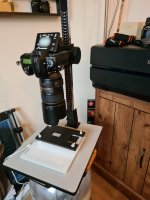
I bought a vintage gnome enlarger for £5, threw the head away and mounted a quick release plate to the arm.
I use a 50mm macro lens, a spare lpl enlarger neg carrier and a small led panel.
I figured the copy stand method would be quicker than using my scanner, and it is and I don't shoot print film so no colour inversion.
It really depends what you're doing with scans, personally I don't care about them, they're just a digital solution to participate in the 21st centuary, they don't have to be gallery quality so copy standing is fine.
If I ever see a 120 slide copier/duplicator, I'll buy it, because that eliminates the stand..... :love:
In fact, I should really make one of those tbh, but my macro lens front thread rotates when focusing so its not straight forward.
 
Last edited:
This all interesting stuff. My set up at the moment is a Nikon Coolscan 9000 for 35mm and medium format, an Epson 750 for 5x4 and a Nikon Coolscan IV for APS scanning, I shoot b&w, colour neg and reversal film in all formats. If I go down the the DSLR route I’ll sell the Epson and 9000.
 
I use a Nikon D780 with a Nikon 105mm macro lens mounted on a copy stand and use the Essential Film holder and a LED light source I bought online.
The camera is tethered to my PC via USB and LR controls the camera remotely as well as uploading the photos directly to the PC.
I use Negative Lab Pro to covert the negative scans.
I've played about trying to use a tripod but the copier stand is a far better option. I use to use a Sony A7R3 with a 35mm macro lens mounted on a macro extender but the edges were way too soft and I then used the Sony 90mm Macro lens and it was fine, I then changed to Nikon.
The IQ of the scans are excellent and I'm pleased with my setup.
 
I use a Nikon D780 with a Nikon 105mm macro lens mounted on a copy stand and use the Essential Film holder and a LED light source I bought online.
The camera is tethered to my PC via USB and LR controls the camera remotely as well as uploading the photos directly to the PC.
I use Negative Lab Pro to covert the negative scans.
I've played about trying to use a tripod but the copier stand is a far better option. I use to use a Sony A7R3 with a 35mm macro lens mounted on a macro extender but the edges were way too soft and I then used the Sony 90mm Macro lens and it was fine, I then changed to Nikon.
The IQ of the scans are excellent and I'm pleased with my setup.
This is interesting as I’m thinking of going full frame digital and would probably look for a D750 as I already have a decent full frame macro lens.
 
I see the road opening up! Light panel (even light, daylight colour temp) sized to cover 5x4 can be masked for smaller originals. Continuous light allows focussing. Macro lens is rectilinear / flat field. Various film holders / masks can be 'borrowed' or made. Camera on stand or tripod.

The thing I hadn't heard of before is Negative Lab Pro, sounds excellent & completes the scheme!
 
I see the road opening up! Light panel (even light, daylight colour temp) sized to cover 5x4 can be masked for smaller originals. Continuous light allows focussing. Macro lens is rectilinear / flat field. Various film holders / masks can be 'borrowed' or made. Camera on stand or tripod.

The thing I hadn't heard of before is Negative Lab Pro, sounds excellent & completes the scheme!
Neg Lab Pro is excellent, I can't recommend it enough. It's a LR addon so LR is required too.
 
Just a tip to get the camera perfectly level to the negative.
Use a flat mirror and put that under the lens then move the copier or tripod mounted camera / lens around until it is aligned up with it's reflection. I put a wee cross on the mirror with a felt tip marker to give the lens something to focus on.
No need to worry about using bubble levels etc and this method gets it spot on.
I'll post a pic of my setup tonight if I can.
 
The thing I hadn't heard of before is Negative Lab Pro, sounds excellent & completes the scheme!
NLP and other alternatives are discussed in the Big Scanner Thread, IIRC. There are a couple of other threads on practical experiences with them.
 
Back
Top