DOF calculations on a TLR

Asha

Blithering Idiot
Suspended / Banned
Messages
11,274
Name
Asha
Edit My Images
Yes
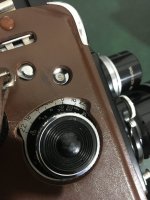
Easy I know when using 120 film as the dial located around the focusing knob shows the dof limits based on the 80mm lens .

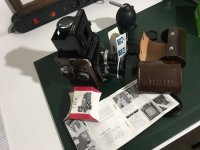
However I have just inserted the 35mm film adapter into the yashica 635 along with a roll of FP4 so of course this changes the dof available at any given focus distance.

In addition I have mounted the telephoto lens which changes the focal length to 113mm.

What I need help with is knowing what dof I will have available with the 35mm film format, at both 80mm and 113 focal lengths

I feel that algebra may be forthcoming :eek::runaway::oops: :$:LOL:743C7D76-E3BD-4A8F-897A-D465F8192355.jpegF34F919F-0466-408B-B56C-1C3812B79B09.jpeg
 
I agree with Nige, the reason smaller formats have bigger DoF is not the format it's the equivalent lens, roughly speaking 50mm on 35mm is 80mm on 120, but you get 50mm DoF on 35mm and 80mm DoF on 120, for the same field of view
 
This might help, Asha. Confuzzles me though!!!

 
Won’t it be the same as for a 120 frame? The lens will still be projecting the same image to the focal plane but it’ll just be a fragment of the overall picture hitting the smaller piece of film.

I could be talking out of my a**e though, in which case ignore me.
Lol, In all honesty I don’t know :oops: :$

Perhaps you’re correct if is use the 80mm focal length.

As for the 113mm, I remain unsure .

In fact, the more I study it, the more confused I become :thinking::LOL:
 
I agree with Nige, the reason smaller formats have bigger DoF is not the format it's the equivalent lens, roughly speaking 50mm on 35mm is 80mm on 120, but you get 50mm DoF on 35mm and 80mm DoF on 120, for the same field of view
Ok i think I get it, I’ll have to reread a thousand times lol, but what about the télé converter that changes the focal length from 80mm to 113mm?……. I find it difficult to believe that doesn’t cause differences in dof.
 
This might help, Asha. Confuzzles me though!!!

Oh lawd if it confuzles you then I’m well and truly stuffed ! :oops: :$:LOL:

I’ll take a look…..
 
Ok i think I get it, I’ll have to reread a thousand times lol, but what about the télé converter that changes the focal length from 80mm to 113mm?……. I find it difficult to believe that doesn’t cause differences in dof.
Yes the tele converter changes the DoF to 113 from 80. DoF is related to the lens and not the film format
 
Last edited:
Me head hurts ! :LOL:

I’m gunna be dreaming about this :banghead:

Ok so the explanation from Nige about it being a fragment of the overall picture hitting a smaller piece of film does make sense so that seems good for the standard 80mm.

The 113mm will however clearly change things.
 
Yes the tele converter changes the DoF to 113 from 80. DoF is related to the lens and not the film format
Thinking about LF.

If for example I put a 300mm lens on a 10x8 outfit , I get x amount of dof at say a distance of 2 meters at f/16

If then I put the same lens onto a 5x4 outfit, do I still get the same amount of dof at the same distance and same aperture ?
( I’ve never checked but I think I get more !)

I ask the question because although it is the same lens and only the film format is different , the lens itself effectively has a 150mm focal length on 10x8 .
 
Last edited:
Are we now all confuzled ??:wacky::ROFLMAO:
 
Thinking about LF.

If for example I put a 300mm lens on a 10x8 outfit , I get x amount of dof at say a distance of 2 meters at f/16

If then I put the same lens onto a 5x4 outfit, do I still get the same amount of dof at the same distance and same aperture ?
( I’ve never checked but I think I get more !)

I ask the question because although it is the same lens and only the film format is different , the lens itself effectively has a 150mm focal length on 10x8 .
Yes, AFAIK 300mm DoF is the same on 10x8 and 5x4. As I said above the reason the DoF is quoted as being different for different formats is that equivalent field-of-view lenses are shorter focal lengths on smaller formats.
 
Depth of field for a given focal length is independent of the format. Except....

Only one plane is ever in actual focus. Assuming a perfect lens, a point source subject will only give a point image at that plane. On either side, you get a circle not a point of increasing diameter as you move from that plane. The photographer (or the compiler of the DOF tables) decides at what point this circle is no longer acceptable as a point. This circle is the famous circle of confusion.

Hence the point (pun intended) of the format mattering. The smaller the format, the more the image will be enlarged if you are aiming at a print size independent of format, and therefore the size of the circle of confusion should depend on the format.

If you are like me, and cease enlarging before grain appears etc. then you can go with the same c of c as you're applying the same degree of enlargement i.e smaller prints from smaller negatives.
 
Yes, AFAIK 300mm DoF is the same on 10x8 and 5x4. As I said above the reason the DoF is quoted as being different for different formats is that equivalent field-of-view lenses are shorter focal lengths on smaller formats.

Dare I suggest that this is yet another example of the concept of "equivalent focal length" making an actually very simple question overly complicated? The phrase might not be used, but the basic idea of converting everything to a standard using just one variable, and then making lots of special cases to try to explain why the end result is different because there are a lot of dependent variables is the same.
 
There's also the question of what DoF really is and what the end user finds to be acceptably in focus.
 
The F-Stop app (iPhone) might help... just select 135 film and the focal length and you'll get info on the depth of field at various distances....
 
Honestly, in your position I'd just reason as follows (and bear in mind that I always approximate for an easy life even when I know how to calculate an exact answer):-

Depth of field will be less on 35mm than 120 because of the extra enlargement. If I'm consulting a scale, I assume that the scale was made on optimistic assumptions, so I would err on the side of DOF being less than the scale and simply use the indicated value for one stop wider than I was actually using i.e. if using f/8 use the marked values for f/5.6.

With the teleconverter on, I'd use the scale but for 1.5 stops less.

Unless you're using a tape measure, and calculating your own DOF values using the size of circle of confusion that fits your standards, your eyesight, your degree of enlargement etc. then an approximate value is all you'll get anyway.
 
Last edited:
Honestly, in your position I'd just reason as follows (and bear in mind that I always approximate for an easy life even when I know how to calculate an exact answer):-

Depth of field will be less on 35mm than 120 because of the extra enlargement. If I'm consulting a scale, I assume that the scale was made on optimistic assumptions, so I would err on the side of DOF being less than the scale and simply use the indicated value for one stop wider than I was actually using i.e. if using f/8 use the marked values for f/5.6.

With the teleconverter on, I'd use the scale but for 1.5 stops less.

Unless you're using a tape measure, and calculating your own DOF values using the size of circle of confusion that fits your standards, your eyesight, your degree of enlargement etc. then an approximate value is all you'll get anyway.
That’ll do for me(y)

I don’t do perfect or exact with anything so somewhere close is fine.

I expect to be shooting some moderately close up images ( close up being about a meter or do with the optics) so although I look forward to some bokey ish style results,having some dof with the focused subject matter would be favourable.

No doubt the results will show if I’ve achieved what I hope to.
The fact that it’ll be 2025 by the time I get through 36 exposures is of course irrelevant :LOL:
 
I tend to either shoot for maximum DoF (well, DoAS - depth of acceptable sharpness!) or shallow, so f/11-16 (in an attempt to avoid too much diffraction softening) or wide open, IF I'm after any DoF effect. Then again, I tend to want more control over SS than aperture.

Given that you intend to shoot close ups, I'd be aiming for as stopped down as practicable and diffraction allows.
 
It is normal to use a different circle of confusion value depending on format
And in practice depth of field also depends on magnification. So any value that might be suggested will be very approximate at best, and probably fairly meaningless, in the scheme of things.

What is certain is that in these circumstances it will be greatly reduced.
On a twin lens reflex you can see what it will be on the screen at wide open. So if it looks ok on the screen, then depth can only be greater stopped down. However the results will be softer using an adapter, than you might expect. Those available for the No.1 bayonet were never that good.

Any depth of field calculator will give the value for a FF camera and focal length. Better to use one designed for film rather than digital. As the circle of confusion that they use is likely to differ.
 
Last edited:
It is normal to use a different circle of confusion value depending on format
And in practice depth of field also depends on magnification. So any value that might be suggested will be very approximate at best, and probably fairly meaningless, in the scheme of things.

What is certain is that in these circumstances it will be greatly reduced.
On a twin lens reflex you can see what it will be on the screen at wide open. So if it looks ok on the screen, then depth can only be greater stopped down. However the results will be softer using an adapter, than you might expect. Those available for the No.1 bayonet were never that good.

Any depth of field calculator will give the value for a FF camera and focal length. Better to use one designed for film rather than digital. As the circle of confusion that they use is likely to differ.
Tbh , although I can use 35mm film with this camera, it’s doubtful that I’ll use it regularly.
I have already obtained additional film but only 120 .

Naturally I’m curious as to what it’s capable , or not capable of with subminiature lol format.

I recall bayonette telephoto attachments for a 124g that I used to have, and yes I can relate that the IQ was pretty naff.

No doubt I’m going to find out what comes my way this time and I’m already braced for dissapointment.

At least I know that decent 6x6 negs are possible going on the results the first roll I put through this camera

;)
 
Tbh , although I can use 35mm film with this camera, it’s doubtful that I’ll use it regularly.
I have already obtained additional film but only 120 .

Naturally I’m curious as to what it’s capable , or not capable of with subminiature lol format.

I recall bayonette telephoto attachments for a 124g that I used to have, and yes I can relate that the IQ was pretty naff.

No doubt I’m going to find out what comes my way this time and I’m already braced for dissapointment.

At least I know that decent 6x6 negs are possible going on the results the first roll I put through this camera

;)

Yashica made very decent TLRs. But in my experience. Minolta made the best, following after Rollie's. And in some ways they were better. Especially the film path and focussing, the large healical focus ring gave a more stable and precise focal plane than any of the others.
However the grease used sets like concrete. Much like that used by Agfa. But their lenses are sharp as a razor. Voigtlander and Zeiss made top tier models, but they were too complex and prone to failure, and were never popular.
 
Back
Top