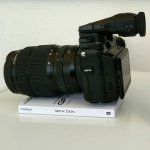
Digital Medium Format Thread

Next 10 years will be Phase One, Hassleblad & Leica users looking for a cost effective upgrade.

Maybe - some of the lenses of these systems are incredible and the physically larger sensor again has a unique look - for fashion and portraiture you can really get that MF look - with 44x33 you don't quite - the sensor isn't large enough. As I say, if you call it super 4/3rds or FF/35mm plus you are closer to the mark.

Fuji cannot offer a sensor larger than 44x33 due to the size of the bodies and design of the lenses. Phase and Hasselblad can, they will and they'll use this as a unique selling point at a very unique price point. Indeed Pentax could offer the larger MF sensor in the 645z - and some of us on the Pentax forum consider it a mystery they haven't but their lenses haven't caught up with the times.

More and more of us on there are buying these Fuji cameras. Even I am very seriously considering it.
 
Last edited:
Without getting into the pro's of global shutters and leaf shutters - lets also consider they aren't needed for the majority of applications and in my own photography I haven't once encountered banding from the use of rolling shutters.

Projected and LED backgrounds are getting common in theatre photography which is a problem for mechanical/electronic, I will welcome global shutter.. but it feels like a while before we see it in full frame.
 
Maybe - some of the lenses of these systems are incredible and the physically larger sensor again has a unique look - for fashion and portraiture you can really get that MF look - with 44x33 you don't quite - the sensor isn't large enough. As I say, if you call it super 4/3rds or FF/35mm plus you are closer to the mark.

Fuji cannot offer a sensor larger than 44x33 due to the size of the bodies and design of the lenses. Phase and Hasselblad can, they will and they'll use this as a unique selling point at a very unique price point. Indeed Pentax could offer the larger MF sensor in the 645z - and some of us on the Pentax forum consider it a mystery they haven't but their lenses haven't caught up with the times.

More and more of us on there are buying these Fuji cameras. Even I am very seriously considering it.
The Pentax division appears to have resource problems.

When Canon & Nikon declared their transition from dSLR to MILC,

Pentax instead insist that dSLR is the future.

No new updates for Pentax 645 system for the past 7+ years.
 
The Pentax division appears to have resource problems.

When Canon & Nikon declared their transition from dSLR to MILC,

Pentax instead insist that dSLR is the future.

No new updates for Pentax 645 system for the past 7+ years.

And nothing new in the highly lucrative 35mm arena either and that is perhaps more concerning. That and the mark up they charge for rebranded tamron zooms.

Let's be honest, Pentax are the only imaging maker than offers, APSC, 35mm, and MF systems. Yet they are the smallest. I expect less releases, but not this much less.

I really love DSLRs, I am holding on to my D850, 645z combo for dear life, but the lure of 100mp is so strong. I am conflicted.
 
And nothing new in the highly lucrative 35mm arena either and that is perhaps more concerning. That and the mark up they charge for rebranded tamron zooms.

Let's be honest, Pentax are the only imaging maker than offers, APSC, 35mm, and MF systems. Yet they are the smallest. I expect less releases, but not this much less.

I really love DSLRs, I am holding on to my D850, 645z combo for dear life, but the lure of 100mp is so strong. I am conflicted.
Pentax dSLR has 4.5% of the worldwide dSLR market that has been rather active in 2021 & earlier.

2022

- zero bodies
- zero lenses

2021

- Pentax K-3 Mark III
- HD PENTAX-D FA 21mm F2.4ED Limited DC WR
- HD Pentax-DA* 16-50mm F2.8 ED PLM AW
- HD Pentax-FA 31mm F1.8 Limited
- HD Pentax-FA 43mm F1.9 Limited
- HD Pentax-FA 77mm F1.8 Limited

2020

- HD Pentax-D FA* 85mm F1.4 ED SDM AW
- HD Pentax-D FA 70-210mm F4 ED SDM WR

2019

- HD Pentax-DA 10-17mm F3.5-4.5 ED fisheye
- HD Pentax-FA 35mm F2 AL

2018

- Pentax K-1 Mark II

When Canon & Nikon halts dSLR production they will be 100% of that market.

2017

- Pentax KP
- HD Pentax-D FA* 50mm F1.4 SDM AW
- HD Pentax-DA* 11-18mm F2.8
 
Last edited:
Pentax dSLR has 4.5% of the worldwide dSLR market that has been rather active in 2021 & earlier.

4.5% of a declining market - it doesn't matter how much you release, but what you have must sell, and for Pentax thats not happening at the moment. Almost certainly we are on the path to the end of Pentax as an ILC camera manufacturer, the clock is defintely ticking. The name will be kept by Ricoh and used for appropriate marketing campaigns where the history of Pentax will be of benefit. Its sad but another great name is disappearing before our eyes.

Any owners will continue to reap the benefits of their equipment, but I can't see any one starting out now investing in a (new) Pentax system.

@SFTPhotography knows all this, its only a matter of time before the 100MP itch gets uncontrollable and needs scratching........
 
Last edited:
4.5% of a declining market - it doesn't matter how much you release, but what you have must sell, and for Pentax thats not happening at the moment. Almost certainly we are on the path to the end of Pentax as an ILC camera manufacturer, the clock is defintely ticking. The name will be kept by Ricoh and used for appropriate marketing campaigns where the history of Pentax will be on benefit. Its sad but another great name is disappearing before our eyes.

Any owners will continue to reap the benefits of their equipment, but I can't see any one starting out now investing in a (new) Pentax system.

@SFTPhotography knows all this, its only a matter of time before the 100MP itch gets uncontrollable and needs scratching........
The value of Pentax may just be its branding and IP.

But to be honest with ~5.3 million ILCs being sold this year and we may have not reached the bottom.

It may occur the APS-C & smaller image sensor bodies may disappear all together.

So we'd be left with FF & MF (crop)
 
It may occur the APS-C & smaller image sensor bodies may disappear all together.
It is difficult to predict without insider knowledge but I would think the small integrated devices like drone cameras, 360 solutions and even phones will slowly move up to m4/3s and then APS-C. Currently it is around 1" and /2.x is getting relegated to the proverbial dustbin and security applications.
It will be down to Sony and Tamron mostly on what camera modules they create.
It is reasonable to expect the shrinking pro-sumer market to be oriented around 36mm and 443 sensors but don't rush to write off smaller formats before we saw the back of 1" era
 
It is difficult to predict without insider knowledge but I would think the small integrated devices like drone cameras, 360 solutions and even phones will slowly move up to m4/3s and then APS-C. Currently it is around 1" and /2.x is getting relegated to the proverbial dustbin and security applications.
It will be down to Sony and Tamron mostly on what camera modules they create.
It is reasonable to expect the shrinking pro-sumer market to be oriented around 36mm and 443 sensors but don't rush to write off smaller formats before we saw the back of 1" era

Just like the good old days, when 35mm was really a small format budget/amateur/reportage format. Now it's seen as the industry standard.
 
Just like the good old days, when 35mm was really a small format budget/amateur/reportage format. Now it's seen as the industry standard.
I think you have to break the notion of comparing products in terms of just sensor or film size. The technology has come a long way both in sensor resolution and optical performance increase really dramatically that it is about as comparable as my 2.0TDI engine and a WWII mercedes diesel truck engine. In photography terms your average prosumer 35mm film scan looks awful even as a 8x10" print; it barely scrapes 4MP. equiv. The best 36mm modern digital sensor is easily capable of 2m long prints with equal or better sharpness per area and that makes it equal to better film MF solution if not close to LF.
 
I think you have to break the notion of comparing products in terms of just sensor or film size. The technology has come a long way both in sensor resolution and optical performance increase really dramatically that it is about as comparable as my 2.0TDI engine and a WWII mercedes diesel truck engine. In photography terms your average prosumer 35mm film scan looks awful even as a 8x10" print; it barely scrapes 4MP. equiv. The best 36mm modern digital sensor is easily capable of 2m long prints with equal or better sharpness per area and that makes it equal to better film MF solution if not close to LF.

There is that argument, but as technology improves the same goes for what medium and larger sensors can deliver.

Sensor design is so advanced we are now seeing diffraction limiting at "middle" aperture settings "ie F11, F13 and F16". Lens design has also improved massively but so have our expectations from cameras.

It is a funny expression full frame, when really it's designed around what was a very small film format. Given new mirrorless bodies, you might say 44x33 is going to be a very portable format with the cameras being sized approximately to present 35mm format DSLRs and the lenses being around the same size.
 
There is that argument, but as technology improves the same goes for what medium and larger sensors can deliver.

Sensor design is so advanced we are now seeing diffraction limiting at "middle" aperture settings "ie F11, F13 and F16". Lens design has also improved massively but so have our expectations from cameras.

It is a funny expression full frame, when really it's designed around what was a very small film format. Given new mirrorless bodies, you might say 44x33 is going to be a very portable format with the cameras being sized approximately to present 35mm format DSLRs and the lenses being around the same size.
At the end of the day what is the largest print you will ever need to make? 3m? 5m long? And that's for something to be inspected from relatively close distance. Billboards on building are OK with just 12MP apparently.

I think 12-20MP covers 95% requirements, 50-100MP - 99.9%. Anything over is 0.1% or less. I would not expect that to change in 100 years.

The rest is dynamic range, colour fidelity, and all other bells and whistles. And by far the greatest factors are the subject and photographer's vision.
 
Last edited:
Projected and LED backgrounds are getting common in theatre photography which is a problem for mechanical/electronic, I will welcome global shutter.. but it feels like a while before we see it in full frame.
how do you cope with this at the moment Dan?
 
how do you cope with this at the moment Dan?

I tell the client the background will limit my shutter speed meaning that I’m unlikely to capture fast action. The projector limits me to 1/125th, the led screen not so bad at 1/200th iirc - normally if light permits I’ll go to 1/500th

After the play rehearsal is done and IF there is enough time, I might ask them to recreate certain scenes without the projected background.

But I’ve always got a decent set of shots regardless, it’s just pains me to know there are shots I’d have taken if my shutter would have let me.
 
I tell the client the background will limit my shutter speed meaning that I’m unlikely to capture fast action. The projector limits me to 1/125th, the led screen not so bad at 1/200th iirc - normally if light permits I’ll go to 1/500th

After the play rehearsal is done and IF there is enough time, I might ask them to recreate certain scenes without the projected background.

But I’ve always got a decent set of shots regardless, it’s just pains me to know there are shots I’d have taken if my shutter would have let me.
I'm having similar trouble with more LED lit stages recently. I feel your pain knowing there are shots that weren't possible. I'm being slow, how would global shutter solve this? There would still be a conflict between the movement and the timing of the projector or LED screen?
 
I'm having similar trouble with more LED lit stages recently. I feel your pain knowing there are shots that weren't possible. I'm being slow, how would global shutter solve this? There would still be a conflict between the movement and the timing of the projector or LED screen?

Ah damnit, you are right - it wouldn’t solve the problem at all.. nevermind! thanks though, realising this will save me jumping in with two feet
 
Is the LED lighting problem you gents are experiencing due to the refresh rates?

I am uncertain if it will solve it but the 2014 Canon EOS 7D Mark II has a feature that reduces flicker.

Your newer bodies should have this capability.
 
Sales of

- >$10k medium format cameras from Phase One, Hassleblad, Leica, etc
- $6-7k double grip full frame flagship cameras like the Canon 1-Series & 3-Series and Nikon D6 & Z9
- $3-4k single grip full frame professional cameras like Canon 5-Series
- $2.5k prosumer full frame bodies like the Canon 6-Series

And other cameras with APS-C and larger image sensors ~$1k or more are largely unscathed by iPhones and Androids.

Below are CIPA's annual worldwide global shipment # of all digital still cameras.

I am displaying key years

- 1999 & 2000: 1st time they released global shipping # for all digital still cameras. In terms of units shipped they reflect 2021 actual shipments and 2022 forecasted shipments
- 2003: 1st time they broke down # of how many Total SLR vs point & shoots
- 2021 & 2022: Last two years with even more break downs of SLR vs point & shoots vs Mirorless

Year1999 Kodak DC2020002003 Canon EOS 10D20212022 forecast
Total Cameras5,088,20710,342,08443,407,9568,361,5217,850,000
Point & Shoot--42,562,6283,013,2502,560,000
Total SLR & Mirrorless--845,3285,348,2715,290,000
SLR--845,3282,241,772-
Mirrorless---3,106,499-
% of Point & Shoots--98.05%36.04%32.61%
% of SLR & Mirrorless--1.95%63.96%67.39%
Worldwide population6.034 billion6.114 billion6.194 billion7.9 billion8 billion
% of worldwide population relative to cameras shipped that year0.0843%0.1692%0.7008%0.1058%0.0981%


In terms of units shipped we are between year 1999 & 2000 but in terms of value of units shipped it is mostly SLR & Mirrorless bodies.

As Canon & Nikon are transitioning out of dSLRs then the future should be based on mirrorless bodies selling for ~$1k or more.
 
Is the LED lighting problem you gents are experiencing due to the refresh rates?

I am uncertain if it will solve it but the 2014 Canon EOS 7D Mark II has a feature that reduces flicker.

Your newer bodies should have this capability.
Anti flicker helps, at higher shutter speeds to capture movement sometimes get banding in lights or glitches in projected images.
 
I am currently fighting off the urge to buy a GFX 50s ii especially as e-finity are selling them with the "kit lens" for a little over £3200.
It is most definitely a want not a need. It would be used almost entirely for landscape/seascape on an amateur basis. I currently use the OM1 and am not disappointed with the results so as I say it would be a luxury item. I did look at the 100s but feel that the file size would become too large to process especially if multiple frames needed to be blended. ( I use a reasonably new dell XPS 17 laptop). I am also not convinced that I would notice the difference in image quality but am very happy to be corrected on that issue.
I note that there are GFX users on here and would welcome any advice they could offer.
Moomike - You say you are downsizing and you find yourself reaching for your 100s less these days. May I ask why, is it the weight? I would not be hiking for miles so can put up with a little weight but not too much,
Normally I would sit down and wait for the GAS urge to wear off but I am going to the Photography show on Sunday and would like to have as much info on the GFX as I can in case I get overcome with Fujiness!
I know the lenses are expensive but I still have both kidneys and 7 grandchildren which should fetch a good price on Ebay!!!
 
I am currently fighting off the urge to buy a GFX 50s ii especially as e-finity are selling them with the "kit lens" for a little over £3200.
It is most definitely a want not a need. It would be used almost entirely for landscape/seascape on an amateur basis. I currently use the OM1 and am not disappointed with the results so as I say it would be a luxury item. I did look at the 100s but feel that the file size would become too large to process especially if multiple frames needed to be blended. ( I use a reasonably new dell XPS 17 laptop). I am also not convinced that I would notice the difference in image quality but am very happy to be corrected on that issue.
I note that there are GFX users on here and would welcome any advice they could offer.
Moomike - You say you are downsizing and you find yourself reaching for your 100s less these days. May I ask why, is it the weight? I would not be hiking for miles so can put up with a little weight but not too much,
Normally I would sit down and wait for the GAS urge to wear off but I am going to the Photography show on Sunday and would like to have as much info on the GFX as I can in case I get overcome with Fujiness!
I know the lenses are expensive but I still have both kidneys and 7 grandchildren which should fetch a good price on Ebay!!!

Welcome to the madhouse!

IMO the resolution and detail is a given from the GFX, its the dynamic range, tonality and depth to the images that take you by surprise. I find that although I do bracket, I rarely have to use a bracketed sequence and can generate a very pleasing result from a single image. That said due to the shallower depth of field I do find myself focus stacking sometimes especially if the camera is pointing down.

There will be a large image quality difference in coming from M43 to a GFX, as you are going from a 2x crop sensor to a 0.79 one! You will immediately notice how much cleaner higher ISO files are.

A 50SII and the 'kit' 35-70 is not a heavy combination especially by Digital MF terms, and is a fairly easy carry all day hiking.

Lenses are more expensive and can be quite weighty but you can still put together 'systems' that don't break the bank and aren't too heavy. There are regular Fuji promotions where lenses get discounted, so if you buy prudently you build up a set of lenses at a (relatively) good price.

There is also a Refurbished shop run by Fujifilm UK https://eshop.fujifilm-x.com/uk/refurbished/gfx.html and https://eshop.fujifilm-x.com/uk/refurbished/gfx-lenses.html - the products from the refurb shop are as new, with UK warranty but often in a generic box.
 
I am currently fighting off the urge to buy a GFX 50s ii especially as e-finity are selling them with the "kit lens" for a little over £3200.
It is most definitely a want not a need. It would be used almost entirely for landscape/seascape on an amateur basis. I currently use the OM1 and am not disappointed with the results so as I say it would be a luxury item. I did look at the 100s but feel that the file size would become too large to process especially if multiple frames needed to be blended. ( I use a reasonably new dell XPS 17 laptop). I am also not convinced that I would notice the difference in image quality but am very happy to be corrected on that issue.
I note that there are GFX users on here and would welcome any advice they could offer.
Moomike - You say you are downsizing and you find yourself reaching for your 100s less these days. May I ask why, is it the weight? I would not be hiking for miles so can put up with a little weight but not too much,
Normally I would sit down and wait for the GAS urge to wear off but I am going to the Photography show on Sunday and would like to have as much info on the GFX as I can in case I get overcome with Fujiness!
I know the lenses are expensive but I still have both kidneys and 7 grandchildren which should fetch a good price on Ebay!!!
For landscape and seascape I’d always reach for GFX. The image files are awesome, maybe most noticeable if you print. I find I’m much more thoughtful with composition when using it so taking far fewer frames than with other cameras.
 
I am currently fighting off the urge to buy a GFX 50s ii especially as e-finity are selling them with the "kit lens" for a little over £3200.
It is most definitely a want not a need. It would be used almost entirely for landscape/seascape on an amateur basis. I currently use the OM1 and am not disappointed with the results so as I say it would be a luxury item. I did look at the 100s but feel that the file size would become too large to process especially if multiple frames needed to be blended. ( I use a reasonably new dell XPS 17 laptop). I am also not convinced that I would notice the difference in image quality but am very happy to be corrected on that issue.
I note that there are GFX users on here and would welcome any advice they could offer.
Moomike - You say you are downsizing and you find yourself reaching for your 100s less these days. May I ask why, is it the weight? I would not be hiking for miles so can put up with a little weight but not too much,
Normally I would sit down and wait for the GAS urge to wear off but I am going to the Photography show on Sunday and would like to have as much info on the GFX as I can in case I get overcome with Fujiness!
I know the lenses are expensive but I still have both kidneys and 7 grandchildren which should fetch a good price on Ebay!!!
YOLO

Go for it!

Price, dimensions and weight-wise the GFX body & GF lenses are = R5 body & RF L lenses.
 
I am currently fighting off the urge to buy a GFX 50s ii especially as e-finity are selling them with the "kit lens" for a little over £3200.
It is most definitely a want not a need. It would be used almost entirely for landscape/seascape on an amateur basis. I currently use the OM1 and am not disappointed with the results so as I say it would be a luxury item. I did look at the 100s but feel that the file size would become too large to process especially if multiple frames needed to be blended. ( I use a reasonably new dell XPS 17 laptop). I am also not convinced that I would notice the difference in image quality but am very happy to be corrected on that issue.
I note that there are GFX users on here and would welcome any advice they could offer.
Moomike - You say you are downsizing and you find yourself reaching for your 100s less these days. May I ask why, is it the weight? I would not be hiking for miles so can put up with a little weight but not too much,
Normally I would sit down and wait for the GAS urge to wear off but I am going to the Photography show on Sunday and would like to have as much info on the GFX as I can in case I get overcome with Fujiness!
I know the lenses are expensive but I still have both kidneys and 7 grandchildren which should fetch a good price on Ebay!!!
I have the original 50S (and have just bought a second one from Fuji Refurb). Here are 2 examples of a recent shot I made in Lydford Gorge of the Devil's Cauldron just to show the shadow detail this sensor is capable of holding.

This is a sooc jpg just resised for posting, shot to conserve the highlights.

DSCF2220 no edit.JPG

This is my final version from the RAW file through Lightroom, resised in Photoshop.

032 Lydford Gorge (Devil's Cauldron (GFX)) 032-2220 PS Adj.JPG
 
Thanks for all your replies. I am now moving into a Salesmans dream territory where I stop talking about "if" and start comparing one model with another!! (it's still an "if" at the moment.)
Reading through previous posts one of the main differences between the GFX 50s and 50sii is IBIS which is very welcome. On the other hand I really like the idea of the tiltable EVF available for the 50s. My knees aren't what they used to be so for some landscape shots this would be useful, how useful though I don't know until I try it - by which time it is too late!
As I can only have one or the other I would be interested to hear your thoughts on the value of both IBIS and the tiltable screen.
Also I am very confused about what non GF lenses can be used via adapters and if it is worth it. I am really looking at something around the FF equivalent of 16mm.
Another question, if a non Fuji image stabilised lens were to be used via an adapter would the IS still be effective?
 
Thanks for all your replies. I am now moving into a Salesmans dream territory where I stop talking about "if" and start comparing one model with another!! (it's still an "if" at the moment.)
Reading through previous posts one of the main differences between the GFX 50s and 50sii is IBIS which is very welcome. On the other hand I really like the idea of the tiltable EVF available for the 50s. My knees aren't what they used to be so for some landscape shots this would be useful, how useful though I don't know until I try it - by which time it is too late!
As I can only have one or the other I would be interested to hear your thoughts on the value of both IBIS and the tiltable screen.
Also I am very confused about what non GF lenses can be used via adapters and if it is worth it. I am really looking at something around the FF equivalent of 16mm.
Another question, if a non Fuji image stabilised lens were to be used via an adapter would the IS still be effective?

The tiltable EVF was why I replaced my original GFX50S (accident - total loss!) with another GFX50S

I’m not a huge fan of IBIS, it does have its place but for handholding in poorer light, I find that too many things are moving in the scene (ie wind blown branches/grass/etc), would rather bump the ISO in these situations. In the past I’ve found IBIS more useful with a telephoto lens at more ‘normal’ shutter speeds.

There are plenty of lenses you can adapt to the GFX (including quite a bit of FF glass that actually covers the sensor), but it’s definitely not as sharp as native glass and often you are working outside the boundaries of the lens design. Plenty of old MF glass can also be adapted but this often doesn’t have the resolution capability to make best use of the sensor

16mm FF equivalent is very wide especially on a 4:3 sensor which gives you a lot of height. The new 20-35mm lens will give you 16mm FF equivalent at the wide end.
 
I’m not a huge fan of IBIS, it does have its place but for handholding in poorer light, I find that too many things are moving in the scene (ie wind blown branches/grass/etc), would rather bump the ISO in these situations. In the past I’ve found IBIS more useful with a telephoto lens at more ‘normal’ shutter speeds.

There are plenty of lenses you can adapt to the GFX (including quite a bit of FF glass that actually covers the sensor), but it’s definitely not as sharp as native glass and often you are working outside the boundaries of the lens design. Plenty of old MF glass can also be adapted but this often doesn’t have the resolution capability to make best use of the sensor

Agree re Para 1.

Re Para 2 - agree and a more modest/budget choice might be to pick up some used Pentax 645 lenses and adapt to the GFX. For the 50mp bodies this is a fine solution, for the 100mp bodies some of the Pentax stuff might fall apart due to the demanding pixel density of the sensor. The only two lenses not to adapt are the 28-45 and 90 mm plus the newer 55 2.8 as these having no manual aperture ring.

Plenty of the Pentax MF guys using their old Pentax glass on the Fuji bodies just a trick - and the glass off eBay is cheap, and the adapter is cheap.
 
Thanks for all your replies. I am now moving into a Salesmans dream territory where I stop talking about "if" and start comparing one model with another!! (it's still an "if" at the moment.)
Reading through previous posts one of the main differences between the GFX 50s and 50sii is IBIS which is very welcome. On the other hand I really like the idea of the tiltable EVF available for the 50s. My knees aren't what they used to be so for some landscape shots this would be useful, how useful though I don't know until I try it - by which time it is too late!
As I can only have one or the other I would be interested to hear your thoughts on the value of both IBIS and the tiltable screen.
Also I am very confused about what non GF lenses can be used via adapters and if it is worth it. I am really looking at something around the FF equivalent of 16mm.
Another question, if a non Fuji image stabilised lens were to be used via an adapter would the IS still be effective?
Tilting EVF is never off my 50S, I use it all the time. I almost always use it on a tripod so IBIS is of no interest to me, I shoot landscapes so things like stabilisation, faster AF aren't of interest (I use MF anyway). As I already said I recently bought a second 50S for future proofing.
 
I have the original 100 and added the tilting EVF at the beginning of this year. It’s stayed on ever since. Extremely useful.

IBIS I benefit from only very rarely eg special stage moments where I need to hand hold. In those situations I’m almost always using Canon.
 
I like the idea of the tilting EVF. I did a search to see if there is an after market one that would fit over the eye piece of the gfx50s ii but drew a blank. They do right angle finders for most FF camera at a cost of around £50. The one for the GFX is 10 times that. Are they totally different things?
 
I like the idea of the tilting EVF. I did a search to see if there is an after market one that would fit over the eye piece of the gfx50s ii but drew a blank. They do right angle finders for most FF camera at a cost of around £50. The one for the GFX is 10 times that. Are they totally different things?
Yes totally different.

The EVF removes from the original GFX50S, then you apply the tilt/swivel adapter to the camera, and insert the previously removed EVF into the top of the tilt/swivel adapter. It is not a simple angle finder, and works in both landscape and portrait formats and offers a varying number of angle positions.

There are often a few about secondhand.

There are two versions one for the GFX50S and one for the original GFX100 - The current camers GFX50SII and GFX100S do not support the tilt EVF.
 
Last edited:
I like the idea of the tilting EVF. I did a search to see if there is an after market one that would fit over the eye piece of the gfx50s ii but drew a blank. They do right angle finders for most FF camera at a cost of around £50. The one for the GFX is 10 times that. Are they totally different things?
Yes, the tilt adapter fits where the noemal EVF goes then the normal EVF clicks into it the whole thing then tilts or swings. 90 deg up and about 45 deg left and right (for when you're shooting in portrait orientation.

GFX and Tilt Adapter.jpg
 
I saw the cashback but it needs a substantial initial outlay. I am still fighting the urge to move into MF but should the GAS become too strong I am erring towards a used 50S, tilt adapter and 30-75 lens. But that could all change after tomorrows visit to the NEC.
 
Having seen and inspected 100s Vs 50sii side by side I strongly think 100s is the only viable option, original 100 is a bit better but too expensive and the option to wait for next gen refresh seems most logical.
50sii had extremely slow af and very slow, jumpy and noisy evf like nothing else in the show. It's ok for tethering on tripod. Give me Pentax any day...
 
Having seen and inspected 100s Vs 50sii side by side I strongly think 100s is the only viable option, original 100 is a bit better but too expensive and the option to wait for next gen refresh seems most logical.
50sii had extremely slow af and very slow, jumpy and noisy evf like nothing else in the show. It's ok for tethering on tripod. Give me Pentax any day...

Used 100 might be an option, they depreciate like stones. I recall wex had one with 2k clicks on it for under £5k.100s will focus better because of the on sensor phase detect pixels.

645z's are ace though...but a dying breed and don't have the len's line up that Fuji now has - their 20-35 really now has levelled the line up.
 
Last edited:
Back
Top