Digital camera's have no personality.

The difference here really is that some like the process, and if the results are any good I suspect that's a bonus.

Not sure. I like the results first, then the process.

For some people, film photography results are not a necessary compromise we accept in order to play with the toys and the process.

My film images look better/more interesting, to me, than my digital camera images looked (when I still had a digital camera).

Also, the ergonomics of a Rolleiflex just doesn't exist in the DSLR/mirrorless world, so the whole thing is a non-issue really.
 
Last edited:
I do see what the OP is getting at, I still have the Canon A1 that my father bought me and will never sell it, but I don’t actually use it very often
Its not even the cost of the film it is just that modern digital cameras as well as lenses are better tools, at least for what I try to do, wildlife and nature photography
Am into watching nature and the camera is a way of documenting the memories :)
 
Last edited:
The difference here really is that some like the process, and if the results are any good I suspect that's a bonus.
I agree.

Photography, for most people, is a hobby or an occassional passtime. In this as in all cases, we need to accept that others are different and that such variety is a good thing - not a threat. I like digital, others like film.

Vive la difference!

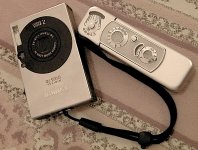
Cameras Canon Ixus 70 and Minox B 705020014.JPG
 
honestly - I think that possession of a "personality" can be an asset or a liability.

When I was taking photo's for a living, the last thing I actually wanted from a camera was "personality" - all I wanted was a 100% reliable, solid, functional and unfailingly accurate in its execution tool to do a job. I don't want personality in a Hammer, or a Saw, or a Spanner either. I just want it to be plain, boring, and work exactly how it should.

My first SLR was a praktika - MTL1000 iirc, and a friday afternoon after a Vodka Lunch one at that. It was all quirks, and foibles, and a pain in the fundament, because no matter what you did, every 2-3 films it'd end up shredding the roll, and you'd be opening the camera in a dark bag, and trying to rescue the film shards. Yeah - way too much personality that one.

Replaced with a Canon A1. More like it. Worked well, was solid (from new - I know they ended up with the dreaded canon-cough as they aged, but I'm talking a from new purchase) and reliable and yes, it was in my eyes really nice to look at as well as handling pretty well. Main issue was for my "meat hooks" of hands, it was a bit small - but, as I wasn't really a photographer at the time, I was a walker/climber that took lots of photo's the trade off in size and weight was worthwhile.

Then I began assisting shooting weddings - and - also shooting fairly early "reportage" second reel stuff - The Canon A1 was good, but I was feeling the itch for Auto-focus for the "grabbed moments" - so - I traded the A1 and lenses in for a EOS-1 based system. This was IT this was the tool-camera i'd been looking for all my working 'tog life. Was quickly accompanied by an EOS-3 body because I got a good deal on one that was barely used - multiple bodies back then were often for "1 colour, the other B&W" - this combo saw me through to the end of any professional work I did. Sold the Bodies and Lenses at that point and had a hiatus of maybe 10 years of just taking photos when I went walking, whcih was covered with a procession of Canon Ixus point and shoot cameras taking me from film to digital.

Maybe 16 years ago, I decided that I missed having proper control over my camera, and had a few bob spare, so dipped back into photography, buying a EOS450 digital camera. I joined this forum, Photography actually became my Hobby - and, because I'd a fair bit of expertise from the film era, I started participating in the film and conventional bit of the forum. A wave of nostalgia, coupled with the (then) pocket money costs of the old film cameras saw me buying, refurbishing and using film cameras again - but - here's the thing - I wasn't searching for efficiency in these purchases - I was looking for things that WERE quirky, and that would make me think and work with, or around, their issues. Because, nailing the image wasn't the be-all and end-all - i'd got the digital eos for that - I wanted the old film camera for it's personality.

At the moment, I don't shoot anywhere near as much as I used to - day job, no money, and no reliable transport means I don't get to just disappear to the hills every weekend, so I'm back with digital and making sure I nail the image I want, because there might not be a chance of a re-shoot for years... Honestly, my film cameras really aught to get a quick run through, pass a film through them to prove they work, and get them sold onto someone who WILL use them and enjoy them - but - its a lot harder to sell cameras that have a personality :D

TL-DR - As a Pro, didn't want Personality in a camera, As a Hobby-Tog, Personality in a camera was pretty much everything.

 
I think that there is a definite difference between shooting with early DSLRs than later models. Particularly the early pro models. I really like using the D3 series. The Canon 1ds mk3 feels even less automated and needs more active management of light levels.
 
Maybe 'characteristics' would be a better term than 'personality'. I hesitate to personalise machines - but they're distinguished by their capabilities & their interfaces - & I'm guessing that it's the interfaces that are in question here?

There are the ergonomics - how is it, even on a tripod, to the hand? Then the capabilities for the visualisation of the image - what it's like to look through (or at, in terms of a focusing screen).

There are always quirks. As a parallel, I could instance my Record No 05 jack plane of a certain age - with a nicely-honed iron, it can take as fine a shaving as anything on the planet, & there's a satisfaction in the crisp sound of that easy action. Its blade adjustment may lack finesse - but you adapt your intention to it.

It seems to me that in some ways, detachment increases as technology advances. Anyone here whittled a clothes peg lately (serious question)?
 
For me, I just want the camera to get out of the way and quietly help me get the picture I want.
This 100% I love the fact that my camera works in exactly the way I expect it to, and I rarely have to think about any ‘settings’.
With an older style film camera the nostalgia can be fun for a few seconds, but that's all.
However, I loved the feel of the Fuji xe1 I had, and if I could have a similar experience with a small Canon I’d be happy to do so most of the time.
 
With an older style film camera the nostalgia can be fun for a few seconds, but that's all.
I sometimes dig out my Pentax ME and pretend to use it for a few minutes for the fun of winding on the non-existent film and hearing the clunk of the shutter. Nostalgic itch scratched.

Any perceived 'personality' a camera has is projected on to it by the human.

That Pentax gave me lots of fun for about ten years. It got battered so it's only ever had sentimental value. I Keep a Nikon D750 for similar reasons (and will it's successor when/if it stops doing what I want it to), so I'd say digital cameras can have 'personality' if you want them to, but the Nikon still gets used.
 
I think all of my cameras work in exactly the way I expect them to :)
Ok
The Bronica I owned had oodles of personality.
The viewfinder was huge and bright, made focussing easier than 35mm but also more critical. It weighed a ton, and that bright viewfinder was reversed L/R, so when the subject was too close to the LH edge, I had to move the camera to the right.
I knew this happened, but it meant using it for anything moving was a task.

Using an external meter meant keeping an eye out for changes in lighting. Then remembering if I changed the aperture I needed to make a subsequent change to SS.

Then there was that big old winder to get to the next frame, and the faff of reloading every 15 shots.

Whereas the R6? Much much easier. Rarely have to do more than focus and shoot, and focussing is as simple as using my thumb on a button
 
Ok
The Bronica I owned had oodles of personality.
The viewfinder was huge and bright, made focussing easier than 35mm but also more critical. It weighed a ton, and that bright viewfinder was reversed L/R, so when the subject was too close to the LH edge, I had to move the camera to the right.
I knew this happened, but it meant using it for anything moving was a task.

Using an external meter meant keeping an eye out for changes in lighting. Then remembering if I changed the aperture I needed to make a subsequent change to SS.

Then there was that big old winder to get to the next frame, and the faff of reloading every 15 shots.

Whereas the R6? Much much easier. Rarely have to do more than focus and shoot, and focussing is as simple as using my thumb on a button

Sounds much like interesting and enjoyable vs simple and boring ;) :ROFLMAO:

I think there are definitely two camps on this subject though as we can easily see :)
 
Sounds much like interesting and enjoyable vs simple and boring ;) :ROFLMAO:

I think there are definitely two camps on this subject though as we can easily see :)
Or infuriating and frustrating vs simple and enjoyable? :D

Best of all with digital we can see when we've messed up and correct on the spot. (y)
 
Or infuriating and frustrating vs simple and enjoyable? :D

Best of all with digital we can see when we've messed up and correct on the spot. (y)

I don't get nowhere near as much enjoyment from using the A7Riii for a landscape image as I do the Yashica Mat....

But, what if we should be getting it correct in the first place anyway and not need to see whether we've messed up? :p:ROFLMAO:
 
I've been tempted to revive using my Bronica ETR, but the pleasure was always in the quality of pictures it would produce (some of which still hang here at home nearly 40 years later) and not the operation. It was fine for the era, but things have moved on. Done the TLR thing, Olympus rangefinder (possibly the nicest 'vintage' experience) but happy to move on.

But, what if we should be getting it correct in the first place anyway and not need to see whether we've messed up?

Try shooting a wedding on film. :eek::giggle::cool:

Getting it right first time, at least enough for the latitude of reversal film, wasn't really an issue even with a completely manual camera without metering built in. That's not heroics, but rather just the basics. And we'd create more prints (especially if you printed your own) because there's no other way you could actually see your pictures, especially if they were a little soft which wouldn't show until you had at least a 10"X8" in your hand. OTOH a little softness was probably more liveable then because no-one knew outside the hobby how much detail there should be, and were often a little in awe of a big print.

Some things never change though, and it still requires a good eye to spot a great picture and capture it just like it always did - it's just that now more great pictures are possible and we've become jaded with the amazing quality of the pictures so many produce.
 
Last edited:
I don't get nowhere near as much enjoyment from using the A7Riii for a landscape image as I do the Yashica Mat....

But, what if we should be getting it correct in the first place anyway and not need to see whether we've messed up? :p:ROFLMAO:
If I enjoyed shooting landscapes maybe I’d have time to ‘enjoy’ the camera. But I shoot people and sports. So the camera getting out of the way is what gives me pleasure
 
If I enjoyed shooting landscapes maybe I’d have time to ‘enjoy’ the camera. But I shoot people and sports. So the camera getting out of the way is what gives me pleasure
That's the big difference. Having time to enjoy the the "camera experience" versus the need to get the job done. The context of why you are using a camera is crucial to this discussion.
 
The context of why you are using a camera is crucial to this discussion.
I'm not sure about "crucial" but certainly "relevant".

Before digital, I used many different cameras. The length of time I'd keep a particular camera or lens depended on how happy I was with the images I recorded and I suspect that was related to how easy I found controlling the camera and its settings.

However the thing that I felt impacted the results more than anything was the viewfinder and that is still the case with digital.
 
I'm not sure about "crucial" but certainly "relevant".

Before digital, I used many different cameras. The length of time I'd keep a particular camera or lens depended on how happy I was with the images I recorded and I suspect that was related to how easy I found controlling the camera and its settings.

However the thing that I felt impacted the results more than anything was the viewfinder and that is still the case with digital.
I thought it crucial, because the context is needed to understand the rationale behind the argument being put forward.

Yes viewfinders were, and are, important. I changed cameras for multiple and complex, reasons,
 
On the 'personality YES if you're an amateur, NO if you're a pro'.

Well it depends on the type of Pro one is, I suppose. If your pro photography has to do with fast moving subjects, action, engines, sports or other technically challenging scenes, then of course a portable, fast, hi-tech microcomputer is going to be more useful than an old mechanical manual focus camera.

If you're a pro like - e.g. - Henry Wessel Jr., who spent 50+ years taking beautiful pictures of the mundane in the American west, was the recipient of two Guggenheim Fellowships and three National Endowment for the Arts grants - then his Leica M3, 50mm lens, and endless supply of TriX rolls (which was all he used for the entirety of his career) had both bags of personality and were clearly the right tools for his professional work - which continued well into the digital age.

I personally think film photography snobbery is silly, and so is digital hi-tech photography snobbery.
 
Last edited:
I personally think film photography snobbery is silly, and so is digital hi-tech photography snobbery.
Agreed.

At the end of the day the image is really all that counts.
 
If you're a pro like - e.g. - Henry Wessel Jr., who spent 50+ years taking beautiful pictures of the mundane in the American west, was the recipient of two Guggenheim Fellowships and three National Endowment for the Arts grants - then his Leica M3, 50mm lens, and endless supply of TriX rolls (which was all he used for the entirety of his career) had both bags of personality and were clearly the right tools for his professional work - which continued well into the digital age.

I have a suspicion that the bit with personality was Henry Wessel, and having found his formula, never changed it.
 
I think most of us would have started back in the film/negative days. This is something Ive only ever used (an could say only use to:ROFLMAO:) With the ability of developing at home.
I have to agree with some of the comments that you cannot beat the old Cameras and Film. Noise of the clicks, leather smell, style, simple but true image of what you captured.
I also enjoyed Lomography, being experimental with liquid filled lens. :geek:
 
I have a suspicion that the bit with personality was Henry Wessel, and having found his formula, never changed it.
The Leica M3 was also considered one of Leica's best cameras, where as their early digital M cameras were bigger and not as "usable". It's hard to think of an obvious reason for him to feel any need to change from using his M3.
 
The Leica M3 was also considered one of Leica's best cameras, where as their early digital M cameras were bigger and not as "usable". It's hard to think of an obvious reason for him to feel any need to change from using his M3.
I can't agree with the bigger and not as useable Graham, I have the 4 M9s I showed in my earlier post but I also have M2 and M4-P (both the same size as the M3) I don't find my M9s that much bigger ans as for usability they're just as easy as the M2/4-P but with the ability to see results quicker and not have to wait for a film to be used up to see the results.
 
I can't agree with the bigger and not as useable Graham, I have the 4 M9s I showed in my earlier post but I also have M2 and M4-P (both the same size as the M3) I don't find my M9s that much bigger ans as for usability they're just as easy as the M2/4-P but with the ability to see results quicker and not have to wait for a film to be used up to see the results.
I can't argue with you on this, as I'm just going on anecdotal comments picked up from M users at the time. There were some specific issues,as well as complaints about the size, which I now can't remember.

I have to say that when I started to think about buying a digital camera, after decades of using film cameras, being able to see the results on the rear screen wasn't something I really considered.
 
There were some specific issues,as well as complaints about the size, which I now can't remember.
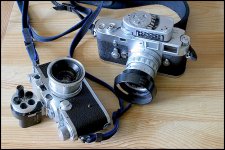
I used a IIIc, a M3 and and a M2.

I didn't get on with the M2's viewfinder whereas that on the M3 is one I miss. The IIIc viewfinder was pretty horrible, even when I had good eyesight, so I stuck a Russian Jupiter 12 on it and looked through a Russian universal eyepiece, which worked quite well!

Leica IIIc and M3 cameras.jpg
 
Last edited:
I used a IIIc, a M3 and and a M2.

I didn't get on with the M2's viewfinder whereas that on the M3 is one I miss. The IIIc viewfinder was pretty horrible, even when I had good eyesight, so I stuck a Russian Jupiter 12 on it and looked through a Russian universal eyepiece, which worked quite well!

View attachment 456921
My personal experience with Leicas is limited to short periods with an M3, R4 and Leicaflex SL, which I seem to remember you could only focus in the centre of the screen.

I still fancy an M3, but it isn't going to happen.
 
I have a suspicion that the bit with personality was Henry Wessel

Textbook red herring.

That's not the point that I'm making, and that you're twisting.

As I said before, I couldn't care less about the 'personality' of a tool, but to say that if you're a pro you will go for a digital camera because 'it gets the job done' whereas the amateurs out there are playing with the film cameras probably because they have no serious job to get done, is really, really silly.
 
Last edited:
Maybe 'characteristics' would be a better term than 'personality'. I hesitate to personalise machines - but they're distinguished by their capabilities & their interfaces - & I'm guessing that it's the interfaces that are in question here?

Yes. Great point. The word 'personality' is clearly getting some people knickers in a twist and making them see the trees instead of the forest ;)
 
Textbook red herring.

That's not the point that I'm making, and that you're twisting.

As I said before, I couldn't care less about the 'personality' of a tool, but to say that if you're a pro you will go for a digital camera because 'it gets the job done' whereas the amateurs out there are playing with the film cameras probably because they have no serious job to get done, is really, really silly.

But that wasn't what I said.

It also seems that he did NOT exclusively shoot Tri-X - from the Wikipedia page "Throughout much of his career he used only one camera and one type of film: a Leica 35 mm camera with a 28 mm wide-angle lens and Kodak Tri-X film.[1][3] His later work did incorporate color.[4]" Examples: https://fraenkelgallery.com/exhibitions/henry-wessel-house-pictures

But it's interesting to ask, why exclusively use a Leica? From Leicaphilia:

According to Wessel, the most important photographic choices were “where to stand and when to shoot,” followed by keeping technological choices to a minimum. Learn to use one camera and one lens. By limiting your tools to a single camera – a Leica M with 28mm – your sense of how light translates to film, and then to paper, would become instinctive.

As suggested by Phil V, he knew exactly how it would behave and it just got out of the way and let him make the photographs he wanted. He started out with it well before digicams were available and, quite likely, continued because it did mostly what he needed it to do. Perhaps there was a special affection for it because it was an essential part of his kit, or perhaps not.

It's not about personality - "Any perceived 'personality' a camera has is projected on to it by the human" to quote @Ed Sutton further up the thread. However if you find a particular tool inspirational then that's great, long may it inspire you to keep making pictures.

And BTW, let's not make this discussion start getting personal, OK?
 
he knew exactly how it would behave and it just got out of the way and let him make the photographs he wanted.

Exactly. All great pro photographers do that, whether they use film cameras or digital cameras. Choose what fits your vision and method best, without worrying if it's a modern digital tool or an ancient analogue one.

All the best to you, Sir!
 
Textbook red herring.

That's not the point that I'm making, and that you're twisting.

As I said before, I couldn't care less about the 'personality' of a tool, but to say that if you're a pro you will go for a digital camera because 'it gets the job done' whereas the amateurs out there are playing with the film cameras probably because they have no serious job to get done, is really, really silly.
Is anyone saying that?

There must thousands (millions) of non-pro photographers who just want the job done and have no interest in the "experience" of using a camera with character/personality that might slow down or interfere with them recording important "life" events. Whether that's a family event, a holiday of a lifetime, a rare bird or a historical sporting event.

This isn't a simple professional vs amateur thing it’s a photographic objective thing.

Many amateurs are very serious about their photography, and certainly not just "playing with film cameras" even if for some, playing with new toys (digital or analogue) might be an important part of their hobby enjoyment.. Professionals like new toys as well, but what they can buy is constrained by the need to pay their wages.

Some professionals are still using film cameras professionally, some are using digital cameras professionally but using film cameras for their personal work, and some are still professionally using cameras of "character" Hasselblad 500s or Mamiya 67s with digital backs replacing the film holders, and some ar using modern digital cameras that still have character such as a Leica M11 or a Cambo Actus/Sinar P3.

The difference being that if you earn your living from photography, your choice of equipment is almost entirely driven by client output demands related to turn around times, as well as image content and quality requirements and not your personal choice of the camera "experience".

You need to have a fairly unusual client to allow the use of film, though apparently some commercial photographers who still routinely use film are seeing a surge in business from clients who want to distance their adverts from those using AI, as are those photographers who earn a living from selling through art galleries, for the same reason.
 
The difference being that if you earn your living from photography, your choice of equipment is almost entirely driven by client output demands related to turn around times, as well as image content and quality requirements and not your personal choice of the camera "experience".

Firstly, there's much, much more to 'pro' photography than what you have in mind.

As for the 'client demands'. Great point there. I don't know about the UK as I don't live there anymore. The place where I live now has, sadly, become a prime destination for the wedding celebrations of the European wealthy elites. Here, wedding photographers (which I suspect is what you're mostly thinking about when you write about earning your living from photography) have almost uniformly ceased offering pure all-digital services to clients. So in a way, you're right, 'client demands' rule. What people demand though, is a 'film photoshoot' or 'the film look' (whatever that is).

If you're a wedding photographer round here and you're still just using the latest mirrorless/DSLR kit to cover the event, nobody will call you anymore. You're done for. You'll need the Hasselblads, the Mamiya 6x7s, the old lenses with the funny/swirly bokeh, and yes, also the aide with the drone to capture the landscape, and you'll need many many rolls of Portra 400 expertly developed and digitalised, otherwise people will look for someone else. Instagram imagery is the driver here.

Don't get me wrong, I cheer for digital photography. I'm really curious about the progress and advancements of digital photography gear, but sometimes I think 'pro digital kit', the big expensive DSLRs and mirrorless camera, with the huge, perfectly corrected f/2 megazooms, are dying a slow, unavoidable death, squeezed between other ways of doing photography, some newer, some older.
 
Last edited:
Firstly, there's much, much more to 'pro' photography than what you have in mind.

As for the 'client demands'. Great point there. I don't know about the UK as I don't live there anymore. The place where I live now has, sadly, become a prime destination for the wedding celebrations of the European wealthy elites. Here, wedding photographers (which I suspect is what you're mostly thinking about when you write about earning your living from photography) have almost uniformly ceased offering pure all-digital services to clients. So in a way, you're right, 'client demands' rule. What people demand though, is a 'film photoshoot' or 'the film look' (whatever that is).

If you're a wedding photographer round here and you're still just using the latest mirrorless/DSLR kit to cover the event, nobody around here will call you anymore. You're done for. You'll need the Hasselblads, the Mamiya 6x7s, the old lenses with the funny/swirly bokeh, and yes, also the aide with the drone to capture the landscape, and you'll need many many rolls of Portra 400 expertly developed and digitalised, otherwise people will look for someone else. Instagram imagery is the driver here.

Don't get me wrong, I cheer for digital photography. I'm really curious about the progress and advancements of digital photography gear, but sometimes I think 'pro digital kit', the big expensive DSLRs and mirrorless camera, with the huge, perfectly corrected f/2 megazooms, are dying a slow, unavoidable death, squeezed between other ways of doing photography, some newer, some older.
I had in mind, commercial photography (which I mentioned) as in advertising and fashion photography, e-commerce, business related company report type stuff ie corporate headshots etc, industrial, scientific and architecture (which is what I mainly did when I was a professional), reportage and documentary, professional sports, wildlife and landscape, plus the small number who can make a living with print sales through galleries (which I also mentioned)

Plus of course weddings and portraits but that wasn't at the forefront of my mind, and it's interesting what you say about a move back to film for weddings. I'm not aware of this happening in the UK.
 
Just some random thoughts, some people will think they’re valid, others won’t, that’s fine.

As a (retired) pro, I’ve always used the right tool for the job, with no subjective interest in the actual tool. I have vast experience, not because I’m good but because technology has changed immeasurably over my time as a pro photographer.

“Personality” is perhaps the wrong word; character may be a better one, and all of my old cameras had “character”, usually a bad one.

When I was very young and poor I lusted over Leicas and Hasselblads. I never did get a Leica but I did eventually get a Hassie, every now and again it would jam up in the middle of the shoot, so I eventually replaced it with a RZ67, which had far less “character” but produced far better image quality and which never let me down.

I used to use large format a lot, I had a 5”x4” (can’t remember the make) that couldn’t hold its movement settings and I had to replace it with a Sinar P2, which was perfect. I had a few 35mm cameras too, none of them were fault-free, I eventually bought a Canon A1, which never let me down. I wore that out and eventually replaced it with a Nikon F90X, another very good choice, I still have it and every now and then I think about getting some film for it, but don’t.

Moving on to digital, I’ve had a D3 and a D700 for years, both are now ancient but still superb, I know them well and never have to give a moments thought to the handling, that’s what, as a pro, I need, because like Gerald Ford, I can’t chew gum and walk in a straight line at the same time and I need to be able to concentrate on the shot, not on the “character” of the tools.

And now, suddenly, I’ve decided to do a bit of video, which has a very sharp learning curve, so I’ve bought a D7200 just for the video. I can’t fault it (OK, I have no basis for comparison) other than that, although it’s a Nikon, some differences are driving me mad and which are (currently) forcing me to think about the camera handling rather than the shoot, the opposite of what I want. I could have bought the latest and best mirrorless camera, but I don’t need one and don’t want to spend more than I need to, and anyway I don’t want to have to learn something completely new to me unless I really need to.

With TP’s wide and disparate membership, it’s inevitable and right that there are a lot of people who love their gear, constantly change and update it, and spend a fortune on it, but my own approach to photography has always been to just buy what I absolutely can’t manage without, learn to get the best from it and stick to what works for me.
 
I agree with you, but as others mentioned, I couldn't afford the time and cost of film photography, so Photoworks grain filters are pretty much my best friends when I want to go after the "film" look. Besides, having a camera with a personality stronger than mine would be a huge blow on my self-esteem, so-
 
Firstly, there's much, much more to 'pro' photography than what you have in mind.
That is, in at least one sense, true.

I've known photographers who earned their livings in all sorts of ways, which the average reader of Talk Photography might not have considered. I once shared "digs" with a bloke who spent his days photographing large castings for ship engines, at all stages of their creation. Another chap I knew, several years ago, was a part-time scenes of crime photographer, attached to the local mortuary. (No, I never quite understood that either). There was a woman who had a good line going in insurance claims, working for a firm of loss adjusters. These were people whose technical standards would probably have put the average committed amateur to shame, because their output had to be right every time.

To quote that geezer from Stratford: “There are more things in Heaven and Earth, Horatio, than are dreamt of in your philosophy.
 
That is, in at least one sense, true.

I've known photographers who earned their livings in all sorts of ways, which the average reader of Talk Photography might not have considered. I once shared "digs" with a bloke who spent his days photographing large castings for ship engines, at all stages of their creation. Another chap I knew, several years ago, was a part-time scenes of crime photographer, attached to the local mortuary. (No, I never quite understood that either). There was a woman who had a good line going in insurance claims, working for a firm of loss adjusters. These were people whose technical standards would probably have put the average committed amateur to shame, because their output had to be right every time.

To quote that geezer from Stratford: “There are more things in Heaven and Earth, Horatio, than are dreamt of in your philosophy.
How do you know what I had in mind, any more than @trypdal :)

But, by strange coincidence I also spent time photographing large castings for ships (not engine parts however) a friend was a Scenes of Crimes photographer for the police, and some of the photographs I took were to illustrate claims (not insurance claims) that the MOD were making against their suppliers. All of them, however, were high quality, and often technically difficult, photographs.
 
Just some random thoughts, some people will think they’re valid, others won’t, that’s fine.

As a (retired) pro, I’ve always used the right tool for the job, with no subjective interest in the actual tool. I have vast experience, not because I’m good but because technology has changed immeasurably over my time as a pro photographer.

“Personality” is perhaps the wrong word; character may be a better one, and all of my old cameras had “character”, usually a bad one.

When I was very young and poor I lusted over Leicas and Hasselblads. I never did get a Leica but I did eventually get a Hassie, every now and again it would jam up in the middle of the shoot, so I eventually replaced it with a RZ67, which had far less “character” but produced far better image quality and which never let me down.

I used to use large format a lot, I had a 5”x4” (can’t remember the make) that couldn’t hold its movement settings and I had to replace it with a Sinar P2, which was perfect. I had a few 35mm cameras too, none of them were fault-free, I eventually bought a Canon A1, which never let me down. I wore that out and eventually replaced it with a Nikon F90X, another very good choice, I still have it and every now and then I think about getting some film for it, but don’t.

Moving on to digital, I’ve had a D3 and a D700 for years, both are now ancient but still superb, I know them well and never have to give a moments thought to the handling, that’s what, as a pro, I need, because like Gerald Ford, I can’t chew gum and walk in a straight line at the same time and I need to be able to concentrate on the shot, not on the “character” of the tools.

And now, suddenly, I’ve decided to do a bit of video, which has a very sharp learning curve, so I’ve bought a D7200 just for the video. I can’t fault it (OK, I have no basis for comparison) other than that, although it’s a Nikon, some differences are driving me mad and which are (currently) forcing me to think about the camera handling rather than the shoot, the opposite of what I want. I could have bought the latest and best mirrorless camera, but I don’t need one and don’t want to spend more than I need to, and anyway I don’t want to have to learn something completely new to me unless I really need to.

With TP’s wide and disparate membership, it’s inevitable and right that there are a lot of people who love their gear, constantly change and update it, and spend a fortune on it, but my own approach to photography has always been to just buy what I absolutely can’t manage without, learn to get the best from it and stick to what works for me.
I agree with the word character, and I've used it in earlier posts.

The problem with Hasselblads I remember, was the magazines failing: there was never a time when at least one wasn't off for repair. but we also had Mamiya RB67s. If I were to buy a film camera today, it would be a difficult choice between a Hasselblad or Mamiya RB/RZ67, but as I've mentioned in the past, it was the Fuji GX680 I lusted after,

I loved the Sinar P2, and that was comparing it against using Linhof, Cambo and Arca Swiss monorails., as well as Linhof Technikas.

You're making me nostalgic now !
 
Back
Top