Jelster
Suspended / Banned
- Messages
- 9,986
- Name
- Steve
- Edit My Images
- Yes
There have been a few threads lately discussing DoF (Depth of Field) so I thought I'd put up a thread showing the effect that DoF can have on an image.
Depth of Field is dependant on a number of criteria but mainly the lens aperture ("F Stop") and the distance of the subject. Other elements can also come into play for a given image, such as the focal length of the lens and the distance of the subject and it's background.
Also, a contentious issue is sensor size, but I don't want to enter into that here as there have been a couple of threads in this section recently, so you can read them and make up your own mind
So, as this is "Talk Basics" I am going to assume that we are working with a single sensor size (in this case the Canon APS-C of my 7D, which is often referred to as a "1.6 Crop").
So, Part 1, we are going to use a focal length of 85mm, a fixed subject to distance (in this case just over 2 Metres) and change the aperture of the lens to see what happens.
Let's start at a nice small aperture of f22.
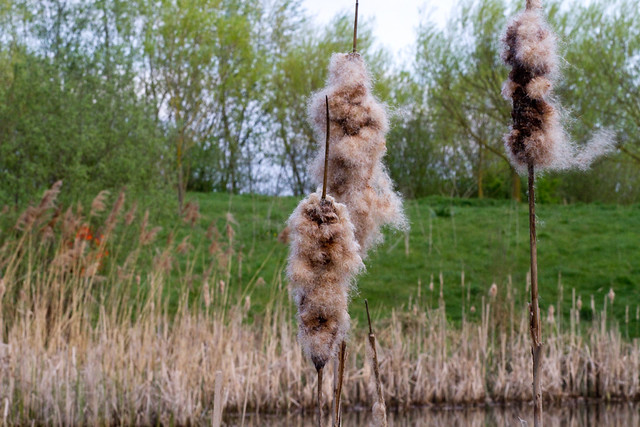
85mm f22 by Steve Jelly, on Flickr
As you can see, although the front bullrush is the focal point, the other two are also in focus, and you get a very good idea of the background.
Now, we open up the aperture a couple of stops to f11.
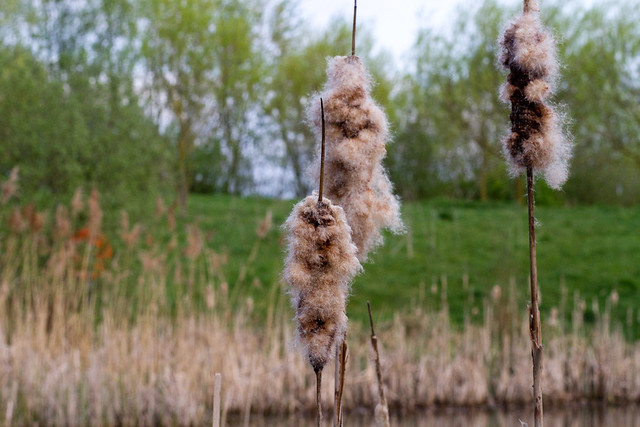
85mm f11 by Steve Jelly, on Flickr
At First glance not a lot seems to have changed, but if you look closely, the foreground does seem to separate from the background more obviously.
Open up a couple of stops more to f5.6

85mm f5.6 by Steve Jelly, on Flickr
Now we are starting to see the background being thrown completely out of focus, the the rear bullrush is no longer in focus at all.
Finally, we'll open the lens right up to f1.8

85mm f1.8 by Steve Jelly, on Flickr
Now we have that wonderful blurred background, the other bulrushes are no longer in focus and the subject leaps out of the image. Your eyes are drawn to the subject because that's all that is in focus.
It's a good exercise for anyone who's fairly new to the hobby to do, and the ability to throw unwanted backgrounds out of focus is a really useful tool. It does however have it's pitfalls.
The closer you get to the subject the smaller the DoF becomes and it can sometimes be difficult to keep all of your subject in focus. Quite often portraits taken at f1.8-1.2 will only get one eye fully in focus, so be careful how you use it.
Likewise, it's not very likely that you'll want to shoot landscapes wide open, but you can to get a different effect, like this shot:
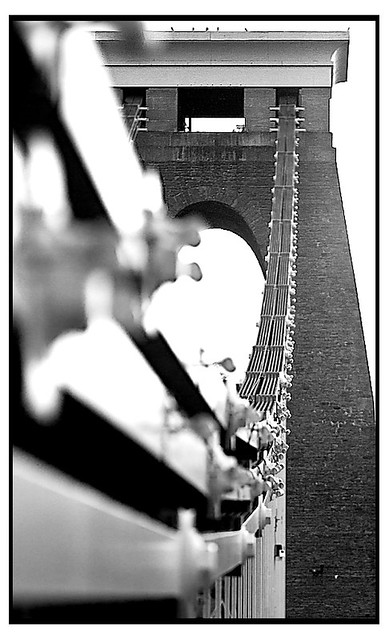
Clifton Suspension Bridge by Steve Jelly, on Flickr
Next we'll look at what happens when you change focal length.
Steve
Depth of Field is dependant on a number of criteria but mainly the lens aperture ("F Stop") and the distance of the subject. Other elements can also come into play for a given image, such as the focal length of the lens and the distance of the subject and it's background.
Also, a contentious issue is sensor size, but I don't want to enter into that here as there have been a couple of threads in this section recently, so you can read them and make up your own mind
So, as this is "Talk Basics" I am going to assume that we are working with a single sensor size (in this case the Canon APS-C of my 7D, which is often referred to as a "1.6 Crop").
So, Part 1, we are going to use a focal length of 85mm, a fixed subject to distance (in this case just over 2 Metres) and change the aperture of the lens to see what happens.
Let's start at a nice small aperture of f22.
85mm f22 by Steve Jelly, on Flickr
As you can see, although the front bullrush is the focal point, the other two are also in focus, and you get a very good idea of the background.
Now, we open up the aperture a couple of stops to f11.
85mm f11 by Steve Jelly, on Flickr
At First glance not a lot seems to have changed, but if you look closely, the foreground does seem to separate from the background more obviously.
Open up a couple of stops more to f5.6
85mm f5.6 by Steve Jelly, on Flickr
Now we are starting to see the background being thrown completely out of focus, the the rear bullrush is no longer in focus at all.
Finally, we'll open the lens right up to f1.8
85mm f1.8 by Steve Jelly, on Flickr
Now we have that wonderful blurred background, the other bulrushes are no longer in focus and the subject leaps out of the image. Your eyes are drawn to the subject because that's all that is in focus.
It's a good exercise for anyone who's fairly new to the hobby to do, and the ability to throw unwanted backgrounds out of focus is a really useful tool. It does however have it's pitfalls.
The closer you get to the subject the smaller the DoF becomes and it can sometimes be difficult to keep all of your subject in focus. Quite often portraits taken at f1.8-1.2 will only get one eye fully in focus, so be careful how you use it.
Likewise, it's not very likely that you'll want to shoot landscapes wide open, but you can to get a different effect, like this shot:
Clifton Suspension Bridge by Steve Jelly, on Flickr
Next we'll look at what happens when you change focal length.
Steve
Last edited: