Crop Factors

Derek.Laurence

Suspended / Banned
Messages
231
Name
Derek
Edit My Images
Yes
Hi,

This is my first proper post so go easy on me please!

As much as I have played about taking pictures with my kit lenses for quite some time I have recently taken an interest in getting a prime lens for some decent portraiture.

I had my mind set on a 85mm lens for my Sony a230 until I started reading about crop factors!

I had never came across this term before and it had thrown some doubt into the equation

Am I best getting a 50mm lens which allowing for crop factor will give me an equivalence of around 75mm (crop factor for a230 =1.5) or am I missing something?

I would be most grateful to hear your opinions on this.

Derek
 
That's correct. If you want a specific focal length on a crop sensor you'll need to take the maths into consideration. So as you say a 50mm will give you 75mm on a 1.5x crop - the 85mm would be 85mm * 1.5 (so 127.5) which may or may not be longer than you want or need.
 
You've got it sussed there by my reckoning Derek!

I've got a 50mm for my Canon 7D, with a crop factor of 1.6 the field of view is the equivalent of 80mm on a full frame.
 
Thanks Number45

Good to see I'm not being completely thick!

I had never heard I this before yesterday. :-(

A lot to learn me thinks
 
Crop factor refers to the field of view compared to a 35mm SLR or 'full frame' DSLR - this happens because the sensor is smaller in your camera compared to a full frame one.

One word of caution - why did you pick the 85mm? If it's because you want more magnification than the kit lens gives you then be aware that 'crop factor' is already at work with that lens too.

So if the kit lens is something like 17-55mm then "getting a 50mm to give you 75mm" won't give you extra reach - you've already got it!!

The whole crop factor thing can be a red herring if you're only considering the one camera you're using. Think about what it is that your current lens does and doesn't do - then base your decisions on that.
 
Hi,

This is my first proper post so go easy on me please!

As much as I have played about taking pictures with my kit lenses for quite some time I have recently taken an interest in getting a prime lens for some decent portraiture.

I had my mind set on a 85mm lens for my Sony a230 until I started reading about crop factors!

I had never came across this term before and it had thrown some doubt into the equation

Am I best getting a 50mm lens which allowing for crop factor will give me an equivalence of around 75mm (crop factor for a230 =1.5) or am I missing something?

I would be most grateful to hear your opinions on this.

Derek


Hi Derek, As others have said you are perfectly correct in your assumption of the crop factor at 1.5

Just to add one small thing to the other excellent answers without trying to complicate matters too much.

Although when using a 50mm lens on a 1.5 crop camera will give you "effectively" the angle of view of a 75mm lens, the depth of field (what is generally accepted as reasonably in focus) will still be that of a 50mm lens as in reality that is what you are still using, ie you will have more depth of field per aperture and focus point than if using a true 75mm lens.

Hope this helps.
 
Derek, have a look back at your favourite portraits taken with your kit lens. Somewhere in the EXIF, you should be able to ascertain what focal length your zoom was set at - that's the focal length prime I'd suggest you get for portraiture. A 50mm lens is a 50mm lens whatever you use it on, what changes is the angle of view the lens offers - a crop body such as yours offers a narrower angle of view than a full frame body - and that angle of view is approximately equal to that of a lens 1.5x the focal length on a full frame body, so a 50mm lens on a crop body offers the same angle of view as a 75mm lens on a full frame camera.

This can be largely ignored unless you use both crop and FF bodies or if you come from a 35mm film background and are used to the angles of view that certain focal lengths gave you on that format. If you've only ever used crop bodies, all you need to know is that a 35mm lens (or thereabouts) is "standard" (offers a natural viewing angle), anything shorter can be seen as a wide angle lens and anything longer as a telephoto.

Wikipedia explains it rather well... http://en.wikipedia.org/wiki/Crop_factor
 
What Nod said - if you decided you wanted an 85mm, what made you decide that?

If it was because someone suggested 85mm as a great focal length for portraits, then there's a whole other bunch of contextualising.

If it's because you wanted something longer than your kit lens, then thats still the case - buy the 85mm.

If it's because you saw some example shots taken with it and you wanted similar, you'll have to find whether the camera used was a crop or FF.

For me personally, I love my 85mm on a crop, but I used to love 135mm on film.

You'll go mad worrying about crop factors, don't get hung up on 'equivalent focal lengths', because technically there's no such thing. 85mm is 85mm whether it's a long telephoto (on a compact) a medium tele (on a crop) a short tele (on ff) a std lens (med format) or a wide angle (large format).

In the old days we just got used to what a lens did on our camera without thinking about how that changed with a different format.

Your choice is either a short or medium tele - which for you is 50mm or 85mm, don't concern yourself with how that relates to a camera you don't own.
 
Yes you have all just actually blown my mind.....

Ill need to fully reread everything to get exactly what you are saying ( although I think I've got the gyst)

I decided on an 85mm because I read somewhere or saw something that suggested it was an excellent lens for portraits.

Any portrait type shots I've been trying I've been setting my 70-300mm lens at approx 85mm ( not ideal, I know) just to get a feel for things. I felt I was too close in on my "subjects" ( primarily my 4.5 kids) with the 55mm on my 18-55mm lens.
 
Yes you have all just actually blown my mind.....

Ill need to fully reread everything to get exactly what you are saying ( although I think I've got the gyst)

I decided on an 85mm because I read somewhere or saw something that suggested it was an excellent lens for portraits.

Any portrait type shots I've been trying I've been setting my 70-300mm lens at approx 85mm ( not ideal, I know) just to get a feel for things. I felt I was too close in on my "subjects" ( primarily my 4.5 kids) with the 55mm on my 18-55mm lens.

There you go, a perfect example of why the 'crop factor equivalent' should be ignored:D. You'd correctly decided that you wanted an 85mm and then some idiots spouting about equivalents made you doubt that decision.

Get the lens, you'll love it.
 
I posted a thread many years ago showing the difference in the real world between 3 different focal lengths on a 5D (full frame) and 30D (1.6 crop factor).

LINKY

It's actually surprising what a difference there is!
 
Crop-factor.jpg
 
Last edited:
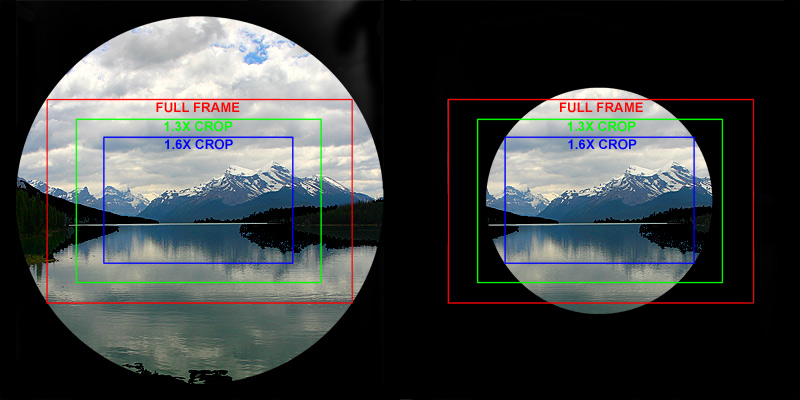
This appeared in the one of many crop factor threads, I don't know who/what/where it came from originally :shrug:

Crop-factor-demo-3.jpg

I posted a thread many years ago showing the difference in the real world between 3 different focal lengths on a 5D (full frame) and 30D (1.6 crop factor).

LINKY

It's actually surprising what a difference there is!

But as the OP only has a crop camera, why does it matter what a lens he hasn't even bought would do on a camera he doesn't own or intend to buy. :bonk:

He came for a little clarity and reassurance, not to be bamboozled with loads of info he has no use for, it's this kind of info that has caused his confusion in the first place.

I appreciate this info might come in handy for others wanting to read up on crop factors, but if you read the OP's posts, do you really think this is helpful?

[/rant]
 
Oh for goodness sake Phil, get off your high horse :bang:

In response to Derek's question myself and others have explained what the difference is between a crop and FF sensor. Seems like a perfectly legitimate response to me :shrug:

:thumbsdown:

And Brian, would you please restore the image in your post. It would actually be very helpful to the OP in understanding what the different sensors do :)
 
And Brian, would you please restore the image in your post. It would actually be very helpful to the OP in understanding what the different sensors do :)

anything for you Paul :love:


:D
 
I wonder if this same debate happened when the majority moved from 6x7/9 to 35mm ;)
 
Sorry for causing an argument with my first post guys....

Looking forward to my second!

<slinks away into a dark corner.......>
 
I wonder if this same debate happened when the majority moved from 6x7/9 to 35mm ;)
You can thank the internet for magnifying everything like this to the nth degree. It's a blessing, because so much information is readily available; and a curse... because so much information is readily available. >_<

Sorry for causing an argument with my first post guys....
I wouldn't worry about it. You asked for confirmation of crop factor, which you've had, but Phil's post is just as useful. It's easy to get caught up in what you don't have and forget to use what you do have (I'm so ridiculously guilty of this...).
 
I wonder if this same debate happened when the majority moved from 6x7/9 to 35mm ;)

Not so far as I can recall. Everyone knew what the standard focal length was for their chosen format(s) and that was all they needed to know.

I think that we only have crop factors now so that makers can specify focal lengths in 35mm terms, which makes the numbers bigger and hence the cameras more desirable. Who'd buy a camera with a zoom range of 3mm to 30mm (= 27mm by subtraction) unless they were told instead that it was a 25mm to 500mm (= 475mm by subtraction) equivalent?

BTW - I use 6x7 as my miniature format :)
 
Also there was far less interchangeability of lenses between MF and 35mm so the issue was far less likely to arise in the first place.
 
Hope you dont mind, im just going to hop on the back of this thread instead of starting a new one.

My question is: A crop factor "gives extra reach" because it is already cropped in camera compared to FF so the subject appears to fill the frame more, thus giving the illusion of "extra reach" right? But surely the compression/"subject isolation" (not bokeh, but how the subject of focus appears compared to the background) effect of the lens stays the same, so 50mm on a crop body would look exactly the same as 50mm on a FF except cropped in towards the centre, instead of an image shot on FF at 80mm even though 50mm x 1.6 = 80mm?
 
That's correct, and one of the reasons I think "crop factors" - or more particularly "equivalent focal length" - should never have reared its exceedingly ugly and confusing head. The only thing that changes when you put a lens onto a smaller format is that the angle of view alters; all the other optical properties (depth of field, working distance and magnification) remain the same.
 
I thought I had my head around this issue but obviously not.

If I have a 60D and stick on a 50mm lens, are you saying that I still get the "nifty fifty" look of photos but merely have to step back a bit to get the same view?
 
I thought I had my head around this issue but obviously not.

If I have a 60D and stick on a 50mm lens, are you saying that I still get the "nifty fifty" look of photos but merely have to step back a bit to get the same view?

That's the problem, and why it's an issue, you can't get the same look from different lenses on different formats, because optically you're not doing the same thing. Your 50mm on a crop is a short tele, on FF it's a standard lens.

If we just accepted that without trying to 'equalise' it then there would be no confusion. The issue only arises because manufacturers created a new format and kept the existing mount. If your 50mm could only fit one camera or the other the world would be a simpler place.

The only way to get a lens to produce exactly the same picture from a crop and FF body, is to crop the FF picture to the same dimensions as the crop sensor one.:thumbs:

The other way to look at it is that there really is no 'nifty fifty' look to discern, I'll bet if you looked at all the great 50mm pictures on the web, they'd be a mixture of formats :shrug:. But they'd all have 'great light' :thumbs:
 
That's correct, and one of the reasons I think "crop factors" - or more particularly "equivalent focal length" - should never have reared its exceedingly ugly and confusing head. The only thing that changes when you put a lens onto a smaller format is that the angle of view alters; all the other optical properties (depth of field, working distance and magnification) remain the same.

The reason we have crop factors with digital (and not with film) is because the same lenses can be used on both FF and cropped sensor cameras. Indeed, when DSLRs first came to market there was no option than to use our existing lenses originally designed for full frame so some method of converting the changed field of view was necessary. Despite the confusion around crop factors, it's the easiest solution.

Think of it this way: if you take a full-frame sensor and put masking tape around the edges to leave a smaller area in the middle, you then have a cropped-sensor camera. The effect of doing this is a) the angle of view is reduced, b) depth of field changes (because the output magnification has altered), and c) less light is collected over the smaller area meaning more noise.

To restore equivalence, apply the crop factor. Using a crop factor of 1.4x for ease of maths (meaning the cropped format would be exactly half the image area of FF) change a 50mm lens on FF to 36mm on a cropper for same angle of view; drop the f/number one stop to equalise depth of field, eg from f/5.6 to f/4; drop the ISO one stop to restore noise levels, eg from ISO400 to ISO200. Doing those things would produce images with identical angle of view, same depth of field, and same noise levels.

All this ignores pixels and sharpness. Crop sensor cameras usually have higher pixel density to restore the balance there, but sharpness is still reduced because the smaller sensor has to be enlarged more for same size output and this asks more resolution from the lens. Fact of physics is as resolution goes up, so image contrast goes down and it is contrast that contributes most to perceived sharpness. This is the main reason why FF image quality is higher.
 
The way I've always found it easiest to grasp the whole crop factor confusion is this:

If you take the same shot of the same Robin from the same place with a 5D (FF) and a 30D (1.6 crop) the size of the Robin in the frame won't change, you'll just get extra scenery around the Robin with the 5D because the sensor is bigger and it uses all of the lens, not just the centre area that the 1.6 crop sensor uses.
 
The way I've always found it easiest to grasp the whole crop factor confusion is this:

If you take the same shot of the same Robin from the same place with a 5D (FF) and a 30D (1.6 crop) the size of the Robin in the frame won't change, you'll just get extra scenery around the Robin with the 5D because the sensor is bigger and it uses all of the lens, not just the centre area that the 1.6 crop sensor uses.

Sorry to be pedantic, but for clarity 'the size of the robin on the sensor' won't change. (Relative to the reduced size of the cropped frame area, the robin will be bigger.)
 
But if you then crop the FF to APS-C size, will the robin then appear to be the same size?
 
However, taking Paul's example of the robin, if you take 2 shots of the same robin on the same perch with the same lens on a crop and an FF body then get them both printed to 6x4, the robin will be bigger on the print from the crop body.

Perhaps fortunately, the Nikon Pronea APS SLRs were never that common since they could have caused confusion, although IIRC they had their own lens mount so F mount lenses couldn't be used on them. Again IIRC, there were very few lenses available for them - a 30-60 and a 60-180 seem to be the only ones around. Imagine the convenience of being able to change ASA values half way through a film...
 
StephenM, thanks for the confirmation :thumbs:

However, taking Paul's example of the robin, if you take 2 shots of the same robin on the same perch with the same lens on a crop and an FF body then get them both printed to 6x4, the robin will be bigger on the print from the crop body.

Yes, but that is because you effectively magnified the robin from the crop body by "stretching" it to fit a 6x4. If both sensors had the same pixel density, and both printed 1 to 1. The robin would be the same size.

but at the moment, crop bodies have higher pixel density than FF sensors so the apparent effect is the robin would appear bigger on crop than FF even printed/viewed at 1:1 because there are more pixels making up the robin on a crop photo than FF
 
OK, now people have complicated things by talking about pixel density, it's time to wheel out the ultimate reference: this thread. You might recognise one of the graphics: it's the one mrgubby posted earlier but couldn't remember where it had come from. Obviously that thread is several years old now and the cameras I used to illustrate it are now pretty obsolete, but that doesn't make it any less relevant.
 
StephenM, thanks for the confirmation :thumbs:


Yes, but that is because you effectively magnified the robin from the crop body by "stretching" it to fit a 6x4. If both sensors had the same pixel density, and both printed 1 to 1. The robin would be the same size.

but at the moment, crop bodies have higher pixel density than FF sensors so the apparent effect is the robin would appear bigger on crop than FF even printed/viewed at 1:1 because there are more pixels making up the robin on a crop photo than FF

No. If both sensors had the same pixel density (let's say 100 px/mm), the crop would be (take Nikon as the crop size) 23.7mm x 15.5mm so 2370px x 1550px but the FF at 36mm x 24mm would be 3600px x 2400px. Since the same lens will project the same sized image onto both sensors, the robin will be smaller in the FF print than the crop print. If you now crop the FF image to the same size as the crop sensor's image, the robin will be the same size.

FTR, my crop body has a much lower pixel (well, photosite) density than my FF body... But that's irrelevant!
 
No. If both sensors had the same pixel density (let's say 100 px/mm), the crop would be (take Nikon as the crop size) 23.7mm x 15.5mm so 2370px x 1550px but the FF at 36mm x 24mm would be 3600px x 2400px. Since the same lens will project the same sized image onto both sensors, the robin will be smaller in the FF print than the crop print. If you now crop the FF image to the same size as the crop sensor's image, the robin will be the same size.

FTR, my crop body has a much lower pixel (well, photosite) density than my FF body... But that's irrelevant!

Unfortunately, strictly speaking FS is correct. The bit you've overlooked is perhaps the reference to 1:1 printing?

I say unfortunately, because pixel density is a completely different subject to crop factor and in the context of this thread it's an irrelevant and confusing addition.
 
Last edited:
I hadn't missed that but had probably misinterpreted what he meant by 1:1 printing; I took it to mean all available pixels, not sure what he meant! As you say, in the context of this thread, it's irrelevant and well beyond Basics anyway!
 
Oh for goodness sake Phil, get off your high horse

Actually, Phil is right.

In reality, it's silly comparing focal lengths with what they would be on other cameras. Just learn what they do on your camera.

Those of us who use various formats of film don't think in terms of 35mm equivalents.

Far easier to know what a 'standard' lens is for your format and take it from there.

e.g. for various film formats, 50mm is the standard lens for 35mm film, 80mm for 6x6 medium format and 150mm for 5x4. Then I just roughly halve the figure for wide angle, double it for a narrower view, etc.


Steve.
 
Actually, Phil is right.

In reality, it's silly comparing focal lengths with what they would be on other cameras. Just learn what they do on your camera.

Those of us who use various formats of film don't think in terms of 35mm equivalents.

Far easier to know what a 'standard' lens is for your format and take it from there.

e.g. for various film formats, 50mm is the standard lens for 35mm film, 80mm for 6x6 medium format and 150mm for 5x4. Then I just roughly halve the figure for wide angle, double it for a narrower view, etc.


Steve.

How is it silly comparing the same lenses on different formats? Many of us have to do it on a regular basis - I certainly do. And yes, of course you have to learn how things compare, which is the point of this thread.

In the examples you give, it's not possible to use the same lens on different film formats - just the opposite of how we work with DSLRs.
 
No. If both sensors had the same pixel density (let's say 100 px/mm), the crop would be (take Nikon as the crop size) 23.7mm x 15.5mm so 2370px x 1550px but the FF at 36mm x 24mm would be 3600px x 2400px. Since the same lens will project the same sized image onto both sensors, the robin will be smaller in the FF print than the crop print. If you now crop the FF image to the same size as the crop sensor's image, the robin will be the same size.

FTR, my crop body has a much lower pixel (well, photosite) density than my FF body... But that's irrelevant!

yup you are right :bonk: i meant if both sensors had the amount of pixels, so crop sensors would have higher pixel density, which means the robin would occupy more pixels so on a 1:1 print it would appear larger
 
Yes Phil

Essentially I've realised it's a topic with a lot of intricacies and differing opinions

For my reasons of asking its best summed up by MrGubbys picture on the first page of this thread.

Thank you for all the answers and varying viewpoints.

Derek.
 
Back
Top