crop factor?

jc101

Suspended / Banned
Messages
124
Name
james
Edit My Images
Yes
What actually is crop factor? Difference between full frame etc?

Also, I cropped a photo today, had it printed and it wasnt the same as viewing it on my computer, I.e- tops of the head where cut off. Why is this? Do i need to resize them after cropping? Thanks.
 
It's a term used to explain the difference between full frame and the smaller sensor SLR cameras.
Full frame is called that because the sensor is roughly the same as a 35mm film frame (24x36 mm) a so called crop sensor camera has a smaller sensor say 22.5 x15 mm (canon D40) this gives a magnification type effect on the lens of 1.6x (on the 40d) so a 50mm lens on a full frame is 50mm, on a crop sensor a 50mm lens give the same effect of roughly as an 85mm lens.

When your cropping you need to crop to the paper size your having printed, the picture from your camera is usually a different aspect ratio to the paper, hence bit cut off Wayne
 
What size did you crop the image to and what print size did you get?

Take an image on a 3:2 ratio sensor and it will print fine at 6x4 but you'll cut the edges off at 5x7 - if you've cropped to, say, a square and try to print 6x4 you'll cut the heads off. You've got to crop to the right aspect ratio as the print size otherwise the printers will do it for you... with disastrous results.
 
Crop factor is exactly that. With a crop sensor you simply lose some of the image the lens sees because the sensor is smaller than a full frame sensor. It appears to magnify the image but it's actually reducing the angle of view for the particular lens you are using.

Actually what Wayne said is what I was trying to explain in a different way - I must learn to read properly ;)
 
Sorry but a 50mm doesn't give the same effect as an 85mm lens it gives the same field of view as an 85mm lens.
 
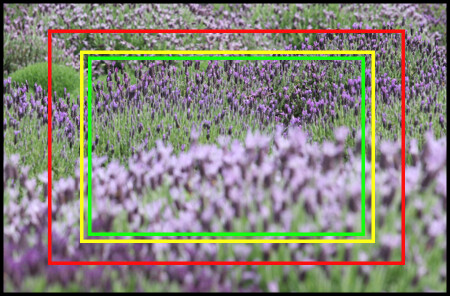
This shows the effect of a crop sensor - its what you would see with the different crop sensors with the same lens on each format - the full picture would be a full frame sensor - 35mm


crop-factor.jpg

Black - Full Frame
Red - 1.3x Crop Factor
Yellow - 1.5x Crop Factor
Green - 1.6x Crop Factor


I've linked to a image from this explanation.
 
Sorry but a 50mm doesn't give the same effect as an 85mm lens it gives the same field of view as an 85mm lens.

Pedantic much.

In the context of the post in which it was used "effect" could easily be interpreted as referring to field of view. When the generic is used rather than the specific it is necessary to read for meaning.

You are the epitome of your user-name. :p ;)
 
Well, if we're being picky, 50mm on a Nikon 1.5x crop is the same field of view as 75mm on full frame, or 80mm in the case of Canon's 1.6x crop factor.

And depth of field changes when you change between formats. You get more depth of field with a crop camera, to the tune of 1.28 stops in the case of Canon. That is, if you shoot with a 50mm lens on a crop camera to get the same field of view as you would with a full frame camera with an 80mm lens, at the same focus distance, you get the same depth of field at, for example, f/4 on the crop as you get at f/6.4 on full frame.

It seems that not everybody knows that, but it's a crucial difference. Check it out here: http://www.dofmaster.com/dofjs.html
 
Pedantic much.

In the context of the post in which it was used "effect" could easily be interpreted as referring to field of view. When the generic is used rather than the specific it is necessary to read for meaning.

You are the epitome of your user-name. :p ;)

Well done, replying to a possibly pedantic post with a very pedantic and mildly insulting post.

Oh, and Rick is 100% correct is stating that it should be referred to field of view only and the 'effect' also includes depth of field.
 
JC dont confuse the crop factor of the camer with cropping the picture to print. Completely different thing. What you see in your viewfinder is (almost) the same as the picture will be. If anything you will see more in the picture when you look at it.

I'm not sure *** your printing problem is but it does sound like you are not sizing your image to match the paper you're going to print it on.
 
Well done, replying to a possibly pedantic post with a very pedantic and mildly insulting post.

Oh, and Rick is 100% correct is stating that it should be referred to field of view only and the 'effect' also includes depth of field.

Cheers RichardtheSane, was in a rush to the zoo this morning and forgot to say why it should be reffered to as that
 
Well, if we're being picky, 50mm on a Nikon 1.5x crop is the same field of view as 75mm on full frame, or 80mm in the case of Canon's 1.6x crop factor.

And depth of field changes when you change between formats. You get more depth of field with a crop camera, to the tune of 1.28 stops in the case of Canon. That is, if you shoot with a 50mm lens on a crop camera to get the same field of view as you would with a full frame camera with an 80mm lens, at the same focus distance, you get the same depth of field at, for example, f/4 on the crop as you get at f/6.4 on full frame.

It seems that not everybody knows that, but it's a crucial difference. Check it out here: http://www.dofmaster.com/dofjs.html

I knew about the crop factor but the DoF differences are new info for me - that's really useful, thank you!
 
at the same focus distance, you get the same depth of field at, for example, f/4 on the crop as you get at f/6.4 on full frame.

It seems that not everybody knows that, but it's a crucial difference. Check it out here: http://www.dofmaster.com/dofjs.html

Hoppy, would you mind explaining the different DoF between the sensor sizes? I've been on the dofmaster site but I can't quite get my head around what the equivalences are.
 
Hoppy, would you mind explaining the different DoF between the sensor sizes? I've been on the dofmaster site but I can't quite get my head around what the equivalences are.

No problem mate.

For Nikon and Canon, and for others with 1.5x or 1.6x crop factor, there's bu99er all difference - about 1.25 stops extra depth of field compared to full frame.

The only other one is the 4/3rds system of Olympus and others, which has an even smaller sensor with a 2x crop factor. These cameras give 2 stops more depth of field compared to full frame.

But bear in mind that depth of field range is not a guarantee of absolute sharpness, it is only a guide and a rough one at that. Photos don't go from sharp to blurred just like that, it's a gradual process. There are international standard which decide, somewhat arbitarily, when an image is deemed to be sharp and when it isn't, based on a set of assumptions around an average print size, viewed from an average distance etc. Individuals might well have different standards. Personally, if at all possible I add an extra stop to recommended figures to make sure I get decent sharpness where I need it.

Edit: I forgot the 1.3x crop factor of the Canon 1DMk3 and its predecessors. That gives 3/4 of a stop more depth of field than full frame.
 
No problem mate.

For Nikon and Canon, and for others with 1.5x or 1.6x crop factor, there's bu99er all difference - about 1.25 stops extra depth of field compared to full frame.

So a 50mm f/4 on a crop will be like an 80mm f/5.25 (if you could get that) on a full frame?

Or in relation to my new 70-200mm f/4 L - that would behave like an f/2.8 on my crop body?
 
Unfortunately f-stops are not linear or that simple.

To increase 1 whole stop you need to increase the f-number by a multiple of 1.4 (or the square root of two to be totally accurate) so 1->1.4->2->2.8->4->5.6->8->11->16 etc.

To confuse things cameras can increase the aperture in 1/2 or 1/3 stops depending on your camera make/model/setting

http://en.wikipedia.org/wiki/F-number#Typical_one-half-stop_f-number_scale
 
I was trying to explain it simply, and refered to the nearest common lens (and I did say roughly), maybe I shouldn't bother replying next time.
Wayne
 
You've almost got it (I think!). And Rick's reply about the slightly obscure relationship between f/numbers is helpful. Once you've got that sorted, it's easy to see how the halving/doubling of aperture/shutter speed/ISO gives you all sorts of different ways of delivering the correct exposure, but I digress.

So a 50mm f/4 on a crop will be like an 80mm f/5.25 (if you could get that) on a full frame?

No, not quite, but I think you're on the right lines.

50mm f/4 on a 1.6x crop (Canon) will give the same field of view as 80mm (1.6x) on a full frame. And if you close that 80mm lens down to f/6.4 you will also get the same depth of field (4 x 1.6 = 6.4).

Or in relation to my new 70-200mm f/4 L - that would behave like an f/2.8 on my crop body?

No, or maybe I'm not clear on what your saying. Depth of field at f/4 on full frame is like f/2.5 on a 1.6x crop camera if the shot is framed identically (4 / 1.6 = 2.5).

To put it more simply, if you shoot the same subject with the same framing on a crop camera (1.5x or 1.6x), compared to full frame you will get just over a stop more depth of field at the same f/number.

This is a freeby that you get with crop cameras. I tend to want more depth of field most of the time, so it's a bonus for me. If you shoot macro for example, where depth of field is usually a headache, then crop format has a big upside. However, if you want very shallow depth of field then a full frame camera has the edge in this respect.
 
Think I've got it now, thanks - I knew your were saying that you got more DoF on a crop but every time a read through the examples I seemed to come away with the idea that the crop was giving less DoF.

Wishful thinking on my part I think - I prefer less DoF for portraits and have just bought an f/4 L zoom for my crop body... would be great if it give an even shallower DoF than I was expecting but I guess this is another reason to go full-frame. Maybe I'll keep the crop for macro and tele-photo work but use the FF for portraits etc.
 
LOL yes it gets confusing.

If you want shallow DoF particularly for portraits, and I can well understand that, then I would think about the 85mm f/1.8. It's a snip at £300.

Even on a crop, that lens does not have much depth of field wide open. Lovely little lens - not like poking that great big white L in people's faces ;)
 
LOL yes it gets confusing.

If you want shallow DoF particularly for portraits, and I can well understand that, then I would think about the 85mm f/1.8. It's a snip at £300.

Even on a crop, that lens does not have much depth of field wide open. Lovely little lens - not like poking that great big white L in people's faces ;)


I've been using my 50mm f1.8 to get shallow shots - an 85mm is on the long-term shopping list.

Just going to have to step back and zoom in on the new L.
 
I've been using my 50mm f1.8 to get shallow shots - an 85mm is on the long-term shopping list.

Just going to have to step back and zoom in on the new L.

Sunds like you've got it covered :)

While we're on depth of field, are you aware that you do not gain any depth of field just by using a longer focal length? Your last sentence kind of implies differently.

Provided the image size remains the same, depth of field remains the same. You get a narrower angle of view, and less background, by stepping back and zooming in, but the depth of field is the same as if you'd used a shorter focal length and moved closer.
 
Sunds like you've got it covered :)

While we're on depth of field, are you aware that you do not gain any depth of field just by using a longer focal length? Your last sentence kind of implies differently.

Provided the image size remains the same, depth of field remains the same. You get a narrower angle of view, and less background, by stepping back and zooming in, but the depth of field is the same as if you'd used a shorter focal length and moved closer.

All I meant was that the wide end of the zoom will be nicer for portraits and replicate the length of an 85mm. Thanks for the reminder though.
 
Back
Top