Creating a blurred Background

Gary Coyle said:
Really doesnt matter what the subject is, Macro modes does something magic that other modes wether manual or not wont

Maybe it's because in "macro" mode you are so close to the subject that the DoF is always going to be reduced ? Unless of course it does some sort of trickery with focal length (or sensor size).

Steve

Sent from my iPad using TP Forums
 
Hoohaa, you're just making it into a chicken and egg argument - which came first, the sensor or the lens.

But if you've got to choose, it makes sense to say that the size of the sensor is the primary defining factor because that's the way cameras work. You start with a sensor of a certain fixed size, and adjust the focal length of the lens accordingly. You don't start with a fixed focal length lens and then fit different cameras to it with different size sensors to get the required framing.

So, if you want a shorthand for that which most people can readily make sense of, then saying that the size of the sensor affects DoF is right. But it is incomplete - it is the sensor and the lens (given that framing, viewpoint and f/number are the same).
 
At a given focal length, given aperture and subject distance, you will not get the same depth of field on different sized sensors.

Yes you will.

Lets take an Nikon 85mm F/1.4G and use it on a D90 and a D700. At a subject distance of 10ft, focal length of 85mm and an aperture of F/1.4, the image projected by the lens towards the sensor is determined by the lens, all that the smaller sensor does is capture a smaller amount of the projected image - the depth of field remains consistent between sensor sizes.

Now if you were to keep the composition of the image obtained constant, with the bigger sensor you'd have to get closer to the subject, decreasing the depth of field.


Same subject distance, same focal length, same aperture, but different sensor sizes:
dof_FFvcrop.jpg
 
Last edited:
Maybe it's because in "macro" mode you are so close to the subject that the DoF is always going to be reduced ? Unless of course it does some sort of trickery with focal length (or sensor size).

Steve

Sent from my iPad using TP Forums
It must do something because i use Macro mode on my Olympus P&S for portraits/candids even when the subject is 20-30 feet away and it defocuses the background beautifully, much better than using AV and using the fastest aperture or even the portrait mode or even shooting it in manual, this also works on my Fuji bridge camera and a sony cybershot ive owned.

Try it.
 
redddraggon said:
Yes you will.

[snip]

Same subject distance, same focal length, same aperture, but different sensor sizes:

But to do this you will have changed the distance to the subject :shrug:

Steve

Sent from my iPad using TP Forums
 
Yes you will.

Lets take an Nikon 85mm F/1.4G and use it on a D90 and a D700. At a subject distance of 10ft, focal length of 85mm and an aperture of F/1.4, the image projected by the lens towards the sensor is determined by the lens, all that the smaller sensor does is capture a smaller amount of the projected image - the depth of field remains consistent between sensor sizes.

Now if you were to keep the composition of the image obtained constant, with the bigger sensor you'd have to get closer to the subject, decreasing the depth of field.


Same subject distance, same focal length, same aperture, but different sensor sizes:

<snip>

It's just not helpful or relevant. You don't end up with the same picture.

The only valid and useful comparison is to start with a picture that is framed the same, from the same position. That's what we're talking about, that's the OP's situation, and that's what folks understand when you say 'the same picture'. Those are the rules of the game and you can't start shifting the shooting distance around because that changes perspective.

So with 'same framing, same position' as the starting point and the camera of choice in your hand, the camera with the smaller sensor (and therefore the shorter lens) will deliver more depth of field.

You cannot describe depth of field in isolation, and without both a camera and a lens, you don't have an image at all.

Edit: put it like this, if you want to make the closest possible comparison between two cameras, say a cropped sensor Canon 7D and a full frame 5D2, with an image that has identical framing, identical perspective and indentical depth of field, then if the 7D is set at f/4, the 5D2 must be at f/6.4 (f/number x crop factor). Check it out here www.dofmaster.com
 
Last edited:
My aim when I first pointed out that sensor size has no bearing on DOF was only to avoid confusion for the OP. I know it may appear to have an affect (because we change lenses to compensate) but it is a clumsy way of looking at it which leads to a lack of real understanding, especially when someone is just learning.

Lots of people (and I'm not particularly referring to anyone here) don't really seem to know that a crop sensor is just that, a cropped sensor. They seem to think it has some magical multiplying power or something. Life is much easier when you realise is it just a smaller sensor. And as such it can have no bearing on depth of field directly.

To understand depth of field you need to know that there is only a plane of focus and that everything else in front of and behind that plane is actually out of focus. When a point is in front or behind this focal plane it will appear on the sensor as a circle rather than a point. The further from the focal plane the point is the bigger the diameter of the circle on the sensor. The circle of confusion is just the size that this circle can be before you can distinguish it as a circle and not as a point. That's why we need the term to define DoF. How far from the focal plane can you go before we can see a point is not in sharp focus. There are obviously lots of things that can affect this. Sensor size is one of them and sensor resolution in another but so are print size, print quality, viewing distance, how good your eyesight is, if you're wearing glasses etc etc. In that sense, yes, sensor size does affect DoF. But it doesn't affect the circle of confusion, this is just down to the lens.

This is a good link and it does indeed explain a lot. It actually goes further than I did really:
"aperture and focal distance are the two main factors that determine how big the circle of confusion will be on your camera's sensor. Larger apertures (smaller F-stop number) and closer focusing distances produce a shallower depth of field. Note that I did not mention focal length as influencing depth of field."​

How many people would have thought that focal length had little effect?
 
My aim when I first pointed out that sensor size has no bearing on DOF was only to avoid confusion for the OP. I know it may appear to have an affect (because we change lenses to compensate) but it is a clumsy way of looking at it which leads to a lack of real understanding, especially when someone is just learning.

Lots of people (and I'm not particularly referring to anyone here) don't really seem to know that a crop sensor is just that, a cropped sensor. They seem to think it has some magical multiplying power or something. Life is much easier when you realise is it just a smaller sensor. And as such it can have no bearing on depth of field directly.

To understand depth of field you need to know that there is only a plane of focus and that everything else in front of and behind that plane is actually out of focus. When a point is in front or behind this focal plane it will appear on the sensor as a circle rather than a point. The further from the focal plane the point is the bigger the diameter of the circle on the sensor. The circle of confusion is just the size that this circle can be before you can distinguish it as a circle and not as a point. That's why we need the term to define DoF. How far from the focal plane can you go before we can see a point is not in sharp focus. There are obviously lots of things that can affect this. Sensor size is one of them and sensor resolution in another but so are print size, print quality, viewing distance, how good your eyesight is, if you're wearing glasses etc etc. In that sense, yes, sensor size does affect DoF. But it doesn't affect the circle of confusion, this is just down to the lens.

Yes it does. It's central to the DoF formula. If you input data to the on-line calculator www.dofmaster.com when you input the camera type it changes the circle of confusion according to sensor size.

This is a good link and it does indeed explain a lot. It actually goes further than I did really:
"aperture and focal distance are the two main factors that determine how big the circle of confusion will be on your camera's sensor. Larger apertures (smaller F-stop number) and closer focusing distances produce a shallower depth of field. Note that I did not mention focal length as influencing depth of field."​

How many people would have thought that focal length had little effect?

:thinking: That's a crazy statement to make, and completely meaningless in isolation.

You said above "My aim when I first pointed out that sensor size has no bearing on DOF was only to avoid confusion for the OP." Well, that's wrong. I'm confused now, you just keep making wrong statements.
 
You said above "My aim when I first pointed out that sensor size has no bearing on DOF was only to avoid confusion for the OP." Well, that's wrong. I'm confused now, you just keep making wrong statements.

Wow, that's clever. I really wouldn't have thought you could be quite so certain about my motives.

Oh, and I'm sorry about my wrong statements. I know you were king enough to point them out but while you kept letting me try to explain DoF and CoC etc you didn't really offer much in the way of a theory, explanation or rationale in return. I might be a bit odd, but I usually find a bit of science or theory rather more persuasive than a blanket assertion. Someone less charitable than I might even wonder if someone who doesn't offer an proper explanation really knows what they are talking about.
:wave:
 
Wow, that's clever. I really wouldn't have thought you could be quite so certain about my motives.

Oh, and I'm sorry about my wrong statements. I know you were king enough to point them out but while you kept letting me try to explain DoF and CoC etc you didn't really offer much in the way of a theory, explanation or rationale in return. I might be a bit odd, but I usually find a bit of science or theory rather more persuasive than a blanket assertion. Someone less charitable than I might even wonder if someone who doesn't offer an proper explanation really knows what they are talking about.
:wave:

I haven't questioned your motives at all. I've simply pointed out your incorrect statements. And that being the case, you can hardly have succeeded in helping the OP.

I have also explained, quite specifically, what the defining parameters of DoF are, given the OP an equivalence in terms of a DSLR, and also explained how to calculate the relative DoF change between formats. There's a link for you to check everything for yourself, and if you want science, there's more of that on there than you can shake a stick at.

On the other hand, not only have you repeatedly got things wrong, you have been rude when corrected.
 
Hoohaa, will you accept that, to achieve a blurred background, up all of the following will have an influence ?

Aperture
Focal length
Subject distance
Background distance
Sensor size (film size)

Steve

Sent from my iPad using TP Forums
 
hi, if your just starting out on photography[or not] take the photo
and edit in picasa[downloaded free].Its a good start again pretty basic
but it works.
 
It's just not helpful or relevant. You don't end up with the same picture.

The only valid and useful comparison is to start with a picture that is framed the same, from the same position. That's what we're talking about, that's the OP's situation, and that's what folks understand when you say 'the same picture'. Those are the rules of the game and you can't start shifting the shooting distance around because that changes perspective.

So with 'same framing, same position' as the starting point and the camera of choice in your hand, the camera with the smaller sensor (and therefore the shorter lens) will deliver more depth of field.

You cannot describe depth of field in isolation, and without both a camera and a lens, you don't have an image at all.

Edit: put it like this, if you want to make the closest possible comparison between two cameras, say a cropped sensor Canon 7D and a full frame 5D2, with an image that has identical framing, identical perspective and indentical depth of field, then if the 7D is set at f/4, the 5D2 must be at f/6.4 (f/number x crop factor). Check it out here www.dofmaster.com

To be honest, reddragons's description is the best, and is accurate. The sensor cannot affect the light arriving on it, simply record it. But as he said, to achieve the same composition from the same distance the focal length must change, hence why senor size has a real world effect.
 
To be honest, reddragons's description is the best, and is accurate. The sensor cannot affect the light arriving on it, simply record it. But as he said, to achieve the same composition from the same distance the focal length must change, hence why senor size has a real world effect.

Well no. It's wrong on two counts.

Most obviously, it doesn't take framing into account so it's an invalid comparison. They are completely different pictures.

Secondly - and this gets confusing! - if you actually do Jelster's comparion that is quoted there ("at a given focal length, given aperture and subject distance") and do not take the format into account in the calculation, the full frame camera actually delivers more DoF. It reverses the real world comparison.

In other words, the sensor size and the subsequent degree of magnification changes everything. Depth of field calcuations are all based on viewing a standard sized print from a standard distance so the net effect doesn't end with the camera, but the final print. That's what the circle of confusion does.
 
Last edited:
Well no. It's wrong on two counts.

Most obviously, it doesn't take framing into account so it's an invalid comparison. They are completely different pictures.

Secondly - and this gets confusing! - if you actually do Jelster's comparion that is quoted there ("at a given focal length, given aperture and subject distance") and do not take the format into account in the calculation, the full frame camera actually delivers more DoF. It reverses the real world comparison.

In other words, the sensor size and the subsequent degree of magnification changes everything. Depth of field calcuations are all based on viewing a standard sized print from a standard distance so the net effect doesn't end with the camera, but the final print. That's what the circle of confusion does.

I think you missed my point. never mind.:wave:
 
Secondly - and this gets confusing! - if you actually do Jelster's comparion that is quoted there ("at a given focal length, given aperture and subject distance") and do not take the format into account in the calculation, the full frame camera actually delivers more DoF. It reverses the real world comparison.

No, no, no. Keeping the focal length, aperture, and subject distance constant the DoF also remains constant between different sensor sizes.
 
redddraggon is correct. DoF is a function only of magnification. If distance is the same, the same lens is used, and the same aperture is used, ie only the sensor size is changed, the circle of confusion is unaltered and so the DoF is exactly the same. IF however, you compose the same field of view, with the same aperture on the same lens, on two different sensor sizes, the DoF will then be altered as the image size has changed and as such, the magnification has changed. There are no two ways about it. If ONLY the sensor size is changed and nothing else, including distance to subject, the DoF remains unchanged.
 
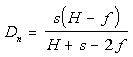
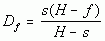
Hyperfocal distance, near distance of acceptable sharpness, and far distance of acceptable sharpness are calculated using the following equations (from Greenleaf, Allen R., Photographic Optics, The MacMillan Company, New York, 1950, pp. 25-27):


Hyperfocal distance:

hyperfocal.gif


Near distance of acceptable sharpness:

neardistance.gif


Far distance of acceptable sharpness:

fardistance.gif


where:

H = is the hyperfocal distance, mm

f = is the lens focal length, mm

s = is the focus distance

Dn = is the near distance for acceptable sharpness

Df = is the far distance for acceptable sharpness

N = is the f-number

c = is the circle of confusion, mm


f-number is calculated by the definition N = 2i/2 , where i = 1, 2, 3,... for f/1.4, f/2, f/2.8,...

Calculations using these equations must use consistent units. When focal length and circle of confusion have units of millimeters, the calculated hyperfocal distance will have units of millimeters. To convert to feet, divide H by 304.8. To convert to meters, divide H by 1000.


No sensor size mention in those equations.........
 
Last edited:
redddraggon said:
No, no, no. Keeping the focal length, aperture, and subject distance constant the DoF also remains constant between different sensor sizes.

Pick up a 7D and a 5D2, place a 50mm lens on both, with the cameras side by side focus on a subject 3 metres away at f1.8 and the depth of field will be different on both images.

I admit it is probably down to field of view, but you can't change that factor without changing the focal length of the lens or moving one of the cameras, both of which have to be a constant in the test. Try it and see....

Steve.

Sent from my iPad using TP Forums
 
Blimey guys, will you please input some data into DoFmaster before stating these things.

redddraggon is correct.

No, he is not.

DoF is a function only of magnification.

I think you should include f/number in that, and then we'll agree. But magnification includes a number of different contributors, ie focal length, distance, and sensor size.

If distance is the same, the same lens is used, and the same aperture is used, ie only the sensor size is changed, the circle of confusion is unaltered and so the DoF is exactly the same.

No, if you change the sensor size, the circle of confusion is changed. That's what it does. Refer to magnification.

IF however, you compose the same field of view, with the same aperture on the same lens, on two different sensor sizes, the DoF will then be altered as the image size has changed and as such, the magnification has changed.

It's a meaningless comparison because the two pictures are not the same. You've changed both the distance to maintain framing and have therefore altered the perspective, and then you've also changed the sensor size! There is no equivalence. What are you comparing?

There are no two ways about it. If ONLY the sensor size is changed and nothing else, including distance to subject, the DoF remains unchanged.

No. Please do the calculation. The sensor size changes the magnification!

No sensor size mention in those equations.........

Yes it is. It's defined by the circle of confusion, which changes with sensor size.
 
The sensor size changes the magnification!

Does cropping an image change magnification of the image projected out the back of a lens?
 
Last edited:
I haven't read all the posts on this one its always a heated discussion lol. But here's my 2 cents.

In practical terms the first problem is sensor size, smaller the sensor harder it is to achieve shallow dof for given focal length. Get close to your subject with whatever length your using and widest aperture possible, you want the greatest distance possible between subject and background, and longer focal lengths increase the effect for given distance from subject.
 
Does cropping an image change magnification of the image projected out the back of a lens?

No, that is applied to the subsequent magnification of the final output image for viewing.

All depth of field calculations are based on international standards of a same size print held at a normal viewing distance, which is defined as the length of the diagonal. So an A4 print for example, viewed at 14-15ins. Unless you want to rewite ISO.

That being set, there are four parameters which define DoF and they all have an effect. Focal length, distance, f/number and sensor size. You can't leave any of them out.

Edit: by the same token, DoF calculations assume that the whole of the frame is used for output. If a smaller section is taken and further enlarged out of the whole image, then the DoF calcualtion needs to be reworked.
 
Last edited:
Edit: by the same token, DoF calculations assume that the whole of the frame is used for output. If a smaller section is taken and further enlarged out of the whole image, then the DoF calcualtion needs to be reworked.

Thats the critical bit. They are two different formats, one being cropped and so will produce a different image providing all other things being equal.


Anyway, this is going round in circles lol. You're not a biologist are you?
 

James, I have what you originally posted above by instant email notification, before you quickly edited it to a full stop, as most others probably have too. All I've done is put you straight, as politely as I know how.

There is no need to be rude, especially when you are mistaken.
 
No, if you change the sensor size, the circle of confusion is changed. That's what it does. Refer to magnification.

Can you please explain why the sensor size changes the CoC? It is my understanding that the CoC produced by the lens and the acceptable CoC required at the sensor for 'proper' viewing are not necessarily related.
 
Can you please explain why the sensor size changes the CoC? It is my understanding that the CoC produced by the lens and the acceptable CoC required at the sensor for 'proper' viewing are not necessarily related.

It is changed by the subsequent magnification required to produce a same size print.

If you input the data into http://www.dofmaster.com/dofjs.html when you change the camera model it adjusts the required CoC according to its format. It appears in the bottom right corner, eg with crop format Canon 7D it is 0.019mm and full frame is 0.03mm (0.019 x 1.6 = 0.03).
 
So does that imply that if the sensor size remains constant, but the pixel density of the sensor changes, the CoC remains unchanged?

Yes. CoC remains constant, and indeed the whole concept of DoF, in principle, is independent of camera or lens. It is simply defined as the smallest detail that can be resolved by the human eye, when a standard print is viewed from a normal distance (as described above). In that sense, you could have a defined CoC in a painting (kind of ;)).

The formula takes the dimension of that smallest detail in the finished print and works it back to the sensor through the required degree of magnification, and then calculates the f/number needed to deliver it. So pixel density isn't invloved.

There is a similar-ish theory (and it's only a theory and not a DoF theory at that) that pixel density impacts the point at which diffraction begins to erode ultimate sharpness - basically when pixel size and the minimium CoC begin to coincide - but that one doesn't really stack up to anything meaningful in practise. It may have something to do with the unknown impact of the anti-aliasing filter, but I've never seen any evidence of it yet, and I've looked pretty hard. There have been some threads on it. Tim Dodd put up a series of test pictures, but so far the jury is out.
 
Yes. CoC remains constant, and indeed the whole concept of DoF, in principle, is independent of camera or lens.

The formula takes the dimension of that smallest detail in the finished print and works it back to the sensor through the required degree of magnification, and then calculates the f/number needed to deliver it. So pixel density isn't invloved.

Ok, that said, I totally fail to see how the CoC has anything to do with the DoF? We've already ascertained that the magnification is only dependent on the image size (produced on the sensor) with respect to the sensor size, and yet, the minimum detail on the print will most certainly involve both the resolving capability of the lens and the resolution of the sensor.

Further, the minimum CoC produced by the lens depends on the quality of the lens, as well as the aperture used. How does the sensor size alone, as you said resolution has nothing to do with it, define what the CoC is? after all, I highly doubt a 1MP sensor will resolve as much detail as say a 12MP sensor for the same dimensions and lens used.

In short, it seems the CoC is being defined as a property of the sensor size only. I simply do not see how this can be correct, when it is the lens which produces the image in the first place.

Take this example. If you have a FF sensor, and use it in crop mode, and then get a DX sensor with the same pixel density and sensor size as the DX mode cropped area (and have it such that the image projected into each of respective area is the same size), are you saying that, just because the sensor is bigger for the FF camera, the DoF is altered? If so, how can this be the case? If this is not the case, then how is resolution of the sensor irrelevant in the CoC calculation?

EDIT: Lastly, exactly how much of an effect does this have on the image, in 'real' terms? IE, does it affect the DoF to the extent that it is actually noticeable? Only in the comparisons I have made in the past, I've noticed zero difference in the DoF for when using the same lens, at the same aperture, at the same distance.
 
Last edited:
Ok, that said, I totally fail to see how the CoC has anything to do with the DoF? We've already ascertained that the magnification is only dependent on the image size (produced on the sensor) with respect to the sensor size, and yet, the minimum detail on the print will most certainly involve both the resolving capability of the lens and the resolution of the sensor.

Further, the minimum CoC produced by the lens depends on the quality of the lens, as well as the aperture used. How does the sensor size alone, as you said resolution has nothing to do with it, define what the CoC is? after all, I highly doubt a 1MP sensor will resolve as much detail as say a 12MP sensor for the same dimensions and lens used.

In short, it seems the CoC is being defined as a property of the sensor size only. I simply do not see how this can be correct, when it is the lens which produces the image in the first place.

Take this example. If you have a FF sensor, and use it in crop mode, and then get a DX sensor with the same pixel density and sensor size as the DX mode cropped area (and have it such that the image projected into each of respective area is the same size), are you saying that, just because the sensor is bigger for the FF camera, the DoF is altered? If so, how can this be the case? If this is not the case, then how is resolution of the sensor irrelevant in the CoC calculation?

EDIT: Lastly, exactly how much of an effect does this have on the image, in 'real' terms? IE, does it affect the DoF to the extent that it is actually noticeable? Only in the comparisons I have made in the past, I've noticed zero difference in the DoF for when using the same lens, at the same aperture, at the same distance.

I'm not sure where you are coming from here.

DoF calcs are independent of both lens quality and sensor resolution. The principle simply states that in order to see a certain level of detail 'x' in a standard print at a standard distance etc, then the system must be able to deliver a CoC of size 'y' at the sensor. That way, when it is enlarged by the appropraite degree of magnifcation (variable according to sensor size) you end up back at detail level 'x'. If the system is not capable of matching or exceeding that level of detail, then all is lost - but in practise they all do, usually quite comfortably.

How much of an effect does this have? Well, the difference between full frame and crop format is about one and a quarter stops (Nikon a bit less, Canon fractionally more). The calc is f/number x crop factor, and so a 1.4x crop factor would be exactly one stop. That is, if the subject is framed the same (by adjusting the focal length by the crop factor), from the same distance, and the same depth of field is maintained. You then have two identical images, and if one was shot at f/4 on a Canon cropper, then the one made on full frame would be at f/6.4.
 
DoF calcs are independent of both lens quality and sensor resolution.

That's because DOF calculations are an approximation*. Go back to first principles and think about what's going on rather than what info an online DOF table asks for.

The lens, particularly the aperture and focal distance, affect the blur circle. This is, as far as I can tell, the size the circle of light from a point source that is not on the focal plane makes on the film plane. This is in no way affected by the sensor. It doesn't even require there to be a sensor.

The CoC is a calculated maximum size for this blur circle beyond which the point will appear to be blurred. Whether it appears to be blurred depends hugely on how closely you can look at it. Which means that sensor resolution, eyesight quality, print size, viewing distance etc all come into play.

Given that, it is possible to argue, although misleading, that sensor size affects DoF. It's the same as saying my eyesight affects DoF. True, but unhelpful.

I accept that if you're trying to produce exactly the same image content then a smaller sensor will require a wider lens and DoF may change. However the original point was to clarify a very simple concept to the OP who was asking for advice with regard to DOF, namely that cropped sensors are just that; large sensors with a bit cropped off them. All the stuff about crop factors is just confusing until you understand that simple fact. If I hadn't understood this and was told that sensor size affected DoF I think I'd have found it confusing.

Edit: *Changed from 'abbreviation'.
 
Last edited:
hoohaaa said:
That's because DOF calculations are an approximation*. Go back to first principles and think about what's going on rather than what info an online DOF table asks for.

The lens, particularly the aperture and focal distance, affect the blur circle. This is, as far as I can tell, the size the circle of light from a point source that is not on the focal plane makes on the film plane. This is in no way affected by the sensor. It doesn't even require there to be a sensor.

The CoC is a calculated maximum size for this blur circle beyond which the point will appear to be blurred. Whether it appears to be blurred depends hugely on how closely you can look at it. Which means that sensor resolution, eyesight quality, print size, viewing distance etc all come into play.

Given that, it is possible to argue, although misleading, that sensor size affects DoF. It's the same as saying my eyesight affects DoF. True, but unhelpful.

I accept that if you're trying to produce exactly the same image content then a smaller sensor will require a wider lens and DoF may change. However the original point was to clarify a very simple concept to the OP who was asking for advice with regard to DOF, namely that cropped sensors are just that; large sensors with a bit cropped off them. All the stuff about crop factors is just confusing until you understand that simple fact. If I hadn't understood this and was told that sensor size affected DoF I think I'd have found it confusing.

Edit: *Changed from 'abbreviation'.

I don't think that saying using a larger sensor make it easier (in practical) terms to get a blurred background. It's one of the advantages of using a camera with a bigger sensor, its easier to achieve that effect to get subject separation the background.
 
That's because DOF calculations are an approximation*. Go back to first principles and think about what's going on rather than what info an online DOF table asks for.

The lens, particularly the aperture and focal distance, affect the blur circle. This is, as far as I can tell, the size the circle of light from a point source that is not on the focal plane makes on the film plane. This is in no way affected by the sensor. It doesn't even require there to be a sensor.

The CoC is a calculated maximum size for this blur circle beyond which the point will appear to be blurred. Whether it appears to be blurred depends hugely on how closely you can look at it. Which means that sensor resolution, eyesight quality, print size, viewing distance etc all come into play.

Given that, it is possible to argue, although misleading, that sensor size affects DoF. It's the same as saying my eyesight affects DoF. True, but unhelpful.

I accept that if you're trying to produce exactly the same image content then a smaller sensor will require a wider lens and DoF may change. However the original point was to clarify a very simple concept to the OP who was asking for advice with regard to DOF, namely that cropped sensors are just that; large sensors with a bit cropped off them. All the stuff about crop factors is just confusing until you understand that simple fact. If I hadn't understood this and was told that sensor size affected DoF I think I'd have found it confusing.

Edit: *Changed from 'abbreviation'.

I don't agree that DoF calculations are an approximation; more the reverse, they are rather too exact! An 'abbreviation' is perhaps a better term. When you go into those DoF tables, you get numbers down to very small fractions of distance, whereas in reality, if you can distinguish DoF in an image to within less than half a stop accuracy, you're doing pretty well.

Your third paragraph is both true and false. It's false because the DoF parameters for print size and viewing distance and visual acuity are very clearly laid down, as they must be in order to establish a level playing field to make like for like comparisons. The reality is often different, particularly when you get a very large print that you then look at it more closely, or as is very common now, blow up an image on screen and start pixel peeping. That just knocks the whole theory to bits, but it doesn't mean that if you stick to the rules they are either invalid or unhelpful or inaccurate. They are laid down by international standards, everyone agrees with them and everyone uses them, whether they are set from an on-line calculator or from the engraving on the lens (the latter BTW always refers to full frame, so are about a stop out if you try to use them on a crop format camera).

Ulimately, there are just two parameters that affect DoF - f/number and magnification. F/number is easy enough, but magnification includes a lot of things - focal length, distance and sensor size. In addition, the international standards set down for DoF are also aspects of magnification, in terms of print size, viewing distance and visual acuity (but they are usually beyond argument!). The point is, that they all have an impact, and you cannot make an accurate calculation of DoF without defining every one of them.

Having said that, I think it is is acceptable to reduce all that down and as a shorthand say that the size of the sensor is the key difference between cameras - in practise. That is the generally held view, and while you can't really argue with it, it does assume that the other factors are undstood as a given so strictly speaking if you want to be pedantic it does need the qualification tagged on to be bullet proof.

It is based on the reality of how we work, and some fairly obvious assumptions 'as given'. That is, if you have a large sensor camera and a small sensor camera, and are shooting the same subject from the same place (same perspective), framed in exactly the same way, then at the same f/number the smaller format camera will deliver greater depth of field. If you want the same DoF, then the f/number must be adjusted by the crop factor difference.

That's just how the physics works out. Sure, you have to adjust the focal length to get that same framing, but we know that - that's what the crop factor is for. If you have a full frame camera, a walkabout zoom will be around 28-100mm, on a cropper it's commonly 18-55mm, on 4/3rds it's 14-45mm, and on a compact maybe 5-20mm depending on the exact sensor dimensions. There is a common theme there, and that is the lens focal length is already adjusted to suit the size of the sensor so I would say that's 'a given'.

And going back to the OP, if he wants to get those blurry backgrounds, the one thing he must do is swap that tiny sensor compact for something a bit bigger.
 
And going back to the OP, if he wants to get those blurry backgrounds, the one thing he must do is swap that tiny sensor compact for something a bit bigger.

At the end of the day, that's the answer for the OP.

I just wish I had a FF body as well as my 7D, and then I'd quite happily do the test I suggested to show the results.

Steve
 
Back
Top