

Correct me if I'm wrong!

twhite87

Suspended / Banned
Messages
1,829
Name
Tim
Edit My Images
Yes
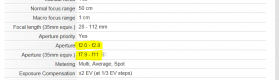
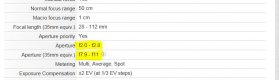
The image below was taken from a website stating the specifications for a Fuji X20. I have highlighted the bits that I'm a tad confused on. I know the focal length has a 35mm equivalent based on the crop factor of the sensor, but I would have thought the aperture numbers would stay the same? For example, the crop factor of this sized sensor is approx. 3.93. So for a 10mm focal length at f2.8, the 35mm equivalent would be 39.3mm at f2.8. Someone correct me if this is wrong.
upload_2015-8-26_13-5-4.png
 

Attachments

  • Capture.JPG
    Capture.JPG
    35.6 KB · Views: 24
I've never heard of aperture ranges changing between crop and FF. This looks wrong to me. What does the little info button say?
 
The aperture value changes.
 
It is possible that the 'extension' of the lens when in its telephoto position works a b bit like an extension tube. (50mm extension on a 50mm lens will introduce a loss of 2 stops). But with the X20 I reckon (even if that's the case) would only be around 1/2~3/4 of a stop.

As the f/number is generally an expression of the ratio of focal_length/aperture then it should remain relatively constant - certainly not the numbers you're talking
 
The aperture value changes.

How so? I can understand focal length causing change, but quoting FF versus Crop equivalents?

The only thing can think of Depth of Field equivalents.
 
It is possible that the 'extension' of the lens when in its telephoto position works a b bit like an extension tube. (50mm extension on a 50mm lens will introduce a loss of 2 stops). But with the X20 I reckon (even if that's the case) would only be around 1/2~3/4 of a stop.

As the f/number is generally an expression of the ratio of focal_length/aperture then it should remain relatively constant - certainly not the numbers you're talking
He's asking about 35mm equivalent. By my calculations it works out a f7 to f10 equivalent with a 35mm lens (not 39.3)

I could be wrong :) , but it is close.
 
How so? I can understand focal length causing change, but quoting FF versus Crop equivalents?

The only thing can think of Depth of Field equivalents.
It's a bit pointless, just take pics.
 
He's asking about 35mm equivalent. By my calculations it works out a f7 to f10 equivalent with a 35mm lens (not 39.3)

I could be wrong :) , but it is close.

But a hole is a hole! It's a fixed relationship to the focal length - that's why we have these 'silly' numbers - so we don't have to make arithmetical conversions like this!
 
It's a bit pointless, just take pics.

I agree - but I have an X20 - now I'm worried it's flying in the face of everything I've ever understood about physics and optics! :runaway:
 
Surely the f number just relates to how much light that focal length will let through. Try putting a 50mm prime on at a set f number and then swapping it for a 100mm lens with the same f number. Exposure settings will remain the same.
 
The only time crop factor should be used for aprture is surely when talking about DoF. For exposure it's the same, or I've gone mad.
 
I don't see how the aperture can change. A 100mm lens on a crop body is still a 100mm lens, it just has the same fov as a 160 as the photos basically cropped down.
 
I agree - but I have an X20 - now I'm worried it's flying in the face of everything I've ever understood about physics and optics! :runaway:
It's a bit convoluted, to be sure.
There can be reasons for working it out, but why bother for everyday photography?
You use the camera and lens you have. I don't work out medium format equivalents.
 
I don't see how the aperture can change. A 100mm lens on a crop body is still a 100mm lens, it just has the same fov as a 160 as the photos basically cropped down.
The problem is that the sensor size is different.
 
Because this is telling me that with this camera I'm going to get exposure levels the same as if I was using a 28-110 lens and a widest aperture of f7 which is pretty shocking.
 
Because this is telling me that with this camera I'm going to get exposure levels the same as if I was using a 28-110 lens and a widest aperture of f7 which is pretty shocking.
I'm sure they've just gone a big mad. My advice is to ignore it.
 
Last edited:
Because this is telling me that with this camera I'm going to get exposure levels the same as if I was using a 28-110 lens and a widest aperture of f7 which is pretty shocking.


Just take pics :)
That's what cameras are for. Why worry?
 
I've just looked at a review of the X20 which shows the lens. The focal length range is 7.1mm - 28.4mm and the maximum aperture varies from f/2 to f/2.8. That's the important data. The "equivalent" focal length is of course equivalent only in angle of view (approximately, because the format proprtions aren't the same) and not equivalent in terms of depth of field and any other optical properties.

The aperture is a ratio of diameter and focal length; this property was chosen specifically to enable the derivation of a number that would give the same exposure for any focal length. Assuming that the lenses had equal light transmission...
 
The f No. is a ratio determined by focal length and apparent aperture diameter from the rear of the lens. Sensor size has no bearing on it. It must be equivalent depth of field settings.


Steve.
 
I don't see how the aperture can change. A 100mm lens on a crop body is still a 100mm lens, it just has the same fov as a 160 as the photos basically cropped down.

Just wait till you get to bellows factors for close ups, at that point your FL changes (gets longer) therefore your actual f stop is different from the one marked on the front.
 
I've just looked at a review of the X20 which shows the lens. The focal length range is 7.1mm - 28.4mm and the maximum aperture varies from f/2 to f/2.8. That's the important data. The "equivalent" focal length is of course equivalent only in angle of view (approximately, because the format proprtions aren't the same) and not equivalent in terms of depth of field and any other optical properties.

The aperture is a ratio of diameter and focal length; this property was chosen specifically to enable the derivation of a number that would give the same exposure for any focal length. Assuming that the lenses had equal light transmission...
And that's the right answer.
DOF is an entirely separate subject and is affected by various factors, including magnification and distance, and of course by effective aperture - the physical size of the actual hole - but although the size of the effective aperture affected by focal length/sensor size, the f/number is not.

Maybe some of the people selling cameras should learn something about them first...
 
I'd never thought of it before, but if it's necessary to specify "equivalent focal length" so that people who have never used 35mm can compare their cameras to it, shouldn't it also be necessary to specifiy "equivalent aperture"? It seems fairly obvious to me that people looking through a viewfinder might get some idea of how much of a scene is included (the focal length part) but might find it harder to visualise depth of field :exit:
 
English definition, aperture = "a space through which light passes in an optical or photographic instrument, especially the variable opening by which light enters a camera"
synonyms = opening, hole, gap, space, slit, slot, vent, passage, crevice, chink, crack,fissure, perforation, breach, eye, interstice

Didn't see anything about depth of field

There can be no need to specify equivalent focal length as, the closest you can get is, equivalent angle of view!

so that people who have never used 35mm can compare their cameras to it

How can you compare it to something you don't know?

The world is going to pot in a hand-basket!
 
This is what the little info button shows (Googled the page as the OP didn't reply)...

35 mm equivalent aperture

Equivalent aperture (in 135 film terms) is calculated by multiplying lens aperture with crop factor (a.k.a. focal length multiplier).
Fujifilm X30 equivalent aperture
Crop factor = 3.93
Aperture = f2.0 - f2.8

35-mm equivalent aperture = (f2.0 - f2.8) × 3.93 = f7.9 - f11
 
You can't; but the numbers are more impressive! Angle of view probably takes a lot more understanding, because, well, you have to know what it is. Focal length is a simple number that you don't have to understand. And it might be an interesting exercise to find out how many people who sell cameras could define focal length.
 
Well, there we have it; I'm surprised as I've been playing around with DOFMaster to see if I could make sense of the equivalent aperture; but it would certainly be the case that to get the same DOF with a shorter lens you'd have to use a larger aperture, and the converse with a longer lens. So it makes (to me) far more sense to have equivalent apertures than equivalent focal lengths as more people seem to worry about DOF (and getting more/less) than do about how much more/less they'd get in with a longer/shorter lens. Aperture affects DOF after all; and as exposure is taken care of automatically, people don't need to worry about aperture affecting it. Well, the people this sort of info is aimed at don't.

Personally, I prefer genuine, real figures and DOF markings on the lens.
 
yes DOF is greater on crop, but the screen grab was for aperture which is a correlation to the focal length of the lens and not in anyway a correlation to the camera. Its been mislabelled IMHO and as such has confused a few people.

I know mentally DOF is affected however every camera i have used including my old SLR's had a DOF button to gauge what is or isn't going to be in focus.
 
yes DOF is greater on crop, but the screen grab was for aperture which is a correlation to the focal length of the lens and not in anyway a correlation to the camera. Its been mislabelled IMHO and as such has confused a few people.

The focal length of a lens doesn't depend on the camera to which the lens is attached either, but people still quote figures that in all honesty seem to imply that it does; "effective aperture" is no worse (and perhaps slightly better for the people it's intended for)
 
The focal length of a lens doesn't depend on the camera to which the lens is attached either, but people still quote figures that in all honesty seem to imply that it does; "effective aperture" is no worse (and perhaps slightly better for the people it's intended for)
this is true...
 
Focal length and aperture are fixed parameters, but the effect they have is dependent on the size of the sensor.

We use focal length as a shorthand for angle/field of view and understand that to convert that to full-frame 35mm format equivalents, it must be multiplied by the crop factor. Same applies to the f/number for depth-of-field purposes (though it remains constant for exposure).
 
Because this is telling me that with this camera I'm going to get exposure levels the same as if I was using a 28-110 lens and a widest aperture of f7 which is pretty shocking.

Aperture has 2 effects on producing a photo: amount of light gathered and depth of field. First is entirely dependent on the lens, but the latter is dependent on sensor size.

In this example, the f2.8 light gathering ability never changes. The depth of field has been changed due to the smaller sensor size. I read it this way: when you need f2.8 light gathering ability, you'll get f2.8 amount of light and still have most of your stuff in focus.

Here's an example, you are shooting a wedding in a dark church: what do you use? Full frame 85mm f1.2, or APS-C 56mm f1.2? Of course the APS-C lens will offer more than the eye lashes will be in focus AND gather more light. Win-win in my books. :D
 
Aperture has 2 effects on producing a photo: amount of light gathered and depth of field. First is entirely dependent on the lens, but the latter is dependent on sensor size.

In this example, the f2.8 light gathering ability never changes. The depth of field has been changed due to the smaller sensor size. I read it this way: when you need f2.8 light gathering ability, you'll get f2.8 amount of light and still have most of your stuff in focus.

Here's an example, you are shooting a wedding in a dark church: what do you use? Full frame 85mm f1.2, or APS-C 56mm f1.2? Of course the APS-C lens will offer more than the eye lashes will be in focus AND gather more light. Win-win in my books. :D
...aperture has three effects on producing a photo...

A bit like the What the Romans did for us :)
 
Aperture has 2 effects on producing a photo: amount of light gathered and depth of field. First is entirely dependent on the lens, but the latter is dependent on sensor size.

In this example, the f2.8 light gathering ability never changes. The depth of field has been changed due to the smaller sensor size. I read it this way: when you need f2.8 light gathering ability, you'll get f2.8 amount of light and still have most of your stuff in focus.

Here's an example, you are shooting a wedding in a dark church: what do you use? Full frame 85mm f1.2, or APS-C 56mm f1.2? Of course the APS-C lens will offer more than the eye lashes will be in focus AND gather more light. Win-win in my books. :D

The amount of light received by the sensor will be the same on a per-square-mm basis, but the total amount of light collected and delivered will be more than double on the full-frame sensor - because the sensor is either 2.25x or 2.56x larger in total area, according to1.5x or 1.6x crop factor (area is crop factor squared). In round numbers, FF is twice the size, so gains one stop ISO advantage and one stop less depth-of-field at same f/number.
 
FF is twice the size, so gains one stop ISO advantage and one stop less depth-of-field at same f/number.

It doesn't gain anything in sensitivity. Think of it in film terms. A 120 frame of ISO 100 film is no more sensitive than a 35mm frame of the same film.

Yes, it gathers twice as much light but it is spread over twice the area - so a net gain of zero.


Steve.
 
Back
Top
