


Michael Sewell
Suspended / Banned
- Messages
- 1,689
- Name
- Michael A. Sewell
- Edit My Images
- No
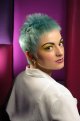
A close friend of mine is an educator for one of the largest UK based training companies within the hair salon industry. Rachel asked me to go along to a training event, where a new hair colouring system was to be launched. Take a few headshots, a few of the entertainment and training, and that’s it. Easy Peasy!
Well, I’ve known Rachel a long time, and it’s rarely been exactly as planned. It’s always bigger and far more complicated
 And guess what?, this turned out to be no different. I arrived an hour early, just in case I needed a bit more time. Which of course turned out to mean I had no time at all! As I arrived, they were in the final throws of rehearsal, and Rachel wanted the head shots doing as soon as possible. No worries, just point me in the direction of the spare room you promised, and I’ll get on with it.
Erm... what room?
I was given a space five feet by five feet, with two deeply padded and multicoloured walls. Now, I could actually stand just outside the allocated five by five feet, because there was a rail that governed one side of my designated area, a table for the second barrier, and of course the two walls.
Meh!
Well, we work with what we’re given, and I was given a very interesting wall
As usual, I had taken a shedload of lighting gear, ranging from 600Ws location heads, right through to the tiniest of miniature speedlights. The bigger lights were not really going to cut it here for a number of reasons. For a start, they would eat into my available space, and secondly, due to the minimal distance between light source and subject, I was going to need very little light anyway, and 600Ws was going to be a major overkill.
For the background, I used a manual speedlight (Yongnuo YN560 II) at a ¼ output, and placed so as to fire across the wall, skimming it. I had to flag it with a piece of cardboard and a lump of chewing gum (note to self: replace lost cards and elastic bands), to prevent any light contamination of my main subject.
Immediately above the background light, I placed a second gridded speedlight facing towards the subject. This provided the accent light seen frame left.
Finally, the main light was provided by a Lencarta Atom 180Ws, firing through a 90cm folding Octa at just above head height and barely camera right.
Nikon D3 1/125th sec ISO200 24-70mm f8

This second image was taken in the same manner
Nikon D3 1/125th sec ISO200 24-70mm f8

And the same again
Nikon D3 1/125th sec ISO200 24-70mm f8
This is the most basic of lighting, in the tightest of spaces.
Budget Version:
Other than substituting the Atom for another speedlight, you can't get much cheaper or much more basic. The folding 90cm Octa was an ebay special at about £15 or £20 and works fine , although the fixing bracket is flakey!
Things to bear in mind:
Even the steepest of challenges usually has a workaround. Here, the main challenge was getting the lighting gear and model within the 5x5 area, and then flagging the various light sources to avoid cross contamination.


 Craig
Craig

