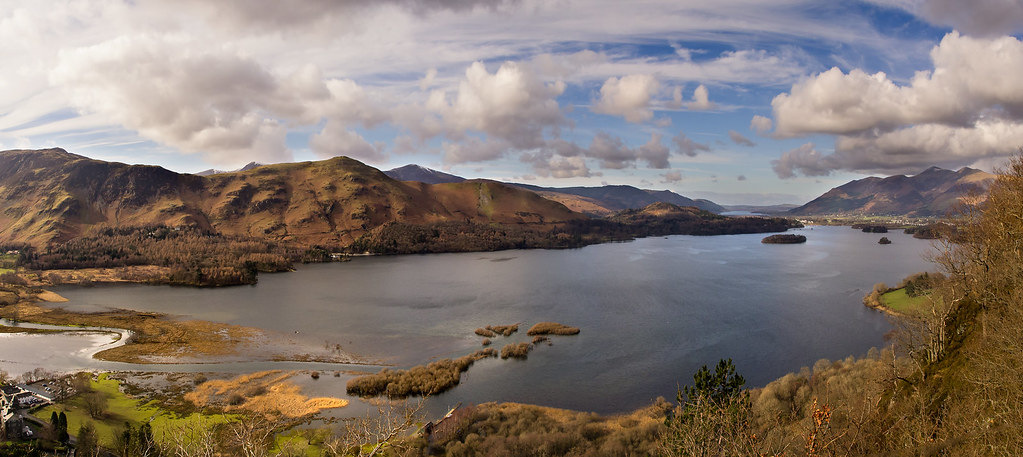
Common mistakes for Beginner landscape photographers

Landscapes need good depth of field - and small apertures increase the depth of field.
Makes sense - right?
I went through a phase where if the lens allowed big f-numbers, then I used them!
FYI - Something like f40 is available on the 75-300.

Wrong....
In those days I was shooting film and didn't really notice the problem till it was too late.
I had a shot published in the local paper even though it was soft printed at 6x4.
I blamed the budget lenses I was using at the time and never really looked into it; I had no idea how much I still had to learn!

In short - diffraction killed the sharpness.
For landscapes on a cropped sensor, you are best keeping below f16.
I'm looking to get my first DSLR (probably a Nikon) and like and have an interest in land and seascapes, but will also use for allround stuff. I was keen on an FX sensor for obvious reasons, but noticed in your post here regarding using cropped sensors for landscapes - can i still get good results?

Finding it hard to justify (and convince wife) of price of 2nd hand FX over DX
 
I use a DSLR with a sensor half the size of FX and I think I do OK. I sometimes use an even smaller sensor.

People seem to think this was OK and it was taken with a compact.

 
So I've read this thread and i'm a little puzzled - I originally understood that a small aperture produced good DOF, but then read that one should not go all he way to the highest F22 for EG. I understand there are lots of technical reasons why this apparently shouldn't be done, but can someone explain in simple layman's terms please.
I have a D3100 with an 18-55 kit lens and would love to know what the 'sweet spot' Fstop is if i shouldn't go right to the smallest aperture like F22

Cheers
 
Basically, if you stop right down (for example, to f/22), the light will not focus correctly, because optics and science and stuff. This is called "diffraction", and manifests as softness. The point (i.e. f-stop) at which this occurs varies from camera to camera and lens to lens, but I found that on my 550D with its 18-55mm kit lens (which I think is a similar sensor/lens combination to your D3100 and 18-55), I couldn't reliably go beyond f/16.

My 6D will stop down to f/22 quite happily, though. Bigger sensor.

Here's an explanation, with pictures. It's not a particularly simple concept, though.
 
Last edited:
Basically, if you stop right down (for example, to f/22), the light will not focus correctly, because optics and science and stuff. This is called "diffraction", and manifests as softness. The point (i.e. f-stop) at which this occurs varies from camera to camera and lens to lens, but I found that on my 550D with its 18-55mm kit lens (which I think is a similar sensor/lens combination to your D3100 and 18-55), I couldn't reliably go beyond f/16.

My 6D will stop down to f/22 quite happily, though. Bigger sensor.

Here's an explanation, with pictures. It's not a particularly simple concept, though.

Thanks Peter - that has helped a lot.

I'm getting the feeling the only way to truly find out is to do some comparison shots

I take it from your comment above it's down to sensor size rather than seeking a different lens?
 
Thanks Peter - that has helped a lot.

I'm getting the feeling the only way to truly find out is to do some comparison shots

I take it from your comment above it's down to sensor size rather than seeking a different lens?
Specifically, it's down to the pixel size on the sensor.
 
Specifically, it's down to the pixel size on the sensor.

OK - so it's a matter of finding that sweet spot on a particular camera lens combo?

I'm trying to keep things simple and not become a kit collector - i want to try and get proficient with what i have and then add to it once I genuinely have a need to expand - although i like 'kit' like all blokes, i think that is the best strategy over time.

Th quest is great land and seascapes

Thanks for your help
 
OK - so it's a matter of finding that sweet spot on a particular camera lens combo?

I'm trying to keep things simple and not become a kit collector - i want to try and get proficient with what i have and then add to it once I genuinely have a need to expand - although i like 'kit' like all blokes, i think that is the best strategy over time.

Th quest is great land and seascapes

Thanks for your help
TBH, whilst you could sit down and tediously calculate the exact best aperture for your camera, it'd be far more convenient to just take a few test shots and see where the tipping point is for you.
 
What's the feeling behind using the hyperfocul distance as an 'optimal' way of getting the best DoF for landscapes? I see lots of talk about it being the best way to get an acceptable focus throughout the picture, but not the best.

So far I've been using the crude 1/3 focus rule that I read somewhere, but apparently that's useless too!
 
What's the feeling behind using the hyperfocul distance as an 'optimal' way of getting the best DoF for landscapes? I see lots of talk about it being the best way to get an acceptable focus throughout the picture, but not the best.

So far I've been using the crude 1/3 focus rule that I read somewhere, but apparently that's useless too!
That's a pity as that was what I was going to try and use!
 
To be honest I focus a third in and it works fine. You get a feeling after a while on how small an aperture you need to guarantee front to back sharpness.

It gets all sorts more exciting when you add scheimpflug into the equation!
?
 
Scheimpflug is what happens when the object plane and the sensor plane are no longer parallel. An example of this is using a tilt-shift lens in its tilted configuration to increase the depth of field of a close-up object - for example, a book laid flat on a desk, whilst the camera is on a tripod.

Takes a bit of getting your head round, but it's got some good applications.

Here's a good video about it (has the book example in it):


If that doesn't get your juices flowing, here's some maths: http://en.wikipedia.org/wiki/Scheimpflug_principle
 
Tilt/shift lenses are basically performing the same function as a large format camera with a bellows between the body/lens.

What's the feeling behind using the hyperfocul distance as an 'optimal' way of getting the best DoF for landscapes? I see lots of talk about it being the best way to get an acceptable focus throughout the picture, but not the best.

So far I've been using the crude 1/3 focus rule that I read somewhere, but apparently that's useless too!

I'd say its useful a good deal of the time but needs adjustment when you start to include objects very close to your in the composition. The main thing to remember is that DOF is controlled by the relative distance between objects not an absolute number so the difference between 1 meter and 2 meters is the same as between 1 mile and 2 miles. So if you want both very close and distant objects in as good a focus as possible the closer the closest object is the closer your focus point should be, plus of course you should stop down the lens as far as your happy with.

You need to consider that with larger formats there are limitations, especially with tele lenses even stopping down won't be enough to get the very near and the very far in focus so either you need to use a tilt/shift lens or focus stack, that is merge several images focused at different points.

Personally I'd add that even shooting landscape doesn't mean everything always needs to be in sharp focus, out of focus areas can either add to the effect of a picture of not really be noticable.
 
Last edited:
You can get a rail that sits on your tripod so the camera slides from one side to the other. I saw it on a tripod review on YouTube.

You can but its more gear to carry about and not very often they would be used
 
You can get a rail that sits on your tripod so the camera slides from one side to the other. I saw it on a tripod review on YouTube.

I saw someone using something like this on the top of Arthur's Seat in Edinburgh! 250m up so he obviously really wanted it. However, I couldn't see the point; as far as I could see the camera wasn't rotating as it traversed, so he was just moving the sensor sideways by a couple of feet while taking images from a view that stretched 80 miles! Am I missing something here?
 
Rails are useful for timelapse sequences, to add a movement dimension to a video. Look up timelapse or hyperlapse on YouTube. Where they use panning, zooming and camera movements to good effect. A lot of work.
 
Last edited:
All this talk of sensor sizes can you still achieve good results from a smaller sensor like micro 4/3rds?, thinking of trading in my D7000 for something like a Lumix G6 mostly due to the lighter weight for holiday use but still want to do landscape photography in my spare time. Probably just pair it up with a kit lens to start with.
 
Many people are making that change. The 43rds sensor is not much smaller than aps-c. And the lenses and bodies are quite a bit smaller and lighter.
 
Last edited:
As a newbie to dSLR, I jump on threads like this that explain things for beginners... I was unfamiliar with the term "hyperfocal" so did a bit of googling... which led me to a page on " The Circle of confusion " :runaway:
That is where I'm at. Going round and round, leanring little bits at a time, then forgetting them and re-encountering them again ;)

All that aside, excellent advice and tips above. Thanks :)
 
For a landscape photography don't need capturing too much scenes as you can.Don't try to take every details.Just keep concentration to the right element and most important things of a scene otherwise you can detract from your goal to take a landscape photograph.
 
I read 4 pages, and I may have missed it, but I'm surprised no one mentioned these points already.

Not planning. Thinking that midday is a good time to take photos.

Getting up at ridiculous times of the day and getting back later is the price of admission if you want to be a serious landscape photographer.

Not using this or something similar: http://photoephemeris.com/
 
Thinking that midday is a good time to take photos.

Telling people that they can only shoot landscapes at one/two times of day is incorrect IMO. There are plenty of valid situations where you can take during the middle of the day. It depends on what you're shooting and what you want to achieve but saying you should only shoot landscapes at morning/evening isn't really helpful.
 
A heads up for a useful little app called OptimumCS-Pro as there seems to be some folks wondering about the compromise between depth of field and diffraction as you close down the aperture.

This little app will compute where diffraction cuts in for your chosen depth of field, just set the sliders for what distance you want in focus, near and far, and the app will show you the optimum aperture for maximum sharpness through the field. This can be quite a useful little gizmo if you're in doubt and can often demonstrate that the aperture you require is a long way from f16-22. Here's a link to the dev's page: http://www.georgedouvos.com/douvos/OptimumCS-Pro_in_Action.html

It's on IOS but don't know if it's on Android or Windows.
 
Yes at some places (the 'classic view' of Buachaille Etive Mòr for example) it's almost a case of join the queue and place your tripod on the 3 marks on the ground made by those who came before you. :D Or for an urban landscape equivalent, Calton Hill (Edinburgh) at sunset: :eek:

9052884791_fec3952394_c.jpg
Look at all of those tripods! They all look young perhaps it a
school photography club outing!
 
Look at all of those tripods! They all look young perhaps it a
school photography club outing!

Nah, it always looks like that! Now getting up there for sun rise is a very different story, me and a dog walker....
 
Telling people that they can only shoot landscapes at one/two times of day is incorrect IMO. There are plenty of valid situations where you can take during the middle of the day. It depends on what you're shooting and what you want to achieve but saying you should only shoot landscapes at morning/evening isn't really helpful.

I see so many photos that would have been a lot, lot better had they been taken at a more ideal time of day.
 
Hang on a sec. What does a camera's sensor got anything to do with the diffraction of the light??? Its physics not electronics. Diffraction occurs because the wavelength if the light is of certain ratio to the gap which is passes through. So it has everything to do with the design of the lens and baldes and nothing to do with the sensors.

Can't believe the nonsense I am reading on this thread!
The sensitivity to diffraction is driven by the size of each individual photo site on the sensor (which in turn depends on the physical dimensions of the sensor, and the number of photo sites packed on there). So the sensor is a main factor when considering likelihood of diffraction affecting an image, and settings to minimise that risk.
 
I see so many photos that would have been a lot, lot better had they been taken at a more ideal time of day.

Of course you do. Certain types of light suit certain types of landscape photography better.

To say that the only time you can shoot any type of landscape photography is early/late is false though.
 
Of course you do. Certain types of light suit certain types of landscape photography better.

To say that the only time you can shoot any type of landscape photography is early/late is false though.

Another thing that really bugs me is photographers who just like to argue for arguments sake, lol
 
Another thing that really bugs me is photographers who just like to argue for arguments sake, lol

I'm not doing that? I was pointing out that I don't agree that the ONLY times to take are early/late. I think that highlighting this belief to newcomers might assure them that they don't all have to approach landscape photography in the same way. There are personal/artistic choices to make, suggesting people only work within one set of constraints isn't particualrly good advice for beginners, in my opinion!
 
Lots of useful info in this thread.
Actually grabbed myself a notebook and jotted down some things to try next time I'm out.
Popped into camera bag then I don't forget :)
 
Not focusing in the correct place and not selecting the most suitable aperture are the most common problems I come across with people attending my photography workshops...the problem is that reading about the subject can be slightly confusing, especially Hyperfocal...a quick demo and people immediately see the difference. It's probably THE most important thing to understand if you want to improve you landscape shots.

For me having the foreground detail sharp is the most important, we naturally don't see distant objects quite as sharp so when viewing images people are not inclined to notice a distant mountain range being slightly unsharp, they will notice unsharp foreground though

Simon

Just read your post and wanted to find out more about Hyperfocal and come accross this web. posting as might be usefull. http://dofmaster.com/ :-)
 
I'm not doing that? I was pointing out that I don't agree that the ONLY times to take are early/late. I think that highlighting this belief to newcomers might assure them that they don't all have to approach landscape photography in the same way. There are personal/artistic choices to make, suggesting people only work within one set of constraints isn't particualrly good advice for beginners, in my opinion!

Its certainly worth pointing out that shooting around sunrise/sunset can often be very effective but I'd agree that suggesting this is the "only" time to shoot is clearly a mistake, most obviously stormy weather can be a goldmine of interesting light/sky and much of the time its going to be at its peak well before sunset.

If your limited in the locations you can visit especially stormy conditions can really help to make for fresh compositions..
 
Back
Top