Comet ISON C/2012 S1

Otium

Suspended / Banned
Messages
4
Name
Angus
Edit My Images
No
Hi,
In the next coming weeks I am going to try and photograph Comet Ison, dubbed "commet of the century". I am hoping to get a few shots as it gets brighter and brighter (providing it does). However I've encountered a few problems so far. I'm not entirely sure how to set up my camera so it will actually capture the comet. I have a canon 60d, with two lens', a f/3.5-32 18-200mm and a f/1.8-22 50mm fixed focus . Will this be enough to capture the comet at it's current magnitude of +5.5? Obviously the comet at this moment is very dim and just visible by the human eye, but can I capture it with my camera? Will I also be able to capture it later in the month as it passes by the sun?
I am going to start going out for most sunrises to try and capture the comet, as that is the best time to see it at the moment. Has anyone captured it without a telescope here yet? and does anyone have any tips for me?
~Angus
 
At present ISON is only about 11 days from its closest approach to the Sun and therefore is not going to be that easy to spot as it will be close to the Sun in the sky. There are lots of guides online but Stellarium is very easy to use (it is free to download) shows the sky for any lat, long and day. Comet ISON is included in its list of astronomical objects so it is easy to see exactly where and when it is above the horizon.

I'd use an ISO of 3200 (or more), aperture of 4 or 5.6 ish and use the 600 rule as a starting point for the shutter speed.

Maximum shutter speed to prevent the stars from appearing as trails = 600/(focal length of the lens x the crop factor of the camera).

On my camera with a crop factor of 1.5 I can get away with about 22second if I'm using an 18mm lens - 600/(18x1.5) = about 22. This does vary depending on exactly where in the sky you are photographing but it is a reasonable starting point.

You'll need a dark sky as sensors pick up light pollution easily. Adjusting the white balance can help but as ISON is not bright and is not far from the rising sun at present, the darker the sky the better. You may need to manually focus as auto focus in the dark is going to be difficult. However, if you are using a wide angle lens you could set the lens to infinity and the DoF would almost certainly means things were in focus.

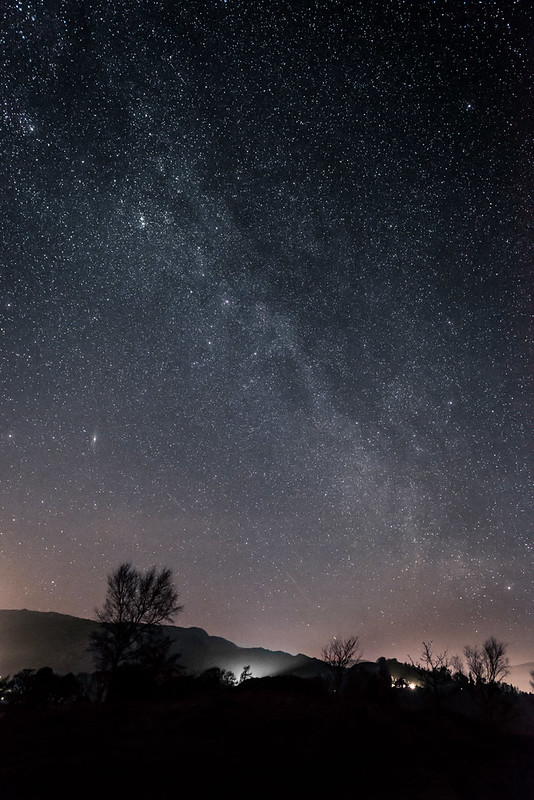
Given the right conditions your set up will record stars below mag 5.5. This shot was 20 seconds at f6.3 and ISO 12800 and even with a little light pollution so dim stars are showing.


The best chance of seeing and photographing ISON may be in December when it is moving away from the sun but it may not be as spectacular as we hope so worth having a go now if the weather is good.

Dave
 
I'd shoot just 1 stop from wide open to reduce any coma... but wide enough to keep the ISO as low as possible. I'm assuming the shot above was f6.3 because it's not very fast lens? If you could have shot with a wider aperture, there would probably have been no need for ISO12800.

This was 20 secs, f4 @ ISO6400. That one stop less ISO makes handling noise a great deal easier.

8524603589_33ca493003_c.jpg


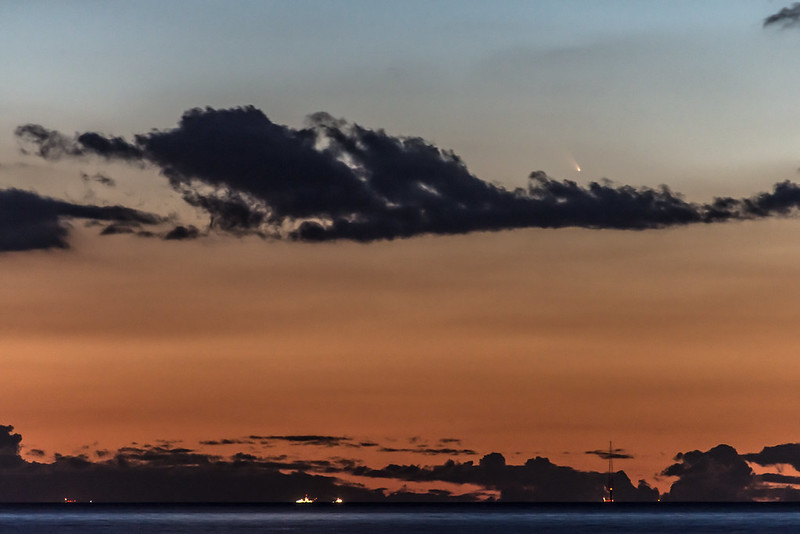
You;ll never get this level of darkness in the sky though as ISON is so close to the sun.. so there will be a lot of pre-dawn light. It was the same with Comet C/2011 L4 (PANSTARRS)

8555018625_ff485069e2_c.jpg


That was over an hour after sunset. It will most likely be around an hour before sunrise before ISON is high enough to get a good shot of.. unless you have a completely unrestricted view of the eastern horizon... right to ground level.
 
Last edited:
Hi, thank you very much for all the very handy replies, and thank you for that app suggestion! Very handy!
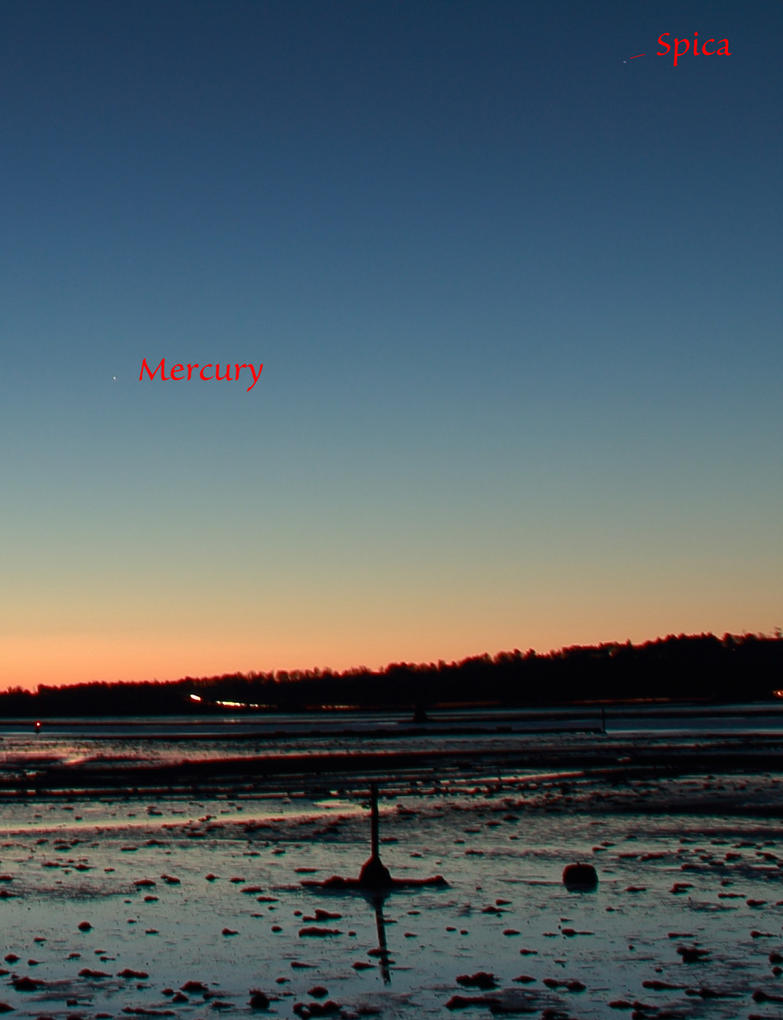
This is the shot I managed to take this morning around 7:03am;
58adf7bb2ebcc814b9f60836a17c02ed-d6uuja5.jpg

No sign of comet ison tho? Perhaps it was a little late? Any help?
 
Same, haven't seen it and have been unlucky with the weather. Pan Starrs on the other hand was seen by the eye easily in comparison.

Cannot be bothered now, will wait to see if ISON makes it around the sun.
 
I reckon the comet is just lost in the glare. Spica is near enough 1st magnitude and Mercury, at present, is about -0.5. In the photo they are both point sources but still look fairly faint so I think the chances of photographing a diffuse object many times less bright are slim.

Dave
 
Okay, I am considering trying a bit earlier to see if I can catch it on the horizon if the weather cheers up. Here's hoping the comet brightens up and gives us a good show after its trip round the sun :)
 
After further information further towards the bottom of the thread I have now withdrawn the photo and earlier post as I now know I posted incorrectly. Many thanks to the more knowledgable people on the site for pointing me in the right directions.
 
Last edited:
Stuart, when was this shot taken? I'll happily come back to this thread and apologise to you if I'm wrong, but this does not look like ISON to me. I'd be surprised if it can be seen now as it is very close to the sun.

Dave
 
I can't think of any other explanation as to what it could be. It was taken last night and the light was constant, very slow moving but without any noise and was visible on the same flight path for over 5 hours. I first noticed it in the sky at just past 4.00 pm, the shot was taken at 6.23 pm and it was still visible on the same flight path at past 9.00 pm. I saw and heard various planes in the sky during the time I was watching so I'm sure it wasn't either a plane or helicopter as it was moving to slowly and was silent. Unless we were buzzed by aliens I can't think of anything else it could be. The only thing I could think of was ISON, as it's been in the news, but I'd be very happy to be corrected if it's not. A news report I read said it would be possible to see it from around now to January so I assumed it was that.
 
I've just managed to get a pretty poor shot of the comet. We've got hazy cloud about and I couldn't get to any place suitable for taking a good shot but I quite like the aura coming off it. Taken with a 70D and Sigma 150-500 OS and the shot is just cropped. I can't wait to get out to a decent, dark location and get some better shots of it now.

David, your shots are fantastic, the second one is my favourite. I can't wait to get to a better location and do something proper, we had lovely clear skies earlier but as soon as I go out to shoot the cloud comes over.


Comet Ison
by modchild, on Flickr

Are you sure this isn't a street light? :P
 
I can't say what you photographed, Stuart but from the extra info you've provided I can say its not ISON. The comet is very close to the Sun just now and sets about 2hs before sunset and is invisible until a little before sunrise. It will be above the horizon all night from about mid December and into January as it moves away from the Sun and should be easy to see assuming it lives up to expectations.

Dave
 
This looks like a lot of fun to have a stab at. Thank you for all the information.
 
I've just managed to get a pretty poor shot of the comet. We've got hazy cloud about and I couldn't get to any place suitable for taking a good shot but I quite like the aura coming off it. Taken with a 70D and Sigma 150-500 OS and the shot is just cropped. I can't wait to get out to a decent, dark location and get some better shots of it now.

David, your shots are fantastic, the second one is my favourite. I can't wait to get to a better location and do something proper, we had lovely clear skies earlier but as soon as I go out to shoot the cloud comes over.


Comet Ison
by modchild, on Flickr


Going with the time you took this shot, I think it could be Venus that you have captured, its right time of the day for that.
Have been having a look at Venus the last few days.
I'm no expert though.
 
Thanks for that Keith, at least that would be a rational explanation (rather than a roving streetlight as suggested above). The only other times I've pointed the camera at the night sky was for the Perseids and Leonids meteor storms so i'm not that well up on the celestial stuff. I will be keeping a good eye open for ISON in the next few weeks and see if I can get something. I will remove the photo from the earlier post now that I'm satisfied it's not the comet.
 
If you want to get to know the constellations and other celestial objects, Stellarium -

http://www.stellarium.org/ -

is good. It can be centred on your lat and long and gives a very good illustration of the sky at night.

Dave
 
Thanks for that Dave, I've just been having a look on there and found it very interesting. I will give it a good looking over in the near future.
 
It seems that "a bit" might have survived and was spotted on SOHO overnight but they're not describing it as any more than a fragment at the moment. Great shame, I was really looking forward to the display. There are billions more out there though so it's just a matter of time before another pops up, let's just hope it hasn't got our name written on it!
 
Back
Top