Clear White Backgrounds - Can't seem to master it

andantesash

Suspended / Banned
Messages
28
Edit My Images
No
Hi,

I have been playing around with my portable studio for a good month now and as I am still learning - could anyone give tips on the best way to get the clear professional looking white background?

The only time it seems to work fine is when I increase the exposure and in turn it blows the colour on the face of who I am shooting. I am using 2 lights at the front, should I purchase another put it behind the white backdrop?

I am using a canon 350d, if someone can suggest the best method for this it would be much appreciated.

Thanks
 
ROUGHLY:
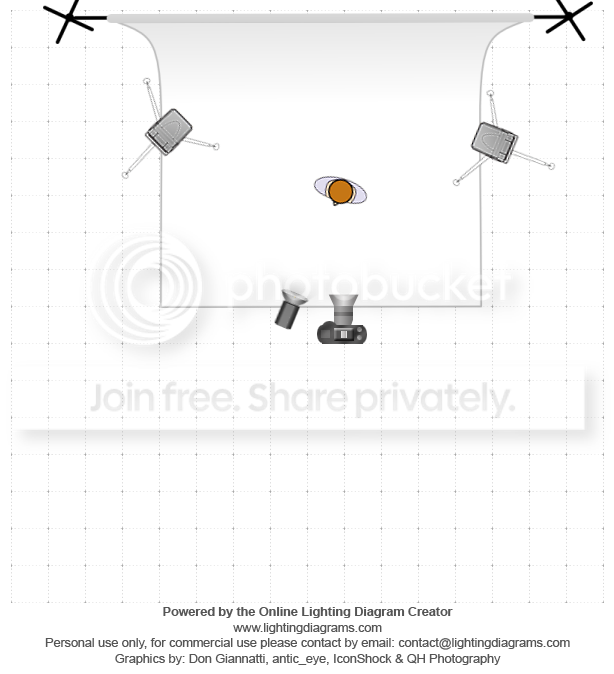
You need to light the bg around +1 stop than the subject. e.g measure the bg @f16 and your subject @ f11. another light may be required to maintain even exposure on the bg.
With the above, set your aperture on the camera at f11 (for exposure of your subject) and don't have them stand too close to the bg.

lighting-diagram-1332891659.png


Looking back at notes I,ve made 1 Stop differnce is absoulutely max, probably 1/2 or 3/4 differenc will be better. Think I still have in my head a Mark Cleghorn/lastolite video where he states sometrhing like 1 to 2 stops difference! :shake:
 
Last edited:
IMO there is far too much effort put into a "clear white background" it's boring and lacks any drama. First mistake is going for white as the background of choice, grey being far more versatile as an achromatic or neutral colour, better still a nice vibrant colour or a dark moody one. Secondly, the background is far less important than the main subject, so, are you putting as much effort into getting that bit right?

OK, so I may be a bit out of kilter with many and their obsession with the even white background, but give me a splash of colour in the form of a gelled lit area any day, or an unevenly lit :eek: coloured background, or get in closer for those crop shots with less background to worry about.

Subject first every time and if you've only got two lights that 'even' background isn't going to happen - so try something different and stop worrying about it. :D

Paul
 
While I have some sympathy with Paul's view, each to their own :)

A blown white background is not easy to do well. You will need three lights (two for the background), quite a bit of space, and know how to set everything up carefully in precise position and balance. The background must be lit separately, and slightly over-exposed.

If that hasn't put you off, there are loads of threads on this if you search, and vids on the web.
 
FWIW, I agree with Paul. Personally I hate 'chavground' shots with a passion, unless they're done really well, and most aren't, because people try to do them with too little space, too little lighting, too much PP or too little regard for getting the level of exposure on the background absolutely right - not helped perhaps because of the misinformation all over the web telling people that the background needs 4x as much exposure as the main subject, when in fact it needs just 50 - 70% more exposure.

But Richard is right too. As photographers, we should be able to get it right, and we should be able to produce what people want and although it needs a lot of care in small spaces, it can be done.

If there's a trick to this at all, it's to recognise that there are two entirely different subjects (the rear subject is the background and the front subject is the person or whatever) and because of this they need to be lit entirely separately so that the lighting one one doesn't affect the lighting on the other. It can be done, I did it yesterday on a number of shots, with no PP whatsoever - but it's easy for me, I have all the space and all the lighting I need.
 
While I have some sympathy with Paul's view, each to their own :)

Yes, I do seem to have a different perspective on certain things - bit like worrying about getting the creases out of a cloth background! I store mine in a compression 'stuff bag' so they are absolutely covered in small random creases, which I light (on the opposite side to the key light with a hard light) at an extreme obtuse angle to accentuate this 'texture' and give an uneven illumination to the background. ;)

Paul
 
I will try and get Cris Lowis to post one of his recent shots in here regarding 'chavground' you may well be surprised at the results.
 
Was surprised to see my name in this thread, thanks Tom lol!

There is a lot of BS surrounding white backgrounds. and whilst I'm not their biggest fan there is a market for them. Here are a few from sunday... there were done in a 16 x 8 foot shed in my back garden. Lit with a single light on the subject (lencarta smartflash) and a hilite with a speedlight in.

We can get hung up about size, space and lighting but from a clients point of view it just needs to be clean, crisp and happy faces.


CL3_9086 by Cris_L, on Flickr


CL3_9113 by Cris_L, on Flickr
 
And this evening I'll be in a studio using a large white cove, where the majority will want a blown white background :gag: but I'll take along a pack of Lee saturates just in case ;)

Paul
 
I can speak from beginner's point of view as studio enviroment is still very new to me.

I hate white background.

It's hard to master and looks bad and boring IMO. Having said that I used it quite a lot in my recent shoot :bang: I now have a lot of PPing trying to get the white background white and even. The creases are absolute PITA as well and spraying water on a muslin background and let it dry helps only so much.

It seems like for most people/clients, studio photography = white background and I get the feeling that this is what they want.

It's hard to get the balance right, on one hand it suits the type of studio photography I do, but on the other I want to use it as little as possible. Mainy because I find it extremely boring and it kills creativity IMO.

All of that said as a studio beginner.
 
LOL :) It seems that the only people that don't like pure white backgrounds are the photographers that have done it too many times. Clients still love it.

If you're tight for space, a Lastolite HiLite background is the answer and they work really well. But that's a few hundred quid.
 
Why does it kill creativity? That's the biggest bs so far in this thread. The bg isn't the most important part of a photograph it's the client. I like to vary my bgs, sometimes hi key white, a graded grey, low key black, I even have purple, orange, pink and yellow. etc etc. I don't feel any less creative based on What colour the bg is.

If its studio portraiture the important issue is the main light and more importantly than that the interaction and posing of the subject.
 
LOL :) It seems that the only people that don't like pure white backgrounds are the photographers that have done it too many times. Clients still love it.

I have a lot of sympathy with the chavground arguments, right up to the point I cash the cheques from my clients for shooting them. Then I really don't mind doing them
 
Why does it kill creativity? That's the biggest bs so far in this thread. The bg isn't the most important part of a photograph it's the client. I like to vary my bgs, sometimes hi key white, a graded grey, low key black, I even have purple, orange, pink and yellow. etc etc. I don't feel any less creative based on What colour the bg is.

If its studio portraiture the important issue is the main light and more importantly than that the interaction and posing of the subject.

It doesn't need to kill creativity, but in reality it often does.
It isn't the white background that kills anything, the colour of the background is just a question of taste, style or personal preference.

The problem is unwanted light that causes problems, especially in small spaces. One problem is flare, created by over-bright light from the background.
Another problem is that the background is sometimes far too wide. Wide is good, but not when combined with close. Wide + close. A primary reason for the over-bright light is that people don't have enough lights to light the background evenly, so they just turn up the power to blitz the background, causing the flare problem. The flare creates an overall loss of contrast, which the photographer then 'corrects' by murdering the contrast and saturation. Increasing the contrast does horrible things to shadows, so lighting tends to be unbelievably flat, which makes everyone's face fat - although of course the faces look fat anyway because of wrap, which is the next potential problem.

Wrap is unwanted light from the background spilling onto and lighting the sides of the face, body, you name it. it makes everyone look fat and makes it impossible to control the light falling on the real subject.

Of course, none of these problems (there are others but these are probably the main ones) need to exist at all. Having enough space and enough understanding of light can result in a pure white background without the background contaminating the main subject and destroying creative lighting - but unfortunately totally flat, over processed images with false skin tones, no detail, flare and wrap are pretty common:'(

Yes, it's possible to be creative with poses and interaction, but these aren't by any means the only qualities of a great portrait.
I have a lot of sympathy with the chavground arguments, right up to the point I cash the cheques from my clients for shooting them. Then I really don't mind doing them
Yep, it's all about money and I fully accept that there are still a lot of people who like chavground shots. But a lot of people have dropped the chavground look altogether, and reported better sales.

 
Yep, it's all about money and I fully accept that there are still a lot of people who like chavground shots. But a lot of people have dropped the chavground look altogether, and reported better sales.


its sometimes difficult to get people to think like that though. I was looking back over my accounts for the last year and from the portraits around 60% has come from chavground.

A lot of clients need some educating, I've shot low key and chavground for the same people and the low key has sold much better, but many people do't realise its (one of many) options
 
(...) I find it extremely boring and it kills creativity IMO(...)

Why does it kill creativity? That's the biggest bs so far in this thread.(...)

Id agree with this.

I've made the important stuff bold. I should probably add in my original post '...and it kills creativity in me' instead of 'IMO', but I thought it's quite clear.

Anyway, I'll take my coat.
 
the creativity comes from the connection between the person in front of the camera and the person behind it. If you haven't got that, the background is the least of your worries.
 
the creativity comes from the connection between the person in front of the camera and the person behind it. If you haven't got that, the background is the least of your worries.

If that 'connection' is broken because photographer worries about the white background too much, then the creativity is lost, which is basically what I'm try to say here.

Right, I can clearly see that I'm wrong here. Once I get more experience with and without white background I'll report back.
 
the creativity comes from the connection between the person in front of the camera and the person behind it. If you haven't got that, the background is the least of your worries.

Up to a point, yes. But that's just one aspect of the creativity that makes a great portrait.

My point is not that a white background necessarily destroys creativity - it doesn't. My point is that when photographers over-light the background (which sadly is extremely common) the spilled light, edge degradation and flare destroys the detail, makes everyone look fat and makes it impossible to light creatively, and creative lighting is an essential creative ingredient.

But it needn't be that way. People often make derogatory comments about Venture, but at least they marketed a style that was executed properly, they recognised the importance of lighting the background evenly, they operated in studios large enough to allow the white background method to work without flare and the other problems, and they trained their staff/franchisees to turn out acceptable quality.

Venture weren't the first of course, they were just the first to sell the concept successfully to the public. Commercial photographers have been creating white backgrounds for just about ever, to commercial photography standards. The problem, as I see it, is not with the white background per se, but with the slipped standards of work and with the widespread belief that in some way white backgrounds are 'professional' and essential, whether the photographer has the resources to do them well or not.
 
If that 'connection' is broken because photographer worries about the white background too much, then the creativity is lost, which is basically what I'm try to say here.

Right, I can clearly see that I'm wrong here. Once I get more experience with and without white background I'll report back.

don't stress it, just experiment, it'll come.


Up to a point, yes. But that's just one aspect of the creativity that makes a great portrait.

My point is not that a white background necessarily destroys creativity - it doesn't. My point is that when photographers over-light the background (which sadly is extremely common) the spilled light, edge degradation and flare destroys the detail, makes everyone look fat and makes it impossible to light creatively, and creative lighting is an essential creative ingredient.

But it needn't be that way. People often make derogatory comments about Venture, but at least they marketed a style that was executed properly, they recognised the importance of lighting the background evenly, they operated in studios large enough to allow the white background method to work without flare and the other problems, and they trained their staff/franchisees to turn out acceptable quality.

Venture weren't the first of course, they were just the first to sell the concept successfully to the public. Commercial photographers have been creating white backgrounds for just about ever, to commercial photography standards. The problem, as I see it, is not with the white background per se, but with the slipped standards of work and with the widespread belief that in some way white backgrounds are 'professional' and essential, whether the photographer has the resources to do them well or not.

I agree with all of this Gary....so where does the 'chavground' come into it?!
 
don't stress it, just experiment, it'll come.


I agree with all of this Gary....so where does the 'chavground' come into it?!
Chavground is just my attempt at humour, I coined the phrase and now everyone seems to have nicked it:)

Chavground as in the background of choice for chavs, usually ladies of ample proportions partly covered by ostrich feathers or faux leopardskin, pouting at the camera and proudly displaying their assets, which merge into a blindingly white background, along with their bleached hair
:exit:
 
Chavground as in the background of choice for chavs, usually ladies of ample proportions partly covered by ostrich feathers or faux leopardskin, pouting at the camera and proudly displaying their assets, which merge into a blindingly white background, along with their bleached hair

ah yes, I forgot, you live in Yorkshire....

:exit: Indeed!
 
I completely agree with Gary. I can and have done lots of chavground stuff, nowadays I generally explain to clients that yes we can do it, but wouldn't they prefer something more fun/exciting/creative. I show what can be done vs a chavground and 9 out of 10 pick something else. So much so that I haven't used the studio for months, everything I've done recently has been on location. When I have used the studio its been for other things. Whereas pure white has its place there is just so much more to be done.
 
But guys most of the argument against white bgs is because the photographer isn't/can't do it properly and is getting flare, spill etc.

The argument should be when it's done properly, anything can be rubbish if done incorrectly.
 
But guys most of the argument against white bgs is because the photographer isn't/can't do it properly and is getting flare, spill etc.

The argument should be when it's done properly, anything can be rubbish if done incorrectly.

Exactly this (which is pretty much what Gary said) which is why the term 'chavground' (despite it's original humorous intent) is a misnomer.
 
Just had some time to kill and read this post.I myself could not do this photograghy as I am not clever enough but I would like to add that I think Chris.s shots here a darn good in my opinion and to say they were done in his garden shed ____well shall I say I am impressed.
We have a new log cabin in the garden 5mx3m seems it would be an ideal little studio.


Gaz
 
I am working with the chavground idea, too. I have been in my little 6mx7m studio for a week, and I am learning the ropes as I go. I am not charging clients, (Chavs or otherwise) just yet. I am just wanting to get the light right on that (and I did some nice shots of my kids using the chavground) but I also play around with other stuff, like very dark, like rim-lights, etc. We also have some other Backgrounds to try.
So, to sum up and stop waffling...the chavground is ONE tool in a box of tools...I intend to learn as many as possible and do it well. Maybe. One day.

:)
 
Back
Top