


- Messages
- 108
- Name
- Ian Grant
- Edit My Images
- No
A few years ago there was a seller I met at a Camera Fair, he would also have a stall at the Malvern Flea and Collectors Fair. He'd often say I've got something for you and pull out something not on display. This lens was one at Malvern.
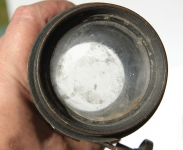
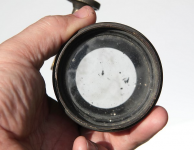
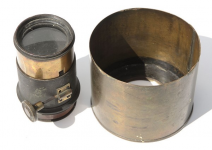
The lens had been used as a projection lens, however it had a slot for Waterhouse stops, so had originally been a Portrait/General purpose lens.
It's a Petzval lens f6 8" and dates to the 1860s. When J.H. Dallmeyer introduced the Rapid Rectilinear lens in 1866 the market for slower Petzval lenses shrank very significantly and many small manufacturers were left with unsold stock. Many of these lenses were repurposed as projection lenses. There was still a market for faster Portrait Petzvals like the f3 Dallmeyer B,series, and similar from Ross etc.
This was a bargain at £20, it had been found in barn, and was inhabited On getting home I dismantled the lens, unscrewing the front and rear cells, and freed the spider.
I took the elements out of the cells and washed them with warm soapy water, and they became remarkably clean, no scratches, or other defects. I removed the rack & pinion separating all the parts, which I cleaned and polished. I re-blackened the inside of the lens barrel and painted the exposed parts of the front & rear cell housing. Then reassembled the lens.

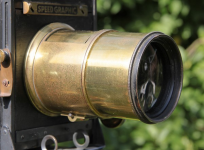
A complete transformation. Now I was able to determine the Focal length and I measured the size the internal restriction, where the stops would sit, and calculated the widest f stop, as f6 with no Waterhouse stop inserted, then I was able to make a set of Waterhouse stops.
I have used it on the Speed Graphic I've shown in this thread. However, I was disappointed with the results and I also have a Dallmeyer 2B 8¼" f3 and was comparing rear cells, with drawings, Dallmeyer reconfigured the real cell for his Petzvals. Then I realised I had put one element in the wrong way around, so corrected my mistake, it already looks way better on the focus screen. So I need to retest this lens.
Ian
The lens had been used as a projection lens, however it had a slot for Waterhouse stops, so had originally been a Portrait/General purpose lens.
It's a Petzval lens f6 8" and dates to the 1860s. When J.H. Dallmeyer introduced the Rapid Rectilinear lens in 1866 the market for slower Petzval lenses shrank very significantly and many small manufacturers were left with unsold stock. Many of these lenses were repurposed as projection lenses. There was still a market for faster Portrait Petzvals like the f3 Dallmeyer B,series, and similar from Ross etc.
This was a bargain at £20, it had been found in barn, and was inhabited
On getting home I dismantled the lens, unscrewing the front and rear cells, and freed the spider.I took the elements out of the cells and washed them with warm soapy water, and they became remarkably clean, no scratches, or other defects. I removed the rack & pinion separating all the parts, which I cleaned and polished. I re-blackened the inside of the lens barrel and painted the exposed parts of the front & rear cell housing. Then reassembled the lens.
A complete transformation. Now I was able to determine the Focal length and I measured the size the internal restriction, where the stops would sit, and calculated the widest f stop, as f6 with no Waterhouse stop inserted, then I was able to make a set of Waterhouse stops.
I have used it on the Speed Graphic I've shown in this thread. However, I was disappointed with the results and I also have a Dallmeyer 2B 8¼" f3 and was comparing rear cells, with drawings, Dallmeyer reconfigured the real cell for his Petzvals. Then I realised I had put one element in the wrong way around, so corrected my mistake, it already looks way better on the focus screen. So I need to retest this lens.
Ian
