Cheapest DSLR

Harlequin565

Suspended / Banned
Messages
8,684
Name
Ian
Edit My Images
No
Hi folks,

I am looking for recommendations for the cheapest DSLR (with any lens) that is...
a) relatively reliable
b) has manual controls for shutter speed and aperture. Auto ISO not required, but would be nice.

I am starting my photography courses back up in January and have spoken to three people now who are all interested but don't have a camera that allows manual control or simply don't have a camera other than their phone. They have asked for suggestions for something that would be suitable and I've pretty much been recommending the Canon 350D as it was my first digital camera, and I found it to be of very good quality.

I totally understand that with the (probable) kit lens, it won't be the best bang-for-buck but for someone wanting to give photography a go without spending a lot of money, what would you recommend?

I am also thinking of getting a couple myself to have as "spares" for those occasions when people turn up with an auto-only camera or a phone.

Price is key here. The cheaper the better. I settled on the 350D because it seems to have the best reliability against its value. eBay has them at around £60 with the kit lens. Is there anything better out there for price vs reliability?
 
I had a 20D for over 7 years but I also had the older and very probably cheaper 10D for a while and one nice thing about that camera was that it has a quieter shutter, it's not compatible with Canons EF-S lenses AFAIK though but should be ok with 3rd party APS-C lenses.

A 10D or even a 20D could be worth a look.
 
Try a Canon D30 or newer.. could be interesting to show people how “things were” with that tiny 1.8” screen and 3 dots on the screen for resolution
 
A used 400d and a kit lens should set you back less than a hundred quid i would have thought and be more than enough to learn your way around manual settings.
 
Nikon D300 every day. Wonderful build, really excellent images below ISO800, what's not to like?
 
Try thinking differently. It require some learning from you though. I realise Canon may fit better for you but how about M4/3.

If you go for an Olympus E-M5 mki it will be a step up from a phone has better image quality than many think. It is great way to show changes to the image before firing the the shutter. Exposure compensation shows in the EVF. The dual dials mean easy to adjustments aperture/compensation or Shutter/compensation. The AF will work just as well when using the rear screen as tge EVF.
It will have features you may not have come across before too.
 
Price is key here. The cheaper the better. I settled on the 350D because it seems to have the best reliability against its value. eBay has them at around £60 with the kit lens. Is there anything better out there for price vs reliability?
I think that you have hit the nail on the head. Cheap but not nasty, huge variety of lenses available, received rave reviews when it came out and it's readily available. I don't see a good reason to look further.
 
I think you'll be hard pushed to equal the value for money the 350D is currently offering. Currently just over £20 with second hand dealers.

The 350 was my first DSLR and I still have it, despite only being 8mp, it's a lovely, simple little camera that offers full control as well has having a lovely sensor.
 
Hiya.

I started with the Canon 450d I loved it. Simple controls. I passed it onto my Daughter so it's still here and working.

Needless to say not used.....

Great memories of a great camera.

I have spoken to loads of folk whom started off with that camera too.

Can be picked up within your budget "well they come up in here now and again cheap"

Gaz
 
Last edited:
I think you'll be hard pushed to equal the value for money the 350D is currently offering. Currently just over £20 with second hand dealers.

The 350 was my first DSLR and I still have it, despite only being 8mp, it's a lovely, simple little camera that offers full control as well has having a lovely sensor.
Yep same for me too I started with one and yes a bargain now
I still have images from that camera and they still look decent
 
I am looking for recommendations for the cheapest DSLR (with any lens) that is...
a) relatively reliable
b) has manual controls for shutter speed and aperture. Auto ISO not required, but would be nice.
I think all dSLRs have manual control of shutter speed and aperture, don't they? With some it's a bit less fiddly than with others (e.g. the '2 dial' Nikons with a separate sub-command dial at the front can be set so that each dial controls one parameter directly). Even my D70, which was a pretty early dSLR, had auto-ISO, so I suspect that's universal, or nearly so. I'm not sure there are any really unreliable SLRs, except those that were found to have design issues early on (like the D600, where oil spots were thrown on to the sensor by the shutter).
 
I think I'd also consider the max shutter speed as some of the more entry level bodies and even the 10D had a max of 1/4,000 which is a problem if you want to use wide apertures in good light. I like to avoid using ND's and much prefer cameras that go to 1/8,000.

If the camera is fitted with a f3.5-5.6 kit lens this probably wont be a problem.
 
I think I'd also consider the max shutter speed as some of the more entry level bodies and even the 10D had a max of 1/4,000 which is a problem if you want to use wide apertures in good light. I like to avoid using ND's and much prefer cameras that go to 1/8,000.

If the camera is fitted with a f3.5-5.6 kit lens this probably wont be a problem.
I wouldn't see that as a major issue. With the 10D's base ISO of 100 and maximum speed of 1/4000, you can shoot at about f/2.8 even in the brightest 'sunny 16' conditions, and at f/2 or wider in more typical conditions.
 
Thanks for all the replies folks. I'm thinking the 350D might be the best option.

I do know a little bit of the Nikon menus (and even less on Olympus) but am very familiar with the Canon setup which makes fixing "experimental student button pushing" much quicker. I've had issues with students with 400Ds and 450Ds that don't fire the remote flash triggers I have which isn't a massive problem for beginners but means I can have a couple of spares for Intermediate/Advanced if there are incompatibility issues.

It's not about brilliant IQ, wide apertures or fast shutter speeds. It's about getting people familiar with a camera that's not a phone and just having basic controls available.
 
I wouldn't see that as a major issue. With the 10D's base ISO of 100 and maximum speed of 1/4000, you can shoot at about f/2.8 even in the brightest 'sunny 16' conditions, and at f/2 or wider in more typical conditions.

Maybe, but this is all dependant on what you point your camera at and how bright the light is and you often can't shoot at wider apertures like f1.4/f1.8 in sunny conditions without an ND to get the shutter speed down to 1/4k. Fitting and removing ND's used to annoy me and I say fitting and removing because if you point your camera at something and want to use a wide aperture you may need the ND but the next thing you point your camera at may require the ND to be taken off if you move away from the wide aperture and leaving it in place means that your ISO can then rise.

And no, I don't think that f2.8 is always adequate for the brightest conditions. In many instances f2.8 will do it but in some it clearly isn't enough.
 
I think I'd also consider the max shutter speed as some of the more entry level bodies and even the 10D had a max of 1/4,000 which is a problem if you want to use wide apertures in good light. I like to avoid using ND's and much prefer cameras that go to 1/8,000.:D
How ever did we cope with film cameras that had a max shutter speed of 1/500th?

If I was teaching beginners I'd ban them from shooting at wide apertures until they had learned why they might want to do that. f8 (or f5.6) and be there! :exit:
 
Maybe, but this is all dependant on what you point your camera at and how bright the light is and you often can't shoot at wider apertures like f1.4/f1.8 in sunny conditions without an ND to get the shutter speed down to 1/4k. Fitting and removing ND's used to annoy me and I say fitting and removing because if you point your camera at something and want to use a wide aperture you may need the ND but the next thing you point your camera at may require the ND to be taken off if you move away from the wide aperture and leaving it in place means that your ISO can then rise.

And no, I don't think that f2.8 is always adequate for the brightest conditions. In many instances f2.8 will do it but in some it clearly isn't enough.
Sure there are conditions where you can't get to f/1.4, but that will happen sometimes even if you have 1/8000, which tops out at about f/2 in sunny 16 light at ISO 100. But these are all edge cases that wouldn't dictate my choice of a cheap camera for a photography course. Sunny 16 is cloudless full sunlight, which I wish I saw more often than I do! Wider than f/2.8 is only relevant if you are using a fast prime, and only desirable in bright light if you want razor-thin DOF. I wonder how many shots I have taken in the last few years where I've both gone wider than f/2.8 and faster than 1/4000 at ISO 100? Possibly none. But YMMV.
 
Sure there are conditions where you can't get to f/1.4, but that will happen sometimes even if you have 1/8000, which tops out at about f/2 in sunny 16 light at ISO 100.
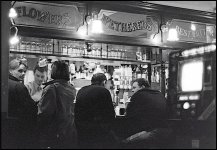
The simplest way to get depth of field home to a student is to give them a long lens and set them loose. I once owned a f1.2 lens but I seldom used it to control depth of field. It was much more so that I could focus in smokey pubs!

London Pub Pentax Spotmatic Rikenon f1.2 1996-20_05.jpg
 
How ever did we cope with film cameras that had a max shutter speed of 1/500th?

If I was teaching beginners I'd ban them from shooting at wide apertures until they had learned why they might want to do that. f8 (or f5.6) and be there! :exit:


How did we cope? Well, a maximum (properly useable) ISO/ASA of 400 helped keep shutter speeds down.

On the original question, I'd probably have a trawl round all the 2nd hand dealers' sites to see what models were most easily available, especially if I wanted several identical bodies.
 
Does it have to be a DSLR?
I'd suggest a mirrorless option like A6000 or even a small bridge camera like RX100iii or LX10 or LX100.

I wouldn't recommend a DSLR to anyone considering most popular brands have clearly said they are no longer developing them. In case your students want to grow in the future its better to be on a actively developing system so that's what I'd suggest anyone coming to me.

But if they still want cheaper to just try things then a older used bridge camera will probably do and they can sell it on without much loss.
 
I'd suggest a mirrorless option like A6000 or even a small bridge camera like RX100iii or LX10 or LX100.
Every time someone comes to me with something they can't find/change on their camera menu it's either a Sony or a Panasonic. Panasonic being the worst. It's a mahoosive time sink trying to sort out their problems. Gimme Canon, Fuji or Nikon any day where menus are concerned :)

I guess it's not massively important to be a DSLR, but I'd prefer something without a fixed lens simply to illustrate the options available. And the A6000 is way out of my budget.

I have had students with very low budget bridge cameras on my course and things like a max ISO of 400, or widest aperture of f/8 makes some of the assignments trickier. If I had 2 or 3 350Ds with kit lenses I would happily lend them out if only to illustrate how equipment can improve your creative options.

All ideas are welcome though and it's been interesting to see some of the responses.
In case your students want to grow in the future its better to be on a actively developing system so that's what I'd suggest anyone coming to me.
This is part of the course and I totally get this. Understanding that lens mounts are tied to cameras and that investing in a system should be done with a bit of forethought is an important bit of info for a newcomer. I do cover the mirrorless vs dslr debate, and also (when asked) have a 1-1 discussion with individuals about what they like to photograph, what their plans are, and what they want out of photography. On a beginners course though, the answer is very often "I don't know". In which case I wanted something I could suggest as a starter camera that is cheap enough to get your money (almost) back if you decide to invest in the hobby.
 
Every time someone comes to me with something they can't find/change on their camera menu it's either a Sony or a Panasonic. Panasonic being the worst. It's a mahoosive time sink trying to sort out their problems. Gimme Canon, Fuji or Nikon any day where menus are concerned :)

I guess it's not massively important to be a DSLR, but I'd prefer something without a fixed lens simply to illustrate the options available. And the A6000 is way out of my budget.

I have had students with very low budget bridge cameras on my course and things like a max ISO of 400, or widest aperture of f/8 makes some of the assignments trickier. If I had 2 or 3 350Ds with kit lenses I would happily lend them out if only to illustrate how equipment can improve your creative options.

All ideas are welcome though and it's been interesting to see some of the responses.

This is part of the course and I totally get this. Understanding that lens mounts are tied to cameras and that investing in a system should be done with a bit of forethought is an important bit of info for a newcomer. I do cover the mirrorless vs dslr debate, and also (when asked) have a 1-1 discussion with individuals about what they like to photograph, what their plans are, and what they want out of photography. On a beginners course though, the answer is very often "I don't know". In which case I wanted something I could suggest as a starter camera that is cheap enough to get your money (almost) back if you decide to invest in the hobby.
I am a bit confused.... is the camera for you or your students? or are you buying on your student's behalf or are you buying to lend?
Also what is the budget?

While I agree that one doesn't need to break the bank for photography, its not a cheap hobby either. If someone cannot afford a used A6000+kitlens (£250-300), I'd say its not really going be a great hobby for them if they are wanting to expand out even a little.

I hope I didn't come across as a photography snob, that wasn't the intension at all.... but its far from a cheap hobby. Even a smartphones with some decent camera and computational features cost north of £600 these days.

And Sony/Panasonic being confusing is really your problem I'd say than your student's problem ;)
 
Last edited:
is the camera for you or your students? or are you buying on your student's behalf or are you buying to lend.
To lend and also to recommend to anyone who has no real budget and doesn't know if they want to take on photography more seriously than on a phone. (I.e. they enjoy photography but want to see if taking it further is something they'd be interested in). To be a bit clearer, if someone says they have budget, and knows the sort of thing they enjoy, and is looking to get into a "system", I would be pointing them in a different direction.
 
Last edited:
The cheapest I've had was a SD14 for nothing, but needed a battery & a lens.
I've brought several models for ~£150 over the years which make much more flexible options than the SD14.
The most recent of theses were a NEX 6 (£136 body only 3 years ago) & the Pentax Q (£140 with prime lens 2 months ago)

The Q is a fun camera but probably not the best to learn on, unless small size is important. The NEX6 proved a very flexible camera able to adapt just about any lens so it was over 6 months before I got a native lens for it.

Personally I'd make a list of desirable features then look on e-bay for older cameras that have those features. Quite often £10 extra can make a significant improvement on usability.

Every time someone comes to me with something they can't find/change on their camera menu it's either a Sony or a Panasonic. Panasonic being the worst. It's a mahoosive time sink trying to sort out their problems. Gimme Canon, Fuji or Nikon any day where menus are concerned :)
That's odd, I've had very little problems with either my Panasonics or Sonys, but when workshop members have come to me with a Canon issue I can never find anything even the most basic controls like ISO.
Nikons have proved a little easier (I've never been confronted with a Fuji).

My background was with Pentax SLRs & DSLRs but I now mainly shoot mirrorless, which fits my usage better (I like adapting lenses, shooting infra-red & low light - all of which are more challenging with a DSLR).
 
FWIW I just checked on MPB and they have loads of Canon 350D's at £29 (body only). Nikon D80's seem to be on a par price wise but less of them, so it sounds like you're on the right track for several reasons with the Canon's - and the students could probably sell them on via bay at the same price - ish if they decided it wasn't for them.
 
FWIW I just checked on MPB and they have loads of Canon 350D's at £29 (body only). Nikon D80's seem to be on a par price wise but less of them, so it sounds like you're on the right track for several reasons with the Canon's - and the students could probably sell them on via bay at the same price - ish if they decided it wasn't for them.
If someone gave me a 350D I too would decide its not for me :exit:
 
Back
Top