Catching Lightning

Skyline

Emmet Brickowski
Suspended / Banned
Messages
4,497
Name
Dave
Edit My Images
No
I've read the books (well, internet and tutorial on here) and watched the videos how it's done. I've got all the gear (camera, lens, tripod, remote and spare boxer shorts). But one thing I haven't got is a Scooby Doo what part of the sky will it be in.
There's meant to be lightning Saturday here in Kent. Anyone got any know how or links to say in which direction a storm would be heading. I'd look at the met office site but they'll probably say it could be coming North, South, East or maybe West.
 
Last edited:
As far as I know, there is no real way to determine exactly where lighting will strike. Obviously, it will be somewhere within the storm cloud, but beyond that, it's guess work.

A small, portable AM radio is a good tool to have, as often you hear the strike build as a increasing static whine on a AM radio (tuned between stations.. Long Wave is best). That way you have a good indicator as to WHEN to release your shutter.
 
As far as I know, there is no real way to determine exactly where lighting will strike. Obviously, it will be somewhere within the storm cloud, but beyond that, it's guess work.

A small, portable AM radio is a good tool to have, as often you hear the strike build as a increasing static whine on a AM radio (tuned between stations.. Long Wave is best). That way you have a good indicator as to WHEN to release your shutter.

Nice one. Thanks for the Radio tip.
 
You have around 5 seconds usually... as soon as you hear a whining, static noise start to increase in volume, release the shutter.

It's not 100% reliable, and depends on the sensitivity of the radio.... but still better than guessing.

It was invaluable in the film days, but today, if you have a large memory card, you can also just release the shutter again as soon as it closes, and just keep the time the camera spends with the shutter closed to as little as possible.
 
I was thinking this only last night. We were expecting lightening here early into the morning, could have swore I saw one brief flash through the curtains.

I've never shot lightening, but imagine keeping wide will be best option, giving you more scope to catch it across the sky. Slow shutter speeds, small aperture .. like catching light trails really or fireworks.

Flashes usually tend to go off around the same area, so after youview the first, aim that-a-way and hope for the best I'm thinking.
 
I was thinking this only last night. We were expecting lightening here early into the morning, could have swore I saw one brief flash through the curtains.

I've never shot lightening, but imagine keeping wide will be best option, giving you more scope to catch it across the sky. Slow shutter speeds, small aperture .. like catching light trails really or fireworks.

Flashes usually tend to go off around the same area, so after youview the first, aim that-a-way and hope for the best I'm thinking.

Thanks for the help :)
 
I've read the books (well, internet and tutorial on here) and watched the videos how it's done. I've got all the gear (camera, lens, tripod, remote and spare boxer shorts). But one thing I haven't got is a Scooby Doo what part of the sky will it be in.
There's meant to be lightning Saturday here in Kent. Anyone got any know how or links to say in which direction a storm would be heading. I'd look at the met office site but they'll probably say it could be coming North, South, East or maybe West.

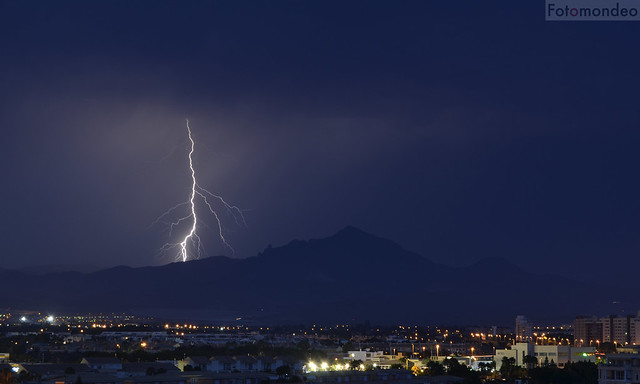
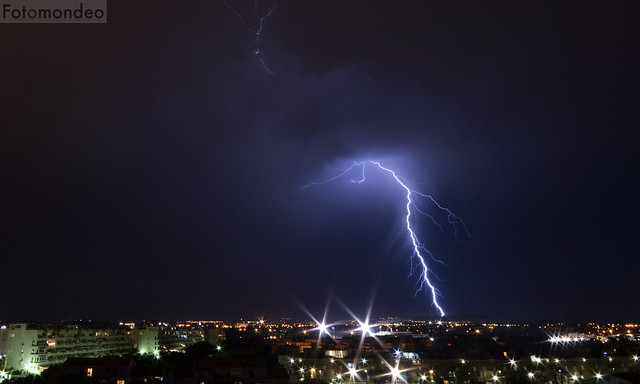
When I took this all I did was point them in the general direction that the storm was coming from. The good thing about an electrical storm is that you can see it coming from afar!


Silueta del Cabeço d'Or by Ricardodaforce, on Flickr


The Storm by Ricardodaforce, on Flickr
 
I was thinking this only last night. We were expecting lightening here early into the morning, could have swore I saw one brief flash through the curtains.

I've never shot lightening, but imagine keeping wide will be best option, giving you more scope to catch it across the sky. Slow shutter speeds, small aperture .. like catching light trails really or fireworks.


'fraid not. Stop down... make your exposures as long as you can and you'll stand more chance of getting a strike.
 
I meant small as in tighter, habit of saying it that way. But stopped down yeah ;)
 
I meant small as in tighter, habit of saying it that way. But stopped down yeah ;)

Ok.. gotcha.. it was the word wide that threw me there... I thought you were referring to the aperture. Was half asleep.. still on singapore time here... having trouble getting my sleep patterns sorted. Good job I'm not back at work yet!
 
Back
Top