


Jao
Suspended / Banned
- Messages
- 3,936
- Name
- Adrian
- Edit My Images
- Yes
Earlier in the year I asked members of this group for advice and user information about Canon rangefinder cameras. I got quick and helpful advice and guidance from @AndrewFlannigan, @PeterSpencer, @desf for which I was really grateful.
It’s been another strange year with limited travel and less opportunity to use my cameras coupled with challenging things at work. But I did start my Canon Rangefinder experience and thought I would share some jottings on my journey so far.
I had always wanted to try an interchangeable rangefinder system but never quite got there. Leica systems were prohibitive price wise. I have used fixed lens 35mm rangefinders, most notably the Yashica 35 GTN, but didn’t like the lack of controls on the camera and my example proved to be a bit flaky in the electrical department.
As a long term film photographer, mainly using medium format and 35mm I often carry a Nikon SLR and occasionally an Olympus OM camera wherever I go but like others I have that GAS itch to try different systems. I’m lucky enough to own many cameras and subscribe to the view that there is no such thing as too many!
I knew of Canon Rangefinders but had never actually seen or handled one in the flesh. Following my post on this group back in May I started my search in earnest. After a lot of googling, I decided to find a suitable lens first and managed to source a reasonably priced Canon 50mm f1.4 LTM with excellent clean optics. This lens has a good reputation and I was pleased to find one in the UK without breaking the bank. I’m not really a 50mm shooter, tending to prefer 28mm and 35mm, but I have grown to love the Canon 50mm f1.4 LTM, sometimes dubbed the Japanese Summilux. YouTuber hyperbolae aside, the lens is a lovely performer in my opinion.
Further internet searching and to be frank some impatience to get a Canon Rangefinder body I sourced a Canon 7 in the UK in what appeared to be great condition. I had also been looking at Canon P models but was unable to find one in the UK. That said I have no issues with buying from Japan, I was just being impatient!
So, armed with my new to me Canon 7 and the 50mm f1.4 LTM I loaded some Kodak Ektar 100, and set out to make some images. In part to check the camera worked and also to see how the camera and lens combo performed.
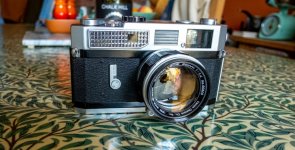
I was not disappointed with my initial experience. The selenium meter was not accurate, but that was to be expected and I use a handheld meter or my Reveni all the time any way
It’s fair to say the Canon 7 is a big and heavy camera. It has a selenium meter and changeable frame lines for 35, 50 and 100. These have to be changed manually unlike the auto system on Leica M bodies. I did get used to this but it did present a few issues on the first roll of film.
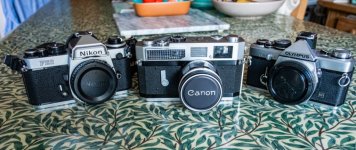
The images below show some of the output from the camera and lens and highlight some of my user errors!

Taken in a cafe in Cambridge 1/15th @ f1.4 the Canon 7 shutter is lovely and quiet, but focus not quite there, but the lens was wide open!

Katy @f1.4, a bit of a dull day, but focus getting better. The slightly star like bokeh shows in this image too

A tad over exposed but another shot at @f1.4, I do love how this lens renders things and my focus by this point was getting better

So nearly a good photo but not quite! Indoors in not great light a quick grab shot, 1/30 @f4. Spot the rookie error, I had the 35mm frameline up and not the 50, so I missed the edge of the mirror! I can see the benefit of the auto frame lines on Leicas!
In use the Canon 7 is an absolute joy. The big bright viewfinder makes using the camera with both eyes open a breeze. The rangefinder patch clear and sharp and focusing was very easy indeed once I had used the camera for a little while. I also wear glasses and had no issues from that standpoint. It isn’t technically a 1-1 ratio viewfinder, but in reality, it feels as though it is. A feature I grew to love. There are a couple of niggles, the biggest one being the location of the strap lugs which means the camera does not balance well even with the relatively big 50mm f1.4. The other is the lack of a hot shoe wich means i can't use my Raveni Meter, but netihere are deal breakers
But 3 rolls of film in and much to my disappointment my Canon 7 proved to have a serious flaw. There were some strange light leaks on three of the frames on the first roll of Ektar. The second roll I shot was Fuji Reala 100 and it had light leaks on almost all the frames as did a third roll of FP4+. My initial thought was it would be an easy fix, like many in this group I’m sure, changing film camera light seals is a common part of the film camera experience. But the camera doesn’t have conventional light seals and the source of the issues was a second metal shutter curtain lag issue. . More complex to fix and the supplier of the camera refunded me without issue.
In spite of the problem with my Canon 7 it really whetted my appetite for this RF system so this is far from the end of my Canon RF odyssey, but that is for the next instalment.
It’s been another strange year with limited travel and less opportunity to use my cameras coupled with challenging things at work. But I did start my Canon Rangefinder experience and thought I would share some jottings on my journey so far.
I had always wanted to try an interchangeable rangefinder system but never quite got there. Leica systems were prohibitive price wise. I have used fixed lens 35mm rangefinders, most notably the Yashica 35 GTN, but didn’t like the lack of controls on the camera and my example proved to be a bit flaky in the electrical department.
As a long term film photographer, mainly using medium format and 35mm I often carry a Nikon SLR and occasionally an Olympus OM camera wherever I go but like others I have that GAS itch to try different systems. I’m lucky enough to own many cameras and subscribe to the view that there is no such thing as too many!
I knew of Canon Rangefinders but had never actually seen or handled one in the flesh. Following my post on this group back in May I started my search in earnest. After a lot of googling, I decided to find a suitable lens first and managed to source a reasonably priced Canon 50mm f1.4 LTM with excellent clean optics. This lens has a good reputation and I was pleased to find one in the UK without breaking the bank. I’m not really a 50mm shooter, tending to prefer 28mm and 35mm, but I have grown to love the Canon 50mm f1.4 LTM, sometimes dubbed the Japanese Summilux. YouTuber hyperbolae aside, the lens is a lovely performer in my opinion.
Further internet searching and to be frank some impatience to get a Canon Rangefinder body I sourced a Canon 7 in the UK in what appeared to be great condition. I had also been looking at Canon P models but was unable to find one in the UK. That said I have no issues with buying from Japan, I was just being impatient!
So, armed with my new to me Canon 7 and the 50mm f1.4 LTM I loaded some Kodak Ektar 100, and set out to make some images. In part to check the camera worked and also to see how the camera and lens combo performed.
I was not disappointed with my initial experience. The selenium meter was not accurate, but that was to be expected and I use a handheld meter or my Reveni all the time any way
It’s fair to say the Canon 7 is a big and heavy camera. It has a selenium meter and changeable frame lines for 35, 50 and 100. These have to be changed manually unlike the auto system on Leica M bodies. I did get used to this but it did present a few issues on the first roll of film.
The images below show some of the output from the camera and lens and highlight some of my user errors!
Taken in a cafe in Cambridge 1/15th @ f1.4 the Canon 7 shutter is lovely and quiet, but focus not quite there, but the lens was wide open!
Katy @f1.4, a bit of a dull day, but focus getting better. The slightly star like bokeh shows in this image too
A tad over exposed but another shot at @f1.4, I do love how this lens renders things and my focus by this point was getting better
So nearly a good photo but not quite! Indoors in not great light a quick grab shot, 1/30 @f4. Spot the rookie error, I had the 35mm frameline up and not the 50, so I missed the edge of the mirror! I can see the benefit of the auto frame lines on Leicas!
In use the Canon 7 is an absolute joy. The big bright viewfinder makes using the camera with both eyes open a breeze. The rangefinder patch clear and sharp and focusing was very easy indeed once I had used the camera for a little while. I also wear glasses and had no issues from that standpoint. It isn’t technically a 1-1 ratio viewfinder, but in reality, it feels as though it is. A feature I grew to love. There are a couple of niggles, the biggest one being the location of the strap lugs which means the camera does not balance well even with the relatively big 50mm f1.4. The other is the lack of a hot shoe wich means i can't use my Raveni Meter, but netihere are deal breakers
But 3 rolls of film in and much to my disappointment my Canon 7 proved to have a serious flaw. There were some strange light leaks on three of the frames on the first roll of Ektar. The second roll I shot was Fuji Reala 100 and it had light leaks on almost all the frames as did a third roll of FP4+. My initial thought was it would be an easy fix, like many in this group I’m sure, changing film camera light seals is a common part of the film camera experience. But the camera doesn’t have conventional light seals and the source of the issues was a second metal shutter curtain lag issue. . More complex to fix and the supplier of the camera refunded me without issue.
In spite of the problem with my Canon 7 it really whetted my appetite for this RF system so this is far from the end of my Canon RF odyssey, but that is for the next instalment.
Last edited:


