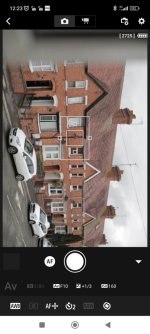
I just thought I’d check you have set the view finder doppler correctly for your eyes. I know I have to set it to see the EVF as crisply as possible as otherwise my eyesight isn’t great.
I got menus and all numbers pretty sharp. It almost looks as if the camera drops the resolution for the actual view and reviews. Try shooting house brick wall and playing it back at 100% and you will be amazed at the difference between EVF and LCD.
I note a lot of youtube personalities are shooting looking at LCD in smartphone-like fashion. It really makes sense despite worse grip and stability since LCD displays offer far sharper and more responsive image. Shame LCDs are so small. Phone like 6" would be much better.
I have to say I’ve not experienced many of the issues you’ve raised. The evf is never going to have the same dynamic range as a OVF and will to an extent have some pixelation as it won’t be as clear or crisp as an OVF. I’m probably more used to EVFs having been solely mirrorless for the last 3 years. I’ve probably forgotten what an OVF feels like.
It could be a lot better with existing hw by employing some processing of raw data stream to give a nice clog3 (only available in video mode - why???!) or HDR-like image to account for full DR visible by the sensor. And that would also give a realistic histogram. Instead it behaves like a contrasty 8bit over-processed JPEG, and even neutral or faithful style with contrast set to -4 doesn't tone it down anywhere near enough. Think of a basic aggressively set highlight and shadow recovery in LR, and that fits nicely into our 8-10bit monitors, and printers. So basically it is a firmware update away, but it won't happen for cheap camera (in their eyes). Most likely this is getting reserved for R1 just because.
And they could really fix the phone app. If bloody mini 2 drone can send full HD signal over 7km away then this can do same at 70cm away!
but there are downsides too (some lag when panning fast, pixilation as resolution will be an issue until technology improves).
I start to think more and more that R6 CPU is unable to cope with so much data coming in and out. Z9 has it all worked out. So basically we get baited into 20fps all singing and dancing body with 1DX III sensor (what could possibly go wrong here?) and then get thrown into the proverbial boiling water. The reality is that there were big savings made here and there to make sure this can never be a true pro grade camera. If your job relies on tracking and capturing streams of fast action images, you would have already traded this in on a day 1 of Z9 or R3 release.
Pixelation is also partly fixed in Sony A1. Expect that to be reserved for next couple of gen to exclusively 5k+ products.
For me the benefits currently outweigh the negatives.
1. VIDEO. No choice really other than SONY A1, A7IV or Z9
2. 1DX III sensor with the corresponding benefits (but fairly low res in modern day standards*). Obviously I could get it in a much better package together with 1. but am not willing to shell out over £5k at the moment. I will likely get this used at some point after R1 release.
* It's enough 80-90% time, and can print A1 just fine, but heavier cropping or printing larger is really out of question. Same for 8K video which will only become truly important after some time.
3. 20fps - if you can make use of them due to HW and software based limitations. It depends on a case by case basis. Z9 would be an obviously better choice money no object.
4. IBIS - for non-stabilised lenses like 400/5.6L or 85/1.4. Former doesn't make as much sense on R6 - you totally want the full res of R5 when shooting one of these.
I can't comment so much on stabilised ones so far but would expect some improvement too. If there are people involved you really don't want to go under 1/200s so its really mostly for longer ones in practice. You really need to try and make mess with 24-70mm at 1/200s IBIS or no IBIS.
I was expecting AF to be more of a great leap forward in this package. Full sensor area is great. That's probably the biggest one. It is a lot smarter than 5D3 / 5Ds but in real life I have very few other complaints on them and that was essentially the dog running at crazy speed towards camera. I am going at extreme lengths to reconfigure R6 to actually make it do what it promised. Canon should have done the homework for their customer. Leaving all in enforced full auto is so digital rebel level, except menus have grown by a few orders of magnitude and they no longer even supply a manual! They are so different from 5D that it made almost zero difference between going to Nikon or Sony. I note R3 retained a lot of 1DX layout....
Now Sony reps told me their cams can do truly crazy things. Like memorise certain people, and prioritise certain people in particular order. I'm not sure how I feel about all that but it is really something else.
There are dodgy primes that just don't behave well on DSLR wide open (excluding live view), and that includes the likes of Canon's own 50mm STM (and all of STM), Tamron 45mm (and I suspect all Tamron in general), etc. Other than that there were already totally no issues.
Both Rx and 5Dx can't drive big whites as well as 1Dx / R3 due to lower voltage so that's theoretically another way how they make sure that fast action pros have no chance here.
Canon clearly intended R5 and R6 to be openly consumer oriented products at pro price levels before adding plastic lenses priced at MF levels, and thus we are really forced to low res R3 or competitor products.
Believe it or not I have not ditched DSLRs and have no such plans whatsoever. R6 was a mid-expenditure solution to get into video business, and take off some load at challenging settings like dark wedding venue where 5Ds only makes the matter worse. I will expect to upgrade away from R6 before too long.