Camera suggestion please

ISO is the sensitivity of the sensor to light, and along with aperture and shutter speed will dictate your exposure. Outside on a bright day it should be choosing the lowest ISO to give the best image quality, and it should be bright enough that shutter speed is high enough so that you do not get motion blur.

The opposite is true for indoors, it will usually require a higher ISO to keep the shutter speed high enough to stop motion blur. Obviously if the room indoors is bright enough you might still be able to use a low ISO and still get a high shutter speed.

To muddy the water even further some of the cameras mentioned (mainly RX100 Mark III to Mark V and the Canons) have wide aperture lenses (f1.8-2,.8) meaning they let more light in allowing you to use lower ISO and faster shutter speeds. The only issue with these cameras is the relatively limited zoom giving a range of 24-70mm or 24-105mm, compared to the 24-200mm and 25-500mm as per my last post.
Thanks, zoom has never been important to me, hardly ever use it, maybe just a fraction to frame a subject better thanks
 
Thanks, zoom has never been important to me, hardly ever use it, maybe just a fraction to frame a subject better thanks
If that!s really true then you don’t need any of the cameras that have been recommended but one with the biggest possible sensor and a fixed length prime! But I doubt it some how. What focal length do you use — the 25mm equivalents that I guess it starts up in?
 
Thanks, zoom has never been important to me, hardly ever use it, maybe just a fraction to frame a subject better thanks
In that case if you do go for an RX100 then maybe stick to the Mark III to V as it’ll save you money over the mark VI and VII and as mentioned have a wider aperture.

If you don’t want a zoom that opens up other possibilities as you could get a fixed focal length camera such as the Fuji X100V ,X100F or Ricoh GRiii, all have APS-C sized sensors which are much bigger than the 1” type and much much bigger than the 1/2.3” type and you will see a step up again in IQ.

The Fuji x100 series cameras are beautiful looking cameras too, but they are a bit bigger. The Ricoh is a truly pocketable camera.

They both have different effective focal lengths, The Fuji being 35mm and the Ricoh 28mm. You can buy converters for the Fuji making it 28mm equivalent and 50mm equivalent but they’re not cheap.

Of course we could get really silly and look at cameras like the Sony RX1’s and Leica Q’s but they are into the £1000’s :oops: :$
 
Last edited:
A big cause of image degradation which often gets overlooked is how much an image has to be enlarged to be viewed. An image from a 1/2.3” sensor has to be enlarged many more times compared to a 1” type sensor resulting in a bigger loss of image quality.
That is, I'm sorry to say, totally wrong.

This goes back to the confusion between analogue and digital technology. In the analogue domain, a smaller "sensor", that is: the film, means a greater degree of enlargement for a given print size. In that situation, your statement is correct.

In the digital domain, however, the image is recorded via a grid of pixels. If there are 20 million pixels on a 1/2.3" sensor and 20 million pixels on a 1" sensor then the same number of points will be delivered to the display medium, be it a laser print or a screen display. The amount of data retained in the display is entirely dependent on the display system. If a 20 million pixel 36mm x 24mm is the recording mechanism, the number of points will again be the same as with the smaller sensors.

As I mentioned above: the main difference introduced by sensor size is the number of photons collected in the pit of each pixel. This will affect the differentiation between each point and therefor the subtlety of differentiation between lines. The bigger the pits, therefor, the sharper the lines will be, again dependent on the display mechanism. However, with the rapid improvement in both hardware and software, the difference between sensors of different sizes has been reduced to a marked degree.
 
Thanks everyone, lots to look at and think about,
Please read my last post. It covers an important point of misinformation that causes much grief when buying cameras.
 
I posted the wrong model for my current camera, I have a cool pix S7000, not S700, sorry was a typo on my OP….released in 2015.
That does change my suggestion of a TZ60 completely, for two reasons, first they are much closer in age, and secondly because I have never owned an S7000, or even used one :)
 
That is, I'm sorry to say, totally wrong.

This goes back to the confusion between analogue and digital technology. In the analogue domain, a smaller "sensor", that is: the film, means a greater degree of enlargement for a given print size. In that situation, your statement is correct.

In the digital domain, however, the image is recorded via a grid of pixels. If there are 20 million pixels on a 1/2.3" sensor and 20 million pixels on a 1" sensor then the same number of points will be delivered to the display medium, be it a laser print or a screen display. The amount of data retained in the display is entirely dependent on the display system. If a 20 million pixel 36mm x 24mm is the recording mechanism, the number of points will again be the same as with the smaller sensors.

As I mentioned above: the main difference introduced by sensor size is the number of photons collected in the pit of each pixel. This will affect the differentiation between each point and therefor the subtlety of differentiation between lines. The bigger the pits, therefor, the sharper the lines will be, again dependent on the display mechanism. However, with the rapid improvement in both hardware and software, the difference between sensors of different sizes has been reduced to a marked degree.


Have to agree fully, if anything it is probably more influenced by the quality of the lens, and how near the camera settings are to to the sensor's optimal.

None of the compacts mentioned have good quality corner to corner, I assume mainly due to the lens design needed to achieve a wide zoom range.

The OP states he does not use much of the zoom range, so I should think that a standard zoom (14-42 on M43 or 18-55 on APS-C) would be more than enough.

Which to me leaves the main question to be does the camera have to be a pocketable compact, or could it be an M43, as for example any of the 16MB G series Panasonics with a 14-42 lens will give better quality images across the frame than any of the 1" compacts mentioned.

I also don't see the sensor size being a major factor in modern compacts unless you want to make heavy crops, which for someone who hardly uses the zoom may not be a factor.
(unless you often shoot at or above 1600 ISO, but if you do, M43 and larger is almost a must)
 
That is, I'm sorry to say, totally wrong.

This goes back to the confusion between analogue and digital technology. In the analogue domain, a smaller "sensor", that is: the film, means a greater degree of enlargement for a given print size. In that situation, your statement is correct.

In the digital domain, however, the image is recorded via a grid of pixels. If there are 20 million pixels on a 1/2.3" sensor and 20 million pixels on a 1" sensor then the same number of points will be delivered to the display medium, be it a laser print or a screen display. The amount of data retained in the display is entirely dependent on the display system. If a 20 million pixel 36mm x 24mm is the recording mechanism, the number of points will again be the same as with the smaller sensors.

As I mentioned above: the main difference introduced by sensor size is the number of photons collected in the pit of each pixel. This will affect the differentiation between each point and therefor the subtlety of differentiation between lines. The bigger the pits, therefor, the sharper the lines will be, again dependent on the display mechanism. However, with the rapid improvement in both hardware and software, the difference between sensors of different sizes has been reduced to a marked degree.
Thank you for your correction, I was indeed using poor terminology descended from the good old days and apologies for the confusion. I guess what I was trying to get at is that the smaller sensors enhance flaws which when viewed/enlarged to the same size as a larger sensor camera they are more apparent and degrade the image quality.

We've already discussed some of these, i.e. noise and dynamic range, but of course another one of these is diffraction, the smaller and more dense the photosites the greater the diffraction and the more it decreases image quality and sharpness as you've just mentioned. Another factor is contrast which is closely related to dynamic range. The more contrast the more sharpness is perceived, and this is why you get more of that elusive 'pop/3D' appearance. Of course, these are very much affected by the lens as well, and probably more so.

I agree that technology advancements have blurred the lines more over the years there is still (imo) a difference in image quality between the different sensor sizes, sometimes there's very little to no perceivable difference between my m4/3 camera and my full frame one, but for the most part the difference is noticeable.

I'm personally yet to find a traditional compact camera or mobile phone that can truly rival a larger sensor camera when viewed on anything bigger than a phone screen, so for the time being larger sensors will always produce better more pleasing images imo. However I can see a day when the lines are definitely blurred.

Steve said the his images are lack lustre and whilst some of this could well be down to technique, light and composition, it wouldn't surprise me one bit if part of the issue was the lack of so called 'pop' that larger sensors give due to the reasons mentioned.
 
I also don't see the sensor size being a major factor in modern compacts unless you want to make heavy crops, which for someone who hardly uses the zoom may not be a factor.
(unless you often shoot at or above 1600 ISO, but if you do, M43 and larger is almost a must)
I'm afraid I disagree, sensor size is still a factor in image quality for the reasons already discussed, to say any different is incorrect. Now of course, how much that bothers the individual, and how much an individual perceives it will be different from person to person (y)
 
I'm afraid I disagree, sensor size is still a factor in image quality for the reasons already discussed, to say any different is incorrect. Now of course, how much that bothers the individual, and how much an individual perceives it will be different from person to person (y)
I agree it is a factor, but under the conditions I stated, not a major one, so I did not "say any different" as such
 
@reddwarf4ever as you can see the wonders of the internet is that there's a whole host of opinions, which is great as it allows you to look at things from all angles, however it can get confusing and it's important to decide for yourself.

You might find this useful, here shows the difference in quality in a controlled studio environment. Unfortunately it doesn't. have your camera so I've chosen the most recent Nikon 1/2.3" sensor camera they have (P900) and compared it against the Sony RX100 V which were released within a year of each other. It's not an ideal test as teh Nikon is 16mp vs the Sony 24mp, however I've included the Olympus EM10 m4/3 camera which is also 16mp for comparison, and then the Ricoh GRiii which is an APS-C camera.

I'll not say what I see so that you can decide for yourself. Images posted to this forum are softer than they appear so it might be worth visiting the actual site here. You can even download the files to view fully.

This is in good light


Screenshot 2022-07-27 at 08.25.48 by Toby Gunnee, on Flickr


And here is a typical low light scenario


Screenshot 2022-07-27 at 08.26.09 by Toby Gunnee, on Flickr


Here we have a comparison of a 16mp 1/2.3" sensor and a 12mp full frame sensor to show there's more than just the megapixels that dictate image quality

Screenshot 2022-07-27 at 08.55.20 by Toby Gunnee, on Flickr


Of course if we go larger sensor and more megapixels the difference is much more noticeable.


Screenshot 2022-07-27 at 08.58.31 by Toby Gunnee, on Flickr
 
Last edited:
I agree it is a factor, but under the conditions I stated, not a major one, so I did not "say any different" as such
Yeah I get that, as I mentioned I think what's considered a major difference and how much we see it will be down to the individual (y)
 
I guess what I was trying to get at is that the smaller sensors enhance flaws which when viewed/enlarged to the same size as a larger sensor camera they are more apparent and degrade the image quality.
You appear to be stuck on the idea that the image from a given sensor has to be "enlarged" to match the image from a larger sensor. This is not the case.

Once captured, the images from sensors with the same number of pixels are, in crude terms, identical.
 
You appear to be stuck on the idea that the image from a given sensor has to be "enlarged" to match the image from a larger sensor. This is not the case.

Once captured, the images from sensors with the same number of pixels are, in crude terms, identical.
I do don't I :runaway: It's a difficult concept to let go of, I need to look into this more. Maybe my technical knowledge of why there are differences needs revising but I know what my eyes see :p
 
I'm afraid I disagree, sensor size is still a factor in image quality for the reasons already discussed, to say any different is incorrect. Now of course, how much that bothers the individual, and how much an individual perceives it will be different from person to person (y)

Yup. Size does matter and so do the ISO and how close you look at the final result.
 
You appear to be stuck on the idea that the image from a given sensor has to be "enlarged" to match the image from a larger sensor. This is not the case.

Once captured, the images from sensors with the same number of pixels are, in crude terms, identical.

I do think it still matters but maybe only if you look close enough to see the differences and there another thing to consider, a larger image may need to be downsized to match the size of a smaller one (for example when comparing a 6000 along the longest edge image to one 4000) giving another advantage to the larger image. Again though, it depends how close you look and the ISO and technical generation of the sensor and wider electronics and processing could be said to have a more significant impact on final image quality.

Compare an older compact with a small sensor to a more modern camera with a much larger sensor and anyone looking closely may see that multiple things matter.
 
Last edited:
... to match the size of a smaller one (for example when comparing a 6000 along the longest edge image to one 4000) giving another advantage to the larger image.
My comments are entirely about the sensor data sent to the processor. What happens after that is another matter.

If two 20 million pixel sensors of different sizes are used to capture the same scene, then they must both send 20 million pixel states to do so. What happens after that will depend on several decisions made by both the designers and the user. If one of the images comes out with an image length of 4,000 pixels and the other comes out with an image length of 6,000 pixels, then processing has been applied, either according to the design of the camera or according to the setings chosen by the user.

Whatever the cause of these changes, they have nothing to do with two basic files each storing the output from the same number of pixels from two sensors of different sizes.
 
My comments are entirely about the sensor data sent to the processor. What happens after that is another matter.

Theory and engineering are wonderful but to most of us it's the end result that matters. As always I'd recommend people start at the end result they want (size of image, viewing medium, circumstance and distance and the quality we want) and then work back to decide the kit and the settings. Being honest about our needs may also help in the decision making process.

Personally I think that tiny sensor devices are best for good light pictures and are possibly best looked at on phones and tablets and in smallish prints too. As you move away from good light, small size images and smartphones and tablets and perhaps move into closer viewing and cropping I think that the size of the sensor, the ISO and where the kit is on the cutting edge to humdrum scale begin to matter more.
 
As you move away from good light ... think that the size of the sensor, the ISO and where the kit is on the cutting edge to humdrum scale begin to matter more.
This may well be true, because (as I said before) the one thing that sensor physical size alters is the size of each pixel and therefor the number of photons it will react to, during a given exposure. This will affect the differentiation between the light levels of the recorded image and, depending on the subject, it may lead to an apparently sharper image. However, software can alter this differentiation, which is why sharpening tools work.

The issue that we seem to be at odds over is that the physical size of the sensor does not affect the number of points recorded.
 
This may well be true, because (as I said before) the one thing that sensor physical size alters is the size of each pixel and therefor the number of photons it will react to, during a given exposure. This will affect the differentiation between the light levels of the recorded image and, depending on the subject, it may lead to an apparently sharper image. However, software can alter this differentiation, which is why sharpening tools work.

The issue that we seem to be at odds over is that the physical size of the sensor does not affect the number of points recorded.

My point is that when discussing theory and pixel sizes we lose sight of the larger and real world picture (haha, see what I did there?) and the fact is that unless the image is quite small and taken in optimum conditions many people interested in photography will see the difference between a picture taken with a teeny tiny sensor and one taken with a larger sensor assuming both are of similar tech. They may have to look closely but the differences will be there to be seen if we look. To pretend otherwise really doesn't help anyone IMO unless we qualify it with some specifics.

For example... "I'm only going to take pictures on sunny days out and holidays and I'm only going to look at them as whole pictures on my smartphone or 10" tablet and I'm not interested in shallow DoF." There you go then... anything made in the lest 10 years will do nicely.

I have small sensor compacts, a 1" compact, MFT and "FF" and the differences are clearly there. Not everyone will see them of course. One of my pet hates is seeing people watching TV in the wrong aspect ratio and not seeing that all the people are short and fat. Those same people may look at a photo taken with a small sensor compact or phone and think it's fine. Ok. Its fine for them :D
 
Last edited:
The issue that we seem to be at odds over is that the physical size of the sensor does not affect the number of points recorded.
I'm not sure this have ever been contested, it's how those points recorded end up displaying in the final image. Sharpening can only get you so far, and of course if you start with a better image you should be able to produce a better final image.

If we compare the screenshots above of the green foliage whilst the RX100 appear to some to be sharper than the Ricoh GRIII I think a little too much sharpening has been applied by the jpeg engine and it looks a little over processed, the GRIII image (to my eyes) looks better and more natural. Of course shooting raw helps prevent this, but still if you start with a better image you should end up with a better image (y)
 
Last edited:
Not everyone will see them of course.
This is another and quite different point, which is of equal or even, greater mportance when discussing sharpness, contrast, etc.

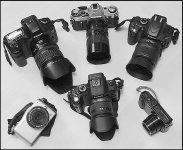
My style of photography seldom depends on sharpness, other than providing enough contrast for the viewer to see what I wish to show. For that reason, I simply use whatever camera is most helpful in a given situation... :naughty:

My cameras DSC-R1 07075.jpg
 
This is another and quite different point, which is of equal or even, greater mportance when discussing sharpness, contrast, etc.

My style of photography seldom depends on sharpness, other than providing enough contrast for the viewer to see what I wish to show. For that reason, I simply use whatever camera is most helpful in a given situation... :naughty:

View attachment 361812
To be honest, despite the previous conversations I do not get too hung up on sharpness per se, although when shooting things like wildlife it is nice to see fur and/or feather detail, and whilst sharpness is not 'that' important to me, I don't like to see soft mushy images either.

For me it's the overall rendering that I am interested in. I want that 3 dimensional look at for images to have that "pop", however these are difficult things to quantify and measure whereas sharpness can be measured and quantified (to a degree). Obviously these things depend on light, depth of field, contrast etc etc as well, but all I know is for the most part images taken with full frame sensors look more "polished" than those with a 1/2.3" sensor. Of course there's the look of medium format which I prefer further still but these are still relatively niche, and of course even bigger and heavier ;)

At the end of the day I do photography for myself, I know what I like and buy the equipment accordingly (within my budget of course), if others don't see it that doesn't matter to me. Hopefully we haven't confused Steve too much and he can do the same (y)
 
Back
Top