Camera or telescope ?

just jon

Suspended / Banned
Messages
75
Name
Jonathon
Edit My Images
No
Wonder if someone can help me .
Some of my photgraphy includes taking pictures of the moon currently i have a 200mm telephoto lens i would like to double it . Would i be better 2× tele coverter to make it into 400mm or a 400mm lens or get a telescope with a adapter to connect my DSLR to the telescope
 
Are you shooting full frame or crop sensor
 
Sorry.. no argument to be had here. Sheer value for money = scope.

Telescope.

The lens you'll need in order to take anything close to reasonable will probably cost more than a decent scope, so unless you already have a nice long lens, buying one for this purpose makes no sense (unless you also need it for other reasons). If it's investing in something just to take lunar images, then a scope offers the best value for money. It's obviously useless for shooting anything else land based though as astronomical scopes invert and reverse the image.

With a lens, you're going to need something in the order of 400mm plus, and even then you'll be cropping into the image quite severely.

£200 to £300 will get you a reasonably good telescope, that will not only allow great astro-photography opportunities, but also a great thing to have in it's own right, as just gazing at the stars is an amazing thing to do.

When buying a scope, you need to ensure that it can actually focus into a SLR body. As most scopes are designed to be used visually with an eye piece, most can't focus an image clearly into a camera body (which is set further away from the scope than the eyepiece normally would be).

A popular model is the Skywatcher series of scopes, and the 6" Skywatcher 150P. I can guarantee it works with all DSLRs, because I have one.

Reflector telescopes offer the best optical quality as they do not suffer from chromatic aberration like cheap refracting scopes do.

You'll also need an adaptor ring to mount the body to the scope.


To shoot anything more than the Moon though, you'll be needing motor driven equatorial mounts, and some kind of tracking.... which get's VERY expensive if you want to do it properly, and is a discipline way beyond photography itself. A whole new science and hobby in its own right, but shooting the moon is easy enough as the shutter speeds are high.

Taken with a Skywatcher 150P 6" scope, and a Nikon D7000

F9Inckr.jpg
 
Last edited:
Depends what your budget is and how keen you are to take photos of the moon. I would suggest a motor driven telescope, and a good, relatively cheap, starter scope would be something like this
http://www.firstlightoptics.com/az-goto/skywatcher-skymax-127-synscan-az-goto.html
You can get an adapter to connect your camera and snap away.
Of course, you will then develop an interest in astronomy and you run the risk of getting aperture fever very quickly!
FLO are an excellent company to deal with, give them a ring and explain what you want and they will make sure you get the best kit for your needs.
 
Thanks for the info much Appreciated and have Good New Year!!!!!!!
 
Depends what your budget is and how keen you are to take photos of the moon. I would suggest a motor driven telescope, and a good, relatively cheap, starter scope would be something like this
http://www.firstlightoptics.com/az-goto/skywatcher-skymax-127-synscan-az-goto.html
You can get an adapter to connect your camera and snap away.
Of course, you will then develop an interest in astronomy and you run the risk of getting aperture fever very quickly!
FLO are an excellent company to deal with, give them a ring and explain what you want and they will make sure you get the best kit for your needs.


That would be Ok for the moon, but not for deeper sky objects due to the alt/azimuth mount. You'd get field rotation on longer exposures. It's also more expensive, and smaller than the Skywatcher I linked to, and you can get a motor drive for the Skywatcher 150's mount, and being an equatorial mount, will offer more scope for long exposures.

There's also no mention of the one you linked to being able to achieve prime focus with a SLR attached.
 
Last edited:
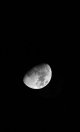
I forgot to include pic of moon
Taken with my sony alha a390 with 70mm - 210mm camera APS-C , and my full frame lens so the piture results are full frame .
This is because my old Minolta (FULL FRAME )film slr camera & lens fit on my sony being the same mount . As Sony now own Minolta .
 

Attachments

  • 1451815914300.jpg
    1451815914300.jpg
    12.1 KB · Views: 48
You need very accurate tracking if you are going to start taking long exposure images of deep sky objects. Depending on how serious you get, you can spend thousands on just the mount. Its a very expensive hobby if you are trying to take images of galaxies and nebulas that resemble the ones you see in books. Any motor driven scope, be it an alt az or eq mount will be fine for taking lunar and planetary images and even some images of prominent deep sky objects will be possible with exposures between 30 seconds and a minute without worrying about field rotation, depending on the size of your scope and where you are pointing it. After that, you soon realise the limitations in tracking accuracy of a cheap mount!
The Skymax I linked to, if you read the reviews, has been used connected to different DSLR,s with an adapter so will be fine for you. Plus, you can use it for viewing any of the hundreds of objects it has in its database.
Heres a couple of shots of Jupiter and Saturn I took using a fork mounted Meade 8" SCT using a camera with a sub 1mp camera.
2850517023_4d3ac3727f_z_d.jpg
3797707774_845ac7fe9e_o_d.jpg


Theres no reason you can't take similar, if smaller, images using the scope I linked to.

And just to show you whats possible when imaging the moon with a telescope and camera. heres a shot of the moons belly button, Copernicus. Again, with a very low powered camera ( 1/3 mp)

3796891439_ca0a3c9686_z_d.jpg
 
I said deep sky objects.
 
I said deep sky objects.
I know, but the OP didn't.
You also said to shoot anything other than the moon, you need a motor driven equatorial mount and tracking, I just posted images of the two planets I had taken using an alt az mount to show you don't.
:whistle:
 
I know, but the OP didn't.
You also said to shoot anything other than the moon, you need a motor driven equatorial mount and tracking, I just posted images of the two planets I had taken using an alt az mount to show you don't.
:whistle:


Once you start down this road... there's no way you'll be content with the moon and the brighter planets... tell me I'm wrong :)

There is one advantage to the scope you linked to though, and that's it's focal length (being a Cassegrain instead of a Newtonian)... but only for planets. A shorter focal length is desirable for deeper sky objects, which in the main, are actually quite large... but very dim, as opposed to planets which are generally bright, but small... with the exceptions of the outer planets (anything past Jupiter) obviously.
 
Last edited:
Once you start down this road... there's no way you'll be content with the moon and the brighter planets... tell me I'm wrong :)

There is one advantage to the scope you linked to though, and that's it's focal length (being a Cassegrain instead of a Newtonian)... but only for planets. A shorter focal length is desirable for deeper sky objects, which in the main, are actually quite large... but very dim, as opposed to planets which are generally bright, but small... with the exceptions of the outer planets (anything past Jupiter) obviously.
You are not wrong. That way leads to bankruptcy! After taking those images of the planets and moon, I tried to get into deep sky imaging. The telescope ( Skywatcher 80ED-DS pro with focal reducer) was the cheapest item at around £450. The mount cost me over £1200, the camera £700 and the guider £300, not to mention all the other bits and bobs you need. It's never ending. In the end, I just didn't have the patience and soon got fed up and sold the lot.
I now have a 10" Meade LX200 an 8" Meade LX 90 ACF and a Celestron 6" Evolution with half a dozen assorted eyepieces. All the scopes are fork mounted, although I have a wedge for the LX200. I just do visual observing now.
 
Back
Top