Camera body repair (Treating aluminium) FILM TEST RESULTS ADDED!

Asha

Blithering Idiot
Suspended / Banned
Messages
11,274
Name
Asha
Edit My Images
Yes
Thanks to the help from you guys I have obtained some adhesive suitable for repairing the peeling leatherette on some of my gear.

This particular repair job concerns me a little as the aluminium is flaking and tbh I don't know wether simply applying adhesve will work;

Do I need to treat the aluminium beforehand with some other product??

dsc0051gf.jpg

Shot at 2012-05-04
 
Last edited:
I'd give it a light sanding to get any loose flakes off, then put the leatherette back on
 
dsc0049mv.jpg

Shot at 2012-05-04


This is the camera ...a folding pocket kodak No 1A

I haven't yet assessed its exact age but definitly 100+ years ...possibly as early as 1897 although more realistically I think it's about 1905

In decent condition and working order except for the red window missing and the leatherette repair job.

Hoping to use it in my 52 all being well!

I'll be having a practice run at this glueing lark on one of the other cameras that I'm not so bothered about should the job go pear shaped.

I'm possibly being a little over cautious and should just get on with the job but naturally I don't want to have regrets at causing unnecessary damage.
 
Funnily enough I have exactly the same camera and was thinking of trying to strip it down and get it running again. It seems to have a working shutter and the bellows appear to be light tight so I would be very interested to see how you get on with this.

Cheers

Andy
 
That looks like salt corrosion, is it quite powdery when rubbed/ scratched? I would suggest a very light sand and seal it with some laquer before regluing the leatherette.
 
That looks like salt corrosion, is it quite powdery when rubbed/ scratched? I would suggest a very light sand and seal it with some laquer before regluing the leatherette.

If it is Aluminium it's not salt corrosion, Aluminium does not corrode in non acidic or alkaline environments due to it's oxidised coating :geek:
It could be the glue from the previous coating still stuck to the Aluminium.
Either way, a light sand and re-glueing will do the job
 
If it is Aluminium it's not salt corrosion, Aluminium does not corrode in non acidic or alkaline environments due to it's oxidised coating :geek:
It could be the glue from the previous coating still stuck to the Aluminium.
Either way, a light sand and re-glueing will do the job

Trust me, it does corrode - have you ever seen a Canal outboard leg with Seagoing (or no) anodes? Or if you have alloy wheels, look at the back of them, There's a good chance you'll see the same thing but of a much lower order.

I used to have to work with this stuff to earn a living, corroded aluminium is very fragile and makes things and arse to work on!
 
Last edited by a moderator:
Trust me, it does corrode - have you ever seen a Canal outboard leg with Seagoing (or no) anodes? Or if you have alloy wheels, look at the back of them, There's a good chance you'll see the same thing but of a much lower order.

I used to have to work with this stuff to earn a living, corroded aluminium is very fragile and makes things and arse to work on!

Thats a different situation entirely, in your case you will have Galvanic Corrosion. This happens when you have 2 different metals in contact with each other and an electrolytic solution, this causes a circuit to form and one metal to break down.
Steel Axel connected to Aluminium Alloy wheel etc
 
robhooley167 said:
Thats a different situation entirely, in your case you will have Galvanic Corrosion. This happens when you have 2 different metals in contact with each other and an electrolytic solution, this causes a circuit to form and one metal to break down.
Steel Axel connected to Aluminium Alloy wheel etc

Now that's geeky! :)
 
indeed ithere is galvanic action (hence anodes) that causes it, but it's still very much corrosion :thumbs:

As to what caused the avove, who knows, scrubbed before the glue was applied?
 
That looks like salt corrosion, is it quite powdery when rubbed/ scratched? I would suggest a very light sand and seal it with some laquer before regluing the leatherette.

It is very powdery when rubbed......some sort of corrosion of some sort. I have no knowledge as to what has/is causing it and am thankful of any advice.

I agree with Rob in so far as a rub down and re glue of the leatherette but am unsure as to wether the glue will hold long term if the aluminium isn't teated/sealed in some way.

If I was to seal it, what would I seal it with?

And, would the sealing product have an adverse effect with the adhesive (pliobond) and / or leatherette.

I appreciate that I could attempt to find a proffessional who does this type of repair but using common sense, I can see no reason as to why renovations cannot be done without their services ( not that i'm convinced that they would do a better job than myself! lol)
 
Funnily enough I have exactly the same camera and was thinking of trying to strip it down and get it running again. It seems to have a working shutter and the bellows appear to be light tight so I would be very interested to see how you get on with this.

Cheers

Andy

With a working shutter and decent bellows, I wouldn't hesitate in giving it some tlc and a new lease of life!
 
If I was to seal it, what would I seal it with?

And, would the sealing product have an adverse effect with the adhesive (pliobond) and / or leatherette.

I would put down a thin coat of primer and a coat of paint, then glue the leatherette on

Make sure the paint is made for metals though, otherwise it wont stick very well.

Most cameras have a layer of lacquer paint on them before the leatherette, but lacquer is hard to apply without air sprays, maybe car paint would do the job?
 
Having done some aluminium painting in the past, I have always put down paint in the following order.

Etch primer specifically for aluminium.

2 layers of primer over this.

A number of layers of coloured paint flatted between coats more layers normally means more depth to the colour.

Lacquer coats over this again flatting between coats then a cut and final polish.

But please note I'm by no means a professional.
 
I would put down a thin coat of primer and a coat of paint, then glue the leatherette on

Make sure the paint is made for metals though, otherwise it wont stick very well.

Most cameras have a layer of lacquer paint on them before the leatherette, but lacquer is hard to apply without air sprays, maybe car paint would do the job?

Mmmm this could prove interesting.....

It's a long time since i primed/painted anything metal.

I did railings last time using a grey primer then black gloss.....specifically for metal surfaces.

I'm presuming something similar will work with a slight rubbing down of the gloss so the adhesive will take properly.

Could turn out quite a pricey renovation as stuff like paint costs a mint down this neck of the woods.

If there is some sort of clear/translucent lacquer that would work then perhaps that would be a cheaper and easier alternative?
 
Ok I'll go on the hunt for primer ...... hopefully be able to find something specific for aluminium.....If not in my local diy store then perhaps online.....wether I can get hold of that particular brand of hammerite will have to be seen as I'm not in the UK!
 
If it is Aluminium it's not salt corrosion, Aluminium does not corrode in non acidic or alkaline environments due to it's oxidised coating :geek:

If you drop aluminium into NaOH or KOH - it will dissolve, slowly at first due to the oxide coat, but once it's through a pinhole or scratch in that - goes reasonably rapidly...
 
If you drop aluminium into NaOH or KOH - it will dissolve, slowly at first due to the oxide coat, but once it's through a pinhole or scratch in that - goes reasonably rapidly...

Does that mean that aluminium corrodes simply in contact with air over a long period of time?
What is a little wierd to understand is the aluminium to the exterior of the camera / under the leatherette is very flakey/powdery whilst the internal sides are like new condition!
 
Does that mean that aluminium corrodes simply in contact with air over a long period of time?
What is a little wierd to understand is the aluminium to the exterior of the camera / under the leatherette is very flakey/powdery whilst the internal sides are like new condition!

Aluminium will not corrode if simply left in air, it protects itself by corroding a small amount, the layer of Aluminium Oxide protects the rest of the Aluminium.

It could well be down to the glue used to put the leatherette on with in the first place
 
Aluminium will not corrode if simply left in air, it protects itself by corroding a small amount, the layer of Aluminium Oxide protects the rest of the Aluminium.

It could well be down to the glue used to put the leatherette on with in the first place

Aha me understanding more now.....takes time for stuff to sink in! :D

Does that apply to brass too?? Turns black but then polishes up a treat only to tarnish again quite rapidly?
 
I think that is due to the copper in brass, not 100% sure though. I would guess it depends on the composition of the brass
 
dsc0049mv.jpg

Shot at 2012-05-04


This is the camera ...a folding pocket kodak No 1A

I haven't yet assessed its exact age but definitly 100+ years ...possibly as early as 1897 although more realistically I think it's about 1905

In decent condition and working order except for the red window missing and the leatherette repair job.

Hoping to use it in my 52 all being well!

I have one as well but don't know how to get the back off it! I thought the small nickel slider on the bottom would be to open it but no luck. Any tips?
 
I have one as well but don't know how to get the back off it! I thought the small nickel slider on the bottom would be to open it but no luck. Any tips?

You are correct with the slider....that locks the two sections of the camera together.

I'll try explain how to get into it:

The camera is in 2 pieces.

The main body of the camera ( bellows, shutter etc) is attached to the leatherette covered aluminium top section ( the piece that the film winder sits on)....see second pic

The main body sits inside the housing which consists of the back, the sides and the bottom.....see first pic

The slider is slid a few mm in the direction away from the film winder. Whilst holding it in that position the two sections can be pulled apart ........if the aluminium is corroded like mine then it may initially be difficult to get them to budge.

The aluminium top overlaps the back and sides of the aluminium bottom section by approx 4mm....once it clears this then the two parts should come apart easily

If this makes no sense at all ( as is probable with my explanation!! lol) then if you wish i'll sort some more pics / diagrams to help you.
 
You are correct with the slider....that locks the two sections of the camera together.

I'll try explain how to get into it...

If this makes no sense at all ( as is probable with my explanation!! lol) then if you wish i'll sort some more pics / diagrams to help you.

Aha! Thankyou so much! :notworthy: I have it open at last!
The shutter works, the bellows are perfect and I've just cleaned up the lens. Just need to improvise some sort of spool modification now...
 
Aluminium does not corrode in non acidic or alkaline environments due to it's oxidised coating :geek:
If you drop aluminium into NaOH or KOH - it will dissolve, slowly at first due to the oxide coat, but once it's through a pinhole or scratch in that - goes reasonably rapidly...

But of course, as Rob says in pH neutral solutions (like NaCl solution) you won't get corrosion. Unfortunately Rob's precision of writing is lacking.

Rob, did David Scantlebury teach you your corrosion stuff?
 
Aha! Thankyou so much! :notworthy: I have it open at last!
The shutter works, the bellows are perfect and I've just cleaned up the lens. Just need to improvise some sort of spool modification now...

Cool!........glad to have been able to help.

An alternative to sorting spools is to cut sheet film to fit. You will only get one shot at a time and you have to ensure that the red window is made light tight.

It's something I do regularly when film is no longer available for the camera I wish to use!

It's a good way of checking that the camera works ok too without "wasting" a whole roll of film.

Would love to see the results you get from yours!
 
But of course, as Rob says in pH neutral solutions (like NaCl solution) you won't get corrosion. Unfortunately Rob's precision of writing is lacking.

Rob, did David Scantlebury teach you your corrosion stuff?

Yes my written communication is a little lacking at times

Alas no we didnt, we got Stuart Lyon, compressed the 12 week course into 4 :shake:
 
An alternative to sorting spools is to cut sheet film to fit. You will only get one shot at a time and you have to ensure that the red window is made light tight.

Nice one, that's got to be worth a try! I'll let you know how I get on.
 
Having done some aluminium painting in the past, I have always put down paint in the following order.

Etch primer specifically for aluminium.

2 layers of primer over this.

A number of layers of coloured paint flatted between coats more layers normally means more depth to the colour.

Lacquer coats over this again flatting between coats then a cut and final polish.

But please note I'm by no means a professional.

OK well an update on this project ( not that i've progressed very far yet!!)

Searched all over for primers suitable for aluminium.....very limited in what I' ve found...most being in aerosol form which will make the job even harder or tins of 500ml which I don't need and to top it all the "profeesional" answer from the retailers as to wether the products will be suitable are not convincing so I've hunted online and found this:

http://www.ebay.co.uk/itm/370582964.../sch/i.html?_sacat=0&_nkw=370582964606&_rdc=1

Awaiting a response to p&p to send out here but i'm presuming this will do the job perfectly as the base then glue the leatherette on top.

I'll keep you informed as to the outcome, not that I'm looking forward to doing the actual job....always concerned that i'll make a complete hash of it!
 
Well I am seriously proud of myself!

I've eventually got this project completed and the camera is now ready to be used :thumbs:

A bit of a run down with some snapshots (not for CC :lol:) basically explaining what i did following the superb help etc i received from you guys:


1. Rubbed down the aluminium and remove as much of the loose flaking as possible without destroying the camera body completely wearing an obligatory dustmask and goggles .....that alu dust is sooo fine and gets everywhere:gag:


Applied one coat of Grey Acid Etch Primer ( Thank you Paul Westhead for the name of the product required!)

Allowed to dry thoroughly ...24 hours +

Ended up with this result:

48231742.jpg

Shot at 2012-09-12


2. Next replacement of the red window.

Many thanks to John (Joxby) for supplying red gel filters...top man! :thumbs:

I decided that the gel filter alone was going to be too flimsy and liable to split in a short period of time so decided to use some clear plastic cut from a fruit container destined for the dustbin alongside it to give it a bit of umph!

This is now where i hit a small problem although it was no surprise.

The adhesive (Pliobond) recommended by Rob Hooley ( Thanks Rob for your help!) for glueing leatherette is very good stuff however the gel filters do not take well to it and litterally disolve on contact :eek: so the first attempt at adhering the new red window to the body failed miserably :(

Undefeated I figured that be making a "pocket" from the clear plastic, the red gel filter would slot inside and be unnaffected by the glue .......left the "pocket" to dry thoroughly before inserting the gel filter then glue a little more around the edges of the clear plastic.....yippee obstacle overcome :banana:

94978256.jpg

Shot at 2012-09-12

66335606.jpg

Shot at 2012-09-12

3. Replacement of the leatherette:

A dry run to see exactly how it would sit on the camera body ensuring that the red window hole was going to line up correctly.

Also examined carefully exactly where to glue so as not to cause any problems when relocated the main part of the camera inside of the body casing.

Glue onto the camera body, applied the leatherette covering, adjusting into correct position, held firmly in place for 10 mins whilst the glue took hold then left to dry thoroughly.


4. Re-assemble the camera with a spool of 120 backing paper to see if all works ok:

22346705.jpg

Shot at 2012-09-12

27932807.jpg

Shot at 2012-09-12

91743578.jpg

Shot at 2012-09-12

To some the job could have possibly been done better I guess especially the red window but tbh I have limited skills in the diy dept so for me it was about the best i could do ....Fact is it will work and it has in no way modified the camera in such a way that it no longer resembles it's original state so for me that is superb news.

Time to get some film through it........

 
Last edited:
Fantastic job Asha, very impressed with your solution to the red window problem, I've got a couple of those that need doing can I send them to you :lol:
 
Fantastic job Asha, very impressed with your solution to the red window problem, I've got a couple of those that need doing can I send them to you :lol:

Should you get yourself down here before you get round to repairing em then by all means bring them with you but be assured I aint glueing two....I'll leave that part to you ...the fumes from pliobond sends me high as a kite :nuts:

On a more serious note, if you do have a go be sure to do a test on the plastics that you use with the glue beforehand...could save you a load of hassle :thumbs:
 
Well done that man, super job. I've compared mine to yours (ooer) and it would appear mine is a later model.

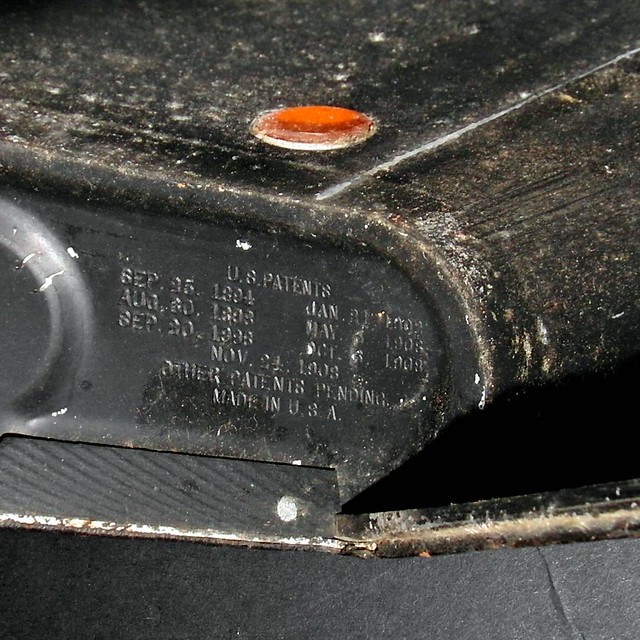
As you can see the latest patent was for 1908

Patents by andysnapper1, on Flickr

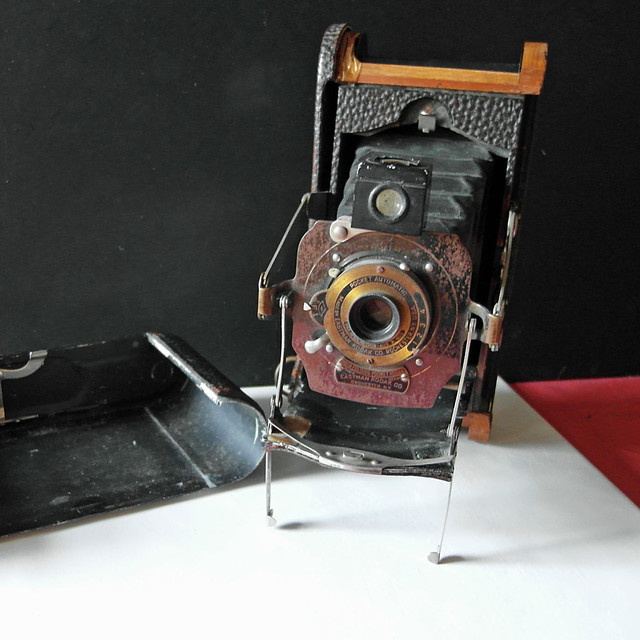
And the front end is completely different

1A by andysnapper1, on Flickr

Seems as if the shutter is very dodgy and the wood frame needs a re-glue but otherwise it looks ok.

Andy
 
Well done that man, super job.
Andy

Thank you Andy ....Like most things in photography, takes commitment, dedication and patience but it does pay off!

I've compared mine to yours (ooer) and it would appear mine is a later model.


Andy

Looks probably like the 1912 - 1915 production but I would have to do more research to be sure ...so many variations of all these old cameras out there can make dating quite a demanding task.

Well done that man, super job. I've compared mine to yours (ooer) and it would appear mine is a later model.


Seems as if the shutter is very dodgy and the wood frame needs a re-glue but otherwise it looks ok.

Andy

I would suggest some form of specific wood glue Andy (I suspect it's available in clear/transparent form) ...I've used superglue before which is ok but tends dry quite brittle and gives way after a while.

As for the shutter......I reckon you could access it.....it probably just needs a clean up inside if it's sticking.....just be sure to choose a quiet time with no pressure so you're calm and relaxed about it if you decide to have a go!
 
Having done some aluminium painting in the past, I have always put down paint in the following order.

Etch primer specifically for aluminium.

2 layers of primer over this.

A number of layers of coloured paint flatted between coats more layers normally means more depth to the colour.

Lacquer coats over this again flatting between coats then a cut and final polish.

But please note I'm by no means a professional.

I have got to agree with the above about etching primer, after working in a classic car paintshop for many years in the 70s/80's we painted a lot of aluminium bodied cars and if the bare ali wasn't done with etching primer it didn't stick very well...
 
Thanks Asha, I will definitely be giving it a go. Just need to find the time when there's no one about and I can have an hour or two to concentrate.

Andy
 
Back
Top