
OP

- Messages
- 3,806
- Name
- Just call me Mad Madam Mim
- Edit My Images
- Yes
This week is a continuation from last week's as it is about the town, Lubrin, where the Fiesta took place.
Over 100,000 years ago it was a settlement of Neanderthals before homo sapiens took over and thousands of years later in the 16th Century when it was populated by Moors from the Granada region. As the Christians battled to take back control of Spain they waged war on many towns, Lubrin included, and killed everyone in mass genocide.
They then resettled the area with about 30 (Christian) families from Lorca to as far away as Galicia and the new town was founded in 1528 and each family was given a piece of land to settle. The main products were olive oil and wheat together with wine and chick peas which they were then able sell to Lorca, Murcia and Almeria.
At that time there were recorded to be 3 olive presses (almazaras), 6 flour mills (molinos de trigo) and 5 public bread ovens (hornos para cocer el pan).
Between 1953 and 1957 there was also mining for iron which employed around 500 people and, a little later, a marble quarry lasting until the 60s producing white and green marble.
It's over 500 metres above sea level and on Tuesday this week, when we had a massive storm (yes it does rain in Spain ) there was snow and massive hailstorms up there
So it's a very old town settled into the hillside with really narrow streets and very steep climbs from street to street. (As I found out to my cost on Thursday - how I suffer for your education
  )
)
So this is what I ended up with. A view of one of those narrow steep streets, a landscape of the town, and an old man sitting weaving thin cane whilst talking to his friends, where I paused to get my breath back.
But at least I'm feeling better

All village/small town streets are like this between about 2 and 5 as people are at home for siesta and,apart from the bars, everthing is closed.

and the almond blossom has just started appearing.
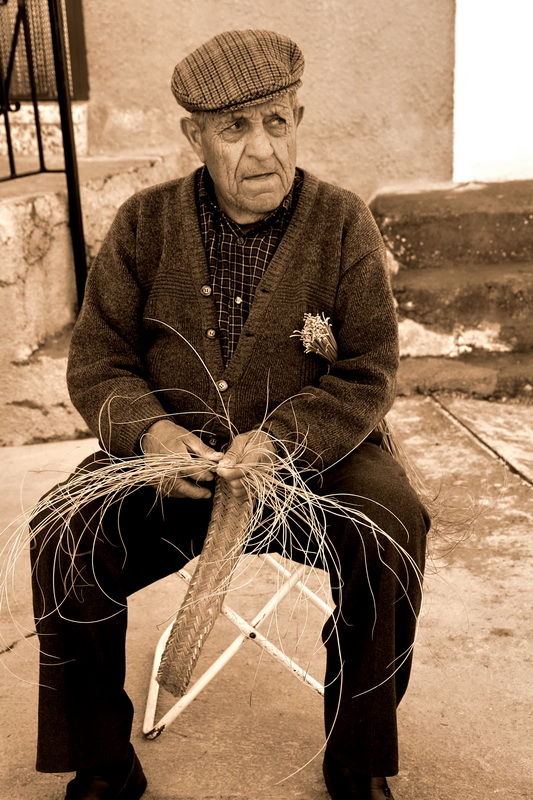
I thought sepia suited him
Over 100,000 years ago it was a settlement of Neanderthals before homo sapiens took over and thousands of years later in the 16th Century when it was populated by Moors from the Granada region. As the Christians battled to take back control of Spain they waged war on many towns, Lubrin included, and killed everyone in mass genocide.
They then resettled the area with about 30 (Christian) families from Lorca to as far away as Galicia and the new town was founded in 1528 and each family was given a piece of land to settle. The main products were olive oil and wheat together with wine and chick peas which they were then able sell to Lorca, Murcia and Almeria.
At that time there were recorded to be 3 olive presses (almazaras), 6 flour mills (molinos de trigo) and 5 public bread ovens (hornos para cocer el pan).
Between 1953 and 1957 there was also mining for iron which employed around 500 people and, a little later, a marble quarry lasting until the 60s producing white and green marble.
It's over 500 metres above sea level and on Tuesday this week, when we had a massive storm (yes it does rain in Spain
) there was snow and massive hailstorms up there So it's a very old town settled into the hillside with really narrow streets and very steep climbs from street to street. (As I found out to my cost on Thursday
- how I suffer for your education )So this is what I ended up with. A view of one of those narrow steep streets, a landscape of the town, and an old man sitting weaving thin cane whilst talking to his friends, where I paused to get my breath back.
But at least I'm feeling better
All village/small town streets are like this between about 2 and 5 as people are at home for siesta and,apart from the bars, everthing is closed.
and the almond blossom has just started appearing.
I thought sepia suited him


 ) Es un pais muy bonita y muy differente.


