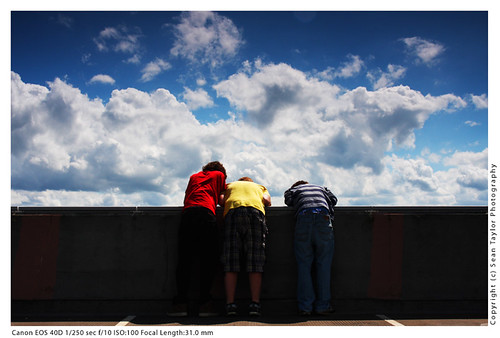
Blown-out Skys

DavidUK

Suspended / Banned
Messages
473
Edit My Images
No
I went on my first outting for a number of years with my D70 yesterday and found myself remembering all the things I used to struggle with, one of which being blown-out skys (or just bright white skys).

I guess it's a case of correct metering, I had a play using the different metering modes and exposure-lock but didn't get consistant results.

Does anyone have any pearls of wisdom to help me on my way! :'(
 
Use a neutral density grad filter to reduce the sky's brightness and get a more even exposure. It made shots like this possible for me:

2742344170_9bdc7bc1e3.jpg


Alternatively take 2 shots: One with the sky correctly exposed, and one with the foreground correctly exposed, and then merge the two in photo editing software.
 
Use a neutral density grad filter to reduce the sky's brightness and get a more even exposure. It made shots like this possible for me:

2742344170_9bdc7bc1e3.jpg


Alternatively take 2 shots: One with the sky correctly exposed, and one with the foreground correctly exposed, and then merge the two in photo editing software.

I seem to remember reading somewhere that you should use the camera to get a reading for the sky, one for the ground and then manually select a reading somewhere inbetween, but didn't work when I tried it.

I might try a filter then :) I had a Lee starter kit I bought a few years ago but the lens mount is damaged, what type of filter do you suggest?
 
Then you'd get a still overexposed sky and a still underexposed foreground. Wouldn't achieve anything sadly :(
But this would mean you could pull more from it, as in reduce the brightness of the sky and increase the brightness of the foreground.

I'd recommend a 3-stop nd-grad filter.
I have the cokin one (a Grey Grad ND8), but no doubt the Lee ND 0.9 Grad is better :)
 
This is one of the hardest things to get right in camera David. Often, the only way to achieve a perfectly exposed sky and foreground is to deal with it in PP. The best thing to do is to have the camera on a tripod, exposed the shot once for the sky and once for the foreground then blend the two together. If a tripod isn't an option then use exposure bracketing to achieve the different exposures.

HTH :)
 
I guess it's a case of correct metering, I had a play using the different metering modes and exposure-lock but didn't get consistant results.

You might try using manual fully, like make sure your white balance isn't on auto too, that should give you consistent results.

I'd go for three exposures on FPs shot myself, one for the sky one for the shadow and one in between then merge them later during PP.
 
I get great skies using a polarising filter and 1-stop grey grad or sometimes a 2-stop.

Use the polariser at right angles to the line of the sun's rays - ie to your left or right. Don't bother when the sun is high in the sky - I get best results about 2-3 hours after sunrise or before sunset. Those for me are the magic hours.:)
 
Some people regard this as cheating - but an alternative is to do it in PP. Lightroom 2's graduated filter tool achieves similar kind of results as a grad filter. There's something magical about seeing the sky reappear in front of your eyes.
 
:agree: go for an ND grad and sort it out on the spot. You can correct only so much back at base
 
To see more of the effect the grad has on the shot, use your DOF review on the camera
 
I'll second foodpoison (and others) a ND grad is the way to go.
 
Well, either you have to sort it out whilst taking the photo (ie. a filter) or you do it in PP with software.

I've been playing with Lightroom 2 today and there's a new dodging and burning tool which does pretty remarkable things to white and bright blown out skies. Or you can underexpose the foreground and use "fill light". Both damage the photo slightly though, but the new dodging and burning tool is pretty damn impressive frankly!
 
This is one of the hardest things to get right in camera David. Often, the only way to achieve a perfectly exposed sky and foreground is to deal with it in PP. The best thing to do is to have the camera on a tripod, exposed the shot once for the sky and once for the foreground then blend the two together. If a tripod isn't an option then use exposure bracketing to achieve the different exposures.

HTH :)

Thanks Grendel :)

When I stopped taking regular photos a few years ago I was more or less at the same stage I am now, I want to take it that step further and improve my skills, and I guess my Photoshop skills will need improving too.

When I went to Fountains Abbey at the weekend I found myself wondering which metering mode to use in case one of those would give better results.
 
Thanks for the advice everyone :)

I think I'm going to go for an ND filter. I already have a Lee filter adapter so might get a Lee ND grad, though on Warehouse Express the 0.9 ND Grad is £50! :(
 
Then you'd get a still overexposed sky and a still underexposed foreground. Wouldn't achieve anything sadly :(
But this would mean you could pull more from it, as in reduce the brightness of the sky and increase the brightness of the foreground.

I'd recommend a 3-stop nd-grad filter.
I have the cokin one (a Grey Grad ND8), but no doubt the Lee ND 0.9 Grad is better :)

Well I was passing a local photo store today so I popped in and bought one of the cokin filters, Gradual Neutral Grey G2 (ND8).

I took quite a few photos using the filter, the weather was particuarly overcast and the light wasn't great. I've just finished looking through some of my shots and what looked reasonably good in the field looks very dull and flat on the computer :(

I've just bought myself a new monitor and am wondering if its colour temperature isn't calibrated correctly, but then again that could just be me making excuses :sulk:

http://www.flickr.com/photos/30319225@N04/2839850019/
 
Back
Top