Blown out skies

Guy Fawkes

Suspended / Banned
Messages
201
Name
Lee Thurston
Edit My Images
Yes
Every photo I take seems to have blown out skies, my girlfriend and I were out walkign tonight and i saw a few nice shots and even commented "that sky looks cool" but in every shot the sky is white or has picked up abour 25%ish of the actual sky I could see with my naked eye. :'(

What am I doign wrong? :thinking:

Do i need to be taking my tripod out all the time?

I'm (very) new to photography and finding it all a bit information overload at the minute. Just bough Tom Ang's how to photograph bloody everything so hopefully than will help.

It's just so frustrating as I have all these shots in my head, and i know exactly what i want to achieve, I just don't have the know-how to be able to get the camera to produce my 'visions'. :(
 
I got round this at first by using a circular polarisor (quick Google and you will know what they are and what they do).

If you have something like Photoshop you can consider shooting in raw and tweaking the exposure. This months Practical Photography had a good tutorial on this and is in general a good mag for beginners.
Well at least I thought so
 
First thing is not to get despondent!

You are seeing the shots and it won't be long before you get them in camera. Rather than having to adjust everything in photoshop (there are shots that you will need to do it but let's try to keep them to a minimum) First thing to do is look at your metering.

Your camera will probably have more than one metering mode and if you are using evaluative metering your camera will be looking at the whole scene and trying to average it. Because the sky is brighter it overexposes.

So.

You can try switching to spot metering and actually exposing for the sky if it is the sky you want to capture. You can then bring out a bit of the foreground in photoshop.

You can also try adding a graduated filter to your kit. A neutral density or a grey grad will help to hold the exposure in the sky while getting the foreground.

Give it a bash and let us know how you get on.
 
Meter for the sky, if its bright you'll lose detail in the land, but you will get the sky.
I don't think its a tripod problem.
The sky is blown because the camera is choosing best exposure for the land, which is darker.
Ideally, your looking for somewhere in-between so you don't have to spend yonks in edit.


busted...by the Ali
 
Thanks so much chaps. :)

Just had a quick check and my camera (400d) has 3 metering modes;
Evaulative metering
Partial metering, and
Centre-weighted average metering

Which of these should be using?

Humble apologies for ridiculous questions.
 
I think Partial uses something like 9% of the centre of the frame so it would be the closest to spot metering.
 
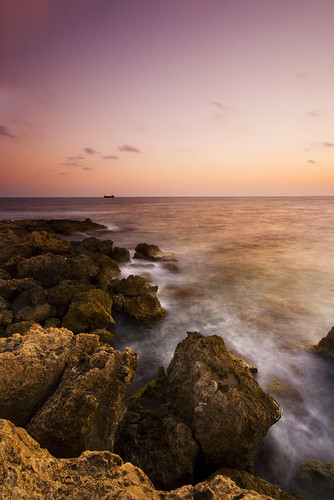
I find graduated filters are the best for these kind of shots, if you are not lazy, if you have a tripod (not really necessary but it helps) and if the horizon is somewhat a straight line.
2293864780_8b577ef6b2.jpg


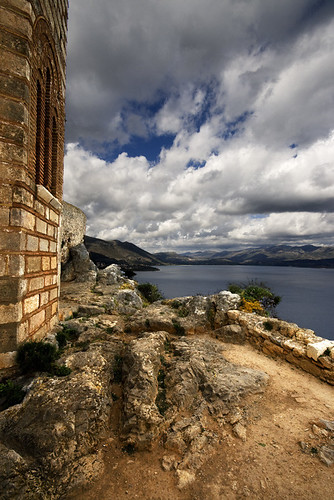
Second best (for some first best) option is to take 2 exposures, one metering for the sky and the other metering for the land. Then combine both in Photoshop or similar. For this you will definitely need a tripod to capture the same image.
2332753303_a99c9d0001.jpg


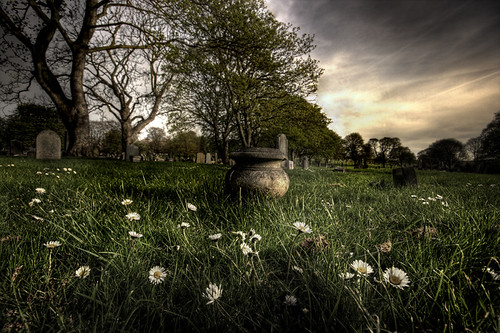
Third best is to combine 3-5 different exposures using the HDR method, with programs such as Photoshop and Photomatix. This gives dramatic results, which can seem a little unatural if you overdo it with the effect.
2458032306_6c866afea2.jpg

This has some other effects in photoshop, to get this eerie look but you get the point.

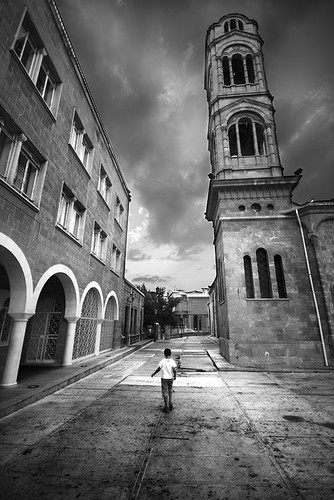
4th option (the lazy option) is to just take one photo in raw, expose it in your raw converter once for the sky and once for the land and do like option 2.
2293854922_806eaf2b50.jpg

In this case I couldn't have used any other method due to the candid shot of the kid in the scene.
 
I find graduated filters are the best for these kind of shots, if you are not lazy, if you have a tripod (not really necessary but it helps) and if the horizon is somewhat a straight line.
2293864780_8b577ef6b2.jpg


Second best (for some first best) option is to take 2 exposures, one metering for the sky and the other metering for the land. Then combine both in Photoshop or similar. For this you will definitely need a tripod to capture the same image.
2332753303_a99c9d0001.jpg


Third best is to combine 3-5 different exposures using the HDR method, with programs such as Photoshop and Photomatix. This gives dramatic results, which can seem a little unatural if you overdo it with the effect.
2458032306_6c866afea2.jpg

This has some other effects in photoshop, to get this eerie look but you get the point.

4th option (the lazy option) is to just take one photo in raw, expose it in your raw converter once for the sky and once for the land and do like option 2.
2293854922_806eaf2b50.jpg

In this case I couldn't have used any other method due to the candid shot of the kid in the scene.

This is what I call PHOTOGRAPHY! A very pleasing and calming shot. It suits the soul within you when you are viewing this.
 
This is what I call PHOTOGRAPHY! A very pleasing and calming shot. It suits the soul within you when you are viewing this.

Wow, thanks shifter!! I'm thrilled by your great compliments! I'm glad you like them!
 
Hi everyone,

Many many thanks for your input, defiintely food for thought and I wil try to digest everythign you've said.

Is it nigh on impossible then to get a perfect landscape with just one shot? Or can the better togs accomplish this?
 
In my experience there's no substitute for being there at the right time in the right quality of light. For skies a polariser helps a lot and if your skies are always blown out a 1 or 2 stop graduated neutral density filter could be the answer.

Otherwise its down to experience and learning from your mistakes.

I don't really think there's any shortcuts ; but still being dragged kicking and shouting into the photoshop age I could be wrong...
 
Guyfawkes,

Graduated filters are a godsend and really do make your photography grow.

Here are two test shots I did today for a magazine spread, one with a grey grad, one without. It's clear to see how they work and how they help balance out tricky exposures that your camera's metering system would have a problem with.

Without a graduated filter
DSC_1141.jpg


With a graduated filter
DSC_1142.jpg


Thjat was using a stadard (+2 I think) grad filter, also called a Neutral Density grad filter. A stronger (+4) filter would have increased the detail in the sky further but would subsequently have darkened the reeds on the left further.

Okay, they're not the greatest shots, but they show how much of an impact a filter can have and it just means less post-production in Photoshop. There's no change in exposure value but the filter just helps to hold ontot he detail int he sky.
 
Cool, think i'm def goign to get myself one of those ND filters then, they look the business and if i try to improve my 'technique' alongside it, I should be laughing in a wee while/few years!!! ;)

Thanks again everyone, much appreciated.

P.s. Where's the best place to buy a filter from?
 
Hi everyone,

Is it nigh on impossible then to get a perfect landscape with just one shot? Or can the better togs accomplish this?

It's not a case of being better GF, it's a case of knowing which tool to use for which job. Sometimes there are conditions that even the best tog will struggle in. Generally the flatter the light, the less you have to overcome it by some form of deception. It's all smoke and mirrors really :geek:
I generally like to get it is good as I can in camera but others prefer the photoshop route, all perfectly valid too.
 
You don't have to always combine shots to get a decent landscape exposure. it takes a bit of experience to work out the best approach and even then there are times when it just can't be done.

My last outing to South Africa I found the polarising filter did all the control of sky brightness i needed. In canada the polariser was not enough at times and i had to use a ND grad filter to darken the sky. Sometimes with light through an opening etc you can't filter it down and it is either accept it or combine shots.

there is a link in my sig that will get you to the SA and canada shots.
 
Other cameras' metering is known for preserving highlight detail, plunging the rest of the shot into the gloom.

The direction of the shot in relation to the sun has a major impact on a polariser's effectiveness and whether subjects on the ground are in shadow.

With the current state of technology, a medium format camera with negative (print) film is still worth using (with a graduated ND filter) for greater latitude and dynamic range.
 
It's not a case of being better GF,

I disagree. Someone starting out in landscape photography is going to struggle to get the results that the more experienced will get. Its just not reasonable to suggest otherwise, and will give a false impression that the landscape is easy subject matter.

The quality of landscape photography is so high now. I was recenly leafing thro' some photography magazines from the 1980's and was shocked at what was being published then. I suspect that the introduction of Velvia may have had something to do with the improvement actually - but I digress.

So, GF, get yourself a couple of filters (as mentioned) and a tripod (if you don't already have one) and get to know how to use your gear almost with your eyes closed. A new camera won't necessarily make you a better photographer , but getting to know what you've already got will.

Also there's some great books out there by people who really know what they're doing. Try Outdoor Photography too.
 
Just a small point to add with Graduated Filters - if you have a lens like a Canon 18-55 where the focus turns the filter thread, then it will be very hard to get it level.
That's the only reason I persevere without an ND Grad.
:bang::bang:
 
So, GF, get yourself a couple of filters (as mentioned) and a tripod (if you don't already have one) and get to know how to use your gear almost with your eyes closed. A new camera won't necessarily make you a better photographer , but getting to know what you've already got will.

Many thanks for the advice everyone, it's absolutely fantastic.

This is exactly what I am goign to do ^^^, thanks again.
 
I disagree. Someone starting out in landscape photography is going to struggle to get the results that the more experienced will get..

Sorry but you have taken me slightly out of context, or perhaps I should have said it better :)

What I meant was in answer to GF's question of "Is it nigh on impossible to get the perfect landscape with just one shot or can the better togs accomplish this"

I'm trying to stress that no matter how experienced, there are still conditions that would be almost impossible not to have to revert to some adjustment in photoshop.

I totally agree that the more experienced you become the more you can get out of a scene (and the more you can get right in camera too). I'm finding this out for myself now I've just bought my first wide angle!:help:

I guess I'm just working around the word "better" your "more experienced" is a better choice I think :thumbs:
 
....Where's the best place to buy a filter from?

Ebay to start with. Don't get screw-in ones, as they're limited. Cokin P-type oens are the best. You don't have to spend a fortune. I bought mine here.

Make sure you get:

a Cokin P-type filter holder (this holds the filters in front of the lens)

a filter adaptor (this will be in the mm of the front of you lens, 67mm for example)

Cokin P-sized filters (rectangualr filters)
 
I learned my photography in the age of film and if you didn't get it right in camera you were stuffed! I probably learnt what could be done successfully on film and what couldn't. Maybe now with digital there are post processing tricks that could correct the pictures I now don't take because they didn't work on film .... if you see what i mean?

I certainly believe there are conditions when no matter what you do, you're not going to get good results. The most frustrating are those lovely bright sunny days often with an easterly wind which we've had so many of recently.

My guesstimate once was that you get about 1 and a half days, on average, a week when you really should be out in the landscape with the camera.

Sometimes you strike lucky and come back home with a whole batch of great pictures, other times you come back with nothing. I remember reading a quote from Fay Godwin once who had spent a week in Northern Scotland and come back with one really good picture. Is that time well spent or not? I don't know.

And Bazzer, its fairly easy to use grad filters without a holder as long as the front lens element doesn't protrude beyond the end of the casing. Just hold the filter against the end of the lens.
 
Back
Top