Black and white vs Colour? Which subjects suit one better than the other?

I don't think it's possible to give a definitive yes or no answer. I'd suggest that certain pictures lend themselves more to black and white, I wouldn't go so far as to generalise that certain subjects do and don't.

I have noticed that some people habitually convert certain stuff to black and white, e.g. Steam trains because they're a subject you've been conditioned to see in black and white (predominantly due to most 'original' photographs of steam in service being in mono), but that doesn't mean you should follow the herd. That's not a criticism of the OP or anyone else, I've shot a good number of steam galas and charters myself over the years:)

In my own personal work, I tend to take with a view to converting to black and white for several reasons:
1) my portfolio body of work is black and white. I didn't want to present it in colour and black and white as it'd be too jarring. I prefer to have a consistent appearance in print and on the web.
2) my black and whites aren't straight conversions, they've often been subject to multiple local and global adjustments. Colour doesn't really lend itself as well to this, certainly not to the same degree of adjustment anyway.
3) my subjects are often shot in low light with dull, faded colours. Removing colour isn't necessarily detrimental to the image.
 
Phil's point about an image conveying a message really nails it. If colour is a key part then it's essential i.e. a red flower among green leaves. Colour doesn't confuse the viewer and mono doesn't simplify an image as such, but a poorly conceived image without helpful visual cues can do that in eaither form.
 
You'll have to elaborate on that.........

No I won't :D

But I will :)

B&W or colour does indeed suit some images more than others, but not necessarily by subject

If colour is an important part of the story behind the image then colour it is, if its more about shape or texture or form or anything else where colour isn't important then it may well suit B&W better

A good B&W image isn't just a colour image with the absence of colour

And finally - personal choice comes into it too. I usually do portraits in colour but may convert the same image into B&W - the client then chooses which they prefer, one is neither more suited than the other

Dave
 
Does black-and-white suit certain subjects better than others? Or vice-versa? I have a few ideas but would just like to get some other perspectives on this.

The world is in colour and we mostly see in colour, night time being the exception for our vision and of course we encounter a few monochrome or near mono environments from time to time so it makes sense to me to try and capture and create in colour unless there's an artistic decision to do otherwise and if the picture just looks better in mono then that's the end of the argument :D Originally mono wasn't an artistic decision was it? More of a technical limitation... and as we now have the tech unless not including colour gets a better and not just different effect then colour it should be. IMO :D
 
<snip>
Originally mono wasn't an artistic decision was it? More of a technical limitation... and as we now have the tech unless not including colour gets a better and not just different effect then colour it should be. IMO :D
Mono has always been an artistic decision. Centuries before there was photography there were artists deciding to use mono.
 
The world is in colour and we mostly see in colour, night time being the exception for our vision and of course we encounter a few monochrome or near mono environments from time to time so it makes sense to me to try and capture and create in colour unless there's an artistic decision to do otherwise and if the picture just looks better in mono then that's the end of the argument :D Originally mono wasn't an artistic decision was it? More of a technical limitation... and as we now have the tech unless not including colour gets a better and not just different effect then colour it should be. IMO :D

It's going to come back to how we view photography itself, rather than how we see the world. Just because we can doesn't mean that we have to; but perhaps more fundamentally, unless photography is defined as being purely a representational and recording medium there is no necessity to use colour. If we want to concentrate attention on certain areas or objects, reveal certain things that are masked by colours (and probably a few other reasons) then there is good reason to regard black and white as necessary and colour as the limitation. I find colour limiting in that it dictates what I can achieve by limiting my choices.
 
Mono has always been an artistic decision.
Winogrand for example said he did it for financial reasons. Of course digitally that doesn't count and there's only one digital camera I know, which is pure monochrome, but for sure not for financial reasons. :D
Making a picture looking better is an artistic decision anyway. And if colour looks better, why should one not use it and vice versa. Some people are reporting, they are looking at monochrome photos more closely, by expecting them being artistic somehow. So it's maybe a way for non artistic people to pretend being artistic. ;)
 
Last edited:
So it's maybe a way for non artistic people to pretend being artistic.
People that pretend are going to pretend in any medium ....
Just because we can doesn't mean that we have to
A big tick here.

It's also plain that some people can't (or haven't learnt to) see beyond the prosaic - ie they can't see that photography might sometimes be more than a recording medium. Others may strive for effects that are hollow (as Lemo said above), because they can't intuit anything beyond the material nature of things.
 
Last edited:
Does black-and-white suit certain subjects better than others? Or vice-versa? I have a few ideas but would just like to get some other perspectives on this.

A colour photograph portrays what the photographer sees. Black and white expresses what he or she feels.
 
A colour photograph portrays what the photographer sees. Black and white expresses what he or she feels.
In my case, black and white portrays what I see. As I said above, I essentially see tonally rather than chromatically.
 
I shoot mostly b/w, so generally I'm already looking for those favorable quality's in the scene, if they aren't there then it doesn't get shot....whats the point ?
The same is true if I'm shooting colour, I'm not looking for b/w quality's and thus it would never occur to me to change a colour photo to b/w after the fact, it was shot as a colour picture and if it doesn't work, that's a fail on my behalf, the idea that it might work in b/w is a game of chance and completely missing the point.
If the choice between colour or b/w is gonna define the picture, why don't we shoot the picture as one or the other instead of deciding what it is after we've shot it.
Not being able to choose really sharpens the focus on what we are trying to do...:)
 
I have noticed that some people habitually convert certain stuff to black and white, e.g. Steam trains because they're a subject you've been conditioned to see in black and white (predominantly due to most 'original' photographs of steam in service being in mono), but that doesn't mean you should follow the herd.

I quite agree with you there. I grew up in that era and B&W was what you did then. My first ever photographs were B&W's of the last steam trains in 1968 and I guess the B&W look has an element of nostalgia to it as well.

Phil's point about an image conveying a message really nails it. If colour is a key part then it's essential i.e. a red flower among green leaves. Colour doesn't confuse the viewer and mono doesn't simplify an image as such, but a poorly conceived image without helpful visual cues can do that in eaither form.

Yes, B&W helps with the message - what I call the content or documentary value - rather than the visual qualities of the subject. Colour provides a surface gloss which can distract from the content if there is some. That's not to say that purely visual qualities are not important in photography - far from it. Speaking as a (mainly ) landscape photographer that's what I've been dealing with for many years. I sometimes think that if a colour landscape photograph has "content" (a message) it can easily be lost amongst all the colour.

A colour photograph portrays what the photographer sees. Black and white expresses what he or she feels.

Superficially that's a really good way of putting it. However, if one looks a little deeper I feel it may be a little bit glib. One would need to define certain terms ( "sees", "feels") and for that reason alone the statement falls down slightly.

Originally mono wasn't an artistic decision was it? More of a technical limitation...

Yes, absolutely - a bit like colour TV's. No-one would dream of watching a B&W TV now. But there is still a value to B&W photography which I'm trying to understand at the moment. Certain subjects seem to suit it, for example steam railways, as discussed above, and possibly likewise industrial dereliction? And is there also a general feeling that B&W allows the documentary value of an image to shine through more clearly?

I shoot mostly b/w, so generally I'm already looking for those favorable quality's in the scene, if they aren't there then it doesn't get shot....whats the point ?
The same is true if I'm shooting colour, I'm not looking for b/w quality's and thus it would never occur to me to change a colour photo to b/w after the fact, it was shot as a colour picture and if it doesn't work, that's a fail on my behalf, the idea that it might work in b/w is a game of chance and completely missing the point.
If the choice between colour or b/w is gonna define the picture, why don't we shoot the picture as one or the other instead of deciding what it is after we've shot it.
Not being able to choose really sharpens the focus on what we are trying to do...:)

It sounds as if your mindset is that of the film photographer? You make the choice to put colour or b&w film in the camera and have to live with that choice.
 
Yes, B&W helps with the message - what I call the content or documentary value - rather than the visual qualities of the subject. Colour provides a surface gloss which can distract from the content if there is some. That's not to say that purely visual qualities are not important in photography - far from it. Speaking as a (mainly ) landscape photographer that's what I've been dealing with for many years. I sometimes think that if a colour landscape photograph has "content" (a message) it can easily be lost amongst all the colour.

Yes, absolutely - a bit like colour TV's. No-one would dream of watching a B&W TV now. But there is still a value to B&W photography which I'm trying to understand at the moment. Certain subjects seem to suit it, for example steam railways, as discussed above, and possibly likewise industrial dereliction? And is there also a general feeling that B&W allows the documentary value of an image to shine through more clearly?

I disagree. Black and white for documentary plays on the nostalgic aspects. We might think of documentary as being black and white for the same reason some here think of steam trains as being monochromatic.That's how it as in our youth. Documentary photography is about information. Removing colour is removing information.

I started out using B&W film, the photography I looked at was black and white documentary stuff for the most part. I took almost thirty years out from 'serious' photography and when I came back it had changed. Documentary photography was in colour. Now when I look at black and white photos I want to know why the photographer didn't use colour. With digital it can't be for reasons of economy, and using film is a n even bigger mystery to me. Black and white seems like an affectation to me these days. It's why I can't enthuse about Salgado's work. I can see the aesthetic attraction of his pictures, but I find it detracts from the messages he aspires to get across.

From time to time I make B&W conversions, and sometimes I can see how they could be considered 'better' than the colour original. However, I almost invariably output the colour version. I did convert one project to black and white as an experiment, and immediately regretted it, to the extent that I deleted all the conversions from my Lightroom catalogue.

For me, black and white (like film) has no place in the 21st century. I can't get past the feeling of nostalgia, or 'artiness', that black and white invokes in me these days. I might make an exception for one-off pictures that exist solely to look nice in a frame , but for documentary photographty it has to be colour. for me. YMMV. etc.

I guess what I'm saying is that the matter is as much about how the people looking at the pictures think about them as much as how the photographer does.
 
Black and white works well when there is a lot of high contrast.....from full black to full white with lower levels of mid tones. If an image has lots of mid tones you just end up with lots of grey's with reduced contrast making the image flat. Looking worse without the detail of colour. I guess you could in theory look at a histogram and have a good guess without actually seeing the image what images would look good in black and white. The above image works reasonably well in b&w as there are limited mid tones.
 
Yes, B&W helps with the message - what I call the content or documentary value - rather than the visual qualities of the subject. Colour provides a surface gloss which can distract from the content if there is some. That's not to say that purely visual qualities are not important in photography - far from it. Speaking as a (mainly ) landscape photographer that's what I've been dealing with for many years. I sometimes think that if a colour landscape photograph has "content" (a message) it can easily be lost amongst all the colour.

TBH I usually decide on colour or mono more based on whether there's an advantage to keeping the image just down to tonal information or if more info is required. Often use of mono will just result in a slightly dull grey image unless one wants to push & pull reality around a lot, while colour lets me keep the natural tones of something while still allowing it to sit distinctly in the image - like the red train pic you posted.

Ed's point about nostalgia & convention is good. When I did my Gospel Bell personal project an early comment was that the images should be in mono, and while I liked them that way, many of the colour images were much better at bringing out the character of the individuals and textures of the clothes and surroundings. Given sympathetic processing, it's likely many images would be OK in either presentation, and in the end comes down to the photographer's taste and understanding of how to interpret an image.
 
Black and white works well when there is a lot of high contrast.....from full black to full white with lower levels of mid tones. If an image has lots of mid tones you just end up with lots of grey's with reduced contrast making the image flat. Looking worse without the detail of colour. I guess you could in theory look at a histogram and have a good guess without actually seeing the image what images would look good in black and white. The above image works reasonably well in b&w as there are limited mid tones.
I rather like photographing in fog - in mono. No blacks, no whites, just greys. Flat, yes, but not 'just flat'. Nice tones slowly morphing into each other.
 
Documentary photography is about information. Removing colour is removing information.

There's information and information, though - colour information can be completely irrelevant. Sometimes, you just want to put across ideas or concepts, or am I asking too much of a photograph, or of the viewers who may see it?

But on the whole, it's good to have another take on the thesis, so thanks for posting. I must look at Solgado in more detail. I may have been put off by the B&W myself.
 
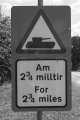
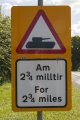
Just to post another two photos; possibly a bit of an extreme example, with virtually no artistic merit but I would suggest plenty of documentary interest. If I wanted to make the point that on this road in the Pembrokeshire National Park, for the next two and three-quarter miles, one is likely to come across tanks, which does this most successfully?
IMG_3159-2.jpg IMG_3159.jpg
 
Just to post another two photos; possibly a bit of an extreme example, with virtually no artistic merit but I would suggest plenty of documentary interest. If I wanted to make the point that on this road in the Pembrokeshire National Park, for the next two and three-quarter miles, one is likely to come across tanks, which does this most successfully?
View attachment 108291 View attachment 108290
Nothing to do with your image (but absolutely central to the original point many of us made)...
Why do you think that warning signs are red triangles?
 
Just to post another two photos; possibly a bit of an extreme example, with virtually no artistic merit but I would suggest plenty of documentary interest. If I wanted to make the point that on this road in the Pembrokeshire National Park, for the next two and three-quarter miles, one is likely to come across tanks, which does this most successfully?
View attachment 108291 View attachment 108290
The colours and simple shapes are the main point of the sign, to grab attention and convey information as quickly as possible. Yellows and reds are the first colours our eyes are drawn to and they are used for this reason. B&W really doesn't work with a photo of a subject which relies on colour.
 
I disagree. Black and white for documentary plays on the nostalgic aspects. We might think of documentary as being black and white for the same reason some here think of steam trains as being monochromatic.That's how it as in our youth. Documentary photography is about information. Removing colour is removing information.

I think this is probably another of the 'almost as old as photography' questions, but I'll bite.

Everything you do in making a photograph is removing information - your choice of focal length, framing of the shot, aperture, shutter speed and the moment that the shutter is triggered all tend to remove information in one way or another. Even rendering an image of a three dimensional world on a two dimensional plane is to remove information that was present in the original scene. The choice to exclude colour is just one of many such decisions.

I'd go as far as to say that one of the key skills of a photographer is in removing the information that does not actively inform the image, so as to enhance that which does. It's a process of selection, much as a sculptor chips away at stone, working with and removing the material to reveal the sculpture that is within.

For me, black and white (like film) has no place in the 21st century. I can't get past the feeling of nostalgia, or 'artiness', that black and white invokes in me these days. I might make an exception for one-off pictures that exist solely to look nice in a frame , but for documentary photographty it has to be colour. for me. YMMV. etc.

I guess what I'm saying is that the matter is as much about how the people looking at the pictures think about them as much as how the photographer does.

Well, that's a risk you take when you put a creation out into the world; your vision may not be how others see it, or it will be taken and used in ways that you cannot imagine.

For myself, monochrome is not nostalgic, it's quite modern. I defy anyone to look at the work of Alexander Rodchenko, László Moholy-Nagy or Eugen Wiškovský in the 1920s and 30s and say that it is nostalgic simply because it is black and white. I will concede that it is often used that way in contemporary photography, as a [I should perhaps say lazy] shorthand suggesting an image from the past; this seems to hold true more in amateur photography.


This Way Up
by Rob Telford, on Flick

Monochrome often allows me to convey better the graphic qualities of the scene; it tunes out the distractions of colour. An abstraction of the world can reveal something about it that may not have been otherwise visible.

Certainly thinking how the shot will appear in monochrome is my default approach and, with digital, if I use colour it is because of what colour will add to the photograph. If that leads to 'artiness' I'm ready to plead guilty, but there is no reason why documentary cannot also be elevated into some form of art.


National Sports Centre
by Rob Telford, on Flickr


Hexagons
by Rob Telford, on Flickr

To return to the OP's original question, I think we must draw a distinction between the subject and the purposes of a photograph; that is the intent in taking it and the uses to which it will be put.

If we are talking about different subjects, then broadly, no, I do not think there are particular classes of subjects, such as steam trains or people that are better suited to colour or black and white. However, there are certainly different purposes which suit colour better.

In the 1950s and 1960s, catalogue shopping companies like Kays and Littlewoods were early adopters of full colour printing which allowed them best to display the goods they were selling, especially clothes, for which colour was an important factor. For that purpose, once affordable colour was available, it clearly made little sense to continue with black and white photographs (or hand drawn illustrations as they had been using in the 1920s). Internet shopping has taken over that retail niche and for that purpose today, it would be unusual that colour should not be used.

This may be what Ed is alluding to in the context of documentary photography. If you are cataloging the plumage of wild birds, then their colour is likely information that will be of interest to ornithologists and you will want to capture it. If you are documenting their behaviour, then the colour of the animal may be less important.

There are occasions, however, where colour itself becomes the purpose of the photograph. This image would probably make less sense in monochrome.


1000 Umbrellas
by Rob Telford, on Flickr

Similarly, I have a short series of photographs of red columns on buildings. The colour is the central theme that caused me to make the photographs, so obviously it requires colour for it to work.


Red Column
by Rob Telford, on Flickr

Although I did choose to subvert the theme somewhat with these two different columns on the same building juxtaposed together. Both of them are colour images, the second column happens to be painted black, leaving the image practically indistinguishable from a monochrome photograph. Nevertheless, in context with the other, red column, it was quite important that the image of the black one to be in colour.


Red Column VI
by Rob Telford, on Flickr


Red Column VII [not red]
by Rob Telford, on Flickr

The only other way to deal with this conceptually would be to say that we will photograph in colour the class of subjects which is 'colourful things' (such as the umbrellas) but that would not deal with my black column on a white ground. That is not a colourful thing.

Setting aside the subject itself and examining the purpose for making that photograph is a more elegant approach to determine how it should be treated; in this situation colour adds something to our understanding of the image.

 
Nothing to do with your image (but absolutely central to the original point many of us made)...
Why do you think that warning signs are red triangles?

The colours and simple shapes are the main point of the sign, to grab attention and convey information as quickly as possible. Yellows and reds are the first colours our eyes are drawn to and they are used for this reason. B&W really doesn't work with a photo of a subject which relies on colour.

I don't know if this comes across or not but the purpose of the photograph was to convey my feelings (surprise, shock, disgust, even....) about the presence of tanks on this road in the Pembrokeshire Coast National Park; the fact that the presence of tanks in a national park is signified in such a matter-of-fact manner as a road sign. Where else would one come across a tank in the road? It seemed so out of place in a National Park. A photograph of a tank would have been more obvious but I felt the the road sign added a layer of complexity to the image. And bearing that in mind does the colour version or the B&W version do the job more successfully? I think that is the nitty-gritty of my dilemma.

The purpose of the road sign, on the other hand, is to warn drivers of a possible hazard ahead. It has a very different purpose and it absolutely makes sense that it should be in colour.
 
I don't know if this comes across or not but the purpose of the photograph was to convey my feelings (surprise, shock, disgust, even....) about the presence of tanks on this road in the Pembrokeshire Coast National Park; the fact that the presence of tanks in a national park is signified in such a matter-of-fact manner as a road sign. Where else would one come across a tank in the road? It seemed so out of place in a National Park. A photograph of a tank would have been more obvious but I felt the the road sign added a layer of complexity to the image. And bearing that in mind does the colour version or the B&W version do the job more successfully? I think that is the nitty-gritty of my dilemma.

The purpose of the road sign, on the other hand, is to warn drivers of a possible hazard ahead. It has a very different purpose and it absolutely makes sense that it should be in colour.

Whether in black and white or colour, without the context you've provided above it's just a photgraph of a road sign. Neither signifies anything about a national Park. For all I know it might be trying to make a point about 'politically correct' bilingual signs. In this case, perhaps, including more in the picture might have helped get the message across? Which relates to what @Musicman was saying about the choices we make about what information to include or exclude.

Taking photographs is easy, making pictures ain't!
 
Taking photographs is easy, making pictures ain't!

I tend to use the words interchangeably....and don't mention "images"!

i'm still making my way through Musicman's post. But a photograph is not necessarily about providing easy answers; it can also pose difficult questions. Like "What is this guy on about with this photograph of a road sign?"

But seriously, I hope it illustrates what I mean about "content" and how that differs from surface qualities. Whether the content comes through more clearly in colour or B&W is still my dilemma.

I can understand why the bilingual nature of the road sign may have added even more to your puzzlement. Living in Wales, one takes bilingualism for granted.
 
Last edited:
I don't know if this comes across or not but the purpose of the photograph was to convey my feelings (surprise, shock, disgust, even....) about the presence of tanks on this road in the Pembrokeshire Coast National Park; the fact that the presence of tanks in a national park is signified in such a matter-of-fact manner as a road sign. Where else would one come across a tank in the road? It seemed so out of place in a National Park. A photograph of a tank would have been more obvious but I felt the the road sign added a layer of complexity to the image. And bearing that in mind does the colour version or the B&W version do the job more successfully? I think that is the nitty-gritty of my dilemma.

The purpose of the road sign, on the other hand, is to warn drivers of a possible hazard ahead. It has a very different purpose and it absolutely makes sense that it should be in colour.
But surely the red helps signify the anger too. The B&W removes impact from the photograph.
 
I don't know if this comes across or not but the purpose of the photograph was to convey my feelings (surprise, shock, disgust, even....) about the presence of tanks on this road in the Pembrokeshire Coast National Park; the fact that the presence of tanks in a national park is signified in such a matter-of-fact manner as a road sign. Where else would one come across a tank in the road? It seemed so out of place in a National Park. A photograph of a tank would have been more obvious but I felt the the road sign added a layer of complexity to the image. And bearing that in mind does the colour version or the B&W version do the job more successfully? I think that is the nitty-gritty of my dilemma.

The purpose of the road sign, on the other hand, is to warn drivers of a possible hazard ahead. It has a very different purpose and it absolutely makes sense that it should be in colour.
Well it never came across.
You know the sign was in the national park, but it's not obvious to anyone from the image of a road sign.

Your surprise of the situation is also a bit odd, I'm not a landscape photographer but I'm travelled enough to have been in plenty of remote areas where there's firing ranges, tank ranges etc.
 
I tend to use the words interchangeably....and don't mention "images"!

i'm still making my way through Musicman's post. But a photograph is not necessarily about providing easy answers; it can also pose difficult questions. Like "What is this guy on about with this photograph of a road sign?"

But seriously, I hope it illustrates what I mean about "content" and how that differs from surface qualities. Whether the content comes through more clearly in colour or B&W is still my dilemma.

I can understand why the bilingual nature of the road sign may have added even more to your puzzlement. Living in Wales, one takes bilingualism for granted.
I think you're trying to pose difficult questions before you've grasped the easier concepts. You're overthinking the unknown without fully studying the known.

Your point about the road sign is a great illustration of this.

You see a question about why there would be tanks in a beauty spot. We weren't there and all you've shown us is a road sign.

So you haven't grasped the simple photographic tool (tell us a story) around which to hang a question. It seems obvious to you, but it's far from obvious to anyone else.

The 'simple' stuff you're missing includes use of colour and other compositional techniques.

Nail the storytelling and you'll understand what many of us have been telling you; the use of colour can either be vital or not at all important.
 
So my question was whether colour or B&W was most effective, and from the replies so far the answer is neither! That's OK. I can live with that.

I did say it was an extreme example.
This suggests you're flipping from the conceptual to the simplistic, and still missing the actual straightforward point that answered your question.

Your question:
Does black-and-white suit certain subjects better than others? Or vice-versa?
can't be answered by 'neither'
The answer is 'No', not 'subjects' but certainly in some situations B&W or colour can have a huge advantage.
 
I'll rephrase my last post -

In the case of the two photographs I recently posted, and bearing in mind that you now know my motivation, which was most effective, and from the replies so far the answer is neither........

I'm tempted to post another pair, but I suspect it might end in tears...........
 
I'll rephrase my last post -

In the case of the two photographs I recently posted, and bearing in mind that you now know my motivation, which was most effective, and from the replies so far the answer is neither........

I'm tempted to post another pair, but I suspect it might end in tears...........
Feel free to keep going, but I'm not sure you've understood the posts that have succinctly answered your question. Which has been answered in one sentence by Dave, in detail by me and plenty of others and in great detail with brilliant examples by Rob above.

You can't aspire to grand artistic concepts whilst expecting the method to be driven by a simple binary choice.

To photograph is to paint with light, all the rest is about 'what' we're painting, you can't tell a story by simply isolating a roadsign, you ignored my detailed critique of the composition of your train image, believing 'I like it and I've got some more normal engine shots' was a smart answer. You're not 'getting' the simple stuff you think you're above. ;)

Go for it.
 
Not if there's any more of that!

I'm still open to discussion but I didn't ask for any advice on composition or processing. We all see those things slightly differently but there has been a bit of a concensus that a message can be more easily perceived if the image is in black and white. Hasn't there?

I'm going to keep Musicman's post for a while and give it a good read through when I have time. Having said that I didn't notice a message coming through very strongly in any of the images, colour or B&W.

I'd like to repeat the point that I made earlier, as well, that an image is not necessarily the same as it's subject matter.
 
Last edited:
I'll rephrase my last post -

In the case of the two photographs I recently posted, and bearing in mind that you now know my motivation, which was most effective, and from the replies so far the answer is neither........

I'm tempted to post another pair, but I suspect it might end in tears...........

TBH Jerry, now we know your motivation the answer is, as you say, neither, for those 2 tank sign shots. Neither the colour nor mono made any difference to the message that you were trying to convey IMO, though the colour might have been processed more sympathetically to be a better image.
 
Not if there's any more of that!

I'm still open to discussion but I didn't ask for any advice on composition or processing. We all see those things slightly differently but there has been a bit of a concensus that a message can be more easily perceived if the image is in black and white. Hasn't there?

I'm going to keep Musicman's post for a while and give it a good read through when I have time. Having said that I didn't notice a message coming through very strongly in any of the images, colour or B&W.

I'd like to repeat the point that I made earlier, as well, that an image is not necessarily the same as it's subject matter.

I think you have problems communicating an idea with limitless words, and you have yet to acknowledge an understanding of anything anyone has posted, other than to tell us all you're aiming for a deeper meaning.

We all know that 'an image is not necessarily the same as it's subject matter', and what we're trying to tell you is that communicating that message has a language, it's not a complicated language, but it's a lot more complex than just 'black and white or colour'. Composition and processing are part of that language.

You not acknowledging that the language exists isn't going to help you communicate using it ;)
 
Phil,

I'm hesitating over whether to respond or not, but I would like to say that you have seen just two photographs of mine, and are making some very broad generalisations about my work in all sorts of areas. Similarly I don't know anything about your background, but I suspect we come from very different places. I'm not going to brag about my photographic achievements, so I'll just leave it at that, I think.
 
I'm going to keep Musicman's post for a while and give it a good read through when I have time. Having said that I didn't notice a message coming through very strongly in any of the images, colour or B&W.

Probably because in those examples there wasn't much 'storytelling' going on there in the sense that Phil is talking about.

As my text set out, the images I included to support it are principally formalist; they are 'about' geometry, line, mass, light and shade (and some of them about colour) not narrative.
 
Last edited:
Phil,

I'm hesitating over whether to respond or not, but I would like to say that you have seen just two photographs of mine, and are making some very broad generalisations about my work in all sorts of areas. Similarly I don't know anything about your background, but I suspect we come from very different places. I'm not going to brag about my photographic achievements, so I'll just leave it at that, I think.
I'm trying to 'understand' where you're coming from and responding to what you're typing and showing.
I did say that with a limitless number of words I was struggling to understand your view, and your response to our view of your images was again light on content.
You're asking profound questions, and not really giving much away to move forward.

I'm guessing I'm not the only one who finds it frustrating, but I'm a tenacious old b****r where others will just ignore.

There's also a deep reluctance round here to discuss 'art' but again, I'm up for it.

Happy to see more of your work and for you to explain further.
 
...but there has been a bit of a concensus that a message can be more easily perceived if the image is in black and white. Hasn't there?

No. I still maintain that colour tells you more.

Phil,

I'm hesitating over whether to respond or not, but I would like to say that you have seen just two photographs of mine, and are making some very broad generalisations about my work in all sorts of areas. Similarly I don't know anything about your background, but I suspect we come from very different places. I'm not going to brag about my photographic achievements, so I'll just leave it at that, I think.

I think you get your messages across well enough using colour from what I have seen of your blog. I don't understand why you think black and white might be better at it.
 
Back
Top