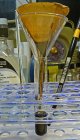
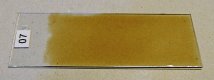
The earliest surviving photograph was made around 1826 by Joseph Nicephore Niepce, using bitumen as the liight sensitive substance. More can be read about him here...
https://en.wikipedia.org/wiki/Nicéphore_Niépce#Photography
I've been interested in the beginnings of photography for some time, and I've decided that I'd like to try Niepce' bitumen process. I plan to document how this proceeds in this thread.
The first thing to do was some research to get a better idea of the materials and method. It seems that the main ingredients are Bitumen of Judea and lavender oil. I've also seen white petroleum and oil of turpentine mentioned. So far as I can tell, white petroleum is what we now call white spirit. I couldn't find anything about oil of turpentine, but I suspect this is just the solvent that's extracted from pine resin, known to artists as distilled turpentine. It may be the case that some stuff referred to as "oil of" isn't really an oil as we might think of it, but closer to a somewhat volatile solvent (another is oil of spike lavender, which isn't lavender oil, but a strong solvent used in oil painting - it dilutes the vegetable oils that are used in the paints in the same way that distilled turpentine does). From what I've read so far, it seems that the bitumen is mixed with lavender oil, although one source says it was mixed with turpentine.
The basic method seems to be pretty consistent in what I've found, namely that the bitumen is dissolved in the lavender oil and then coated onto a substrate. This is dried and then exposed to light. When the exposure is made, the plate is washed in solvent, causing some parts of the coating to dissolve, leaving an image. The key property of the bitumen is that areas that get more exposure harden to the extent that the solvent is less able to dissolve them, resulting in a negative. Descriptions of the solvent vary, Some sources say it's just more lavender oil, some say it's a mix of that and white spirit.
Next, I needed to source the ingredients. The solvents were easy - white spirit from any DIY place, turpentine from an artists supply shop, and lavender oil from anywhere selling essential oils. Of those, the lavender oil was the most expensive at £12 for a 100ml bottle. The hardest thing to find was the Bitumen of Judea. It turns out that this stuff is used in antique restoration and conservation - it's used to add patina to repaired sections of antique furniture. It comes as a liquid and as a powder. I didn't want liquid because it meant I would be stuck with using the maker's chosen solvent (which I don't necessarily know anything about), and is also rather expensive for the amount of actual bitumen it contains. After some searching, I found a conservator place in Portugal that sells the powder in 500g and 1kg bags. It was 6 euro for 500g, and 9 euro for 1kg, and 12 euro for shipping, so I decided to burn the extra 3 euro and get 1kg, even though it's far more than I'll ever need (and so is 500g).
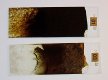
Then it was time to try some experiments to see how the bitumen behaved with the solvents. Something I'd heard mentioned in a video about Niepce' original image was that it's quite grainy when examined up close, suggesting that it's not the case that the powdered bitumen dissolves completely into the solvent to make an amorphous liquid. I mixed a bit of the powder with each of the three solvents to see what happened, and got quite a noticeable variation in how grainy or gritty the result was. Each mix was in a test tube and when each was shaken before being left to settle in a stand, the walls of the tube had a deposit.
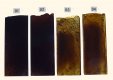
These can be seen here...
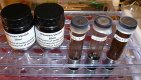
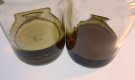
The leftmost tube is actually a mix of lavender oil and turpentine, but was originally just lavender oil. In terms of grain, the white spirit was the strongest and the turpentine had the least, The lavender oil on its own was somewhere between the two. When I saw that the turpentine seemed to dissolve more of the powder, I added some to the lavender oil tube, and this seemed to make it less grainy. You can see the difference between the eventual three mixtures in the photo above. The white spirit on the right is particularly dark due to the amount of poorly dissolved powder deposited inside the tube.
With this, I decided that I wouldn't try using white spirit to make up the liquid to be coated, but would make one using just lavender oil, and another with a 50/50 mix of lavender oil and turpentine. The mixture is 3g of powder to 10ml of solvent, based on a video where somebody uses the method to make contact prints from large format negatives (he used only lavender oil).
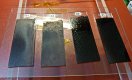
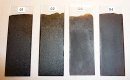
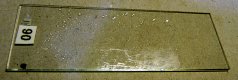
The next thing to do was to try coating some substrates to use for tests. A nice, convenient substrate is microscope slides, available in packs of 50 for not much money. Four slides were numbered with the intention of coating a pair with each mixture. The idea is to have one to play with and a backup in case something goes wrong, without having to wait to coat more.
At this stage, I want to try to establish a few things...
What it's like to coat glass with the mixtures.
How to dry them.
What the grain looks like once they're dry.
What solvent and method works for removing the uncured bitumen.
I tried coating using a fairly soft artists paint brush, but wasn't terribly impressed. It was a mix of grainy particles with extremely thin solution between, with thicker bits where the brushstrokes had overlapped. This was the case with both mixtures. I decided to use the brush to just pick up quantities of the mixture and dollop it onto the glass until there was enough to get it to flow around slowly when the glass was tilted.
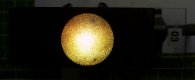
Here's a slide coated with the lavender oil mixture...
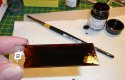
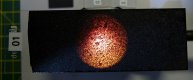
And a view looking down on it with a small torch behind...
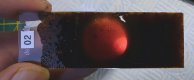
The colour of the mixture, and the graininess become apparent. (The reddish tinge was apparent in the video I mentioned earlier, where the chap was doing contact prints.)
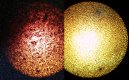
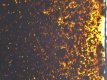
Here's a closer view with some manipulation to bring up some more detail...
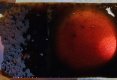
There are clearly some large particles that haven't dissolved, which are most noticeable at the left where they make bumps in the surface of the oil. Then there is a general suspension of finer particles which can be seen in the illuminated area. I don't know if the reddish colour is due to even smaller particles suspended in the oil, or whether some of the bitumen has actually dissolved. In the test tubes and the two jars containing the mixtures, there is certainly a bit of sludge at the bottom which can be dissipated into the liquid with a bit of shaking.
Anyway, the next thing is to get the slides dried.
https://en.wikipedia.org/wiki/Nicéphore_Niépce#Photography
I've been interested in the beginnings of photography for some time, and I've decided that I'd like to try Niepce' bitumen process. I plan to document how this proceeds in this thread.
The first thing to do was some research to get a better idea of the materials and method. It seems that the main ingredients are Bitumen of Judea and lavender oil. I've also seen white petroleum and oil of turpentine mentioned. So far as I can tell, white petroleum is what we now call white spirit. I couldn't find anything about oil of turpentine, but I suspect this is just the solvent that's extracted from pine resin, known to artists as distilled turpentine. It may be the case that some stuff referred to as "oil of" isn't really an oil as we might think of it, but closer to a somewhat volatile solvent (another is oil of spike lavender, which isn't lavender oil, but a strong solvent used in oil painting - it dilutes the vegetable oils that are used in the paints in the same way that distilled turpentine does). From what I've read so far, it seems that the bitumen is mixed with lavender oil, although one source says it was mixed with turpentine.
The basic method seems to be pretty consistent in what I've found, namely that the bitumen is dissolved in the lavender oil and then coated onto a substrate. This is dried and then exposed to light. When the exposure is made, the plate is washed in solvent, causing some parts of the coating to dissolve, leaving an image. The key property of the bitumen is that areas that get more exposure harden to the extent that the solvent is less able to dissolve them, resulting in a negative. Descriptions of the solvent vary, Some sources say it's just more lavender oil, some say it's a mix of that and white spirit.
Next, I needed to source the ingredients. The solvents were easy - white spirit from any DIY place, turpentine from an artists supply shop, and lavender oil from anywhere selling essential oils. Of those, the lavender oil was the most expensive at £12 for a 100ml bottle. The hardest thing to find was the Bitumen of Judea. It turns out that this stuff is used in antique restoration and conservation - it's used to add patina to repaired sections of antique furniture. It comes as a liquid and as a powder. I didn't want liquid because it meant I would be stuck with using the maker's chosen solvent (which I don't necessarily know anything about), and is also rather expensive for the amount of actual bitumen it contains. After some searching, I found a conservator place in Portugal that sells the powder in 500g and 1kg bags. It was 6 euro for 500g, and 9 euro for 1kg, and 12 euro for shipping, so I decided to burn the extra 3 euro and get 1kg, even though it's far more than I'll ever need (and so is 500g).
Then it was time to try some experiments to see how the bitumen behaved with the solvents. Something I'd heard mentioned in a video about Niepce' original image was that it's quite grainy when examined up close, suggesting that it's not the case that the powdered bitumen dissolves completely into the solvent to make an amorphous liquid. I mixed a bit of the powder with each of the three solvents to see what happened, and got quite a noticeable variation in how grainy or gritty the result was. Each mix was in a test tube and when each was shaken before being left to settle in a stand, the walls of the tube had a deposit.
These can be seen here...
The leftmost tube is actually a mix of lavender oil and turpentine, but was originally just lavender oil. In terms of grain, the white spirit was the strongest and the turpentine had the least, The lavender oil on its own was somewhere between the two. When I saw that the turpentine seemed to dissolve more of the powder, I added some to the lavender oil tube, and this seemed to make it less grainy. You can see the difference between the eventual three mixtures in the photo above. The white spirit on the right is particularly dark due to the amount of poorly dissolved powder deposited inside the tube.
With this, I decided that I wouldn't try using white spirit to make up the liquid to be coated, but would make one using just lavender oil, and another with a 50/50 mix of lavender oil and turpentine. The mixture is 3g of powder to 10ml of solvent, based on a video where somebody uses the method to make contact prints from large format negatives (he used only lavender oil).
The next thing to do was to try coating some substrates to use for tests. A nice, convenient substrate is microscope slides, available in packs of 50 for not much money. Four slides were numbered with the intention of coating a pair with each mixture. The idea is to have one to play with and a backup in case something goes wrong, without having to wait to coat more.
At this stage, I want to try to establish a few things...
What it's like to coat glass with the mixtures.
How to dry them.
What the grain looks like once they're dry.
What solvent and method works for removing the uncured bitumen.
I tried coating using a fairly soft artists paint brush, but wasn't terribly impressed. It was a mix of grainy particles with extremely thin solution between, with thicker bits where the brushstrokes had overlapped. This was the case with both mixtures. I decided to use the brush to just pick up quantities of the mixture and dollop it onto the glass until there was enough to get it to flow around slowly when the glass was tilted.
Here's a slide coated with the lavender oil mixture...
And a view looking down on it with a small torch behind...
The colour of the mixture, and the graininess become apparent. (The reddish tinge was apparent in the video I mentioned earlier, where the chap was doing contact prints.)
Here's a closer view with some manipulation to bring up some more detail...
There are clearly some large particles that haven't dissolved, which are most noticeable at the left where they make bumps in the surface of the oil. Then there is a general suspension of finer particles which can be seen in the illuminated area. I don't know if the reddish colour is due to even smaller particles suspended in the oil, or whether some of the bitumen has actually dissolved. In the test tubes and the two jars containing the mixtures, there is certainly a bit of sludge at the bottom which can be dissipated into the liquid with a bit of shaking.
Anyway, the next thing is to get the slides dried.
Last edited: