Bit of a 'weird' one - any help or advice would be most welcome...

conk

Suspended / Banned
Messages
4
Name
Pete
Edit My Images
No
Hi all,

First I need to state that I have zero interest in photography! (please don't hate me and please read on!) - Not sure if this is even posted in the correct place but here goes.....

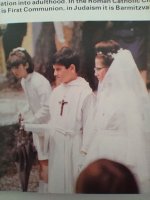
I am very keen to try and trace the professional photographer who took a specific image in a specific educational text book. The reason for this is that I am very interested in one of the subjects captured in one of the stated images.

Problem is the book's publisher has been out of business for many years now and the picture library that owned the image in question has also been out of business for years. I managed to trace a new picture library that purchased some of the other libraries images, but they don't hold the image I am seeking if that makes sense.

So to the details:- The text book in question is called "World Religions and Beliefs". Published by Macdonald Educational Ltd, Holywell House, Worship St, London, EC2A 2EN. 1st in 1978, republished in 1980. The original picture library was Zefa (these now default to Getty images and I have had no response from them - yet!). The image is on page 4, Lower Left.

I don't think I can add any pics to this yet so for now that is about all I can say except I know I'm probably urinating into the wind with this as the guy who took the pic could well be long dead (to me the picture looks like very early 70's but could be late 60's looking at the clothes worn by other subjects in the image - very hard to put a date on).

Many thanks for reading this far and any, any help with this would be most welcome.

Cheers.
 
Am I correct in assuming it is to identify one of the people in the publication, can I suggest that approaching the relevant religious organisation may be more fruitful in identifying the person.
 
As someone who has taken pics for publication and advertising, I have to say the chances of the photographer knowing the subject is fairly slim.
Most of the time when I've gone to schools or businesses for these sort of photos, they have organised the "models" and I use the word loosly, Most often it's either studients or friends they have borrowed for the day.
Yes a few times we have supplied the models, but remembering their names after years.... No chance.
You might get lucky and it's the photographers mate, or sister or something he/she would remember, but you might as well buy a lottery ticket if your that lucky.
 
If you’ve got a copy of the text book, scan the image, crop it, and do a google reverse image search and see if it’s in one of the stock libraries - you’ll be surprised, you find it, or a link to it, that gets you one step closer.
 
Your post is missing the ‘why’ and that makes it difficult to help with a ‘how’.
What are you trying to achieve

That’s the question. Be interesting if OP could post a low res photo of it or explain in a bit more detail as it’s difficult to understand exactly why the question is being asked.

I'm wondering if this is a manifestation of the XY problem?
 
Your post is missing the ‘why’ and that makes it difficult to help with a ‘how’.
What are you trying to achieve
That’s the question. Be interesting if OP could post a low res photo of it or explain in a bit more detail as it’s difficult to understand exactly why the question is being asked.

I'm wondering if this is a manifestation of the XY problem?

The "why" is: he is wanting to trace the photographer of a specific photograph.
 
Yes, but the reason is that he wants to find out more about a specific subject in the photograph, implying that the photographer may have some additional knowledge of it - the question, is why that might be? Why would the photographer remember it? Or have a record of it after all these years?

And my point is that can this information be obtained by asking a better question?
 
Last edited:


And my point is that can this information be obtained by asking a better question?
I’d have said ‘different question’ but yeah this.

My working life is spent answering questions, and very often the first question I’m asked by a stakeholder will not tell them what it is they need to know. Because they don’t understand the business or the way the data works.

So much of my life is spent working out ‘what’s really the question’.

It’s highly unlikely that a pro photographer will have any useful knowledge of a photo taken 50 or more years ago.
My first weddings were only 40 years ago and I could only give scant details of some memorable moments from the 80’s.

But there may be other useful info the OP could get from elsewhere.
 
Hi all,

Thanks very much for the responses so far. The reason why is most personal - I will explain and I think I need to change the question somewhat....

The why:- I understand that doppelgangers do exist (anybody remember Steven Waldorf?? and so many American cases of injustice due to mis-identifying the wrong person who turns out to be the identical twin of the wrong guy who has been rotting in some cell for 30 years!) - but, knowing my old, this is not such a case. The why is that when I first saw this image at about age 11, it was like looking in a mirror! One of my many nicknames for the next 5 years at school was the priest!!! Don't worry, I got over it. But I never got over the fact that this image could well have been a relative. Life goes on and last year I retired early. I thought it was about time I found out if I had one more f*!k*!g half brother somewhere in the world!

The new question:- I don't understand how you can take a picture for any publication that then gets printed and the subjects contained in the image and the publication don't get informed about it - I mean what if they don't give their consent? There must be a way you have to let someone know that they are about to be included in a book? What if you publish and then several or one person comes back and doesn't want to have their face in the book? So I don't understand how you don't have to have the persons details before publication - yes I know times have changed and what you have to do today is probably a lot more than what you would have to do back in the day, but still, if I was a Photographer I think I would want to know who I was shooting.

I should just add that I have tried all the obvious things (google reverse image etc).

Here is the picture in question and a shot of the books front cover.

Thanks again guys.
 

Attachments

  • IMG_20241031_111621221.jpg
    IMG_20241031_111621221.jpg
    194.2 KB · Views: 57
  • IMG_20241031_111757625.jpg
    IMG_20241031_111757625.jpg
    108.1 KB · Views: 56
Missed a very important word out of last post - Knowing my old MAN - hope that makes sense - cheers
 
In answer to your question about consent: this was a long time ago. Many of the safeguards which came in about child protections and media consents generally came in as a reaction to stuff that happened many years later: Dunblane and the Soham murders are the two big tragedies which shaped a lot of what is now considered normal safeguarding processes of young people.

So back then, what would have happened? A photographer would have come in and a letter would have gone home to mum and dad to sign - and that’s at best, no computers back then, none of it stored or recorded.

This might very well be lost information.

If you can find out where it was taken, which church it was - they are more likely to have a record of it than the photographer, I would say.

In my work, this side of the job would have nothing to do with me as a photographer since the liability of it being published incorrectly would not be with me - it would be with who I took the photo for. We don't know if it was a commissioned photo and then subsequently submitted to a stock library or the other way around. I can't help but feel that even if it was a stock image taken at some public event, it wouldn't have necessarily had any documentation submitted with it - at least not back then.

and just to say I have taken hundreds (if not more) photos of students that have been used in marketing materials at events like this - I couldn't tell you the name of a single child - that's for photos taken in 2024!
 
Last edited:
Same here i have taken 100`s of images of all faiths , and children in the past , i supp;ied the images to the organisation , it was there responsibility to sort out the permissions
 
I mean what if they don't give their consent?
This is a mistake many non-photographers make. The fact is; in most places/countries, and for most uses, consent is not required. The general legal principle is; if you don't want to be seen doing whatever, then don't do it in public where it could be seen and photographed.

The information you want was probably never obtained. And it almost certainly wasn't retained if it isn't included in the publication/caption.
 
@conk

IF you can find out where and when the photo was taken, the church might be able to help, IF local laws allow them to. There are registers of clergy.
 
The new question:- I don't understand how you can take a picture for any publication that then gets printed and the subjects contained in the image and the publication don't get informed about it - I mean what if they don't give their consent?
How many times have you been photographed in your lifetime? Including recordings by CCTV?

It's one of those situations where a large proportion of the population 'believes' something that is completely illogical - they know they've never given written permission for something they're 'certain' other people must have given permission for.

There are a few countries where local privacy laws override this, but generally speaking a photographer doesn't require permission to photograph you, but in some places the publisher might require permission to publish your image. The UK isn't one of those exceptions.
 
In answer to your question about consent: this was a long time ago. Many of the safeguards which came in about child protections and media consents generally came in as a reaction to stuff that happened many years later: Dunblane and the Soham murders are the two big tragedies which shaped a lot of what is now considered normal safeguarding processes of young people.

Dunblane had an impact on handgun laws.

Soham had an impact on police management of intelligence.

I'm not sure how either had any bearing on photography and 'consent'.
 
Dunblane had an impact on handgun laws.

Soham had an impact on police management of intelligence.

I'm not sure how either had any bearing on photography and 'consent'.

It had a huge impact, directly and indirectly on the safeguarding of young people and put the burden of documenting and recording all sorts of information that could pose a safeguarding risk to a child, not just checking the suitability of individuals working with children, or the physical security of the site, but - for example, if the child is adopted or estranged from parents and could not be photographed or any other risks associated with the child being identified. Those two events (and others) massively contributed towards the cultural shift that really puts a lot of responsibilities on any institution that works with young people to ensure they are safe.

That’s why, had that image been taken in the last couple of decades, there would be a chance that some record of that consent from the parent actually existing somewhere- particularly if it taken as part of a school or organised activity.
 
Last edited:
It had a huge impact, directly and indirectly on the safeguarding of young people and put the burden of documenting and recording all sorts of information that could pose a safeguarding risk to a child, not just checking the suitability of individuals working with children, or the physical security of the site, but - for example, if the child is adopted or estranged from parents and could not be photographed or any other risks associated with the child being identified. Those two events (and others) massively contributed towards the cultural shift that really puts a lot of responsibilities on any institution that works with young people to ensure they are safe.

That’s why, had that image been taken in the last couple of decades, there would be a chance that some record of that consent from the parent actually existing somewhere- particularly if it taken as part of a school or organised activity.
It's not that long ago I was photographing for the scout movement, and my perfectly legal and right and proper adherence to those safeguarding issues was to simply not photograph / publish where there might be a specific issue. So, the hundreds of kids whose images were taken and published were completely absent of names or other personal details.

To flip that on it's head, a photographer can keep millions of photo's of people on his hard drives, but if he adds names to those photo's then they become 'personal data' and are subject to GDPR. And no one wants to get involved with GDPR if they don't need to.
 
It's not that long ago I was photographing for the scout movement, and my perfectly legal and right and proper adherence to those safeguarding issues was to simply not photograph / publish where there might be a specific issue. So, the hundreds of kids whose images were taken and published were completely absent of names or other personal details.

To flip that on it's head, a photographer can keep millions of photo's of people on his hard drives, but if he adds names to those photo's then they become 'personal data' and are subject to GDPR. And no one wants to get involved with GDPR if they don't need to.

Yep, it’s a nightmare. I actually had one, where I shot a whole bunch of photos for a school to market their new uniforms (or publicise them because the school had been taken over by a different trust) and something got missed or the student withdrew consent (can’t remember now) and I had to reshoot a whole lot of them at stupidly short notice. I don’t need to know anything about the students, thankfully, and so I rely on the institution doing that but I have literally been standing next to a headteacher on the phone double checking with the parents if a photo can be used (I think this one was going on a big mail shot). But I also know there are really good reasons why we have to do it. Fortunately, this kind of thing has only ever happened a couple of times to me.

I think it’s the withdrawing of consent that is the most tricky - thinking about it, in this case, I’m pretty sure they had some of the materials made up and they had to be done again as well. Not saying it’s wrong - clearly you should be able to change your mind, but it creates quite a challenge with things like this.
 
Last edited:
It had a huge impact, directly and indirectly on the safeguarding of young people and put the burden of documenting and recording all sorts of information that could pose a safeguarding risk to a child, not just checking the suitability of individuals working with children, or the physical security of the site, but - for example, if the child is adopted or estranged from parents and could not be photographed or any other risks associated with the child being identified. Those two events (and others) massively contributed towards the cultural shift that really puts a lot of responsibilities on any institution that works with young people to ensure they are safe.

I'm disagreeing with you. The issue of consent is separate from checks on individuals.

The consent issue with regard to photography arose separately and independently - well before the Soham murders and the subsequent reporting.

The cultural shift behind that was independent. It was in part driven by shifts in technology, information sharing, and a general move towards being more protective of children.
 
The cultural shift behind that was independent. It was in part driven by shifts in technology, information sharing, and a general move towards being more protective of children.

It wasn’t independent - those two events, in particular, were defining moments in driving what you describe as the general move towards being more protective of children.

They created a massive shift that reshaped how institutions approach safeguarding, triggering the development of frameworks that influenced everything from parental consents for photography to broader processes like employee checks, record-keeping, and reporting.

I’m not saying that technological shifts didn’t also contribute - they most certainly did - but those events were really what underpinned these changes.

We might just have to agree to disagree on this one.
 
Last edited:
Once again, Thanks everyone who responded.

As I said in the 1st post - I'm probably urinating into the wind and at least 40 years too late!

Where the shot was taken is one of the main things I'm trying to find out and I thought the best way to do this is try and find the guy who took the shot (hence the 1st post on here) but I doubt anyone will come forward - I was hoping perhaps there might be some 'older' ex pros' on here who might be able to say something like "that looks like the work of xxxx" if that makes sense. Maybe I should try an American forum???

The original picture library who owned the image has long since stopped trading, Getty Images took over their stock pics and I have contacted Getty but they say they don't hold the image.

Probably my last chance is with the British Library who have taken all the details (no idea what channels they may have to help but...) and will come back to me at some point. I'm not holding out much hope - maybe I need to improve my detective skills!!!

I won't waste any more of your valuable time - unless anyone can come up with anything else that might be useful - so thanks all again - happy snapping and I'll try and dig something up elsewhere!

Cheers guys - thanks for taking the time.

Conk
 
Best of luck.
 
Back
Top