BHP and Torque

gman

Suspended / Banned
Messages
11,100
Name
Graham
Edit My Images
Yes
Would anyone be able to describe what each of these actually are and more importantly the effect they have with cars? Layman's terms if possible!

I have a basic understanding from reading up online, but would prefer to hear someone's own words who really knows about it all. :)
 
Last edited:
Not an entirely accurate description, but it made me smile: "Understeer" is when you hit the fence with the front of the car. "Oversteer" is when you hit the fence with the rear of the car. "Horsepower" is how fast you hit the fence. "Torque" is how far you take the fence with you.
 
BHP is Brake Horse Power. That being the power delivered at the driven wheels as opposed to IHP which is Indicated Horse Power which it the theoretical power delivered by the engine and does not take account of power loss loss due to friction and engine/transmission inefficiencies.
Torque is simply a turning force (measures in foot/lbs etc.). The torque delivered to the wheels dictates how fast a vehicle goes and accelerates. High torque give rapid acceleration provided the tyres grip the road. Too much torque causes wheel spin.
 
BHP is an expression of the engine's overall power.
Torque is how effectively that power is delivered and where in the powerband it occurs.
More torque low down in the rev range means greater accelleration from slow speeds or standing starts.

For example: my 'Bullitt' Mustang has less BHP than a BMW M3 (325 to the Beemer's 414 bhp), but more torque (370 lb-ft to the Beemer's 300 lb-ft)) low-down means I effectively beat that car to a quarter-mile every time.
Because that's what it's designed to do.
The axle ratio of 3.73:1 also helps deliver that power to the road more effectively.

Beyond that distance, the BMW's greater BHP comes to the fore and after about 120mph I'm left standing in a cloud of Bavarian exhaust fumes...

It's very useful for overtaking where bursts of power enable you to use the engine's power to get past slow, soft-hat-wearing pensioners on quiet sunday roads, safely and effectively whilst deafening them with a throaty roar from your race-tuned exhaust and leaving them in a cloud of gravel and leaves...
 
hp = torque x revs (with a fixed multiplier) - I'm not getting into hp at the wheels vs hp at the flywheel

If measuring torque in lb ft then the multiplier is 1/5250, so an engine's hp at 5250rpm is the same as its torque.

As stated previously, torque is the turning force generated by the engine, so 1lbft is the same turning force as a 1lb weight on the end of a lever 1' long that has the other end at the centre line of the crankshaft. hp is the work done (or power generated if you prefer) by the engine.

A consequence of the equation I mentioned is that for a given amount of torque, the more rpm the engine is doing at the time it is making that much torque the more power it is producing. Now a = F/m, so it "shouldn't" matter at what rpm the torque is generated, if it's the same about of torque the acceleration will be the same. Drag complicates things and makes power more important.

Moving the torque up the rpm range by "tuning" (I don't mean an airbox and a big tailpipe like the kiddies in their Saxos outside McDonalds on a Saturday night) it increases the amount of power the engine can produce. This affects acceleration when there is drag as the maths gets more complicated and kinetic energy starts to come into play. My Newtonian mechanics is a bit rubbish so I won't attempt to explain it.

edit - oh, I see Arkady already has explained it!
 
Last edited:
It's very useful for overtaking where bursts of power enable you to use the engine's power to get past slow, soft-hat-wearing pensioners on quiet sunday roads, safely and effectively whilst deafening them with a throaty roar from your race-tuned exhaust and leaving them in a cloud of gravel and leaves...

When I had the race engine in a roadgoing Imp I could overtake people promptly despite it's complete absence of low down or midrange torque, I just had to downshift a couple of gears to get it into the powerband, then scream by (and remember to upshift at 9200 or so), leaving them with just the aroma of Castrol R to know I'd been there :D.

The standard syncromesh transaxle didn't like it very much after a while though, especially second gear which did most of the work (wouldn't go in) and third (kept popping out).
 
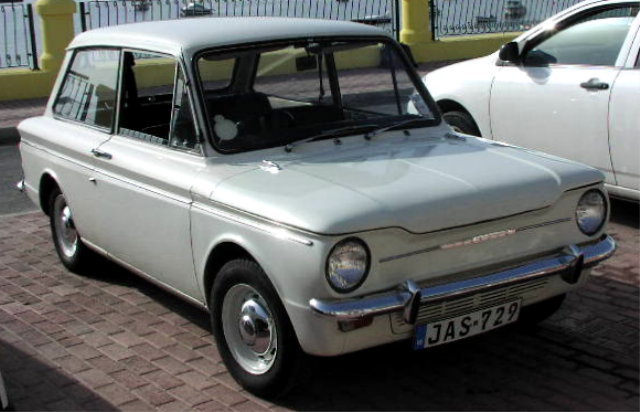
Hillman Imp - awesome.
My granddad had a white one when I was about 7...

Like this one...

MHV_Hillman_Imp_01.jpg
 
Hillman Imp - awesome.
My granddad had a white one when I was about 7...

My mum had one when I was about 7, broke down a lot but I decided I wanted one when I grew up. I haven't grown up yet, but still bought one when I was 22 and have always had at least one ever since. This is the current one (actually a Singer Chamois), parked outside my old house:

jeb1-640.jpg
 
Cheers for all the replies.

So if I understand this correctly, because of the relationship between BHP and torque and that torque tends to be at it's highest point lower down in the revs then:

1. High torque but Low BHP = strong acceleration (or pulling power) at low revs but it only for a short duration? Turbo Diesels for the acceleration side of things and tractors for the pulling power side of things

2. Low torque but High BHP = weak acceleration at low revs but stronger acceleration at high revs and can keep it going for longer? Such as formula 1 cars hence their high revs?

3. High torque and High BHP = strong accelerations at lows revs and can keep it going right up through the revs?


Would this be accurate enough or am I way off course! lol

It's starting to look like torque is much more useable in real life situations rather than BHP.
 
BHP is how hard you hit the wall
Torque is how far you take the wall with you
 
Ah the old torque verses BHP quandary ….In lamens terms ...err, something like

Torque is the amount of initial inertia of a twisting force.
BHP is a measure of the continuous acceleration of that inertia.

Also BHP, unlike HP is a measure of the braking power of an engine, but in reverse.
Like if the road was a drum, and you ran the drum in the opposite direction to normal movement, BHP is a measure of how well your engine stops that drum spinning.
 
In normal road driving a high torque engine is more flexible and easier to drive with greater grunt from a low speed (up to about 60mph).
In addition torque increase is generally linear so you dont get any rapid increases of power to the tyres, so better in poor weather conditions.
High BHP is good for higher speed acceleration (say above 90mph).
Generally high torque engines are more fuel efficient.

Matt
 
Hillman Imp - awesome.
My granddad had a white one when I was about 7...

Like this one...

MHV_Hillman_Imp_01.jpg

Rear engined. Alloy cylinder head if I recall correctly. Easily warped when replacing it after a gasket change.
Basic model had no heater !!
Front end was seriously lacking in protection for occupants in the event of a collision. Rootes would not allow that info to be made known to Brit public and at that time the law forbade anyone doing so. However the BBC found a way around it and made the info known via a live broadcast from USA on it's Tonight programme - the one presented by CLiff Mitchelmore.
 
torque is more fun :D

but power to weight is where its at ;)

weight is def where it is at, removing weight especially high up makes a phenominal difference, just fitted polycarbinate windows to our track car, although a massive turbo makes a big difference!

Basically you want a balance of the two bhp and torque, but it also needs to be usable, for instance low down torque will make a car feel quick but get too much and its good bye traction!! Bhp in normally aspirated engines tends to come high up the rev band, but in turbo charged cars it can come in alot earlier.
 
It's starting to look like torque is much more useable in real life situations rather than BHP.

Bang on.
When you accelerate and the car pushes you in to the seat thats torque, when you look down and go "jeez Im doing XXX mph" thats power.

So if you want to lug a weight around (like a caravan for example), you want lots of torque, the lower down the rev range this is will make it more usable.

As someone above says power (bhp) is equal to torque (lb/ft) at 5252rpm for a four stroke engine.
Normally road cars have peak torque just before this, peak power after it.

You touched on F1 cars and high revving engines. If you want to make horsepower you select a large bore (the diameter of the cylinders in the engine).
If you wanted a torquey engine you'd use a longer stroke (the distance the piston travels up and down in the cylinder).

An F1 engine will have a small stroke, but a large bore. I just found specs for an F1 engine from about 10 years ago, 3.0 litre V10 - stroke is 46mm, but bore is 91mm. This is known as "over square"

Chrysler had a 6 cylinder engine known as the slant 6, 3.7 litre, it had a 86mm bore but a 105mm stroke. This is known as "under square"

Sports bike engines are typically over square. I believe most if not all piston aircraft engines are under square.

over square = high revving but low torque
under square = restricted rev range but high torque.

You do get "square" engines where bore and stroke are equal, this is often a good compromise. Virtually all 2.0 petrol Vauxhall engines are square (86x86mm).

 
Cheers for all the replies.

So if I understand this correctly, because of the relationship between BHP and torque and that torque tends to be at it's highest point lower down in the revs then:

1. High torque but Low BHP = strong acceleration (or pulling power) at low revs but it only for a short duration? Turbo Diesels for the acceleration side of things and tractors for the pulling power side of things

High torque and low bhp will generally give you good pulling power, but poor acceleration

2. Low torque but High BHP = weak acceleration at low revs but stronger acceleration at high revs and can keep it going for longer? Such as formula 1 cars hence their high revs?

Low torque but high bhp will generally be fast with quick acceleration. This scenario usually makes for a peaky or narrow power band engine. Think motorbike or F1 car, big power at the top of the rev range

3. High torque and High BHP = strong accelerations at lows revs and can keep it going right up through the revs?

High torque and high bhp make for fast acceleration and a good spread of power throughout the rev range


Would this be accurate enough or am I way off course! lol

It's starting to look like torque is much more useable in real life situations rather than BHP.

BHP and torque are usually relative to each other i.e high bhp = low torque value in comparison. There are few other things to consider, such as power delivery and power band. Also when you talk about acceleration the power and weight are key factors.

A diesel car engine will tend to have less bhp and more torque compared to a petrol equivalent and a lower rev range. This makes acceleration slow, but pulling power good i.e a diesel will pull out of a corner well using the torque of the engine.

A petrol equivalent will have better acceleration from a stand still, but poorer pulling power i.e you might change down a gear for the same bend, so that you use the power (higher revs).
 
Last edited:
When you accelerate and the car pushes you in to the seat thats torque, when you look down and go "jeez Im doing XXX mph" thats power.

I'd disagree with that. What pushes you back into the seat is 'g' G-force, which is an effect of acceleration. The bigger the acceleration the bigger the 'g'.

Big torque doesn't give you fast acceleration, big bhp does (relative to weight of course)

Take a motorbike engine for example, low torque but big bhp = fast acceleration, with a massive rev range making peak power at the top of the rev range and peak torque in the middle of the rev range.
 
High torque at low revs is good for pulling away. Think of a steam locomotive which can spin its wheels, yet has no gearbox. Insufficient torque: think of an electric drill or hedgecutter getting jammed, followed by smoke from the motor.

Power is needed for maintaining high speeds.

All this, plus the colour of Ferraris, was settled with the Peking to Paris race in 1907.
 
High torque at low revs is good for pulling away. Think of a steam locomotive which can spin its wheels, yet has no gearbox. Insufficient torque: think of an electric drill or hedgecutter getting jammed, followed by smoke from the motor.

Power is needed for maintaining high speeds.

All this, plus the colour of Ferraris, was settled with the Peking to Paris race in 1907.

WTF?
 
Big torque doesn't give you fast acceleration, big bhp does (relative to weight of course)

Take a motorbike engine for example, low torque but big bhp = fast acceleration, with a massive rev range making peak power at the top of the rev range and peak torque in the middle of the rev range.

Not strictly 100% accurate. Triumph engines are big on Torque, but then again 110 bhp in a bike isnt to be sneezed at either. BM & Triumph make high torque engines that accelerate fast enough to be "competitive" at the trafic light GP.
Their higher torque also means they are less affected by extra weight in the form of touring equipment and/or a passenger.

The more BHP you cram into an engine of a given size the less rev range it generally has, especially true if you go the multicylinder route, which if you want high revs you have to (high revs generally equals high bhp/low torque) because high revs destroys big heavy pistons so you need small light ones, therefore you have to go multi cylinder.
Multi (4 or more) cylinders usually means a lower torque output for a given engine size when compared to single/twin cylinder, hence Triumph and BM using 3 and 2 cylinders (generally) respectively. 3 cylinder engines usually combine the best of both worlds (in addition to being lighter than say a 4 cylinder engine of the same size).
Of course this all gets complicated by the addition of turbo (or better still super) chargers to boost either bhp or torque add in cam profiles and/or variable valve timing plus exhaust tuning and engine design starts to get very complex and here we are talking largely 4 stroke petrol engines throw in diesels and two strokes (plus Wankel/Rotary) and it gets even more complex.

Good subject though, but probably not for a dinner party. :)

Matt
 
Last edited:
Nah matt, I think you've got the wrong end of the stick their , or I’m not quite understanding you.

Its all as Craft has said above.

Its the amount of push on the pistons by size of the explosion ..so for the same sized pistons a short stroke (short conrod) will have less swept volume than a long stoke ... so you can get more fuel in on the longer stroke, giving a bigger explosion and more push on the piston, providing more torque per stoke.

But the benefits of a shot stoke are that you are effectively reducing the amount of inertial that the piston gathers, this means you can increase revs without the build up of inertia exceeding the engineer and ripping the engine apart.

The real tricky bit is finding time to explode normal unleaded fuel at high revs ...Like the pace of some modern engines out does the speed of the fuel explosions. lol ..I’ve worked on some bikes where we joke about lighting the fuel before we even got it into the cylinder because at 18,000 revs its just doesn’t explode fast enough!


Surely torque is the result of flywheel inertia?


Yes I think your right. But then also add the weight of the pistons and condors ... and the amount of push of the fuel explosions.
All of that twisting power/inertia is the engines torque.
 
Oh my God you guys are giving me a headache! lol What happened to Layman's terms???? grrrrr ;)

Ok, back to practical examples. My pipe and slippers car (normally a term associated to Honda riders hehe) has fairly good torque (330 N-m or 240 lt-ft) for a bog standard car but it's bhp is pretty crap at 130. It's an average to fairly heavy car I guess?

At around 1,850rpm I can get a nice shot of acceleration but it dies pretty fast. So would I be correct in saying that it losing it's "boost" of acceleration because it doesn't have the BHP to keep it going up through the revs? I'm also guessing that the maximum BHP is achieved at an RPM not all that higher than 1,800 rpm and therefore I'm probably better to be changing gears well before the red line in order to keep things in the 1,800 rpm band and above in order to maintain maximum torque.

Or am I just talking [PLEASE DON'T TRY TO BYPASS THE SWEAR FILTER]?
 
A piston can only apply a force downwards (in the vertical orientation) and therefore relies on the inetia of a flywheel to bring it back into a power stroke position. This is a fact and you can apply as many cylinders in as many configurations as you like BUT! The Flywheel is ALWAYS the master.
 
Its not always like that as it goes ... on motorcycles for example the flywheels can be very small. My Italian race bike has a fly wheel diameter of 7 cm ... and crank webs diameters of 9 cm ..its the webs that counter and return the pistons and conrods, not the flywheel.

The advantage of this is that an engine can spin up more quickly when revved, and visa versa, slow down quickly...all useful racing stuff.
The disadvantage is that there is very little low down torque, so it stalls easily.


Or am I just talking [PLEASE DON'T TRY TO BYPASS THE SWEAR FILTER]?


Oi, that was lamens terms. lol ... Im loving this thread, go on, ask me about fuel injection ignition mapping I dare ya.

No your making sense, just :p .... On your cage, it sounds like your rev range is up to about 2500 max revs ... so that usually means that your max bhp will be around 2200 plus and after that it will fall off...so yes you need to change gear before that end to keep your engine in its power range. (Bhp not torque at the top end btw)
 
BHP is your engines ability to do work, more bhp the faster you can go.

Torque is your engines ability to apply force, more torque the 'ooomf' your engine has when you push the loud pedal. Torque is also a good indication of your engines efficiency, at peak torque your engine is running at its most efficient (getting the most air in the cylinders and burning it to extract the maximum amount of energy).

if you have a low torque but high power engine (like my honda interga) you need to use the gears a lot to keep the engine in its power band (area around peak torque) if you want to accelerate fast. The gearbox is just a torque multiplyer between the engine and the road.
 
Oh my God you guys are giving me a headache! lol What happened to Layman's terms???? grrrrr ;)

Ok, back to practical examples. My pipe and slippers car (normally a term associated to Honda riders hehe) has fairly good torque (330 N-m or 240 lt-ft) for a bog standard car but it's bhp is pretty crap at 130. It's an average to fairly heavy car I guess?

At around 1,850rpm I can get a nice shot of acceleration but it dies pretty fast. So would I be correct in saying that it losing it's "boost" of acceleration because it doesn't have the BHP to keep it going up through the revs? I'm also guessing that the maximum BHP is achieved at an RPM not all that higher than 1,800 rpm and therefore I'm probably better to be changing gears well before the red line in order to keep things in the 1,800 rpm band and above in order to maintain maximum torque.

You are losing the acceleration because your car is (I'm guessing) a turbo diesel. The "power" band (it's more a torque band) on those is narrow, maybe 1800-3000ish and they run out of puff completely by about 4000. They generate a lot of torque at low revs and this means to keep it accelerating you really have to row the gearstick. The red line in a diesel is actually pretty meaningless, there's no point taking it all the way there as that's not where the engine is doing anything useful, due to the way diesel burns. Keep it in the torque band to make it go.
 
You are losing the acceleration because your car is (I'm guessing) a turbo diesel. The "power" band (it's more a torque band) on those is narrow, maybe 1800-3000ish and they run out of puff completely by about 4000. They generate a lot of torque at low revs and this means to keep it accelerating you really have to row the gearstick. The red line in a diesel is actually pretty meaningless, there's no point taking it all the way there as that's not where the engine is doing anything useful, due to the way diesel burns. Keep it in the torque band to make it go.

Diesel for economy, petrol for 'Go'...:thumbs:
 
Graham,

In your particular instance, yes. I used to have a Focus ST that when modified delivered around 270 BHP and 300+ ft/lbs in torque. It red lined at 6k (or maybe 7k) RPM, but as maximum power was achieved at around 4.5-5k it was pointless taking to the red line (except it made a wonder pop when you came off the gas to change gear :lol:).

An engine with a lot of torque tends to give you a wider rev band in which to use the power (This is a generalisation I know....) making the engine far more flexible to use, and not having to rely on changing down to get away. Most cars with a decent torque value also provide better engine braking.

My little 1.6 Cooper S just doesn't have the torque that the 5 pot ST had, but I tend to drive it differently, and the MINI goes round corners better than the ST ever did :nuts:

Steve
 
OMG, I'm going to regret posting in this threat but what a lot of nonsense...

Horsepower is what determines the acceleration of your car, at any speed, no matter what. Your engine's amount of torque will tell you nothing about the acceleration.

In a primitive world where cars have no gearbox, yes, you could make a simple association between torque and acceleration, but it would still be down to horsepower.

Lets say you have two 1500kg cars rolling at 30mph. One is in a 4:1 gear, the other in a 1:1. They floor it.

- Car 1's engine that moment produces 100Nm at 4000rpm.

- Car 2's engine that moment produces 400Nm at 1000rpm

The cars, despite one having four times the amount of torque, will accelerate exactly side by side because the car's acceleration is determined by horsepower, not torque, and as horsepower is a function of torque x RPM, they both produce exactly the same amount of horsepower despite massively different torque numbers, hence they will accelerate at the same speed!

gman, ignore torque for speed and acceleration purposes. What torque is an indicator off, coupled with what RPM band it occurs in, is how relaxed and low RPMs you can comfortable drive the car at.

I'll go hide now...
 
Your engine's amount of torque will tell you nothing about the acceleration.
Newton's second law? I'm assuming non-relativstic velocities since we are talking cars.
 
Newton's second law? I'm assuming non-relativstic velocities since we are talking cars.

Without taking into account the gearing the torque is relatively meaningless. as said above if you have 2 engines one with 100lb.ft and one with 400lb.ft the 100lb.ft one could accelerate faster if the gearing is right for it!
 
My mum had one when I was about 7, broke down a lot but I decided I wanted one when I grew up. I haven't grown up yet, but still bought one when I was 22 and have always had at least one ever since. This is the current one (actually a Singer Chamois), parked outside my old house:

jeb1-640.jpg
There looks something much more interesting sat in the garage - and I don't mean the lawnmower :lol:

As for the original question, I'll leave it to the petrolheads to answer but I liked John's theory but need to ask is the fence on the outside or inside of the bend? I assume you are meaning the outside.
Not an entirely accurate description, but it made me smile: "Understeer" is when you hit the fence with the front of the car. "Oversteer" is when you hit the fence with the rear of the car. "Horsepower" is how fast you hit the fence. "Torque" is how far you take the fence with you.

Note to self - must take more notice when Top Gear is on
 
There looks something much more interesting sat in the garage - and I don't mean the lawnmower :lol:

Well spotted ;)

davrian1.jpg

(photo by Wheelspin photography)

That's me, at Longleat in 1999.
 
My little 1.6 Cooper S just doesn't have the torque that the 5 pot ST had, but I tend to drive it differently, and the MINI goes round corners better than the ST ever did :nuts:

Steve

the S isnt that much lower than the focus tbh, standard 240, with overboost its 260... and dont forget it weighs half as much :P

and lets be honest, its not boring like a focus ;)
 
Layman's terms: both are a measure of the same thing, but are expressed differently.

Torque is a measure of the actual roational force (of in thisc case lets say the flywheel) can exert. This is the raw value. If you had a fixed speed engine, then this is the most important thing you'd want to know, as it tells you wherther it's got enough grunt for the job.

Now Power takes into account the speed of our imaginary flywheel. So if the flywheel was spinning at a fixed speed and the torque was increased, you would have more power, which is bvious I would have thought. The opposite is also true: Keep the torque the same, and make it spin faster and you also get more power.

So if you need to choose a value to decide which engine has the higher output, you'd be best to look at the power figure rather than the torque one. Why? Well engines aren't perfect - they will work very well and produce the most torque at one point only, and different amounts at all other speeds. If you plotted it on a graph you'd get a torque curve.

If the torque curve was not a curve, but a flat line (fixed torque output no matter what the speed) then the equivalent power curve would not be flat, but would increase rapidly with egine speed.

Diesels often have a good amount of torque low down, which is why they can do a lot of work and pull loads etc, but because there is so little torque higher up the rev range they will appear to be very low on power.

A 16v petrol N/A engine on the other hand is very low on torque untiil you reach the high RPM range, and even then it's peak torque may be much less than your typical diesels peak torque, but because it's revving faster, it produces more power.

Hmm, maybe I veered off the laymans terms there.,..
 
Back
Top