cuillinade
Suspended / Banned
- Messages
- 512
- Name
- Adrian
- Edit My Images
- No
Benro TMA28C Tripod and B1 Ballhead Review
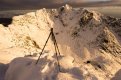
Tripod in use high above Coire Lagan and looking across to Sgurr Alasdair, the highest point on Skye Tripods are really underrated pieces of gear that don’t get the interest they deserve. Photographers spend a fortune on top of the range cameras/lens, agonizing for ages about technical specifications and pixel peeping at 100% at photos taken in ideal conditions. Often very little thought seems to go into tripod selection yet photographers happily place thousands of pounds of gear on flimsy tripods. I recently saw a photographer high in the Cuillin with a top of the range Canon DSLR and very expensive lens with costly Lee filters attached and all this was precariously balanced on a lightweight, budget tripod. To make matters worse, the photographer was very tall and the tripod very short so he was uncomfortably hunched up and the wind constantly threatened to topple his tottering tripod.To me this is a false economy; not only are you risking damage to your expensive camera and lens but also you are not getting the best results from your expensive camera/lens combination.
I have always believed in using quality tripods, any savings being a false economy. Buy cheap, buy twice, so the saying goes and that’s what happened to me in my tripod odyssey. Landscapes are certainly one genre of photography that can benefit a lot from a good tripod especially if you are going to print large and want to get the most detail you can in your image. Good technique and good support can allow a lesser camera to produce great photos. For instance, I have just reviewed Saal Digital’s A3 photo book and the large size enabled me to print photos up to 84 cm wide using a full frame camera but an old one. I use a Sony A7 mostly because it is the smallest and lightest in the series yet it’s only 24 megapixels compared to the 42 of the A7 mark 3 version. Most of the photos were taken on a tripod with a timer and everything was done to produce an image of the highest quality.
Quality tripods and heads can seem expensive for something that doesn’t have the kudos of electro-optical components but when you factor in the cost per day they are probably worth almost their weight in gold. My first decent tripod was a Gitzo and I remember paying about £300 for it which at the time was a huge amount. But that tripod has been used constantly since 2005 often on a daily basis in very harsh terrain. The good thing about tripods is that they don’t become obsolete, don’t require upgrading, so the actual cost per day is very small.
Having been a long term user of Gitzo, I haven’t really kept abreast of developments in the tripod field and until recently didn’t know a lot about Benro.
ATC member Mike Quinn asked about advice for a lightweight tripod and Tim Wilcock suggested a Benro FIF19CIBO Carbon Fibre Tripod which prompted me to do a bit of research myself. A few days later Mike was on holiday on Skye and kindly brought his new toy round for me to see and I was instantly hooked. The product looked top notch and oozed quality. Just a few seconds of play convinced me this was a premium quality tripod. I contacted Benro UK about the possibility of reviewing a tripod and was impressed by their prompt response and felt like a child in a sweet shop when asked simply what would I like to review. It was tempting to simply go for the top of range, most expensive model but common sense kicked in and I knew I should opt for something that I’d actually want to use.
Benro UK’s Digital Marketing Director, Scott Baggaly, was brilliant in answering my questions and between us we decided on TMA28C carbon fibre tripod and a B1 ball head. The reasons behind the choice;
- Reasonably lightweight, although to the non photographer the set up seems fairly hefty. 1.54 kg for the legs and 0.36kg for the head. Quite a bit lighter than my Gitzo.
- Carbon fibre for weight saving but also handles better especially in the cold when touching metal is a big no no. Also one leg is foam clad making it easier to handle and carry especially in winter.
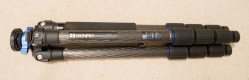
- 4 section legs so that it is more compact when closed. I wanted something that would easily strap on the side of my rucksack. NB 4 sections versus 3 can be heavier and potentially less stable. 53cm folded length of legs which was noticeably shorter than the Gitzo.
- Didn’t need to be too tall since I’m only 5’ 8” so could be a lighter, shorter model.
- Reasonably sturdy but not overkill since I am only using a Sony A7 but wanted something to show and potentially loan to clients using Canikon DSLRs.
- Twistlock legs rather than folding levers. Twistlocks were what I was used to from the Gitzo and make it easy to slide the tripod down the side compression straps on my rucksack. Clips would make loading and unloading a chore as they would snag on the straps.
- Bewildered by the choice of heads, I left the choice of the B1 to Scott. It seemed a reasonable compromise of weight and ability still to support a huge 14kg.
- Universal Arca Swiss style quick release plate compatible. I have a L bracket on my camera which enables you to quickly swop from portrait to landscape orientation and it needed to accept this rather than having some own brand mount which requires you to by manufacturer specific plates.

The complete package
The gear quickly arrived by courier and it was like Christmas come early for me. The packaging looks very professional in black with the blue Benro colour matching the highlights on the actual tripod. Must make for eye catching displays in shops but for me personally it was nice to see everything well packed. The legs were in a padded carry bag inside the box. The padded case seems to reflect Benro’s ethos and is well thought out. It’s nice and large and will easily accommodate legs and head so it’s easy to use with separate pockets for accessories.
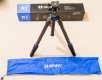
The padded carry case is a nice touch and good for transporting and storing but something I personally wouldn’t use in the field. Usually the tripod is just strapped to the outside of my rucksack with a neoprene case protecting the head. This allows for quick deployment when combined with a chest mounted camera bag carrying my A7 and 25 and 85mm lenses. Ironically I will probably use the blue Benro dust bag which should be enough to protect the tripod on the outside of my rucksack. It may seem strange but the addition of this lightweight bag that just slides over the tripod really pleased me.
It was good to see a bunch of accessories included as standard;
- Spiked feet as an option to the installed rubber feet. Useful on grass, snow etc.
- 2 allen keys and a spanner so you have all necessary tools to tighten and loosen things.
- Padded carrying strap which has proved surprisingly useful especially .
- Instructions.
- Best of all a short central column to replace the long one that is fitted as standard. I don’t often extend the central column much, if at all, because it makes the camera a lot less stable. A short column would save weight and allow for shots from very close to the ground.
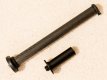
Standard and short centre columns
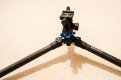
How low can you go?
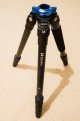
The Benro Mach 3 collection is billed as their most advanced combining classic design with cutting edge materials. In this case, carbon fibre legs using Benro’s signature 9 layers to maximise the strength to weight ratio. All metal components, which are mainly magnesium alloy to reduce weight, are doubly protected by anodising and a powder coating which not only look pretty cool but increase corrosion resistance.
I’m not a product photographer so I’ not going to include lots of shots of the tripod. For those interested here’s a link to Benro with all the specifications and product shots;
http://www.benroeu.com/products/benro-tma28c.aspx
http://www.benroeu.com/products/benro-tma28c.aspx
The tripod looks the business with its dark 9X carbon fibre legs and Benro trademark blue highlights and feels really well made but now to the important question of how it performed in the field. My first outing with it coincidentally produced one of my favourite images of 2017 and two other great shots. Now I’m not saying I wouldn’t have got them with the Gitzo but the fact was I used the Benro and everything worked perfectly on it’s debut.
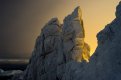
One shot I have been dreaming of for literally years was the sunrise lighting up the Bhastier Tooth high on the Cuillin Ridge and I have been there many times but never has the light been right. I went up one day in the snow in December but it was too cloudy for any sunrise to be visible despite the forecast. Next day I went again. First outing for the Benro, another 3 hour struggle in deep snow in the dark and nearly 900m of ascent over rough terrain. This time the stars were all aligned and a glorious glow lit the edge of the tooth but literally only for a minute or so. I was head down in a knackered state plodding up steep snow when I saw the glow wout of the corner of my eye and knew I had to be quick. Flung down my rucksack, grabbed the tripod from it and A7 from it’s chest pouch and carefully picked my way across the steep slope conscious of how silly it would be to end up sliding down to the coire below with a camera and tripod when there were ice axe and crampons in my rucksack.
The legs extended smoothly and I kicked down the snow for a solid platform and shot 5 shots. So ephemeral was the light that the glow was only visible in the first 3 shots. As certain as I could be that I had got a stonking good shot, I continued up to Bealach nan Lice and enjoyed a flask of hot coffee whilst hoping the clouds that had rolled in would clear. After an hour they parted and I got another great shot.
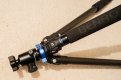
The B1 ballhead operates very smoothly and being able to adjust the friction on the main control knob is great so you can set it exactly how you want. I particularly like the Pull and Twist safety system which reduces the chance of accidentally dropping the camera from the Swiss Arca mounting system. The more I used the Benro, the more impressed I was and I kept discovering hidden features. For example, below the blue anodised ring on top of the centre column is a rubber ring which acts as a shock absorber for the camera/lens as you slide the centre column down.
Having used the tripod quite a lot for about a month, I thought I knew enough to write a review although of course the ultimate test is how durable and long lasting it is. I feel pretty confident it should last as long as my Gitzo. The design and construction seem superb and from research on the internet I haven’t found anyone reporting any problems so all seems good. Also good was the feedback I received from several Benro users who said they treated their tripods pretty harshly and how well they have survived with only an occasional clean and servicing.
I must admit, I am pretty heavy on gear. Gear is bought to be used not molly coddled. Cameras and tripods are tools and the Cuillin is a particularly harsh environment. In fact, it’s hard to imagine a harsher testing ground for gear with the abrasive gabbro rock, bogs and lochs then the salt water as the mountains rise straight out of the sea. I try to be careful with gear and with the new tripod have washed it down after use in the sea and leave it open to dry overnight. Also I have read that carbonfibre is vulnerable to splitting in cold weather if dropped so I have been careful with the Benro since my old Gitzo has two cracks from when strong winds in Coire Lagan blew it over several years ago.
Positives
- Design and build excellent. Benro must be confident in their products since they are covered by a 3 year warranty which extends to 5 years if you register online. I like that their website details this and also has an address to send items to for repair or service.
- The leg locks are chunky and easily adjusted even in the cold with gloves on.
- The B1 ballhead is very smooth with large control knobs; the Pan Lock controls horizontal rotation, their is a friction control to adjust the tightness of the main control which releases/locks the ballhead. Everything works slickly and as it should. Lots of landscape photographers use geared heads and I don’t think Benro make one but I have always used ball heads.
- The ability to get really low shots using the short centre column and the very wide splaying legs. This will be useful for macro shots and low angle landscapes.
Negatives
- Short centre column doesn’t have a hook like the longer one it replaces to hang a bag etc on to weigh down the tripod especially in windy conditions. Only a small thing but for the time being I will probably use the longer one because of it’s hook. My brother is an engineer and I may ask him if he can add a hook to the shorter one to make it ideal.
- This is only a negative to me since I will probably never use it but the tripod design allows one leg to be removed and used as a monopod. Presumably it could be a tad lighter without but it is a clever design and many people will obviously make use of it.
- Not just Benro but most tripod manufacturers seem to have only an option to screw on metal spikes or rubber feet. With the profusion of rock on Skye, I inevitably opt for the rubber feet even in winter with snow and mud but ideal would be a design which incorporated perhaps metal spikes which screwed out from rubber feet thus allowing the best of both worlds.
The TMA28C has a RRP of £310 but is widely available for about £269.
The B1 Head costs £99.
NB this was first published in the All Things Cuillin group on Facebook https://www.facebook.com/groups/165143940728168/