Before you press the button!!??

naveen.nag

Suspended / Banned
Messages
214
Name
Naveen
Edit My Images
No
We all know photography is not just about pressing the shutter release button on the camera.

Lets get a little personal here :). Lets get one level deeper on this. What is the thought process? How the ideas flows? Hope to pick each other's brains. Lets start with these questions. On a typical day when you walk out of your home hoping to capture some nice shots, how do you approach? What are things you do before press the button?

Firstly, i mount the lens i want to shoot with.
Then, put my camera on aperture priority mode, firstly.
Keep an eye for something worth photographing (sometimes i do go out with pre conceived notions,do you?)
Then i try to get to a position and compose a frame.
Press the button.
Now more often than not, i dont like what i see on my camera lcd after i click.
Hence this thread!!

How do you guys go about your typical /average camera day?

Curious how my peers do things? Hoping to pick some pointers. :)

Naveen
 
Before I leave the house I often have a pre-conceived idea of what I wish to shoot and the type of results I want to get.

Although with my main subjects this turns out to be a lot easier and it would when going for a photo walk or something...
 
Yeah i go out with an idea of what i want to shoot - that informs which lenses i take, when i go, where i go etc

there are no set settings etc as that depends on the individual circumstances
 
I pack gear in accordance to what I expect to encounter. So long lenses for wildlife etc.

Strap camera to hand, so it's always to hand, no fumbling around, just lift my arm and the camera is always magically there.

Walk about absent minded till something gets my attention. As I walk I adjust exposure, metering off trees / floor so the exposure should be semi there when I find a subject I like, as I do everything in manual. This is so I can fire off a couple of quick snaps incase it's one of those fleeting moments.

Find subject, adjust exposure, compose and take a couple of shots. If I'm unhappy with those shots, ill circle the subject to find a better angle and recompose.
 
Find a base iso that gives me enough flexibility for either a faster shutter speed or smaller aperture.

Generally sit on wide open - f4 or so, stopping down as and when needed.

Keep shutter speed high enough to avoid shake at the longest length on the lens so I don't need to worry about adjusting the shutter speed suddenly if I zoom all the way in.

I try to keep iso as low as possible without restricting the flexibility of other settings, it is generally the last thing I'd change if I was struggling with getting the exposure right.

Adjust as needed, that is a very very rough outline of how I go about, but as mentioned, there are too many variables to give even a semi accurate "do this, do that" reply.
 
Last edited:
Great, this is the way evrryone one of go about.
How about more on camera modes, what kinda settings or adjustments do u do apart from varying apertures?

I'll use shutter or aperture priority depending on whether I want to choose the shutter speed or the aperture - which depends on the circumstances and the intended result - adjust ISO if I can't get what I want with it as it is - spot meter if required - otherwise evaluative - ND grads if required - manual mode if it's easier than trying to manipulate whilst in an auto mode etc. etc. etc.

Actually, that's not really the right answer - I find this question an awkward one in such a general, non-specific context - I make an assessment (often to a degree before I leave the house but certainly when I'm considering a shot) of what I want and what I think is possible - and then I work out how to do it and give it a go - then I'll try tweaking it a bit - or give up and move on to the next shot/idea.
 
I carry all three of my lenses all of the time and have not much of a plan other than finding something fab or pretty to shoot. I usually have a short lens fixed permanently so the only settings ill ponder as I wonder are base settings, like if its a dull day I might set my ISO up higher, or if im shooting sports i may set the shutter speed as priority instead, mostly though I change settings as I raise the camera to my eye depending on what i see happening, Like I'll quickly choose what's the more important priority DoF or shutter. (my iso is usually set) and then just check the opposite is exposing as I want it before finally pressing the shutter.
However slick, I still think the most successful shots come from seeing and thinking clearly, not so much the settings even.
 
Most of my important thinking is done days before I'll be pressing that button.....

What time is sunrise/sunset,
what are the tides (for seascapes),
what's the weather forecast (not always that helpful:bonk:),
is all my kit clean, serviceable,
what locations do I plan to visit and exactly where will I setup on arrival

Most of the time I've visited a location at least once and had a good walk around and made a note of the possible compostions...I try to minimise the amount of thinking I do on the day so I can maximise the chances I get to take the photos I want

Simon
 
See photo opportunity,
Raise camera to eye,
Lower camera,
Remove lens cap.

Raise camera,
Lower camera,
Power on.

Power off,
Insert memory card,
Insert fully charged battery.
Power on.

Wonder where subject went. :)
 
Last edited:
It all starts at home for me. I'll be checking weather to see where's good to go, then decide what I want to shoot and what with and on what medium. If it's an unknown location I'll probably go digital and work with what I'm presented with - this often means no good shots, but I can use them as reference for a future visit when I know what conditions are more favourable to that location.

I like that about landscape, you never know what will happen at a place and you can't just rock up and be able to make a masterpiece with just your skill. If nature isn't playing then you'll always be disappointed.
 
How about more on camera modes, what kinda settings or adjustments do u do apart from varying apertures?

there isnt really a simple answer to that as it depends what i'm shooting

I generally use AV for most things, M for long exposures, but there are times when TV or even P are appropriate - I don't use the scene modes

ISO I set to whatever is needed,

WB usually lives on shade, but again changes depending on what i'm doing

AF is on single shot for static subjects and AI servo if they are moving

I leave the camera on burst nearly all the time , I find that with care i can fire single shots without having to swap to single shot mode.

Exposure comp is usually set to - 0.5 to avoid blown whites as my camera has a tendency to slightly over expose, but again this varys with situation and subject.
 
See photo opportunity,
Raise camera to eye,
Lower camera,
Remove lens cap.

Raise camera,
Lower camera,
Power on.

Power off,
Insert memory card,
Insert fully charged battery.
Power on.

Wonder where subject went. :)
:lol::lol:

I do that too :D

Though in my defence, I seldom do any of them, rarely do I do them all together, and mostly in the mornings before leaving the house/garden (I do check cards and batteries before leaving the house but power and lens caps do catch me out).
 
Last edited:
I take all my lenses with me when I venture out as you never know what the day will bring, camera always set to manual, adjust settings as and when required- simples :D


Les :thumbs:
 
*Wake up, have brekkie then check I have all my directions to venue etc
*Batteries are all checked before I leave the house, as are cards.

-- big gap in the middle where I spend several hours drinking coffee, smoking lots and getting stuck in traffic - -

*Arrive and say hello to subject, have a chat and a cuppa - this breaks the ice and gives you an idea of how they are on the day
*Read brief from editor (if I have one) or just work out the types of shots I need for the feature
*Set base ISO relevant to give me a decent enough shutter speed for the 70-200mm, usually a minimum of 1/250th, combined with f/5.6.
*Make sure WB on relevant setting for the day
*Usually set it to Av but this all depends on whether I'm starting off with or without flash. If I need to start off with flash then it's manual and then have to set up off-camera units controlled by an SU-800 or I use a large 40" reflector (handheld) and then bounce on-camera flash off that.

Although I can kind of summarise, in reality every shoot has similarities but none are the same. Some days I'm there before dawn so there's little chance of photographing anything worthwhile for the job, unless it's sunrise shots that are required. I'll always rattle off some personal shots, but in general I have a structured list of shots that are either required by the editor, or I feel are relevant to the feature to make it visually interesting.

Of course, I have 'go-to- shots that I do every time; man holding fish on long lens, man holding fish on UWA, catch shot, playing shots (etc) - but if for example the feature is about using lifelike fly patterns, then I'll shoot a variety of openers (in DPS and single-page format) that could range from macro stuff of the fly in a blade of grass, right through to shots of multiple flies in context with the environment. That's just one example.

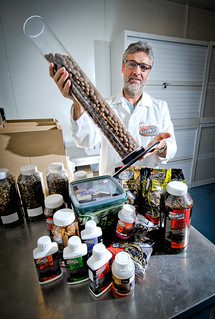
There are times when I'm really limited in what I can shoot - off-shore boat fishing being one - or when I really am just required to shoot a small number of specific shots; had one in Holland where I had to go over there for the day just to get a few headshots of a bait scientist and a main image that had a 'mad professor' feel without it looking ridiculous. This is one of the shots, although looking at it now I wish I'd done a few things differently:


The Fishing Scientist by Pat MacInnes, on Flickr

Events such as the Evesham Festival, or a major tackle show are totally different; I still have a rough idea of certain types of shots but there's no set shapes I have to shoot so I have free reign to shoot shoot as I see fit. Evesham is a good example of this - lots of people watching the fishing, lots of people shopping i the tented village, lots of people just milling around.... add in the actual angling action (not always rivetting might I add) and I just go into 'zombie mode', firing off shots like my life depend on it. I usually end up with about 3,000-4,000 shots overall from that event.
 
Last edited:
This is one of the shots, although looking at it now I wish I'd done a few things differently:


The Fishing Scientist by Pat MacInnes, on Flickr


Like what ?

What makes the picture fit your brief, peeps wanna know, I mean could it be a compo change to make text easier to add for a cover, or is the proximity of scientist compromising your mad professor idea a little, or do you need to include some readable detail on the bottles or something ?
Its all about attention to detail....:)
 
Like what ?

What makes the picture fit your brief, peeps wanna know, I mean could it be a compo change to make text easier to add for a cover, or is the proximity of scientist compromising your mad professor idea a little, or do you need to include some readable detail on the bottles or something ?
Its all about attention to detail....:)

There are so many things I can think of - composition change, lighting change, environment change.... I suppose it's one of the pitfalls in A) having very little time to shoot, and B) looking back on work that was shot when you were at a different stage of your photography. Two and a half years is a long time in anyone's development....

One major thing was not being able to take a soft box with me; this was all lit with bare flash so there was less control over fall-off, plus because the room was small, it was hard to create differences between the light sources as far as apparent size goes.

It was never intended as a cover - it ran full page next to a page of text with cutouts of the products to give more context about the bait involved. Still, you've highlighted a good point... the ability to lay text over the top. Much of what I shoot these days gives the designer the option to overlay copy.... I suppose a shot like this highlights your deficiencies as a photographer because it's an everlasting record of the decisions (good or bad) that you made on the day.

Plus, there's that awful cardboard box in the background:bang:

Overall, it carried the message required by the editor - it showed the man, it showed what he is involved with and who he works for. And it looked different to the rest of the (mainly) stock/supplied images that trade magazines often rely on.
 
Last edited:
To be fair to yourself I think you should always feel slightly dissatisfied with your pictures that you took a few years ago, that way you know you've moved on.

I used to do coarse fishing and the sheer number of picture ideas you came up with as your safe shots sounded pretty good to me. I probably wouldn't have done half them!

But to go back to the question. I normally have a brief, I don't just go out with the camera and hope for the best. It may be an organised event or I might have a specific idea of what I want to do. For example if i neec an autumn picture then to the park with huge trees i must go! The settings and kit etc are built around that, not the other way round.
 
Plus, there's that awful cardboard box in the background:bang:


Out of all the things you relinquish control of, time constraints, softbox flash and clearly space etc, the box is the simplest to fix....its maddening.

I agree about the picture though, like with a lot of things you can pick and pike at it all you want, it still does the job..
 
most of my photography is landscape or seascape.. therefore lots of app's on my phone to cover local tide times sun rise set times and positions.....

Generally shoot Av or M... depending on individual situation... tripod 10 stop and off camera hahnel trigger with timer for exposure... this is also great for star trails as can set for 100x 30 sec exposures and sit in the car and keep warm whilst it does its stuff... (then stack on pc later)

Occasioanlly use Sv for aircraft - to get prop blur...

Never use TAv - on pentaxes, it gives you control of shutter and aperture, and compensates by ISO adjustment...

There is no general rule.. it depends on the circumstances and lighting and what you are doing... for example wedding in a dark church, may have to open the lens fully, and to get enough light, bump the iso considerably...
 
Back
Top