Band shots advice.

simond11

Suspended / Banned
Messages
368
Name
Simon
Edit My Images
Yes
Hi,

Im after a bit of advice. I asked a band a few weeks ago if I could take some live stage shots of them so i could improve my technique, anyway they agreed. 1500 people capacity venue with quite decent lighting, Im pretty much OK with the stage shots. I run full manual, no flash, nifty 50, 24-70 2.8L and 70-20 2.8L on a canon 7D and have looked at previous shots of them to see how they move on stage.

Anyway theyve just contacted me and asked if I wanted to do some pre show portrait / set shots. Im not sure exactly what there after and Ive not done anything like that before.
I was thinking of using the nifty 50 with flash (580mk2) if needed and running in aperture priority of about F4 or F5.6 and seeing how the flash in ETTL coped with that. Basically Im after ideas of what would be best?. I wont have much time to practise but should be able get some test shots if I get there early.

Any ideas? this is for tomorrow !

Thanks

Simon
 
Trust yourself. I've never practised posed things for bands, because if I come up with ideas before I've met them or seen the venue, etc, then there's less chance it'll have any form of personality (theirs). Just go with the flow, see what they want, what kind of people/band they are & what you can do with the surroundings. If you're completely blank, ask them to go for a walk around an interesting part of wherever you are & photograph them doing that. Something will happen.


As for the gig, my only advice is don't use manual. The lighting is nearly always mental & changes a lot - you're guaranteed to f*** up & miss something.

Before my first band thingy I spent a good while on Flickr looking at whatever I could find. If it helps, and doesn't seem too much like I'm just trying to promote myself, have a look at the 'music' section on my site (clicky linky below). Everything there was with a very basic set up - Nikon D80, kit lens (18-70) or 50mm 1.7 & only 5 or so with a flash that I borrowed from another tog at the same gig.

Good luck :D

-J
 
As for the gig, my only advice is don't use manual. The lighting is nearly always mental & changes a lot - you're guaranteed to f*** up & miss something.

Hate to disagree with this, but I always shoot manual with live music, much better results. Lighting plays havoc with meters. But if you are not 100% confident in it then you need stick with tv or av.
 
Have to agree with Carl, I always use manual for my gig shoots as it gives me greater consistency and does not allow the auto settings to cock things up particularly with back lighting. Here are a couple of recent examples:

Link 1

Link 2
 
Hate to disagree with this, but I always shoot manual with live music, much better results. Lighting plays havoc with meters. But if you are not 100% confident in it then you need stick with tv or av.

+1 for Manual under these conditions
 
Thanks for the tips. I do usually use manual for the very reasons mentioned, lighting is so unpredictable and when i first started shooting music I soon realised this. Stage shots I pretty much fine with.

I think it all down to trusting my eye with the portrait/set shots but as its the first time and i only get a 1/2 hour session to get it right.

They are very experienced musicians and have been in the buisness for years (Rory Gallagher Band, Alex Harvey Band, MSG) so they know what they want and when I originally asked them I was upfront and said I was an amatuer Tog and wanted to shoot there gig to gain experience which they were fine with.

I think I will go with the nifty 50 & 24-70 and see how the land lies.

Aperture though F4/5.6 but I have also been reading about upto F8/11. I suppose this depends on the pose, lighting situation. I will have flash though

Cheers
Simon
 
I also shoot manual for gigs, I know a lot of people consider it lazy but if the lighting is very quick you need to machine gun it.
 
I've got to agree with the majority in here, manual really is the only way. Only thing to watch out for is if the colours of the lights shift, I often find the red lights are less intense than other colours.
 
For a first time I would definitely not recommend manual, too much faffing around and it could easily go pear shaped if time is limited. I have shot at over a hundred gigs and never used manual at all so you are not missing much! I would start off in either [24-70L is perfek for most close up venues] AV or TV mode. AV 2.8 and see what you get and in TV say 1/250.

I use 'safety shift in TV mode, set to 1/250. Its a great facility as the camera will use the widest apeture it can and then incrementally drop the speed depending on how good [or more probably how bad!] the lights are. If you are allowed to shoot more than three try AV for one song and TV for another, see what differences you can spot! I bet you struggle to see the difference!
If you can use flash then use manual, say 1/60 0r 1/100 and 2.8/4. Use your flash on manual at low power, you don't want to wash the lights and atmosphere out.
Most important is position, position and position!! Get in the wrong place and your shots will not look good. As a general rule 45 degrees off to one side so you are shooting guitarists from the body of the guitar not the fret. Finally spot focus always for me and centre focus point, focus on the face, be careful not to get the mike between camera and face.....
My final piece of advice is be on your toes for the one in a thousand opportunity shot, take loads and be ruthless in your editing. If its crap bin it!

Good luck

Dunc
 
I'm on the `manual` bandwagon. Given the speed that lights tend to change, the camera is going to struggle to keep up anyway, so there's quite a bit of shoot-and-hope going on. Vary things as much a you can - some flash (low output), some wide, some tight. If you can move around, move around.

DON'T change your lens unless you really, really have to. It'll be dark, there will be other snappers, roadies, security, fans, all shoving you. And if they have a smoke machine going, bear in mind that this smoke is made from oil. You do not want oil on your sensor. You don't. Trust me on this. Find out how far from the stage you'll be, pick the appropriate lens, and go with it (17-40 or 24-70 usually works for me) Most places will only allow you to shoot the first three songs, so you don't want to miss anything messing around picking up broken bits of glass from the floor.

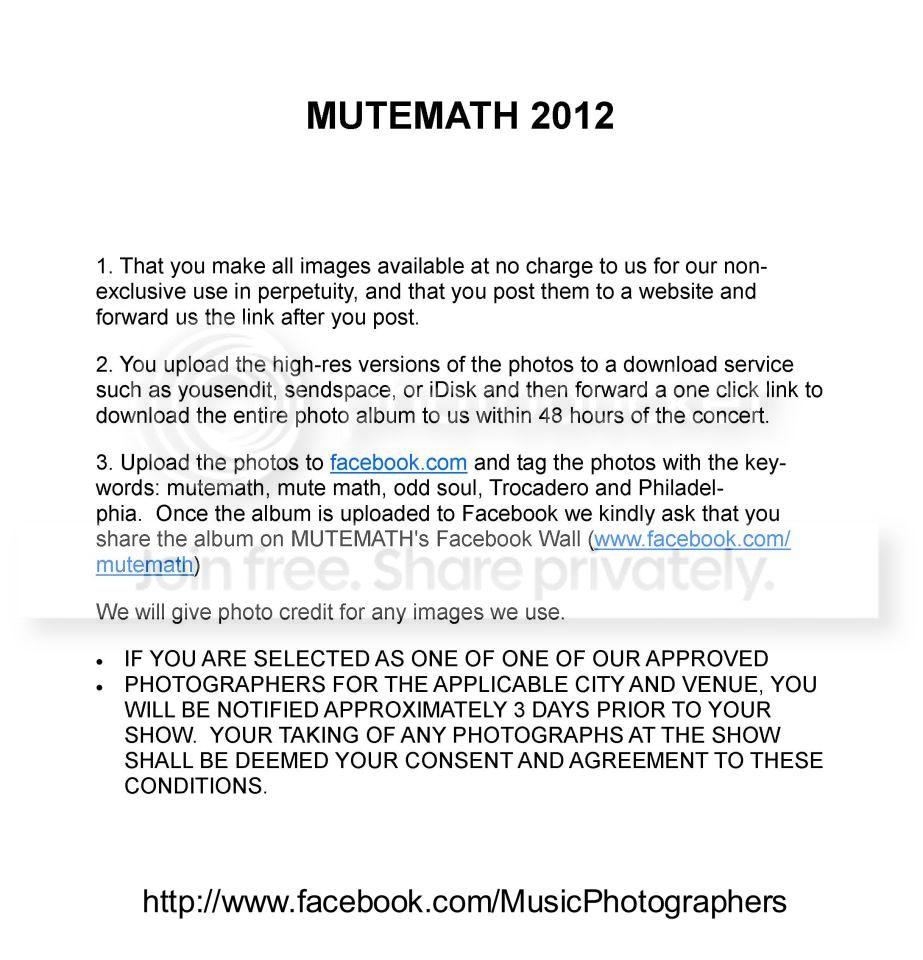
I'm also on the `watch out for seriously, but seriously restrictive contracts` bandwagon. Have a look at the stuff at the top of the Music Photographers Facebook site.

Example:

7441610e.jpg
[/IMG]

Another example (actually, this one may be a spoof. I mean, who's going to shoot under those restrictions? But then again...):

7d127adc.jpg


Don't forget to turn around and get some crowd shots.

Have fun!
 
Last edited:
On one other tip, be prepared to do black and white conversions.
 
I see so many photographers at gigs not having a clue. You look at the top plate of their camera & it's on P mode, so wrong. As mentioned above manual is a good start but as Duncan mentions it's a real faff. Aperture priority is a must for more consistant results as the lighting can be all over the place, be prepared to bin many, many photos. Having said that some of the overexposed stuff can look really cool. Again as Duncan mentions spot focus & more importantly spot metering is a must. I'm laughing at those contracts but to be honest I have photographed thousands of bands & never have had to sign one (yet). There have been instances where there has been a blanket rule of no photography (Prodigy & Kanye West) so I escaped into the crowd & shot from there. I hope this helps?
 
Metering of a camera is so easily fooled by lighting exposures, whether spot metering or not. Manual is the best way, timing and shooting to the lighting pattern, using and trusting your skills. My opinion of course, but shared by a lot of high end music pros.

To say spot metering is a must is plain wrong, and using the Av mode is pretty much the same as P. You are letting the camera decide which is the best setting for your shot, the only difference is you choose your depth of field or shutter speed rather than letting the camera decide both.

Regarding people not having a clue. The thing is every music photographer starts somewhere. The only choice is whether you talk to them, help them and build a contact or just get upset by their choice of mode or their equipment. In some cases I have seen photographers pushing others with lesser equipment out of the way physically to get their shots because they are "obviously not serious about it".

Only time I get upset in the pit is when iPhones are being used to shoot a gig (happened at some festivals) but you just have to let them do what they do & get your shots.
 
Thanks for all the advice.
As normal I suppose, doesnt matter how much planning you do something will go wrong.
Anyway by the time all the band got there after being stuck in traffic they just had time to get the soundchecks done. We had litterally 5 mins to snap a few portrait shots which were very rushed. The live stuff was fine later on and Im pleased with some of the shots. I used manual pretty much most of the time as I normally do and had a few different viewpoints to go at.
700 photo.s on the night and about 70 which are OK, not too bad.

These are the 2 set shots

IMG_1902.jpg


IMG_1901.jpg


Let me know what you think, good/bad or indifferent . The lighting and walls were very yellow so I went to b&w
I will post a few more for critique in the correct section.
Cheers
Simon
 
Would be interesting to see some of the gig, I find them hard, but get a goodun every so often. If it was a raised stage did you have problems with angles?.
 
Back
Top