Backdrop and stand

Adamcski

Suspended / Banned
Messages
2,984
Name
Adam
Edit My Images
No
Sorry mods if I've posted this in the wrong forum.

Can anyone recommend some decent, collapsible backdrops and some stands / clamps.

I've looked on Amazon and there seems to be some from a brand called Kate and neewer.

Want to start taking some portraits of my dog and I currently just use the wall in the living room.

Thanks in advance
Adam
 
I'd avoid the Kate backdrops unless you like ironing, they crease and their printed so if 'scratched' white shows through.

Manfrotto and Westcott 'stretchy' fleece backdrops are far better.

If your wall is a solid colour you could light it or gel the lights for differant looks.

Stand & Cross bar I use
 
Last edited:
Watching with interest :)

I'm also in the same position, trying to take more pics of family / dog, I have stands and I bought a white fabric backdrop that curves down to give a seamless white backdrop, works okay but it gets very creased.

This is what I got on my first attempt with it
2025-07-19 15.00.45.jpg2025-07-19 14.57.07.jpg
 
Oh I just use the wall as it’s plain. Space is my biggest issue and need to keep things relatively small / collapsible, etc.
Try playing with a light on the wall first, gels etc for colours.


I think these better quality ..

 
Last edited:
Watching with interest :)

I'm also in the same position, trying to take more pics of family / dog, I have stands and I bought a white fabric backdrop that curves down to give a seamless white backdrop, works okay but it gets very creased.

This is what I got on my first attempt with it
View attachment 459825View attachment 459826
Sadly, the background here is seriously overexposed, this is the cause of the loss of edge definition. It's one of the unintended consequences of using a creased background, it's tempting to over-light the background to get rid of the creases. The background needs an overexposure level of around .7 of a stop, although it can be a bit more if there's loads of space between the subject and the background, but it doesn't need to be more.

Stands do take up space, and space inside most homes is limited, so just using a plain white wall, if there is one, is always a good choice.

Pop-up backgrounds can be useful, but don't underestimate the size needed - if the background isn't lit then you'll need a fair bit of space between subject and background, and if it IS lit you'll need a lot more, and perspective distortion will create the need for a much larger background than you might expect - unless of course you can shoot with a long lens from far away, but that can be difficult in most homes.

And, whatever you choose, make sure that the background has a matt finish.
 
Below are some I just took this morning.

Z8 and 85 mm F1.8. Single flash (Godox TT350o had to use a trigger Xpro N as that is my Olympus flash and I don't have a Nikon flash yet). Placed flash behind a white brolly, Roxi on the Sofa foot stall and against a plain coloured wall. Took longer to set up than to catch the images lol. Less than 30 minutes and I am pretty happy with the results.


Both camera and flash in manual mode.

I am just after some different backgrounds really and have seen some Godox ones at places like essential photography that don't appear to be too expensive.
 
Sadly, the background here is seriously overexposed, this is the cause of the loss of edge definition. It's one of the unintended consequences of using a creased background, it's tempting to over-light the background to get rid of the creases. The background needs an overexposure level of around .7 of a stop, although it can be a bit more if there's loads of space between the subject and the background, but it doesn't need to be more.

Stands do take up space, and space inside most homes is limited, so just using a plain white wall, if there is one, is always a good choice.

Pop-up backgrounds can be useful, but don't underestimate the size needed - if the background isn't lit then you'll need a fair bit of space between subject and background, and if it IS lit you'll need a lot more, and perspective distortion will create the need for a much larger background than you might expect - unless of course you can shoot with a long lens from far away, but that can be difficult in most homes.

And, whatever you choose, make sure that the background has a matt finish.
You're bang on :ROFLMAO: the creases were doing my head in and I did over expose with a flash low down lighting the background to try and get rid of them.

Great advice, thank you :)
 
Below are some I just took this morning.

Z8 and 85 mm F1.8. Single flash (Godox TT350o had to use a trigger Xpro N as that is my Olympus flash and I don't have a Nikon flash yet). Placed flash behind a white brolly, Roxi on the Sofa foot stall and against a plain coloured wall. Took longer to set up than to catch the images lol. Less than 30 minutes and I am pretty happy with the results.


Both camera and flash in manual mode.

I am just after some different backgrounds really and have seen some Godox ones at places like essential photography that don't appear to be too expensive.
These are much better than mine, I need to try and get my dog to sit still to get some more practice!!
 
I cut loads of little treats up and give her one. I then balance the treat on the camera lens hood whilst I take pictures. Every three or four images I give it to her and then do it again. My daughter wants me to take some pictures of her now, but asked if she can have £20 notes instead of treats lol. I am sure the money is supposed to flow in the opposite direction.
 
You're bang on :ROFLMAO: the creases were doing my head in and I did over expose with a flash low down lighting the background to try and get rid of them.

Great advice, thank you :)
You're welcome:)

I don't know whether this helps or not, it's a very old video, made when my hair was brown, and it uses 2 lights not one, but the principles are the same.

There's a more recent one that's more detailed, but thanks to the YouTube changes I can't find it . . .

One of the problems (as I see it) is that, way back when everyone was shooting on film, a higher level of overexposure was needed than with digital, but as always there are still a lot of people who just don't understand that things have changed and so still grossly overexpose.

In the video, I used a flash meter, but you don't need one. Set your camera to show the over-exposure blinkies, all that needs to blink is the area immediately around the subject, so try that out and then adjust the aperture until that's what you have. The areas that don't blink won't be pure white but that doesn't matter because you can eaily get it right in PP
 
You're welcome:)

I don't know whether this helps or not, it's a very old video, made when my hair was brown, and it uses 2 lights not one, but the principles are the same.

There's a more recent one that's more detailed, but thanks to the YouTube changes I can't find it . . .

One of the problems (as I see it) is that, way back when everyone was shooting on film, a higher level of overexposure was needed than with digital, but as always there are still a lot of people who just don't understand that things have changed and so still grossly overexpose.

In the video, I used a flash meter, but you don't need one. Set your camera to show the over-exposure blinkies, all that needs to blink is the area immediately around the subject, so try that out and then adjust the aperture until that's what you have. The areas that don't blink won't be pure white but that doesn't matter because you can eaily get it right in PP
I'm going through Karl Taylor's online courses at the moment, they're very useful, I'll also give this a watch thank you :)
 
Sadly, the background here is seriously overexposed, this is the cause of the loss of edge definition. It's one of the unintended consequences of using a creased background, it's tempting to over-light the background to get rid of the creases. The background needs an overexposure level of around .7 of a stop, although it can be a bit more if there's loads of space between the subject and the background, but it doesn't need to be more.

Stands do take up space, and space inside most homes is limited, so just using a plain white wall, if there is one, is always a good choice.

Pop-up backgrounds can be useful, but don't underestimate the size needed - if the background isn't lit then you'll need a fair bit of space between subject and background, and if it IS lit you'll need a lot more, and perspective distortion will create the need for a much larger background than you might expect - unless of course you can shoot with a long lens from far away, but that can be difficult in most homes.

And, whatever you choose, make sure that the background has a matt finish.
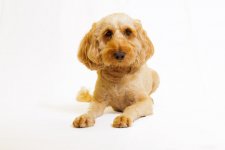
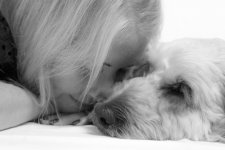
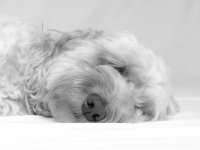
Managed to have another try at this, once I could get the dog to settle, I know they're far from perfect but I'd appreciate your advice again @Garry Edwards

I used 2 lights, a Godox AD400 Pro and my Canon speedlight (need to pick up a second AD400 but haven't had time to sort that yet). No light on the background this time.
Background is a white fabric, took the effort to try and sort out the creases by running an iron over it which seemed to really help, got rid of the bigger creases anyway.

Shot on Hasselblad X2D II and the 90V lens.
All 3 images shot at 90mm, F11, 1/20 and ISO 200

2025-11-09 11.57.07.jpg2025-11-09 13.38.58.jpg2025-11-09 13.43.44.jpg
 
I'd avoid the Kate backdrops unless you like ironing, they crease and their printed so if 'scratched' white shows through.
I have a couple of the Kate backdrops and yes they are prone to creasing. So instead of ironing, I use a hand steamer and steam from behind whilst hanging on a backdrop stand. I have pretty much eliminated the need to steam/iron them now. I bought some lengths of 22mm copper pipe (although steel tube is probably cheaper now) a bit wider than the backdrops, drilled a hole at each end, so I can attach it to the stands. I just roll them up when not needed and use a couple of spring claps to stop them from unfurling.
 
Managed to have another try at this, once I could get the dog to settle, I know they're far from perfect but I'd appreciate your advice again @Garry Edwards

I used 2 lights, a Godox AD400 Pro and my Canon speedlight (need to pick up a second AD400 but haven't had time to sort that yet). No light on the background this time.
Background is a white fabric, took the effort to try and sort out the creases by running an iron over it which seemed to really help, got rid of the bigger creases anyway.

Shot on Hasselblad X2D II and the 90V lens.
All 3 images shot at 90mm, F11, 1/20 and ISO 200

View attachment 467504View attachment 467505View attachment 467506
I think you're getting there, but you're making it unecessarily complicated . . .
Bear in mind that there are in fact 2 separate subjects here, the front (dog) and rear (background). Within reason, the more distance there is between the two, the easier it will be, and the background is far too close here.

The only downside of this is that the background will inevitably be darker, due to the effect of the inverse square law, so you will need that extra light for the background - or maybe you won't, because 1 light on the front subject, with reflector, will probably be fine.

The maximum sync speed for your camera is an incredible 1/4000th second. I'm not suggesting that you should set the camera to this, but it would make sense to set it to 1/250th, you've used just 1/20th, which is pointless and almost certain to create camera shake.
 
I think you're getting there, but you're making it unecessarily complicated . . .
Bear in mind that there are in fact 2 separate subjects here, the front (dog) and rear (background). Within reason, the more distance there is between the two, the easier it will be, and the background is far too close here.

The only downside of this is that the background will inevitably be darker, due to the effect of the inverse square law, so you will need that extra light for the background - or maybe you won't, because 1 light on the front subject, with reflector, will probably be fine.

The maximum sync speed for your camera is an incredible 1/4000th second. I'm not suggesting that you should set the camera to this, but it would make sense to set it to 1/250th, you've used just 1/20th, which is pointless and almost certain to create camera shake.
I'm a bit tight for space, this was set up in my front lounge, the big double garage now has a full gym installed so I can't use that now :ROFLMAO:
That's why he was closer to the background than I would have liked, point taken on the shutter speed, although pixel peeping at 100% in Lightroom they're incredibly sharp, I'll make sure to push it up to at least 1/200 next time.

I'll carry on experimenting and I appreciate you taking the time to feedback :)
 
Many of us are short of space, I certainly am - see the various examples in the Lighting Challenges and the recent ones in the Resources section, all deliberately done in the smallest of spaces.

There are always workarounds, to create more space between main subject and background. For example you can (often) use a shorter lens, and you can often shoot through an open door to (often) dramatically increase the distance between subject and background.
 
About 15 years ago I needed similar, something I very rarely do.

I found some stretch velvet fabric, which never creases, and is non reflective. It was 3m wide and I got 4m of several colours and white

I had some flashes that just go into a normal screw light fitting, and are triggered by the light from another flash, I use those to light the backdrop with some crumpled cooking foil to stop the light coming towards the camera, and to get more on the back drop.

Main lighting was studio flashes with umbrellas etc

I'm sure not the experts way to do things, but it worked well
 
The neewer framework is reasonable for the money for amateur use.

The backdrop clothes however are crap. Creases don't drop out as described and they cannot be ironed as they melt at a very low temperature.
 
Last edited:
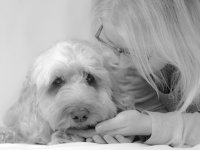
That dog is a precious ball of fuzz. I was at first uncertain what I was looking at in the first picture, since nothing really stood out in it except the nose and the fuzz and my old brain didn't pick up on the fact that the nose was sideways. All of the shots posted are great, once I figured out what I was looking at in the first shot. Closeups like this almost don't need backgrounds.

I have muslin, Kate, and backdrops made from plastic. For their creases, folds, creases, and wrinkles, I bought and use a hand held steamer intended for steaming clothing that has worked well to remove these un-desirable effects from my backdrops. It only holds about 1/2 drinking glass of water, so refills are frequent, but it works well, and is portable so I can take it on out of studio shoots easily, but it does need Mains power to operate. I always use distilled water, purchased in gallon size, from my local grocery store when I steam my backdrops, to avoid getting mineral stains on the backdrops. The plastic backdrops do require extra care, but the heat of the steam will be successful, if you are careful to use only enough steam to get the wrinkles or fold lines out. Too much and you may damage the backdrop.

This is the one that I bought, but it isn't for use on your Mains power. I live in the USA, so it's fine for me. Find something similar that works with your mains power and get it.


I like the Kate backdrops the most, because I like the velvet like face surface of them for their reflection free properties, but they do wrinkle too.

Get yourself a hand held steamer, use only distilled water in it, and I'm quite certain that you will be happy with how well it works for you.


Charley

 
Last edited:
That dog is a precious ball of fuzz. I was at first uncertain what I was looking at in the first picture, since nothing really stood out in it except the nose and the fuzz and my old brain didn't pick up on the fact that the nose was sideways. All of the shots posted are great, once I figured out what I was looking at in the first shot. Closeups like this almost don't need backgrounds.

I have muslin, Kate, and backdrops made from plastic. For their creases, folds, creases, and wrinkles, I bought and use a hand held steamer intended for steaming clothing that has worked well to remove these un-desirable effects from my backdrops. It only holds about 1/2 drinking glass of water, so refills are frequent, but it works well, and is portable so I can take it on out of studio shoots easily, but it does need Mains power to operate. I always use distilled water, purchased in gallon size, from my local grocery store when I steam my backdrops, to avoid getting mineral stains on the backdrops. The plastic backdrops do require extra care, but the heat of the steam will be successful, if you are careful to use only enough steam to get the wrinkles or fold lines out. Too much and you may damage the backdrop.

This is the one that I bought, but it isn't for use on your Mains power. I live in the USA, so it's fine for me. Find something similar that works with your mains power and get it.


I like the Kate backdrops the most, because I like the velvet like face surface of them for their reflection free properties, but they do wrinkle too.

Get yourself a hand held steamer, use only distilled water in it, and I'm quite certain that you will be happy with how well it works for you.


Charley

That first shot, I'd put up the stands and backdrop, then nipped upstairs to get my camera and the flash trigger, when I walked back into the room he was laying on the backdrop, totally unprompted, so I quietly took a couple of shots while he was sleeping :)

I'll definitely look into a hand held steamer!!
 
@Hanley,

Be sure to use only distilled water in it and it will last a very long time, without leaving mineral streaks on your backdrops, and the steamer won't last very long. when using water containing minerals . I always buy Distilled Water in gallon jugs from my grocery store and try to keep about 2 gallons in my studio gear closet, but there are many other sources. Even Amazon here carries it. Less than $1.50/gallon US at my grocery store, so I keep 2 gallons, because fully steaming two 10 X 14' backdrops can easily use more than 1/2 gallon, and I never want to run out while prepping for a shoot.

Charley
 
Last edited:
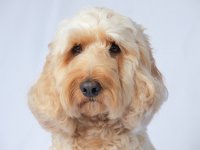
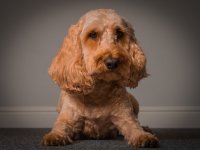
Just a single light and no backdrop, just utilising what was in front of me, I feel like they're getting better. He's had a rough day today, vets and the groomer so I didn't want to mess him around with more lights etc. :ROFLMAO:
You probably can't make it out on here, and I know I keep saying it, but the detail from the Hasselblad just blows me away
2025-11-14 21.57.20-2.jpg
 
Back
Top