Hi Cris,
Astrophotography is a whole different ballgame to "normal" photography.
The word "Photography" originates from Greek words which when translated mean "Drawing with Light". Unfortunately in a night sky, the one thing lacking is light!
The methods you will need to use vary depending on the subject you are trying to capture. I will try to dump some of my (limited) knowledge of the most common shots:
The Moon
The Moon is probably the easiest astronomical subject to capture. If you put a nice big lens on (say, 400mm+). On manual focus, set to infinity, open up the aperture a fair bit (you want to catch as much light as possible is the shortest amount of time). Depending on how much of the moon is visible will depend on the shutter speed and ISO. Try to keep the ISO low as noise will be very aparent in dark shots. For a gibbous moon (more than a new moon, but less than full) start with ISO400, f6.3, 1/250. The reason for the relatively fast shutter is becuase the moon is effectively a big light. Check focus and exposure and tweak as necessary.
Star Fields
Stars are pretty much impossible to get pin sharp unless you own a telescope which has automatic tracking. You will be amazed how far they (or more to the point the earth) moves in 30 seconds.
On the other hand, star trails can make fantastic pictures.
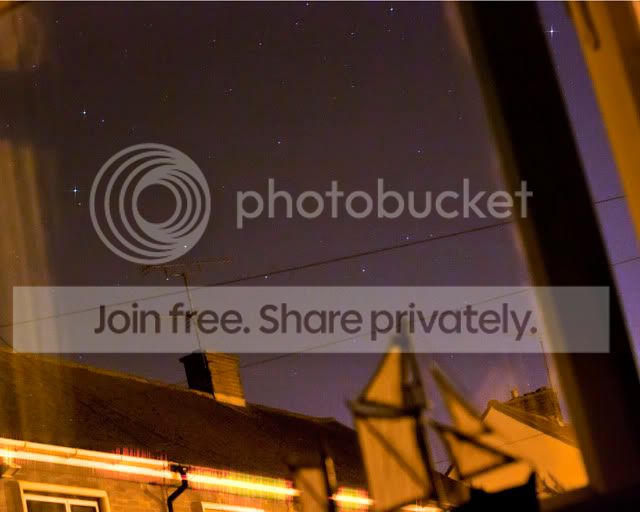
It sounds like you were almost there with your 4 second exposure. Basically, stick the camera on the most sturdy tripod you own, point it at the area of sky you wish to capture, focus on infinity (you should be able to see the brightest stars or planets as pinpricks of light in the viewfinder), set the shutter to 30 seconds and press go. If your camera has the option to put the mirror up first then do this as it will reduce camera shake when the shutter fires. This should give you most of the stars you can see with the naked eye as small streaks a couple of millimetres long. For a more impressive effect, point the camera at the north star lock it all down and set the shutter for 5 minutes, then repeat with 10 minutes. You should get amazing coloured circles unless of course you're located in some light polluted big city.
You may notice streak of light going in random directions. This is likely to be satellites, meteors or planes going overhead.
Meteors
This Thursday (12th August 2010) is the annual Perseid meteor shower. If the skies are clear, follow the steps above for capturing star fields and fire off a series of 15-25 second exposures, keep going for as long as you like and you are likely to capture some streaks of light which are small specks of dust form the comet Swift-Tuttle burning up in our atmosphere.
Planets
Photographing planets in any kind of detail is, in my opinion, impossible without a telescope. I've tried and failed a number of times to get a decent shot of Jupiter and Saturn with my DSL couple on to my small telescope.
However, a low cost webcam poiting down the telescope eyepiece can yield very impressive results.
I hope that helps you start out. If you want any info on getting a particular shot just ask and although I'm not likely to know the answer I'm happy to experiment and offer some suggestions.
Don't forget to post you pics when you get some!
Never EVER EVER look at the sun through the viewfinder of a camera or telescope!!!! :nono: