Are Tripods Dead Now Too?

Dale.

Bo Derek
Suspended / Banned
Messages
13,716
Name
Dale.
Edit My Images
Yes
I've been thinking about this. What with pretty incredible combined image stabilisation in camera and in lens nowadays, getting upto 8 stops (ish) of stabilisation, is there any need for e tripod in lot of scenarios nowadays?

For me, there are of course situations where I need one, 8 hours in a hide and I don't want to be holding a camera all that time and even less, moving it to get my subject in frame. I use a tripod for that and I pre focus on where I'm expecting things to happen, which means I don't have to hold the camera all day.

Another scenario is of course long exposure photography, especially landscape.

I'm thinking though, with all those extra 'stops', it's now quite possible to hand hold for landscape, anyhing upto say 1/2 second? Not complaining about tripods, they are a very handy tool but how nice it would be, to be free of one sometimes. There's something about just hand holding a camera and taking an image, it's a different process that I thoroughly enjoy.

So I'm wondering, can my tripod stay in the car boot on my next Glencoe adventure?
 
Last edited:
So I'm wondering, can my tripod stay in the car boot on my next Glencoe adventure?
That's entirely up to you, isn't it?

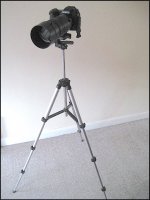
I've accumulated several tripods over the years and they get used when they're needed. Most of them were bought very cheaply, such as this "Atlantic" branded, light weight job, for which I paid a princely £5, while on holiday. I hadn't brought one with me and of course, there was a night scene I wanted.

Whenever I want some extra stability for a lighter camera, I take this with me but, as you can see, it will even support quite a serious load.

Atlantic branded lightweight tripod open Ixus 70 IMG_4476.jpg
 
I've been thinking about this. What with pretty incredible combined image stabilisation in camera and in lens nowadays, getting upto 8 stops (ish) of stabilisation, is there any need for e tripod in lot of scenarios nowadays?

The standard for sharpness with stabilization is far lower than the normal CoC standard for sharpness. And even the CoC standard is quite arguably inadequate for today's high resolution sensors and pixel peeping. So, no, actual stability and actual image IQ still outperforms stabilization and AI noise reduction/sharpening.

Now, whether you actually need the higher level of performance is another question entirely.
 
For some it's an essential compositional tool. I'll use one where either the exposure will be longer than 1/10th sec or where it's helpful as part of setting up the shot, so indoors for still life for example. For me personally a tripod can suck all the life out of a picture, and I prefer not to use them.
 
Tripods have been dead to me a long time. They're such a faff. I've still got 2 or 3 hanging around with the quick release plates but haven't used one in years. Again I'm just too idle :)

If you want to do high quality long exposures I think they're essential.
 
I've been thinking about this. What with pretty incredible combined image stabilisation in camera and in lens nowadays, getting upto 8 stops (ish) of stabilisation, is there any need for e tripod in lot of scenarios nowadays?

For me, there are of course situations where I need one, 8 hours in a hide and I don't want to be holding a camera all that time and even less, moving it to get my subject in frame. I use a tripod for that and I pre focus on where I'm expecting things to happen, which means I don't have to hold the camera all day.

Another scenario is of course long exposure photography, especially landscape.

I'm thinking though, with all those extra 'stops', it's now quite possible to hand hold for landscape, anyhing upto say 1/2 second? Not complaining about tripods, they are a very handy tool but how nice it would be, to be free of one sometimes. There's something about just hand holding a camera and taking an image, it's a different process that I thoroughly enjoy.

So I'm wondering, can my tripod stay in the car boot on my next Glencoe adventure?
 
I have actually started to use a tripod more now for macro anyway
If it’s early morning and the Dragonfly isn’t going anywhere a tripod means that getting a really sharp shot is much easier in lower light levels
Focus bracketing works better with a tripod too
 
Tripod certainly for me. I don't posess a camera with image stabilisation, neither would I want to. A blurred image is my fault, focus or stability. I don't want a microchip taking over my control.
 
My tripod is collecting dust, IBS does a great job and what with cleaner high ISOs i never need extra stability.
 
I’ve never been much of a tripod user, I don’t often shoot static subjects.
I used to use a monopod quite a lot, cos holding up an unstabilised 70-200 for hours on end is no fun.
So for wedding speeches and rally photography I had a substantial Manfrotto monopod.

I reckon my Manfrotto tripod has been used more often as an outdoor lightstand than it has as a tripod.

I have bought a travel tripod with a view it’d be more likely to be used, but it seems I was wrong, I’m just not that kind of photographer.
 
Not used one in anger since moving to Olympus with its I.b.i.s system , but I still have a large tripod ,a travel tripod and a siriu monopod plus various heads and a gimbal .. if I decide to keep / use the Nikon I have as well , I may well use one of the above this year . That’s as long as I remember to put one in the car
 
I've been thinking about this. What with pretty incredible combined image stabilisation in camera and in lens nowadays, getting upto 8 stops (ish) of stabilisation, is there any need for e tripod in lot of scenarios nowadays?

For me, there are of course situations where I need one, 8 hours in a hide and I don't want to be holding a camera all that time and even less, moving it to get my subject in frame. I use a tripod for that and I pre focus on where I'm expecting things to happen, which means I don't have to hold the camera all day.

Another scenario is of course long exposure photography, especially landscape.

I'm thinking though, with all those extra 'stops', it's now quite possible to hand hold for landscape, anyhing upto say 1/2 second? Not complaining about tripods, they are a very handy tool but how nice it would be, to be free of one sometimes. There's something about just hand holding a camera and taking an image, it's a different process that I thoroughly enjoy.

So I'm wondering, can my tripod stay in the car boot on my next Glencoe adventure?
Like Toni @ancient_mariner the greatest value to me from using a tripod is composition.

With hand holding I find it impossible to check "exactly" what is included in the frame because as I shift my eye to one edge of the frame, I can no longer properly see what I'm including or excluding at the other frame edges. I find my framing "wanders" a little when I'm hand holding and lacks the precision that I get with the camera on the tripod. Overall, it's just a much more relaxing and satisfying experience composing on a tripod.

It's also useful (as you say), if you are waiting for the light to change or for a lull in the wind (or for an animal to do something specific) before pressing the shutter. I find it also forces me to spend more time with the subject, than I would hand held, often seeing things that I might not have noticed with the hand held shot: but that is my failing, not a failure of hand holding.

I also find it more difficult to get the focus "exactly" right in close up photography without a tripod, as I tend to wobble backwards and forward a bit (in and out of focus) when hand holding. So instead of getting focus on a flowers stamen, I end up with the focus on the edge of a petal. A work around is to blast off several frames, which all end up at slightly different focus points, but I would rather start with the camera in a fixed position.

I often use a monopod as compromise for a tripod, which helps with both of the above problems, but doesn't really solve them.

Of course, tripod and monopod both make it slower and more difficult to get the camera set up, and not suited to every subject, but for that final bit of compositional fine tuning and the overall experience, I prefer using a tripod. I still do a lot of hand held photography, but that is a different, still enjoyable, type of experience.

I was also interested in Steven's @sk66 comment as I have always felt that my tripod shots (at mid range shutter speeds) are always a bit sharper than those that rely on IBIS. I had always assumed that I must have particularly shaky hands: but maybe not.
 
Still use a tripod when needed. VR/IS etc. helps reduce movement but not as well as a good tripod.

Also use a thing called the pod. A beanbag with a tripod thread on the top. Ideal for lightweight kit like a compact or GoPro. Not sure they're still available (new).
 
I have a number of tripods. They all have their uses.
They are especially useful for:-
Precision alignment and framing.
Panorama 360x180 and multi row stitching
Exposure fusion.
Macro
Stabilising long exposures.
Stabilising long lenses

Tripods are just a useful tool, that come with their own downsides.
Especially in they way that they can be an inconvenience and encombrance.
 
I agree modern cameras with IBIS, and less with image stabilization do make it easier to hand hold, except when you do video !
I have a medium to heavy tripod, travel tripod, and my trusty gorilla pod which I take on holiday with me. Which I mainly use for time lapse either with my aging GoPro Hero 4 Black, or more recently my Samsung S24 Ultra.
The only time I use a tripod now is for macro, hind shoots, and occasionally I might use a monopod if I am using the sigma 150-600 C on my R7, A6600, or 7Dii
 
I was also interested in Steven's @sk66 comment as I have always felt that my tripod shots (at mid range shutter speeds) are always a bit sharper than those that rely on IBIS. I had always assumed that I must have particularly shaky hands: but maybe not.
The CIPA DC-011 standard for improvement in sharpness is based on viewing a postcard sized image from a distance of 1 meter. This is then converted mathematically to a CoC standard of .62 mm. Whereas the standard CoC for image sharpness is based on viewing a print from a distance equal to its' diagonal measurement; i.e. 8x10 from 12 in, which is CoC of .31 mm (1/4 the area in size). And even the .31mm standard is inadequate for pixel peeping images on a screen (i.e. non-standard critical viewing).

So when they say "up to 8 stops of improvement," know that it is a very lax standard.
 
I am often surprised by how good the IBIS is, but I usually take a tripod with me and frequently use it.
 
The CIPA DC-011 standard for improvement in sharpness is based on viewing a postcard sized image from a distance of 1 meter. This is then converted mathematically to a CoC standard of .62 mm. Whereas the standard CoC for image sharpness is based on viewing a print from a distance equal to its' diagonal measurement; i.e. 8x10 from 12 in, which is CoC of .31 mm (1/4 the area in size). And even the .31mm standard is inadequate for pixel peeping images on a screen (i.e. non-standard critical viewing).

So when they say "up to 8 stops of improvement," know that it is a very lax standard.
Given it's an improvement, does the standard for determining sharpness actually matter?
Provided the measure of sharpness is consistent, then if you take a series of shots with a a 1 stop variation in shutter shutter speed, there will be a point at which 1 shot is perceived as sharp, and the next (with a 1 stop slower shutter speed) is not.
Repeat but with stabilisation, and the difference in the point where the change from sharp to not sharp occurs is a measure of how well the stabilisation works.
(both steps should be done multiple times and averaged to minimise variation due to the user).
 
Maybe this lack of sharpness is camera / shutter or user related? At the moment I'm getting hand held pictures which stand up to 100% viewing at 1/40 with cameras with IS and an electronic shutter.
 
The CIPA DC-011 standard for improvement in sharpness is based on viewing a postcard sized image from a distance of 1 meter. This is then converted mathematically to a CoC standard of .62 mm. Whereas the standard CoC for image sharpness is based on viewing a print from a distance equal to its' diagonal measurement; i.e. 8x10 from 12 in, which is CoC of .31 mm (1/4 the area in size). And even the .31mm standard is inadequate for pixel peeping images on a screen (i.e. non-standard critical viewing).

So when they say "up to 8 stops of improvement," know that it is a very lax standard.
In spite of having an interest in CofC with reference to depth of field, it had never occurred to me to think about how they measured the effectiveness of IBIS.

I had looked at it in a comparative way, ie if I can get consistently good sharpness with this shutter speed at this magnification, then 5-stop IBIS should allow me to get the same sharpness with a shutter speed five times slower. Which, I have never managed to achieve.
 
Maybe this lack of sharpness is camera / shutter or user related? At the moment I'm getting hand held pictures which stand up to 100% viewing at 1/40 with cameras with IS and an electronic shutter.
I did suggest in my post that I assumed the issue was my shaky hands, but when I compare photographs at 1/30s or 1/60s, shot hand held with IBIS, to those taken on a tripod there is a "consistent" crispness with the tripod shots that isn't there with the handheld shots.

I begin to get more consistent results with IBIS once I get faster than 1/80th (my go to before IBIS for handheld shots was 1/125). This is with 35mm and 50mm lenses.
 
Provided the measure of sharpness is consistent, then if you take a series of shots with a a 1 stop variation in shutter shutter speed, there will be a point at which 1 shot is perceived as sharp, and the next (with a 1 stop slower shutter speed) is not.
Well, "the measure" is not consistent; and the issue really is "perception." Perceived sharpness under what conditions? My only point is/was that the marketing behind image stabilization benefits is rather misleading.

This whole discussion really comes down to "do I really need a tripod for my purposes." It is much the same as the recent discussion "modern phones are amazing". Can technology (stabilization/AI/etc) help? Sure; somewhat. But when it comes down to it, nothing beats a quality camera/lens and good technique (tripod/settings/etc).
 
I had looked at it in a comparative way, ie if I can get consistently good sharpness with this shutter speed at this magnification, then 5-stop IBIS should allow me to get the same sharpness with a shutter speed five times slower. Which, I have never managed to achieve.
Because it won't; unless your original basis for image sharpness was viewing a postcard sized image from a meter away... and the original image is far sharper/more detailed than it needs to be.

It's much like saying gives 5 stops more usability when downsized to ≤ 2MP and uploaded to social media... which is actually more than enough in many instances.
 
I'm thinking though, with all those extra 'stops', it's now quite possible to hand hold for landscape, anyhing upto say 1/2 second? Not complaining about tripods, they are a very handy tool but how nice it would be, to be free of one sometimes. There's something about just hand holding a camera and taking an image, it's a different process that I thoroughly enjoy.

I would say 'it depends'.

I find IBIS very useful. And it's great for just being able to walk aroud in low light conditions and get shots that would otherwise be impractical or impossible) without a tripod.

But I'll still carry a light tripod when travelling - and a heavier tripod when I'm only going to carry it short distances and for studio projects.
 
I've been thinking about this. What with pretty incredible combined image stabilisation in camera and in lens nowadays, getting upto 8 stops (ish) of stabilisation, is there any need for e tripod in lot of scenarios nowadays?

For me, there are of course situations where I need one, 8 hours in a hide and I don't want to be holding a camera all that time and even less, moving it to get my subject in frame. I use a tripod for that and I pre focus on where I'm expecting things to happen, which means I don't have to hold the camera all day.

Another scenario is of course long exposure photography, especially landscape.

I'm thinking though, with all those extra 'stops', it's now quite possible to hand hold for landscape, anyhing upto say 1/2 second? Not complaining about tripods, they are a very handy tool but how nice it would be, to be free of one sometimes. There's something about just hand holding a camera and taking an image, it's a different process that I thoroughly enjoy.

So I'm wondering, can my tripod stay in the car boot on my next Glencoe adventure?
I wouldn't be without my 3 Legged Thing, but honestly, my Platypod Delta gets far more use - ridiculously portable, steady, and sturdy - perfect for those days where I really can't be bothered lugging a tripod around.
 
I did suggest in my post that I assumed the issue was my shaky hands, but when I compare photographs at 1/30s or 1/60s, shot hand held with IBIS, to those taken on a tripod there is a "consistent" crispness with the tripod shots that isn't there with the handheld shots.

I begin to get more consistent results with IBIS once I get faster than 1/80th (my go to before IBIS for handheld shots was 1/125). This is with 35mm and 50mm lenses.

I think I can look too closely at times. I know I'm guilty of this. I suppose if we could stop ourselves from pixel peeping that'd be a good thing also I find double digit shutter speeds are really very often too slow as things in the world tend to move.
 
I think I can look too closely at times. I know I'm guilty of this. I suppose if we could stop ourselves from pixel peeping that'd be a good thing also I find double digit shutter speeds are really very often too slow as things in the world tend to move.
Yep, IBIS isn't going to help with moving subjects :-)

I would ignore any assessments that might be affected by subject movement, but you can still pick up on the parts of the photograph unlikely to be moving.

Except for rare occasions, I don't find pixel peeping very useful.
 
Except for rare occasions, I don't find pixel peeping very useful.

If I have multiple images of a subject then it's handy for selecting which of the images will bear significant enlargement and may therefore be worth investing time in for proper development, all else being equal. In general, if an image can only stand being displayed at 1024 on the longest side, then for me it's only fit for the bin.
 
If I have multiple images of a subject then it's handy for selecting which of the images will bear significant enlargement and may therefore be worth investing time in for proper development, all else being equal. In general, if an image can only stand being displayed at 1024 on the longest side, then for me it's only fit for the bin.
Yes, I agree it can be useful when you are struggling to choose between images that otherwise appear identical.
 
I'm going to try it.

That said, I will still need a tripod for hide work, long exposures etc. I am turning my thoughts to landscapes at the moment, as Autumn and Winter kick in, so hopefully, I will be out and about in that sense rather than in a hide down the river. I say I'm going to try it but the tripod will be in the car, or on my bag, just incase.

2 of my cameras will still need a tripod as they have no IBIS, although I don't use them much nowadays, prefering my Canon mirrorless cameras.

There's a guy I watch on YouTube, James Popsys and he is who got me thinking about this as he is a landscaper and I don't recall ever seeing him use a tripod.

'Trying it' will be a test, I may not like the results, we'll see. :)
 
Anytime the light and camera settings get around 1/2 second or less, usually sunrise/sunset, but can be daylight with a strong ND filter, the tripod is used. And obviously for almost all night time images. :)
 
  • Like
Reactions: Nod
I wouldn't be without my tripod. Not only does it keep it all nice and sharp, more importantly it slows me down and makes me think much more about refining the composition that drew my eye in the first place. Saying that, with the latest IBIS, I do find myself enjoying just wandering about with the camera more without the tripod too.
 
Surely it's just horses for courses?

We all have our own interests and specialities. My own type of photography is very much in the "measure twice, cut once" category and I absolutely rely on a tripod, because the very first thing I do with nearly every shot is to make a decision about camera placement/position/angle, and the use of a tripod is essential for that.

I feel that one of the reasons why a lot of people don't use tripods is that most of them are very badly-designed, fiddly to use and incapable of providing a really stable, shake-free camera platform - which is probably why I have quite a range of different ones. The best of the lot is my ancient Manfrotto, which looks like a set of scaffolding, and has an enormous range of adjustment - but I can only just about lift it:(
 
Back
Top