Hello all, I am new to this but doing my best to learn. I am reading (perhaps misinterpreting) from various sources, that the sharpest images don't really come from a lens where the aperture is wide open. More stopped down one to two stops. For taking pics of birds and wildlife, and using my 70-200mm 2.8l and 200-800mm 6.3-9, should I avoid the lowest aperture number in good light for best results?

and please use their services
You are using an out of date browser. It may not display this or other websites correctly.
You should upgrade or use an alternative browser.
You should upgrade or use an alternative browser.
Beginner Aperture question
- Thread starter briansy
- Start date

dibbly dobbler
Suspended / Banned
- Messages
- 3,158
- Name
- Mike
- Edit My Images
- Yes
There are many on here that know a lot more than me Brian but I would say you'd be fine shooting wide open with these two lenses - shooting wide open will also help gather more light (faster shutter and/or lower iso) and also give a more blurred background (better bokeh).
Cheers, Mike
Cheers, Mike
Generally you will get sharper images with any lens when the aperture is stopped down a little than when wide open - however when shooting wildlife you also generally want to have the fastest shutter you can, for which you want the aperture as wide as possible to avoid having to increase the ISO.
Fortunately with digital you are free to take lots of shots, so you can experiment when out and see what works best with each lens in the situations you are using them - try some wide open, and some stopped down. Remember closing he aperture will also increase depth of field - which is sometimes a good thing.
Fortunately with digital you are free to take lots of shots, so you can experiment when out and see what works best with each lens in the situations you are using them - try some wide open, and some stopped down. Remember closing he aperture will also increase depth of field - which is sometimes a good thing.

Fixer
Suspended / Banned
- Messages
- 543
- Edit My Images
- Yes
A sharp lens is sharp at all apertures.
Different apertures of the same sharp lens just give different amounts of in depth focus.
Example with the same sharp lens:
At f2.8 a 1ft length of what you see in front of you is all in sharp focus (all the rest is blurred).
At f16.0 a 100ft length of what you see in front of you is all in sharp focus (all the rest is blurred).
The beauty of digital photography is you can take photos and then look at them straight away on the computer to see what is going on!
Different apertures of the same sharp lens just give different amounts of in depth focus.
Example with the same sharp lens:
At f2.8 a 1ft length of what you see in front of you is all in sharp focus (all the rest is blurred).
At f16.0 a 100ft length of what you see in front of you is all in sharp focus (all the rest is blurred).
The beauty of digital photography is you can take photos and then look at them straight away on the computer to see what is going on!

Garry Edwards
Moderator
- Messages
- 13,475
- Name
- Garry Edwards
- Edit My Images
- No
You've been given very good answers, but the real answer is what works for you . . .
Very good lens? often very little difference, too little to see anyway, unless you enlarge the image a lot
Cheap lens? Often a lot of difference, especially if you enlarge the image a lot.
But image quality is subjective anyway, because if the shot doesn't do the job for you then the technical quality in itself isn't enough, it will still be sub-standard.
Sometimes you might want to use the largest possible aperture to achieve the smallest possible depth of field, but sometimes the minimum depth of field isn't enough.
And if you stop the lens down a couple of stops then the rules of reciprocity kick in, you will have to either use a shutter speed 2 stops slower (say 1/500th instead of 1/2000th, which may result in subject movement, or in camera shake, or you will have to increase the ISO setting by 2 stops, say from 1000 to 4000, which may or may not degrade image quality - or a bit of each - so the choice isn't always as simple as it seems.
As others have said, just try it and see, there's no downside to experimenting with digital.
Very good lens? often very little difference, too little to see anyway, unless you enlarge the image a lot
Cheap lens? Often a lot of difference, especially if you enlarge the image a lot.
But image quality is subjective anyway, because if the shot doesn't do the job for you then the technical quality in itself isn't enough, it will still be sub-standard.
Sometimes you might want to use the largest possible aperture to achieve the smallest possible depth of field, but sometimes the minimum depth of field isn't enough.
And if you stop the lens down a couple of stops then the rules of reciprocity kick in, you will have to either use a shutter speed 2 stops slower (say 1/500th instead of 1/2000th, which may result in subject movement, or in camera shake, or you will have to increase the ISO setting by 2 stops, say from 1000 to 4000, which may or may not degrade image quality - or a bit of each - so the choice isn't always as simple as it seems.
As others have said, just try it and see, there's no downside to experimenting with digital.
Last edited:

Petrochemist
Suspended / Banned
- Messages
- 1,352
- Name
- Mike
- Edit My Images
- Yes
All lenses will indeed have an optimum aperture where they are sharpest which is usually 1-2 stops closed down, but often the difference between wide open & sharpest is not too significant. When shooting birds a bigger issue is usually movement, even fairly fast shots can show blurring from movement, which can have a drastic affect on image sharpness, This is particularly apparent with small birds, where subject movement (twitching etc) can often be seen even at 1/1000s
Aperture also alters depth of field (DOF), which can be used to help bring out a subject form it;s background (shallow DOF) or to show it's environment (deeper DOF from s)mall aperture).
Many settings in photography involve balancing two (or more) conflicting requirements. The best compromise between these will depend on the subject, lighting, hardware used, as well as the skill & the intention of the photographer.
If conditions allow you to close down a stop or two without getting excessive noise or too long an exposure, then it could be a benefit, in poorer light (especially at 800mm) I suspect you'd like to be able to open the aperture further than the hardware allows!
FWIW I suspect the lenses optimum sharpness is only really relevant to landscape & macro photographers
Aperture also alters depth of field (DOF), which can be used to help bring out a subject form it;s background (shallow DOF) or to show it's environment (deeper DOF from s)mall aperture).
Many settings in photography involve balancing two (or more) conflicting requirements. The best compromise between these will depend on the subject, lighting, hardware used, as well as the skill & the intention of the photographer.
If conditions allow you to close down a stop or two without getting excessive noise or too long an exposure, then it could be a benefit, in poorer light (especially at 800mm) I suspect you'd like to be able to open the aperture further than the hardware allows!
FWIW I suspect the lenses optimum sharpness is only really relevant to landscape & macro photographers
Last edited:
Thank you so much to everyone for your comments. I can't believe the thread got this much traction and I am really grateful. I've never used a proper camera before and even my RX10 I had on automatic! So lots of learning and experimenting still to be done. Having access to so many amazing natural reserves within a couple of hours drive of my apartment in Wimbledon will make this a tolerable exercise.

Gav.
Suspended / Banned
- Messages
- 9,390
- Name
- Gav
- Edit My Images
- No
@briansy
If you do try to test your lens for the sharpest FL and settings, it would be best to do it in a controlled setting, as best as posible outdoors anyway, at 800mm your going to have atmospherics to fight against, this will affect the sharpness from day to day regardless of the settings you use.
Sorry if I'm repeating something you already know
Good luck.
If you do try to test your lens for the sharpest FL and settings, it would be best to do it in a controlled setting, as best as posible outdoors anyway, at 800mm your going to have atmospherics to fight against, this will affect the sharpness from day to day regardless of the settings you use.
Sorry if I'm repeating something you already know
Good luck.

Phil V
Suspended / Banned
- Messages
- 26,303
- Name
- Phil
- Edit My Images
- No
My favourite quotes re ‘sharpness’ are:
Sharpness is a bourgeois concept
And
There’s nothing worse than a sharp image of a fuzzy concept
And neither of them make any sense to me; but then neither does the concept of ‘sharpness’.
If I need an aperture of f11 to create the image I want, then what’s the point in knowing that I’ve gone beyond the point of optimum sharpness and am heading towards diffraction?
Likewise if I need to use f2.8 to isolate my subject, what’s the point in knowing it’d be sharper at f5.6?
I feel like a broken record every time I say to a newbie ‘don’t lose sight of the fact that you started this to make pictures’.
It’s far too easy to get dragged into rabbit holes of ‘sharpness’, ‘noise free’ or simply obsessing over the maths of the exposure triangle.
If you’re not having fun trying to make pictures that make you feel something, then what’s the point.
Sharpness is a bourgeois concept
And
There’s nothing worse than a sharp image of a fuzzy concept
And neither of them make any sense to me; but then neither does the concept of ‘sharpness’.
If I need an aperture of f11 to create the image I want, then what’s the point in knowing that I’ve gone beyond the point of optimum sharpness and am heading towards diffraction?
Likewise if I need to use f2.8 to isolate my subject, what’s the point in knowing it’d be sharper at f5.6?
I feel like a broken record every time I say to a newbie ‘don’t lose sight of the fact that you started this to make pictures’.
It’s far too easy to get dragged into rabbit holes of ‘sharpness’, ‘noise free’ or simply obsessing over the maths of the exposure triangle.
If you’re not having fun trying to make pictures that make you feel something, then what’s the point.
Last edited:
If you are able to, the best and probably cheapest improvement to resolution is not the next good lens but the next good tripod and a cable release. The biggest destroyer of absolute sharpness is camera shake. Following that, the next step is to ensure the les is focussing exactly where you want it to.@briansy
If you do try to test your lens for the sharpest FL and settings, it would be best to do it in a controlled setting, as best as posible outdoors anyway, at 800mm your going to have atmospherics to fight against, this will affect the sharpness from day to day regardless of the settings you use.
Sorry if I'm repeating something you already know
Good luck.
I still use film for most of my picture taking using a Nikon F2a with a number of short to medium focal length zoom lenses. One lens which I have had for over 30 years I always thought of as being at best mediocre was a Tamron 35/135. On a tripod the results will stand with the best with regards sharpness. It is only the slightly lower contrast of the earlier coatings shows it up. It is as good as the same specification lens made by Nikon which cost a shed load more.
Last edited:

Barney
Suspended / Banned
- Messages
- 3,043
- Name
- Wayne
- Edit My Images
- No
Hello all, I am new to this but doing my best to learn. I am reading (perhaps misinterpreting) from various sources, that the sharpest images don't really come from a lens where the aperture is wide open. More stopped down one to two stops. For taking pics of birds and wildlife, and using my 70-200mm 2.8l and 200-800mm 6.3-9, should I avoid the lowest aperture number in good light for best results?
I would. Other factors permitting.
I like to give as much chance as possible of landing that bird etc,, bang in the middle of that focus plane golden highway. Some are razor thin and a gust of wind can send things awry.
Know your distances and work out the depth of field you need from there

Blue439
Suspended / Banned
- Messages
- 211
- Edit My Images
- No
First of all, maybe a word of clarification about those confusing aperture numbers. The fact that 4 is a larger aperture than, say, 16, is counter-intuitive. The reason why that is is because aperture values are a fraction of the focal length of the lens. If one wanted to express it in full, an aperture value would read 1/4 or 1/16. That is why you often see, after the ƒ symbol which is used for aperture values (often replaced by the letter “f” for convenience), a slash: a 50mm ƒ/1.8 lens. The slash is there to remind you that the figure you will read after it is the denominator of a fraction. The numerator is omitted and the slash symbolizes that omission.
Simplifying things a bit, a lens with a maximum aperture of ƒ/1.0 has an iris that is as wide when fully open as the focal length of the lens. For example, a 50mm ƒ/1.0 lens has an iris that has a diameter of 50 mm when fully open. A 200mm ƒ/4 will also have an iris of 50 mm in diameter when wide open, because 200÷4 = 50.
We now understand easily why ƒ/16 is a smaller aperture (the iris is more closed) than ƒ/4: one sixteenth of something is indeed smaller than one quarter.
Now that that’s out of the way, back to the aperture values and the sharpness of the image.
One of the main problems in photographic optics is that you use a round optical device (the lens) to project an image onto a square or rectangular surface (the frame of film or the imaging device). Things are more difficult when you look at the corners, because the circular lens has no corners. There are ways to make up for that, for example design a lens that will have so large a diameter that it will easily cover the angles of the rectangular imaging surface, but that is difficult and very costly to make, and result in a bulky and heavy lens. That is why lenses are better at providing sharp images towards the center of the frame than in the corners.
When you use a lens wide open, you intend to make use of absolutely all of the lens glass surface, including the areas near the corners of the imaging device. When you “stop down” (close the iris a bit or more), you restrict the portion of the lens’s glass surface you intend to use to the center, which makes things easier —that’s why most lenses produce a sharper image when stopped down a bit.
There are top-of-the-line lenses that deliver almost as sharp an image wide open as stopped down, but even those pro masterpieces are ever so slightly better when stopped down a bit.
Now, how much exactly is “a bit”? That depends on the lens. The aperture value (also called the ƒ/ stop or f/ stop value) at which a given lens performs best is often called “the sweet spot”, and that sweet spot is provided by so-called “MTF charts”. MTF charts are available online and you will certainly learn to read and understand them in just a few minutes. Look up the MTF chart for your lens and find out what its sweet spot is. Of course, with zooms, there are as many sweet spots as there are focal lengths, because the optical configuration of the internal glass elements in the lens changes as you zoom in or out, but let's say that, generally, you will be fine around ƒ/8, sometimes between ƒ/5.6 and 8.
Hope this helps.
Simplifying things a bit, a lens with a maximum aperture of ƒ/1.0 has an iris that is as wide when fully open as the focal length of the lens. For example, a 50mm ƒ/1.0 lens has an iris that has a diameter of 50 mm when fully open. A 200mm ƒ/4 will also have an iris of 50 mm in diameter when wide open, because 200÷4 = 50.
We now understand easily why ƒ/16 is a smaller aperture (the iris is more closed) than ƒ/4: one sixteenth of something is indeed smaller than one quarter.
Now that that’s out of the way, back to the aperture values and the sharpness of the image.
One of the main problems in photographic optics is that you use a round optical device (the lens) to project an image onto a square or rectangular surface (the frame of film or the imaging device). Things are more difficult when you look at the corners, because the circular lens has no corners. There are ways to make up for that, for example design a lens that will have so large a diameter that it will easily cover the angles of the rectangular imaging surface, but that is difficult and very costly to make, and result in a bulky and heavy lens. That is why lenses are better at providing sharp images towards the center of the frame than in the corners.
When you use a lens wide open, you intend to make use of absolutely all of the lens glass surface, including the areas near the corners of the imaging device. When you “stop down” (close the iris a bit or more), you restrict the portion of the lens’s glass surface you intend to use to the center, which makes things easier —that’s why most lenses produce a sharper image when stopped down a bit.
There are top-of-the-line lenses that deliver almost as sharp an image wide open as stopped down, but even those pro masterpieces are ever so slightly better when stopped down a bit.
Now, how much exactly is “a bit”? That depends on the lens. The aperture value (also called the ƒ/ stop or f/ stop value) at which a given lens performs best is often called “the sweet spot”, and that sweet spot is provided by so-called “MTF charts”. MTF charts are available online and you will certainly learn to read and understand them in just a few minutes. Look up the MTF chart for your lens and find out what its sweet spot is. Of course, with zooms, there are as many sweet spots as there are focal lengths, because the optical configuration of the internal glass elements in the lens changes as you zoom in or out, but let's say that, generally, you will be fine around ƒ/8, sometimes between ƒ/5.6 and 8.
Hope this helps.

sk66
Suspended / Banned
- Messages
- 9,557
- Name
- Steven
- Edit My Images
- Yes
You can usually find test reviews that will tell you the sharpest aperture for your lens/focal length... but not all are terribly reliable.
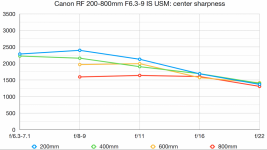
This is your 200-800, and you can see that it depends a bit on which zoom position you are using. A chart like this may be confusing as it shows that the longer focal length is less sharp; but that is generally true due to the way sharpness is tested (i.e. a longer lens is tested at a longer distance).
These charts are from ePHOTOzine for the 70-200 L, which also shows variability by zoom position. And the results show that the lens is much sharper at 200mm than it is at 70mm; because it is recording greater resolution at a longer distance (but no result is "bad").
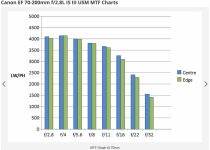
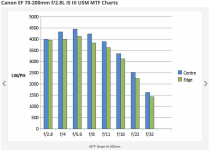
Note that the two sources are using different resolution units... the first is using line pairs per picture height, and the second is using line widths per picture height (2x lp/ph). Also note that you cannot necessarily reliably/accurately compare results from different sources because the specific test setup/methodology is critical; and it is even more difficult for longer focal lengths.
So, that's the technical parts... but what usually matters more is the artistic/aesthetic parts.
In that sense aperture is best chosen for depth of acceptable sharpness instead of maximum sharpness (increased depth of field), or for background separation (reduced depth of field). And sometimes it is best to choose the aperture needed in order to achieve an acceptable/desired shutter speed without an excessively high ISO. Those two factors together determine what an image is and conveys. The last factor should generally be the ISO required by the other two.
This is your 200-800, and you can see that it depends a bit on which zoom position you are using. A chart like this may be confusing as it shows that the longer focal length is less sharp; but that is generally true due to the way sharpness is tested (i.e. a longer lens is tested at a longer distance).
These charts are from ePHOTOzine for the 70-200 L, which also shows variability by zoom position. And the results show that the lens is much sharper at 200mm than it is at 70mm; because it is recording greater resolution at a longer distance (but no result is "bad").
Note that the two sources are using different resolution units... the first is using line pairs per picture height, and the second is using line widths per picture height (2x lp/ph). Also note that you cannot necessarily reliably/accurately compare results from different sources because the specific test setup/methodology is critical; and it is even more difficult for longer focal lengths.
So, that's the technical parts... but what usually matters more is the artistic/aesthetic parts.
In that sense aperture is best chosen for depth of acceptable sharpness instead of maximum sharpness (increased depth of field), or for background separation (reduced depth of field). And sometimes it is best to choose the aperture needed in order to achieve an acceptable/desired shutter speed without an excessively high ISO. Those two factors together determine what an image is and conveys. The last factor should generally be the ISO required by the other two.
Last edited:

ancient_mariner
Moderator
- Messages
- 27,768
- Name
- Toni
- Edit My Images
- No
I am reading (perhaps misinterpreting) from various sources, that the sharpest images don't really come from a lens where the aperture is wide open
There's a lot more to an image than sharpness - often perceived as edge contrast making a picture look sharp. Things to consider that you may/may not want from your lens in no particular order:
Detail resolution (sometimes confused with sharpness).
Contrast (may be high or low).
Rendering quality (is the image smooth or crunchy).
Appearance of our of focus areas.
Absence of artefacts (halos around objects, flare from light sources in front of the lens).
Different optical performance centre to edge of the frame.
Vignetting (darkening of the edges).
Fringing/chromatic aberration at points of high contrast.
And more. Food for thought.
Petrochemist
Suspended / Banned
- Messages
- 1,352
- Name
- Mike
- Edit My Images
- Yes
That's a valid point that should always be raised when discussing apertures with beginners.First of all, maybe a word of clarification about those confusing aperture numbers. The fact that 4 is a larger aperture than, say, 16, is counter-intuitive. The reason why that is is because aperture values are a fraction of the focal length of the lens. If one wanted to express it in full, an aperture value would read 1/4 or 1/16. That is why you often see, after the ƒ symbol which is used for aperture values (often replaced by the letter “f” for convenience), a slash: a 50mm ƒ/1.8 lens. The slash is there to remind you that the figure you will read after it is the denominator of a fraction. The numerator is omitted and the slash symbolizes that omission.
However the f actually refers to focal length so f/4 means focal length divided by 4 (more complete than 1/4 and more accurate than f 1/4). Of course there are numerous ways of displaying f-numbers to cause extra confusion, many lenses use 1:4, and many of use are prone to simply putting f4...
An additional minor niggle - the measurement is not quite the iris, but instead the entrance pupil (the iris as seen through the front of the lens) Any elements before the iris will adjust it's effective size somewhat.
Blue439
Suspended / Banned
- Messages
- 211
- Edit My Images
- No
You are right of course. I was just trying not to overcomplicate things...That's a valid point that should always be raised when discussing apertures with beginners.
However the f actually refers to focal length so f/4 means focal length divided by 4 (more complete than 1/4 and more accurate than f 1/4). Of course there are numerous ways of displaying f-numbers to cause extra confusion, many lenses use 1:4, and many of use are prone to simply putting f4...
An additional minor niggle - the measurement is not quite the iris, but instead the entrance pupil (the iris as seen through the front of the lens) Any elements before the iris will adjust it's effective size somewhat.
My first post here so I hope the tone is acceptable. I should also say I don't consider myself expert in any aspect of photography. I take a lot of terrible pictures, and few enough good ones as to feel almost random sometimes. 55 years after buying my first SLR I still consider myself a novice, and I have had long periods away from regular camera use. Now I'm ancient my choice of hobbies is narrowing somewhat and I'm taking more interest
Brian, I'm guessing some of your shots aren't as sharp as you want. I'd take a few test shots on a tripod to bottom out just how sharp your lenses are at the settings you use. Then you'll know whether you need to try and avoid certain apertures, or not.
In my mind there are a few things that, if I don't pay attention to them, will mean I'll definitely be disappointed with my efforts as to focusing/sharpness. The premise here is that sharpness, or lack of it, is at least as likely to be related to the photographer (me) as to the lens.
1. Camera/hand shake. When using longish zooms handheld, shake will happen randomly, regardless of how hard I try to hold steady. I use release setting 'continuous low rate' by default, which makes it easy to take single shots but holding the shutter release will keep it firing. I always take at least 3 frames, a few more if it's an important or unrepeatable shot. It's surprising how often there are only one or two properly sharp ones even when using VR/IS.
2. I love zooms, but they do tend to be noticeably less sharp, not to mention distorting, in the corners. I keep things I want sharp away from the edges.
3, When using an auto mode, I look at the first few frames immediately to make sure I know what it's doing, and that it is what I want/need. I can forget, if I have made an adjustment, to put the camera back to my 'defaults'. Different auto modes usually allow some manual adjustments especially to metering and autofocus modes and I sometimes trip myself up.
4. Consider what needs to be in focus and check that it is. This is reasonably straightforward if there's only one thing that needs to be in focus, less so when the subject is surrounded by clutter or if there are 2 or more in different planes, when I need not only to consider the necessity for depth of field but where to actually focus somewhere around the middle of that, possibly on an otherwise irrelevant feature
When it really goes wrong, it's usually because I haven't been out for a while and I've just forgotten or overlooked part of my routine.
The other thing for me, as a sporadic photographer, is that if I am trying to capture fleeting opportunities I have to have a set up that leaves me to adjust/check the minimum number of adjustments for each shot. In the instinctive part of my mind I want every camera to be a K1000. One hand on aperture ring, one thumb on shutter speed, watch the needle, under or over expose a bit according to scene, job done. I can't deal with 6 adjustments but I can reduce a D750 to a simple tool. 'M' is really an auto mode if I use autofocus and auto ISO but I can maintain direct control of shutter and aperture which gives me the old feeling. On the 750 I have one dial for shutter and one for aperture. 'Centering the needle' is done for me, and I can manually add or subtract some exposure. I just have to keep an eye on the ISO to ensure it stays in a reasonable range.
As a basic photographer myself, I'm not trying to give expert advice here - just describing how a non-expert can control the basics and leave some headspace for the creative bit.
I must say I'm stunned by the quality of the shots on this forum. It might be a while before I have the confidence to release a few of mine.
Brian, I'm guessing some of your shots aren't as sharp as you want. I'd take a few test shots on a tripod to bottom out just how sharp your lenses are at the settings you use. Then you'll know whether you need to try and avoid certain apertures, or not.
In my mind there are a few things that, if I don't pay attention to them, will mean I'll definitely be disappointed with my efforts as to focusing/sharpness. The premise here is that sharpness, or lack of it, is at least as likely to be related to the photographer (me) as to the lens.
1. Camera/hand shake. When using longish zooms handheld, shake will happen randomly, regardless of how hard I try to hold steady. I use release setting 'continuous low rate' by default, which makes it easy to take single shots but holding the shutter release will keep it firing. I always take at least 3 frames, a few more if it's an important or unrepeatable shot. It's surprising how often there are only one or two properly sharp ones even when using VR/IS.
2. I love zooms, but they do tend to be noticeably less sharp, not to mention distorting, in the corners. I keep things I want sharp away from the edges.
3, When using an auto mode, I look at the first few frames immediately to make sure I know what it's doing, and that it is what I want/need. I can forget, if I have made an adjustment, to put the camera back to my 'defaults'. Different auto modes usually allow some manual adjustments especially to metering and autofocus modes and I sometimes trip myself up.
4. Consider what needs to be in focus and check that it is. This is reasonably straightforward if there's only one thing that needs to be in focus, less so when the subject is surrounded by clutter or if there are 2 or more in different planes, when I need not only to consider the necessity for depth of field but where to actually focus somewhere around the middle of that, possibly on an otherwise irrelevant feature
When it really goes wrong, it's usually because I haven't been out for a while and I've just forgotten or overlooked part of my routine.
The other thing for me, as a sporadic photographer, is that if I am trying to capture fleeting opportunities I have to have a set up that leaves me to adjust/check the minimum number of adjustments for each shot. In the instinctive part of my mind I want every camera to be a K1000. One hand on aperture ring, one thumb on shutter speed, watch the needle, under or over expose a bit according to scene, job done. I can't deal with 6 adjustments but I can reduce a D750 to a simple tool. 'M' is really an auto mode if I use autofocus and auto ISO but I can maintain direct control of shutter and aperture which gives me the old feeling. On the 750 I have one dial for shutter and one for aperture. 'Centering the needle' is done for me, and I can manually add or subtract some exposure. I just have to keep an eye on the ISO to ensure it stays in a reasonable range.
As a basic photographer myself, I'm not trying to give expert advice here - just describing how a non-expert can control the basics and leave some headspace for the creative bit.
I must say I'm stunned by the quality of the shots on this forum. It might be a while before I have the confidence to release a few of mine.
John, that is absolutely fantastic stuff. I've only been properly out with my decent camera twice since buying it. So I'm kinda doing it all on the fly! But I will most certainly go back to this post on Saturday morning before I leave the house. I don't have a tripod, I must get one...
I do wonder if, with the modern day lenses ie mirrorless lenses that, if you put an image taken "sharp" - in the supposed sharp aperture range next to one more wide open, and asked those that live and die by the sharpness of the aperture premise to identify which is which, whether they actually could.My favourite quotes re ‘sharpness’ are:
Sharpness is a bourgeois concept
And
There’s nothing worse than a sharp image of a fuzzy concept
And neither of them make any sense to me; but then neither does the concept of ‘sharpness’.
If I need an aperture of f11 to create the image I want, then what’s the point in knowing that I’ve gone beyond the point of optimum sharpness and am heading towards diffraction?
Likewise if I need to use f2.8 to isolate my subject, what’s the point in knowing it’d be sharper at f5.6?
I feel like a broken record every time I say to a newbie ‘don’t lose sight of the fact that you started this to make pictures’.
It’s far too easy to get dragged into rabbit holes of ‘sharpness’, ‘noise free’ or simply obsessing over the maths of the exposure triangle.
If you’re not having fun trying to make pictures that make you feel something, then what’s the point.
In short is there that much of a noticeable difference for everyday use.
ancient_mariner
Moderator
- Messages
- 27,768
- Name
- Toni
- Edit My Images
- No
I've recently been going through pictures of local scenes taken over the last 11 years for a friend who wants some prints. Even viewing normally in lightroom I can see a progression in definition as the kit has got better, and some older shots benefitted cleaning up and detail enhancement from more recent software.
It's not about sharpness as such, but it is about clean undistorted rendering, especially in areas of high contrast.
It's not about sharpness as such, but it is about clean undistorted rendering, especially in areas of high contrast.
Garry Edwards
Moderator
- Messages
- 13,475
- Name
- Garry Edwards
- Edit My Images
- No
I do wonder if, with the modern day lenses ie mirrorless lenses that, if you put an image taken "sharp" - in the supposed sharp aperture range next to one more wide open, and asked those that live and die by the sharpness of the aperture premise to identify which is which, whether they actually could.
In short is there that much of a noticeable difference for everyday use.
A good question
Some people obsess about sharpness, they study lens data, MTF data, every other factor that could possible help them to rationalise their decision to spend a lot of money on lenses, and that's fair enough, it's a kind of sub-division of photography that matters to them, but most of us just take photos and judge them by different criteria, rightly or wrongly.
Agreed. And sharpness isn't always objective anyway, a lot depends on the scene, for example a photo taken in mist/fog may be perfectly sharp but may not look sharp because of the very low subject contrast.I've recently been going through pictures of local scenes taken over the last 11 years for a friend who wants some prints. Even viewing normally in lightroom I can see a progression in definition as the kit has got better, and some older shots benefitted cleaning up and detail enhancement from more recent software.
It's not about sharpness as such, but it is about clean undistorted rendering, especially in areas of high contrast.
And then we find ourselves in the realm of viewing distance, where a photo looks sharp at the "correct" viewing distance but doesn't stand up to viewing at much closer distances.
DOF is another one, there can only ever be one plane of sharp focus, but DOF, increasing with smaller formats, smaller apertures and greater distances, is really nothing more than one plane that's actually in focus, with areas in front and behind that plane that appear to be acceptably sharp, Manufacturers have always published DOF charts fro their lenses, many years ago there were "Russian" lenses (actually made in The Ukraine) that claimed to have greater DOF than the lenses from other countries, and a lot of photographers swore blind that they were better, but the reality was that they used different criteria (different size circle of confusion) to produce different data.
Some more very good points, but I'll just address the one I've snipped, above. That's you, and many other people, but personally I can hold a camera very steady. That sounds like a boast but it isn't, it's just a fact, which I put down to a lifetime of experience at shooting rifles, where any movement is amplified by magnification, just like photography. We're all different.1. Camera/hand shake. When using longish zooms handheld, shake will happen randomly, regardless of how hard I try to hold steady. I use release setting 'continuous low rate' by default, which makes it easy to take single shots but holding the shutter release will keep it firing. I always take at least 3 frames, a few more if it's an important or unrepeatable shot. It's surprising how often there are only one or two properly sharp ones even when using VR/IS.
My overall advice? Don't obsess about it, or if you want a more eloquent summary (although I've never described @Phil V as eloquent before
) read this againMy favourite quotes re ‘sharpness’ are:
Sharpness is a bourgeois concept
And
There’s nothing worse than a sharp image of a fuzzy concept
And neither of them make any sense to me; but then neither does the concept of ‘sharpness’.
If I need an aperture of f11 to create the image I want, then what’s the point in knowing that I’ve gone beyond the point of optimum sharpness and am heading towards diffraction?
Likewise if I need to use f2.8 to isolate my subject, what’s the point in knowing it’d be sharper at f5.6?
I feel like a broken record every time I say to a newbie ‘don’t lose sight of the fact that you started this to make pictures’.
It’s far too easy to get dragged into rabbit holes of ‘sharpness’, ‘noise free’ or simply obsessing over the maths of the exposure triangle.
If you’re not having fun trying to make pictures that make you feel something, then what’s the point.
As well as there are many more variables that impact how sharp an image is anyway, so its very difficult to tell if the lens quality had the most impact in the overall sharpness of an image, unless you take the "all things considered" approach. But realistically how many take the time to eliminate all possible variable, by the time you've run through the checklist you will probably have missed that actual shotA good question
Some people obsess about sharpness, they study lens data, MTF data, every other factor that could possible help them to rationalise their decision to spend a lot of money on lenses, and that's fair enough, it's a kind of sub-division of photography that matters to them, but most of us just take photos and judge them by different criteria, rightly or wrongly.
I agree - it's muscle memory. Once I'm in the groove I'm fine. And if you have to grab the shot, grab it.As well as there are many more variables that impact how sharp an image is anyway, so its very difficult to tell if the lens quality had the most impact in the overall sharpness of an image, unless you take the "all things considered" approach. But realistically how many take the time to eliminate all possible variable, by the time you've run through the checklist you will probably have missed that actual shot

Major Eazy
Suspended / Banned
- Messages
- 1,150
- Name
- John 'Jack'
- Edit My Images
- No
Hello all, I am new to this but doing my best to learn. I am reading (perhaps misinterpreting) from various sources, that the sharpest images don't really come from a lens where the aperture is wide open. More stopped down one to two stops. For taking pics of birds and wildlife, and using my 70-200mm 2.8l and 200-800mm 6.3-9, should I avoid the lowest aperture number in good light for best results?
It's like one chef says you should only use two pinch of salt, yet another chef suggest one pinch of salt. Which chef is right?
My advice...
Use either manual or aperture-priority setting.
Open to maximum (the lowest f-stop number) and take a few photos, then turn to next f-stop, few shots, and so on.
Like...
f/2 click, click,
f/2.8 click, click,
f/4 click, click,
f/5.6 click, click,
You simply review your photos, and pick what you like the best.
If someone or the light meter says something like f/2.8 then it does not mean you have to use f/2.8 You just shoot with a few stops before and after what they said. ( Like you opt for between f/2 to f/4 )
Back in my earlier days, working for various professional photographers, I've seen them go click, then turn the aperture then click then turn the aperture. Sometimes they have three shots of the same subject, but at three different aperture setting, they simply see which photo they like the best.
Don't forget that the more you stop down (going from a low f-number to a high f-number) will eventually bring the background into focus as your depth of field increase. Do you want your viewers to look at the birds and wildlife only? Or do you want them to look at the birds / wildlife and the trees in the background?
You decide how blurred the background should be, by choosing your preferred aperture setting.
You simply just take few photos, and adjust your aperture in between shots, instead of being told by various sources on which one aperture is right.
Petrochemist
Suspended / Banned
- Messages
- 1,352
- Name
- Mike
- Edit My Images
- Yes
Great advise but if using manual mode don't forget to adjust shutter speed to match the apertures, otherwise you might get a false reason for liking one particular settingIt's like one chef says you should only use two pinch of salt, yet another chef suggest one pinch of salt. Which chef is right?
My advice...
Use either manual or aperture-priority setting.
Open to maximum (the lowest f-stop number) and take a few photos, then turn to next f-stop, few shots, and so on.
Like...
f/2 click, click,
f/2.8 click, click,
f/4 click, click,
f/5.6 click, click,
You simply review your photos, and pick what you like the best.
If someone or the light meter says something like f/2.8 then it does not mean you have to use f/2.8 You just shoot with a few stops before and after what they said. ( Like you opt for between f/2 to f/4 )
Back in my earlier days, working for various professional photographers, I've seen them go click, then turn the aperture then click then turn the aperture. Sometimes they have three shots of the same subject, but at three different aperture setting, they simply see which photo they like the best.
Don't forget that the more you stop down (going from a low f-number to a high f-number) will eventually bring the background into focus as your depth of field increase. Do you want your viewers to look at the birds and wildlife only? Or do you want them to look at the birds / wildlife and the trees in the background?
You decide how blurred the background should be, by choosing your preferred aperture setting.
You simply just take few photos, and adjust your aperture in between shots, instead of being told by various sources on which one aperture is right.
On the concept of a sharp image. A long, long, time ago I was advised instead of spending more money on a new lens, spend it on a decent tripod and a cable release. And do you know guys they were right - it works every time whatever the camera/lens combination! One of Nikon's so called 'indifferent' lenses the F3.3/4.5 AF or manual (They are the same optical construction.) On my Manfrotto 99b tripod with a cable release it is capable of a 12x16 print at virtually any aperture. It would probably go to 20x16 but my enlarger won't print that large.
Last edited:
ancient_mariner
Moderator
- Messages
- 27,768
- Name
- Toni
- Edit My Images
- No
A long, long, time ago I was advised instead of spending more money on a new lens, spend it on a decent tripod and a cable release. And do you know guys they were right - it works every time whatever the camera/lens combination!
Really not trying to take a pop at you, but if you found sharpness improved by using a tripod in normal photography then you needed to work on technique. Particularly if true for lenses known not to provide great detail (although the Nikon 28-70 f3.5/4.5 AFD was actually a decent consumer zoom IME).

swanseamale47
Suspended / Banned
- Messages
- 10,876
- Name
- wayne clarke
- Edit My Images
- Yes
While good advice,, the OP is after advice for wildlife and bird photography, and in my experience neither will work for those moving supjects. Perhaps better suited to landscapes.On the concept of a sharp image. A long, long, time ago I was advised instead of spending more money on a new lens, spend it on a decent tripod and a cable release. And do you know guys they were right - it works every time whatever the camera/lens combination! One of Nikon's so called 'indifferent' lenses the F3.3/4.5 AF or manual (They are the same optical construction.) On my Manfrotto 99b tripod with a cable release it is capable of a 12x16 print at virtually any aperture. It would probably go to 20x16 but my enlarger won't print that large.
If that is your viewpoint about one of Nikon's less appreciated lenses that is up to you. There were several versions of them ( 3, I think) and non really stood out used without a bit of support assistance) but on a tripod this improved and produced some quite remarkable results and were capable holding their own. If you have never tried various lenses on and off I tripod I respectfully suggest you do so before giving such a misleading and opinionated remark!Really not trying to take a pop at you, but if you found sharpness improved by using a tripod in normal photography then you needed to work on technique. Particularly if true for lenses known not to provide great detail (although the Nikon 28-70 f3.5/4.5 AFD was actually a decent consumer zoom IME).
ancient_mariner
Moderator
- Messages
- 27,768
- Name
- Toni
- Edit My Images
- No
If you have never tried various lenses on and off I tripod I respectfully suggest you do so before giving such a misleading and opinionated remark!
And if I have?
As a moderator, I'm concerned about you providing advice to a beginner that is misleading - not for the first time. You have a very particular point of view on a variety of photographic topics that are not always bourne out by the experience of many experienced photographers here.
Last edited:

BillN_33
Suspended / Banned
- Messages
- 13,952
- Name
- Bill
- Edit My Images
- No
"wildlife and bird photography"
aim to use a tripod and a high shutter speed, especially for birds - because of the available light in the UK 90% of the time this, (the need for a high shutter speed), will mean using the widest f value that you have in order to get a sharp image, (all relative) and as a consequence depending on the size of the bird, part of the image may be less sharp, (OOF), than another part, and that's one of the reason why it is recommended that you focus on the birds eye - if you can achieve a sharp image by using f/5.6 or f/4 that should give you an OOF background and (foreground, if applicable), which is usually desirable with bird/wildlife images.
aim to use a tripod and a high shutter speed, especially for birds - because of the available light in the UK 90% of the time this, (the need for a high shutter speed), will mean using the widest f value that you have in order to get a sharp image, (all relative) and as a consequence depending on the size of the bird, part of the image may be less sharp, (OOF), than another part, and that's one of the reason why it is recommended that you focus on the birds eye - if you can achieve a sharp image by using f/5.6 or f/4 that should give you an OOF background and (foreground, if applicable), which is usually desirable with bird/wildlife images.
Last edited:
Barney
Suspended / Banned
- Messages
- 3,043
- Name
- Wayne
- Edit My Images
- No
IF you can get 1/2000, F8 and iso 100-400 I have found that there is not much difference in lenses. Mostly all are, at a minimum, acceptable to good for sharpness.
Manufacturers have been making lenses a long time, the technology is well understood and no one is making absolute rubbish.
Manufacturers have been making lenses a long time, the technology is well understood and no one is making absolute rubbish.
The Nikon 14-24 F2.8 AFS lens for full frame sensors is highly acclaimed as being one of the sharpest lenses ever made with virtually no fall off in the corners even at full aperture at all focal lengths (Not my words but from a test report) - but weighs a load with all the elements used to create an almost perfect image. Conversely my long gone Nikon 70-300 AFD zoom was quit sharp, but at certain focal lengths most of the focussed image was sharp, but there were small areas that were almost like out of focus swirls, very similar to deliberately blurred areas using photoshop.
I had one which was annoyingly bad because these areas used to move depending on what distance it was focussed at or what aperture used. I traded it in for a Tamron Close focus 70/300 close focus lens which apparently (By a comparison test) had the same optical design and number of elements including a low dispersion element which was perfect compared to the Nikon version.
I had one which was annoyingly bad because these areas used to move depending on what distance it was focussed at or what aperture used. I traded it in for a Tamron Close focus 70/300 close focus lens which apparently (By a comparison test) had the same optical design and number of elements including a low dispersion element which was perfect compared to the Nikon version.
Last edited: