

Aperture Query & DOF

mattchewone

Suspended / Banned
Messages
884
Name
Matt
Edit My Images
Yes
I started a photography course last week and the first lesson this week was based on aperture. I have been learning and doing photography for about 3-4 years so have some basic understanding but wanted to go on this course to confirm and learn more of what I know.
I have an understanding on exposure and aperture, but in the course we went in to diagrams and bits which was interesting and nice to be able to ask questions and have a discussion with the teacher and group.

But I do however have a question after going through what I was learning, we was trying f/stops at different ranges whilst taking a picture of a group of apples on the table, we were asked to be relatively close to them and just keep adjusting as to see the difference with what was in focus etc. But whilst I was watching others have a go I decided to take a shot a bit of a distance and it was obviously a lot different. So my question is, how much does distance affect your DOF/aperture, whilst I was close to the apples (using my nifty fifty) I shot down at f/1.8 and up to about f/20 and you could see the difference in what was sharp and what wasn't. But at a difference although the other apples were out of focus they were not any where as OOF as close up.

I have drawn a bit of a diagram to show more of what I mean and was wondering if people could confirm or inform me perhaps on what I am thinking. Excuse the poor diagram its not exact just a rough idea.

Here goes:
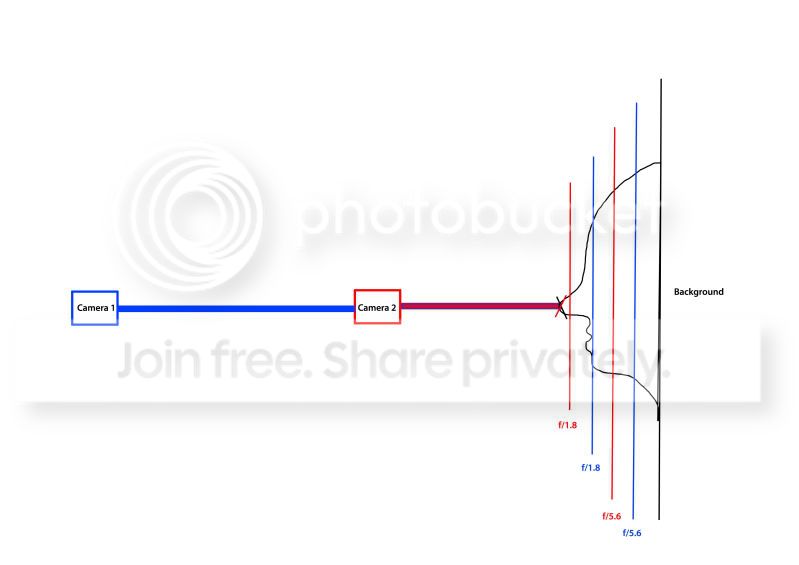
DOF.jpg


The lines represent what would be in focus. I have chosen the nose as the focal point for ease of use really.

Thanks
 
Assuming both the cameras in that diagram have lenses that are of the same focal length, you're right.

DOF gets narrower as the focal length goes higher.
{For example → An 85mm f/1.8 will be produce a much shallower DOF than a 50mm f/1.8}
 
Last edited:
So assuming both cameras have the same lens 50mm the closer you get the shallower the DOF, correct?
Just so I can get this right as it has been bugging me for a while. Is there a rule of thumb on calculation what aperture to have on what lens and distance to ensure you get a face for example in great sharpness.
Thanks
 
Hyperfocal Distance

Have a look at this - have a play & it will help.

http://www.dofmaster.com/dofjs.html

Example:

Canon 40D / 50mm / f1.8 / subject distance 5 feet =
Depth of field
Near limit 4.9 ft
Far limit 5.1 ft
Total 0.2 ft
In front of subject 0.1 ft (49%)
Behind subject 0.1 ft (51%)

Caon 40D / 50mm / f1.8 / subject distance 20 feet =
Depth of field
Near limit 18.5 ft
Far limit 21.8 ft
Total 3.3 ft
In front of subject 1.51 ft (46%)
Behind subject 1.78 ft (54%)

Canon 40D / 50mm / f1.8 / subject distance 100 feet =
Depth of field
Near limit 70.8 ft
Far limit 170.1 ft
Total 99.3 ft
In front of subject 29.2 ft (29%)
Behind subject 70.1 ft (71%)
 
Last edited:
Thanks everyone, I think I am finally getting to understand this a bit more!

Dinners - that info you posted, the total feet, is that what would be in focus, so e.g. @ 5 feet you would have .1 foot in focus in front and behind of your focus point?
 
Firstly, just to counter a couple of replies here, focal length has nothing to do with depth of field.

Depth of field is decided by aperture, and magnification. Which you would hope would be the first thing your teacher explained to you.

If your subject is the same size in the frame, then your depth of field is controlled by your aperture.

eg. if you step back and put a longer lens on to keep the framing the same, then the depth of field will be the same. But, if you step back and use the same focal length (as you did) then the depth of field will be deeper, unless you open up the aperture.
 
@Jayst84 I think Matt already understood that DOF was controlled by Aperture & was just confirming if placing the camera at different distances would effect the DOF ~ That's how I came to understand his original thread. We were merely confirming & explaining that as well as distance, the focal length can have an effect on narrow DOF.
 
@Jayst84
Despite the focal length not controlling it, in my experience I found that it did effect the DOF? My mistake perhaps.
if you step back and put a longer lens on to keep the framing the same, then the depth of field will be the same.
I meant when not maintaining the frame, assume the photographer has not moved.
The longer focal length would mean the subject filling the frame more & the DOF appearing narrower, no?
 
Last edited:
@Jayst84
Despite the focal length not controlling it, in my experience I found that it did effect the DOF? My mistake perhaps.

I meant when not maintaining the frame, assume the photographer has not moved.
The longer focal length would mean the subject filling the frame more & the DOF appearing narrower, no?

Yes, but it's not really the focal length. It's magnification that matters. If you stand in the same place and change focal length, then you're taking a different shot, so not really comparable anyway.
 
Its no wonder folk get confused on here!

Langford Basic Photography (The Bible) Focal length, Aperture and Distance to the subject are the three factors which affect DofF.

Basically

Focal Length: Longer = Small DofF
Aperture: Small fNo = Small DofF
Distance: Closer to subject = Small DofF

And vice versa to increase DofF :D simples!
 
garryg163
Hahaha, definitely ~ This is probs the best post on this thread.

Langford Basic Photography (The Bible) Focal length, Aperture and Distance to the subject are the three factors which affect DofF.

Focal Length: Longer = Small DofF
Aperture: Small fNo = Small DofF
Distance: Closer to subject = Small DofF
 
Jay is right :thumbs:

The thing that hasn't been mentioned though is field of view, which alters when you change focal length, even depth of field doesn't (for a given size subject in the frame).

Longer lens have a narrower field of view, which has the effect of making the background appear larger in relation to the main subject. With a longer lens, this often gives the appearance of less depth of field, but it isn't.
 
How does sensor size effect DOF ? I always assumed smaller sensors had greater DOF.

Thinking it through however - is this merely the result of having to stand further away to get the same field of view on a cropped sensor ? An 85 mm lens is a 85 mm lens. Just because we choose to say it's 135 mm on a 1.6 crop doesn't change it's characteristics.

Is this right ?
 
How does sensor size effect DOF ? I always assumed smaller sensors had greater DOF.

Thinking it through however - is this merely the result of having to stand further away to get the same field of view on a cropped sensor ? An 85 mm lens is a 85 mm lens. Just because we choose to say it's 135 mm on a 1.6 crop doesn't change it's characteristics.

Is this right ?

Yes, DoF is a result of the subject distance and focal length (actual) and why (pedantic) photographers dont like to use 'effective focal length' when referring to a crop factor, because with the smaller sensor all you're doing is cropping into the image. Which is not the same thing optically as using a longer FL lens.

So if you think of the DoF of a 11mm lens at 2 meters, at f3.5 you'd understand that it'd have quite a large DoF. On a digital P&S that 11mm could be roughly a 'standard' field of view. And a longer FL (20mm) would only be able to create a shallow DoF at fairly close subject distances.

Likewise, on a proper Medium format camera (lets use 6x6) the standard lens is 80mm, so you can see why they were prized for their shallow DoF.
 
Just to clarify when you say large dof are you referring to more background blur or more of where you are focusing is sharp?
 
Just to clarify when you say large dof are you referring to more background blur or more of where you are focusing is sharp?

DoF is Depth of Field, a description of the part of an image which is acceptably sharp. So a large DoF is where most things in the image are aceptably sharp and a small or shallow DoF is where only a selected part of the image is sharp.

Larger apertures (small f numbers) and longer lenses are generally used to produce shallow DoF for artistic effect.
 
Hyperfocal Distance

Have a look at this - have a play & it will help.

http://www.dofmaster.com/dofjs.html

Example:

Canon 40D / 50mm / f1.8 / subject distance 5 feet =
Depth of field
Near limit 4.9 ft
Far limit 5.1 ft
Total 0.2 ft
In front of subject 0.1 ft (49%)
Behind subject 0.1 ft (51%)

Caon 40D / 50mm / f1.8 / subject distance 20 feet =
Depth of field
Near limit 18.5 ft
Far limit 21.8 ft
Total 3.3 ft
In front of subject 1.51 ft (46%)
Behind subject 1.78 ft (54%)

Canon 40D / 50mm / f1.8 / subject distance 100 feet =
Depth of field
Near limit 70.8 ft
Far limit 170.1 ft
Total 99.3 ft
In front of subject 29.2 ft (29%)
Behind subject 70.1 ft (71%)

Thanks everyone, I think I am finally getting to understand this a bit more!

Dinners - that info you posted, the total feet, is that what would be in focus, so e.g. @ 5 feet you would have .1 foot in focus in front and behind of your focus point?

Hi

The thread seems to have become more complicated than your original question.

Your example related to one focal length (50mm) and one aperture (f1.8) and how the amount of subject 'in focus' changed as you simply moved further away from you target.

So yes - what I posted shows how much of the scene would be within 'acceptable' focus either side of (in front or behind) the point you focus on and how that increases as you move backwards.
 
Last edited:
How does sensor size effect DOF ? I always assumed smaller sensors had greater DOF.

Thinking it through however - is this merely the result of having to stand further away to get the same field of view on a cropped sensor ? An 85 mm lens is a 85 mm lens. Just because we choose to say it's 135 mm on a 1.6 crop doesn't change it's characteristics.

Is this right ?

That smaller sensors give greater DoF is correct, but it's a shorthand for the Full Monty explanation.

Depth of field is defined by multiple factors, and they must all be included to get the full meaning. DoF does not exist as a concept until you have a final output image, eg a print, and look at it from the prescribed distance - which is a 10in print viewed from a distance equal to the diagonal, ie 12in. It also works with any other sized image, from a postcard to a street poster, providing the viewing distance/diagonal thing is maintained.

When you do that with a 10in print, the international standard states that the average person cannot detect any detail smaller then 0.2mm (that's the aptly named circle of confusion) so anything in the image of that size or smaller appears perfectly sharp (even though technically it isn't) and is therefore within the zone of acceptable sharpness known as depth of field. That is the critical measure used as the basis for all calculations that are then worked back in the forumla.

Then, given that as a start point, the other factors are sensor size, focal length, subject distance and f/number. If you go to a DoF calculator like DoF Master http://www.dofmaster.com/dofjs.html those are the parameters that must be input. Note that inputting the camera type sets the size of the sensor by altering the CoC in the bottom right corner of the page, which is already pre-adjusted from 0.2mm to account for the sensor size.

So strictly speaking, all of those factors affect DoF, but since the only one you cannot change* is the size of the sensor, this then drives all the other necessary changes to get the same picture (in terms of field of view, distance/perspective, and DoF). It's therefore an acceptable shorthand to say that sensor size affects DoF - and that you end up with greater DoF with smaller sensors, and less DoF with larger ones.

*If you crop an image, you are effectively changing the size of the sensor so the DoF formula is void. Equally, if you enlarge to 100% on screen and look at it closely, DoF calcs go out of the window.
 
And an alternative view to that expressed above is that format size does not in any real way affect DoF. And if you think about it how can simply cropping an image (that's all smaller sensors do - crop the image) affect DoF? It can't. Not in any real and meaningful way compared to other factors. What it does do however is affect other decisions such as what lens you use and the camera to subject distance and these things have far more effect on DoF than things such as the circles of confusion.

For example, take three cameras, micro four thirds, APS-C and full frame and take shots with each using the same lens at the same aperture and the same camera to subject distance. It'll be quite obvious that although the field of view will vary with each format the actual DoF is the same.

For your next experiment take the three cameras and the one lens and without changing the aperture retake the shots so that the field of view is identical. To do this you'll have to change the camera to subject distance from one shot to the next. You'll now see that the DoF varies from shot to shot.

These little easy to do tests should be enough to convince anyone that aperture and camera to subject distance are what really affect DoF much more so than CofC or print size assuming that you do not take either to silly extremes like comparing a postage stamp sized print to an A3 print.

And back to the original question...

DoF will look thinner the closer you are to the subject and will look deeper when you move further away so even if you keep the same aperture setting the DoF will still look deeper if you shoot from further away.
 
Last edited:
And an alternative view to that expressed above is that format size does not in any real way affect DoF. And if you think about it how can simply cropping an image (that's all smaller sensors do - crop the image) affect DoF? It can't. Not in any real and meaningful way compared to other factors. What it does do however is affect other decisions such as what lens you use and the camera to subject distance and these things have far more effect on DoF than things such as the circles of confusion.

And that's exactly what I feel on the matter

A lens is a lens, its imaging properties belong to the lens, not the sensor

In large format photography, you can choose to mask the film to a smaller format, nothing changes to the image the lens produces, except more or less of it lands on film
 
Very interesting. The non-effect of focal length and sensor size on DoF isn't something I've considered before but it makes sense. I think. :thinking:

Heck, what do I know, I just push the damn buttons. :shrug:
 
And an alternative view to that expressed above is that format size does not in any real way affect DoF. And if you think about it...

<snip>

And your posts on the subject Alan now count as trolling, because you have clearly never though about it and refuse to accept that the entire concept of DoF cannot live independently of anything, and only exists at all in any measurable way if every parameter is taken into account - as per the above. From viewing a finished print under fixed conditions, to focal length, f/number, distance and sensor size.

Smaller sensors give more DoF is a shorthand for all that, and one that is universally used these days - including by manufacturers. On the other hand, your statements do not make sense at all.

And that's exactly what I feel on the matter

A lens is a lens, its imaging properties belong to the lens, not the sensor

In large format photography, you can choose to mask the film to a smaller format, nothing changes to the image the lens produces, except more or less of it lands on film

Then you're also mistaken Richard. Tut tut!
 
Then you're also mistaken Richard. Tut tut!
Explain this in terms of physics, optics and ray tracing then.

To simplify this, consider a overhead projector forming an image on a screen, if you replace the screen with something half the size. Has the image changed - NO, the only thing that has changed is the size of the screen

In Optics, the image is the image is the image... what the sensor, or screen, or any other system does with the image afterwards is a secondary issue

I choose to see a lens for what it is - a lens. That means when I jump formats, or use a large format camera and only choose to use half the frame, or just crop an image, the lens remains unchanged, so the qualities of the image formed by the lens remain unchanged

I see individual lenses in terms of Focal length, Dioptres, Index, curvature, shape of the curves used, and the same applies to systems of lenses. I studied Optics for a long time, and to me a focal length of 50mm is something that is measurable, with a ruler - its a physical quality of a lens or lens system. If I choose to utilise that lens in-front of a glass screen, or a sensor or a film, is irrelevant, the qualities the physical lens exhibits and the way it alters the path of the light that passes through it doesn't change if I change what I am focussing the light on, or the size of the sensor I am focussing the light on (if we ignore off axis aberrations for the purposes of this debate)

Your argument is for sure going to need to include the fact you want to subsequently print or display the final photograph at the same size between the different formats. My way of seeing this ignores this (marketing) presumption and looks at the image formed in the image plane (on the film, on the sensor, or on the glass screen) simply as an image

As you seem to review stuff, its worth trying to understand the marketing hype. A 50mm lens is a 50mm lens, and its imaging qualities don't suddenly change if you use a 35mm film, or a DX format or a FX format. If you were to measure lateral colour fringing in microns the measurement will not change. If you take the same lens and put it on a Nikon F100 or a D7000 or a D3x the qualities of the formed image in the plane of the film or sensor will not change. The size of the image wont change etc. etc.. What does change is what is recording the image. If you conceptually separate "forming the image" from "recording the image" you will really start to understand what I am going on about

A 50mm lens, doesn't suddenly have a different set of optical qualities and become a 75mm lens because you have changed the sensor - that's marketing hype
a 50mm lens doesn't suddenly become sharper, or show less aberrations because we are using a DX format - that's marketing hype too - it is just that the smaller sensor uses less of the peripheral lens
 
Last edited:
ZoneV said:
Very interesting. The non-effect of focal length and sensor size on DoF isn't something I've considered before but it makes sense. I think. :thinking:

Heck, what do I know, I just push the damn buttons. :shrug:

Nope, just sensor size. Focal length does have an effect on DoF. But that's actual focal length not some 'equivalent' focal length.
 
Nope, just sensor size. Focal length does have an effect on DoF. But that's actual focal length not some 'equivalent' focal length.

Now I'm with you. The term "crop sensor" makes more sense now, as this accurately describes the effect on the resulting image when compared to the same image produced by full-frame counterparts, as the DoF remains unaffected (unlike when the focal length is changed).

So, a 50mm lens on a 1.5x crop body produces the same field of view as a 75mm lens on a full frame body but that is where the similarities end, as the DoF will be different for each at any given aperture.
 
Last edited:
Now I'm with you. The term "crop sensor" makes more sense now, as this accurately describes the effect on the resulting image when compared to the same image produced by full-frame counterparts, as the DoF remains unaffected (unlike when the focal length is changed).

So, a 50mm lens on a 1.5x crop body produces the same field of view as a 75mm lens on a full frame body but that is where the similarities end, as the DoF will be different for each at any given aperture.
:clap:
Yes, and as I said earlier, where a very short lens at normal distances creates a large DoF.

Which is why its difficult to get a shallow DoF with a P&S (short FL lens) Canon Powershot S95 is a great little camera but the focal length of the zoom is 6mm-22.5mm
 
And your posts on the subject Alan now count as trolling,

Thanks, but I don't think you are in any position to call me a troll. I'm surely entitled to express a view, just as much as you are, and at least I'm always willing to back up my opinions with real image examples, and I've done so, and that's something that you've refused to do in the past when asked by me to do so.

DoF tables that go to three decimal places and links to web sites that express the same opinion as you are one thing but practicalities and real world examples also count and these days as many of us own several cameras with different sized sensors all it costs is a little time to prove to ourselves what different kit options and settings mean to each of us and how and what we shoot.

What works for me might not work for you but please respect my right to express my views even if they oppose yours and please, please... keep your accusations of trolling to yourself or to pm.
 
Last edited:
And that's exactly what I feel on the matter

A lens is a lens, its imaging properties belong to the lens, not the sensor

In large format photography, you can choose to mask the film to a smaller format, nothing changes to the image the lens produces, except more or less of it lands on film

These days I think that some cameras include a crop mode, don't some Nikons have this? So, if your camera has a crop mode and you engage it does the DoF magically change? Of course it doesn't. The field of view and "the look" change but if you look carefully the DoF is exactly the same.

As pointed out, the reason that the DoF changes with smaller format cameras has much more to do with the lens and the distance you shoot from than the CoC or print size unless things are taken to unrealistic and extreme exemples.

All IMVHO of course, and call me a troll for having an opinion but I can at least offer to post examples to back up what I'm saying :D
 
Explain this in terms of physics, optics and ray tracing then.

To simplify this, consider a overhead projector forming an image on a screen, if you replace the screen with something half the size. Has the image changed - NO, the only thing that has changed is the size of the screen

<snip>

Yes it has. Consider just one of the changes - the size of the new image. It's smaller, so to re-establish the correct viewing distance (which is fundamental to the whole concept) you must move closer. Therefore you can see more detail, and therefore the DoF changes.

These days I think that some cameras include a crop mode, don't some Nikons have this? So, if your camera has a crop mode and you engage it does the DoF magically change? Of course it doesn't. The field of view and "the look" change but if you look carefully the DoF is exactly the same.

As pointed out, the reason that the DoF changes with smaller format cameras has much more to do with the lens and the distance you shoot from than the CoC or print size unless things are taken to unrealistic and extreme exemples.

All IMVHO of course, and call me a troll for having an opinion but I can at least offer to post examples to back up what I'm saying :D

Of course the DoF changes, for the same reason as the example given by RK above. If you change the size of the image, you either have to enlarge it more/less (which changes DoF) or view it from a closer/further distance to restore parity (which changes DoF).

And that's leaving aside changes to field of view which means it's not even the same picture and the whole comparison becomes invalid.

Sorry Alan it counts as trolling in my view because this has been explained to you by me and others a hundred times. And you still refuse to get it. And BTW, you're not only disagreeing with me, you're arguing against the ISO standard.
 
CoC is technically correct , however with today's lenses surely its a miniscule difference to the point of irrelevance?
 
Regards sensor size can you not then move the argument to a compact size camera and we all know that the DoF is much larger on compacts.... Why is that? Same focal length, distance to subject (call that magnification to be correct) and the same aperture and the DoF is drastically different.....

What's changed?.... Has to be Sensor size.
 
CoC is technically correct , however with today's lenses surely its a miniscule difference to the point of irrelevance?

:thinking:

The actual points are kinda irrelevant yes, but the CoC size still makes for the DoF ranges effect on apparent sharpness at accepted viewing distances.

Edit. Actually thats wrong isn't it. ...CoC cluster, not size so much.
 
Last edited:
Regards sensor size can you not then move the argument to a compact size camera and we all know that the DoF is much larger on compacts.... Why is that? Same focal length, distance to subject (call that magnification to be correct) and the same aperture and the DoF is drastically different.....

What's changed?.... Has to be Sensor size.


I think this has been answered already... One needs to imagine the small sensors resulting image size blown up to match a similar viewing distance to say a full frame sensors photo ... it will have to be enlarged considerably and this changes the size of the apparent sharpness, changing the depth of the resulting visual DoF.

I think ive worded that right, ...been like a refresher course this thread has. :thumbs:
 
Back
Top