Anyone mill their own flour?

I would *expect* ceramic to be essential engineering pottery, fused together with heat and pressure or set like concrete rather than plastic materials.
That sounds much more desirable. I like that idea. It would save me a lot of money too... if I indulge my slightly nutty side.

I did think of writing to the mill companies to ask. The one that uses granite stones, makes a point of saying that some of their mills are plastic free. No UK sellers though, from what I can see.
I'll wait a bit longer for the phase to pass :ROFLMAO: Commercial wholewheat, spelt and white loaf on the go at the moment :)
 
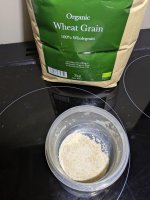
I am so impressed!! What are you going to do with it? Ceremonial pancake?
I thought about that, I'll mill some more at the weekend and then see. Possibly just make a small flatbread or damper
 
Don't forget, "99 - change hands!!!"
 
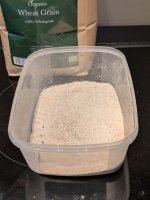
I milled some more today

PXL_20241110_114331858.MP.jpg

I processed 12oz of grain in about half an hour, it was a workout, and after sieving I had 3.5oz of flour which was a bit disappointing. There was a little spillage but mainly it just wasn't ground fine enough.

So I thought I'd put the coarse stuff through the coffee grinder which worked well and gave very similar results without the workout.

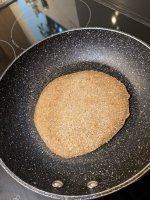
I made a flat bread with the hand ground flour which was quite tough and ever so slightly gritty.

PXL_20241110_125838596.jpg

It's been a very interesting learning experience and there are a couple of thoughts: to produce a light flour is going to need quite a fine sieve and I think a coffee grinder (assuming you don't mind the flour getting warm) is quite a good option.
 
If your flour from the stones is gritty, maybe the stones need a bit of "running in" to get rid of any loose bits.
 
I don't know how the hand grinders work, but in a full scale mill, the miller can control the separation of the millstones to give a finer or coarser grind. Additionally, French burr (or buhr) stones give a finer flour than the Derbyshire mill stone grit wheels, which were used for meal for animal feed rather than fine flour.
 
I milled some more today

View attachment 438442

I processed 12oz of grain in about half an hour, it was a workout, and after sieving I had 3.5oz of flour which was a bit disappointing. There was a little spillage but mainly it just wasn't ground fine enough.

So I thought I'd put the coarse stuff through the coffee grinder which worked well and gave very similar results without the workout.

I made a flat bread with the hand ground flour which was quite tough and ever so slightly gritty.

View attachment 438443

It's been a very interesting learning experience and there are a couple of thoughts: to produce a light flour is going to need quite a fine sieve and I think a coffee grinder (assuming you don't mind the flour getting warm) is quite a good option.
Well done! That does sound like a lot of hard work. If the end of the world is nigh, I might have to come and live near you :ROFLMAO:

I believe raising the temperature of the flour is detrimental to the nutrients, though I'm not sure how high is bad. I asked a question somewhere... I was thinking through the merits of a more powerful motor and size of stones... more power = more friction, so more heat, but there again it would be quicker, so perhaps less contact with increasingly warm stones... so which is best, more or less powerful? I suspect larger stones and lower power probably heats it less, but I didn't get an answer, so either no-one knew or else I was written off as completely potty :ROFLMAO:


I don't know how the hand grinders work, but in a full scale mill, the miller can control the separation of the millstones to give a finer or coarser grind. Additionally, French burr (or buhr) stones give a finer flour than the Derbyshire mill stone grit wheels, which were used for meal for animal feed rather than fine flour.
Really interesting about the different stones. I think the small ones you can buy are granite, although most are corundum which seems to be a composite.
 
I've seen a few recommendations to multiple grind for finer flour. Time consuming and muscle building, I expect!
 
I believe raising the temperature of the flour is detrimental to the nutrients, though I'm not sure how high is bad. I asked a question somewhere... I was thinking through the merits of a more powerful motor and size of stones... more power = more friction, so more heat, but there again it would be quicker, so perhaps less contact with increasingly warm stones... so which is best, more or less powerful? I suspect larger stones and lower power probably heats it less
TBH it didn't get that warm in the coffee grinder, about body temperature but I also wonder if there is a difference between stone grinding where the grain is crushed and broken and the coffee grinder which uses blades and hence is more of a slicing action.

I think bigger stones would heat up less because there is more surface area to dissipate heat and the mass of a larger stone will take longer to heat up. I imagine when the stones are actually moving then power would be more affected by the feed rate of the grain rather than stone size
 
Feed rate in big mills is quite a critical factor. Not sure why but it seems to be. Probably worth talking to a local miller - the seem to love talking about the process, although it can be a little hard to get them off the subject of their pet mill!!!
 
My understanding with conventional mills, meaning ones with stones rather than rollers, is that "running empty" can generate heat, which could ignite the flour dust in the atmosphere, which in turn is not a good thing to happen. I don't know if the modern rollermills have the same problem.

Fire was always a danger in the old mills.
 
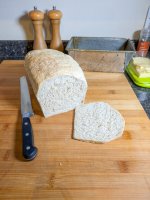
That looks fabulous. Well risen and doesn’t look dense. Does it taste different?
TBH not noticeably but then it is only 25% home milled. I think its heavy because I had to add a bit more water to the dough than I usually would but it is a nice loaf.
 
TBH not noticeably but then it is only 25% home milled. I think its heavy because I had to add a bit more water to the dough than I usually would but it is a nice loaf.
I guess there is a learning curve with the hydration. It would make sense that it would need more water as wholemeal usually does and yours is (partly) the true wholemeal. I'd feel quite proud of that :)
Sorry for my sporadic replies. I have been off travelling. I'm back just in time to see if there are any good Black Friday deals on mills and photography gear :)
 
Back
Top