Anyone know a Model metal work engineer?

Terrywoodenpic

Suspended / Banned
Messages
8,172
Name
Terry
Edit My Images
Yes
Any one know a Model metal work engineer?

Does any one know a metal working engineer or model engineer who would make me a spacer for an L-bracket?

It is a very small part only about.12mm x 20mm and 3mm thick.

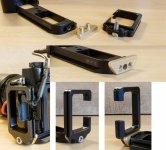
The problem is the upright part of the L-bracket fits too close to the contacts door on the side of the camera. Preventing it from fitting to a quick release clamp when open, so as to allow cables to be fitted to the necessary sockets. The door needs to be left open when in use.
Were the L- piece to be 3mm further from the camera there would be no problem.
The spacer piece would need to be drilled for a centre screw and have two small posts and matching holes to hold the L-bracket piece in register.

I would send them the L-Bracket to work to.

See the attached photograph
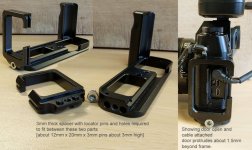
L-Bracket-spacer.jpg
 
I wonder if @GyRob can be of help or suggest somewhere/someone :thinking:
 
Is that for an XT4?
If so Paul Compton had a small quantity made up. He has a youtube and facebook group - Landscape Vlogtography. dont know if he has any left or if its for a specific L bracket or the cost but worth dropping a message
 
Unfortunately I don't think it would be possible in the way you describe, not at just 3mm thick. The spacer would need to be thick enough to receive the two pins and then have pins of it's own on the other side.

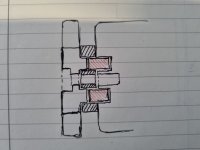
What I would do is us a thicker spacer which would be a much simpler piece of metal with three holes, and put new pins in the holes of baseplate of the bracket, so both the base and the upright parts have pins that locate into the new space. Quick sketch below. Black hatch is the spacer and red hatch is the new pins.

20211209_193719.jpg
 
Is that for an XT4?
If so Paul Compton had a small quantity made up. He has a youtube and facebook group - Landscape Vlogtography. dont know if he has any left or if its for a specific L bracket or the cost but worth dropping a message

It is for an XT30 but. Same sort of problem.
 
Unfortunately I don't think it would be possible in the way you describe, not at just 3mm thick. The spacer would need to be thick enough to receive the two pins and then have pins of it's own on the other side.

What I would do is us a thicker spacer which would be a much simpler piece of metal with three holes, and put new pins in the holes of baseplate of the bracket, so both the base and the upright parts have pins that locate into the new space. Quick sketch below. Black hatch is the spacer and red hatch is the new pins.

View attachment 337617

I can see what you mean. It might be best to drill out the existing pins in the L piece and use longer ones to go into all three pieces. But I will leave that to anyone who can do it.
The two pins just keep everything in true alignment. While the screw does the fixing.
 
Another option would be to have the spacer designed to required dimensions and 3D printed. Just need to replicate both sides that join together and use longer set screws. May need to be thicker than 3mm.
 
Last edited:
3D printing sounds like a good option.

Would a generic L Plate solve the problem?

For a model metal working engineer, I can recommend one who is close to me, but that is in Switzerland.
 
The small rig brackets have an adjustable side to overcome this, cant fault the one I have on my XT3 but not cheap especially as a second purchase
 
@Terrywoodenpic

None too sure if this a viable suggestion (as an interim measure?) but visually the holes in the base plate look approx the size of the 'confetti' you get with a paper hole punch.

If so, perhaps use such a punch on plastic sleeves (the sort for paper filing?) and put the appropriate thick stack of them in the holes................yes it means the locating pins/stubs are raised nearer the end of their travel but to gauge the clearance with a measurable 'distance' might help???

So just a thought :thinking:
 
I am a mechanical engineer with access to mills/lathes and stuff.
If you provide a dimensioned drawing, I'll see what I can do.

No promises though.
 
Just out of curiosity, what does the vertical end plate do?
 
The small rig brackets have an adjustable side to overcome this, cant fault the one I have on my XT3 but not cheap especially as a second purchase
I have a small rig one but it is a bad fit to the base of the camera and fits slightly on the skew.
It is very nice in other ways, but unsuitable to be used in conjunction with a Pano bracket as it is too inaccurate.
 
I am a mechanical engineer with access to mills/lathes and stuff.
If you provide a dimensioned drawing, I'll see what I can do.

No promises though.
That is a kind offer, would it be better to send the bracket as a template?
 
That is a kind offer, would it be better to send the bracket as a template?
I'm not comfortable with being responsible for other peoples possessions (no offence)
Do you have access to a Vernier caliper of perhaps a micrometer?
 
Also, I still don't understand what the end plate does.
 
I'm not comfortable with being responsible for other peoples possessions (no offence)
Do you have access to a Vernier caliper of perhaps a micrometer?
I have a digital Vernier. and an old one inch micrometer but inches only. I have taken a few measurements of it, but they are none of them exact millimetres. Not even the centers.
But I will draw it up this weekend and show you to see what you think.
 
I have a digital Vernier. and an old one inch micrometer but inches only. I have taken a few measurements of it, but they are none of them exact millimetres. Not even the centers.
But I will draw it up this weekend and show you to see what you think.
Just looking at the assembly of the bracket the spacer would need to be about 6mm thick.
It would basically be an aluminium plate with three holes in it.
If I can find them, I would then fit two roll pins in the outer holes at the same pitch as the ones in the main bracket.
You'll also need a longer socket headed cap screw to bolt the parts together.

That said, if the connector cover only protrudes 1.5mm beyond the bracket you only need a simple 1.6 (ish) mm spacer.
Assuming the two location pins are longer than 1.6mm, they should still engage.

I still can't really visualise how you get the cabling past the tripod mount though. Unless they have a very tight bend radius.
 
Just looking at the assembly of the bracket the spacer would need to be about 6mm thick.
It would basically be an aluminium plate with three holes in it.
If I can find them, I would then fit two roll pins in the outer holes at the same pitch as the ones in the main bracket.
You'll also need a longer socket headed cap screw to bolt the parts together.

That said, if the connector cover only protrudes 1.5mm beyond the bracket you only need a simple 1.6 (ish) mm spacer.
Assuming the two location pins are longer than 1.6mm, they should still engage.

I still can't really visualise how you get the cabling past the tripod mount though. Unless they have a very tight bend radius.
I might be able to do this myself with my pillar drill

I have discovered that the holes are 5mm diameter and the pins rather smaller.
the back end of a 5mm drill fits nicely in the holes
They are spaced 12 mm apart with a further 5mm hole centered between them.
I have been having a check and the lugs are 2mm high.

I thought That I should be able to drill the three hole in some 3.2 mm brass bar.
Then check it for fit and tighten it down in to the bracket.
next drill away one of the lugs and a further 2mm depth using the pre drilled hole as a guide.
insert a temporary pin.
And drill out the second lug +2mm depth
Cut suitable lengths of 5mm brass rod to size as guide lugs.
And bobs your uncle.

At this stage I would Scribe around the excess 3mm strip and finish to size with a file
I may or may not solder the brass pins in place I rather think the shear strength will be sufficient as it is when tightened down.

The cables have right angled connectors. (if you look at my opening picture) and there is sufficient space with the door open.
They come through the Gap in one side of the bracket.

I will need to get a new 5mm cap screw 14 mm long ( existing one is 10mm)

Success will all depend on the accuracy of my drilling But I do not need to do anything destructive. until I have achieved that and tested it

As an engineer what do you think.?
 
It should work.
If you are going to drill into the lugs, I'd be sorely temped to buy or make 5mm dowels and fit them permanently into the holes in the main body.
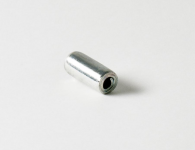
Spirol pins are ideal for this sort of thing although buying just 2 might be an issue.

1639142608333.png
 
As a cautionary note.
When drilling out the lugs it will be very difficult to find the exact center.
 
As a cautionary note.
When drilling out the lugs it will be very difficult to find the exact center.
When am drilling them out I will be using the pre drilled new spacer plate over them, which will act as a guide for the drill, it will not need to find the center of the lug. I will probably file down the one to be drilled by half its length to increase depth of the available guide hole.
 
Please let me know how you get on.
I admire a person who has the balls to try this sort of thing.

My offer still stands if you give me a dimensioned drawing.
 
Please let me know how you get on.
I admire a person who has the balls to try this sort of thing.

My offer still stands if you give me a dimensioned drawing.
I made proof of purpose one, to test the theory. But I discovered that I need to makes a simple small jig to get better accuracy while drilling the three holes exactly parallel and 6 mm apart.
Also if I get some 4.7 mm brass, I do not need to remove the bosses, but can put brass studs in the opposing holes to stop the twisting torque. To further increase the stability, I will solder on a lip to engage with the lip on the horizontal part of the L bracket. It would be better to machine it but I do not have the equipment to do so, I have everything needed to machine it out of wood, but it would be far too weak.
The 4.7 mm brass should arrive some time next week. So I can do it over Christmas.

Doing it all this way means that there is no need to attack the original bracket at all.


I will let you know how it all works out.
 
Unfortunately I don't think it would be possible in the way you describe, not at just 3mm thick. The spacer would need to be thick enough to receive the two pins and then have pins of it's own on the other side.

What I would do is us a thicker spacer which would be a much simpler piece of metal with three holes, and put new pins in the holes of baseplate of the bracket, so both the base and the upright parts have pins that locate into the new space. Quick sketch below. Black hatch is the spacer and red hatch is the new pins.

View attachment 337617

I will be using the two counter pin method using 4.7 mm thick brass this will allow each pair to penetrate to their full 2mm depth with a small clearance between.
It also needs a lip to engage with the top of the base section to further prevent twist. There is one on the existing Verticle piece. but while it engages with the spacer, it is far too narrow to engage with the Base when the spacer is in place.
 
Please let me know how you get on.
I admire a person who has the balls to try this sort of thing.

My offer still stands if you give me a dimensioned drawing.


I have managed to do it. took some thinking about. but very easy in the end, even with wood work kit.
The jig simple wooden jig, and hole spacers, worked very well, I tried it on hardwood first, cut to the dimensions of the brass bar It left me with an over tight fit that I hoped would fit with a rub or two on abrasive paper.

I started the holes in the brass bar with a centre finder first, then drilled them through with a 5mm drill. the little brass pins are a very tight fit, Which is good.
The spacer was as expected too tight to fit, so rubbed down the top till it would just fit under the lip on the end piece. it now fits with an extremely tight fit and no play at all.
After cutting off the corners and fine sanding them on my disk sander, all works, feels and looks just fine. The new cap screw is 5mm longer than necessary, and screws in more than the previous one.

L-Bracket-spacer-finished.jpg

As you can see the door can now be fully open and leaves a path for the cable to the radio release.

The L bracket fits the X T10, X T20 And X T30
 
Last edited:
Back
Top