Any motorsport panning tips for a beginner?

sduk

Suspended / Banned
Messages
1,005
Name
Sammy
Edit My Images
Yes
Tommorrow I am off to my local drag strip/drift track with my new 300mm lens for my Sony A200 DSLR.

I have only tried panning once previously with my smaller lens and failed miserably. lol

Does anyone have tips for me about technique and camera settings to achieve the best results?

I really cant wait to get out there and try it!

thanks

Sammy
 
Is it a zoom or a fixed 300mm, panning at 300mm is going to be difficult because any vertical movement is going to be exaggerated by the length of the lens, if it's not a prime shoot in RAW at a shorter focal length and crop after on the PC.

It's just practice, shutter priority and anything between 1/125 and 1/400 depending on the speed of the vehicle.
 
yeah saw that, defo gonna be puting that into practice.

can anyone give me some advice about shutter speeds and optimum camera settings?:)

You need to experiment a little with shutter speeds. Mine vary between 1/250 down to 1/50 (if I'm feeling very brave and if I'm prepared to have a low rate of keepers.) 1/125 is a good speed to wok with.

I know a lot of people will flame me for saying this but I often favour manual focus rather than auto focus. I pick a spot on the track and set my lens to that and take a single shot as the car goes by, making sure that I move smoothly and that I continue moving after I've pressed the shutter to ensure a smooth movement.
 
You need to experiment a little with shutter speeds. Mine vary between 1/250 down to 1/50 (if I'm feeling very brave and if I'm prepared to have a low rate of keepers.) 1/125 is a good speed to wok with.

I know a lot of people will flame me for saying this but I often favour manual focus rather than auto focus. I pick a spot on the track and set my lens to that and take a single shot as the car goes by, making sure that I move smoothly and that I continue moving after I've pressed the shutter to ensure a smooth movement.

cool thanks! will give those speeds a try. it sounds pretty hard so am not expecting much from my first time.:)
 
its a zoom, 75 - 300mm lens :)

i take it thats better?

I find I get better results if i'm not trying to fill the whole frame with the car or bike, I wouldn't drop below 1/125 when you're learning unless they're going really slowly as you'll find it very frustrating taking pic after pic that's blurred.

also some that look sharp on screen aren't when viewed on a PC.

I've been doing it most weekends for a year now and I still get loads of duffers but not as many as when I first started with superbikes.

front of bike, back of bike, no bike :D
 
I find I get better results if i'm not trying to fill the whole frame with the car or bike, I wouldn't drop below 1/125 when you're learning unless they're going really slowly as you'll find it very frustrating taking pic after pic that's blurred.

also some that look sharp on screen aren't when viewed on a PC.

I've been doing it most weekends for a year now and I still get loads of duffers but not as many as when I first started with superbikes.

front of bike, back of bike, no bike :D

Darren's spot on in that the speed of the thing your panning has a huge bearing on the speed you set your shutter speed at.

It really is a case of trying a few things to see how it goes.
 
Take plenty of memory. I would use the centre sensor, AF set to continuous focus. Steady-shot on. Try iso200 for starters, go up to 400 if shots are blurred. I'm guessing that your 300mm will only be f5.6. Use aperture priority and leave it at full aperture. Stop down to F8 if you can get away with it. The lens will be sharper at that aperture but it's a trade off with shutter speed. Set your zoom about midway. A monopod may be helpful if you've got one. Start sighting on the car as it approaches with your finger on the shutter button to continuous autofocus, pan smoothly and start firing off shots at it approaches. Continue until just after it passes. Adjust the zoom after the first set of shots to fill about half the frame. This will allow some cropping to frame the image nicely. Be prepared to bin a lot of shots. :)
Good shots can be got if you're way in front of the car, zoom on max, wide open and get the car in the smoke as they take off headed towards you.
 
I've been watching this thread with interest, I'm guessing the answer is yes but I'll ask anyway...

One of the reasons for getting a tripod was for motorsport, if I lock the up/down and just use it to spin shooting would I be more likely to get better shots as the movement would be restricted to left to right?

OK It's late so my description may not be as good as it could be, but, I hope you get the picture of what I mean :)
 
ryan, new this myself. but i think u would of been better with a monopod. setting up the tripod at a circuit may a bit of a pain. but i may wrong?

the main tip i would say is take some photos and get them up in the motorsports section asap and u will get all the help u need.
 
You might be able to use a tripod, after all a drag strip is going to be level I presume, and yes, as you say, you should be able to lock the tilt lever and just use panning. But like Martin says, it's a pain to cart about especially if you want to wander around and try different shooting locations. I think a monopod will give you a little more stability than just hand holding but keep the freedom to follow your target.
 
Get those pics up SDUK... oh and im guessing u recognise my username? :P
 
I've been watching this thread with interest, I'm guessing the answer is yes but I'll ask anyway...

One of the reasons for getting a tripod was for motorsport, if I lock the up/down and just use it to spin shooting would I be more likely to get better shots as the movement would be restricted to left to right?

OK It's late so my description may not be as good as it could be, but, I hope you get the picture of what I mean :)

This is an interesting point because the whole tripod issue is questionable in motor sport shooting.

I know pro wildlife togs who are amazed when I tell them that I never see motor sport shooters use tripods. They inform me that they always use tripods to pan birds in flight. This has got me thinking if they're right and I've been wrong all along. The one thing that strikes me is that they use very high end ball-heads on their tripods.

I shoot hand held apart from the occasional use of a monopod - particularly for head on or three quarter shots - but a lot of the venues I shoot are hilly. On the flat, a tripod might work well.
 
It depends what subject you are photographing, what speed the subject is travelling at, what lens your are using and getting the right shutter speed / aperture to match to create the right motion blur. shutter speeds of 1/30 1/60 or even 1/125 aren't easy to get right. So apply the 1 over focal length rule explained below.

A common rule of thumb for estimating how fast the exposure needs to be for a given focal length is the one over focal length rule. This states that for a 35 mm camera, the exposure time needs to be at least as fast as one over the focal length in seconds. In other words, when using a 200 mm focal length on a 35 mm camera, the exposure time needs to be at least 1/200 seconds-- otherwise blurring may be hard to avoid. Keep in mind that this rule is just for rough guidance; some may be able to hand hold a shot for much longer or shorter times than this rule estimates. For users of digital cameras with cropped sensors, one needs to convert into a 35 mm equivalent focal length.

That will help with setting up the right shutter settings.

Now, Panning is a technique which requires mastering over time, its not something that you can instantly do and repeat. It require training you body to become familiar with the motion, thus it become almost automatic. What this will achieve is a smooth pan, something that is not easy to master.

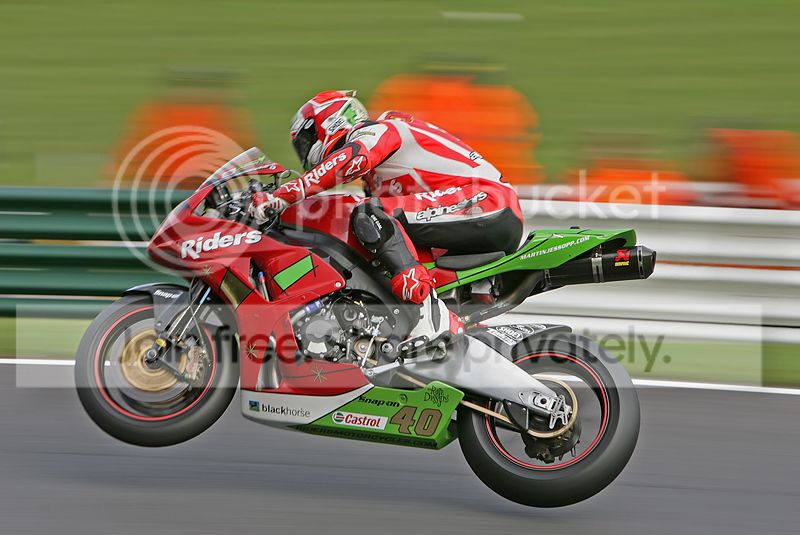
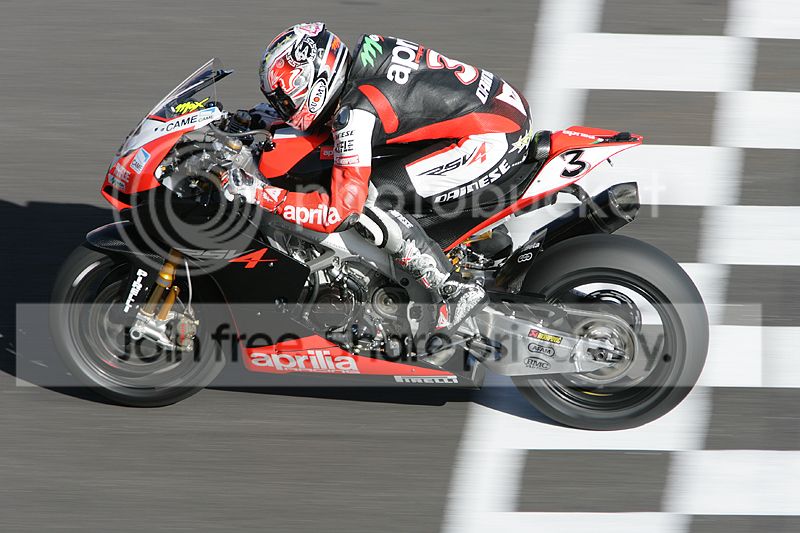
Pick up the subject early, focus and pan with the subject, take them image when subject fills 2/3 of the frame, continue the pan after the shot, try and avoid stopping the pan or jerking at the edge will also aid in good results.

You are able to capture pans at slower shutter speeds, but to get everything right in the shot takes practice and a very smooth pan movement, taken at 1/100sec, but generally, I'm taking shots at 1/200 or 1/320 sec because of the speed of the bikes and slightly slower for cars....

1/100 sec
IMG_9314copy1.jpg


1/320 sec
IMG_9025copy1.jpg


or even 1/640 sec, but still generate motion blur
IMG_0603copy1.jpg


As for a tripod or monopod, it depends on your lens. Mainly used for the larger lenses like the 300. 400, 500mm primes due to weight, you don't need support for a 70-300mm lens.

 
The only time I use a tripod at motorsport is to hoild the camera for me between races. I do occasionaly use a monopod when shooting though if my arms are getting tired!

To add a little to the panning advice, I tend to have the camera set to continuous low shooting, with a frame rate of 3 fps. as the subject's coming to the spot I want to catch it at, I shoot a short burst of 3-5 shots. The relatively slow frame rate just gives the mirror enough time to come down so I can make sure I'm following the action as it goes past. I've tried a higher rate and have problems following accurately.

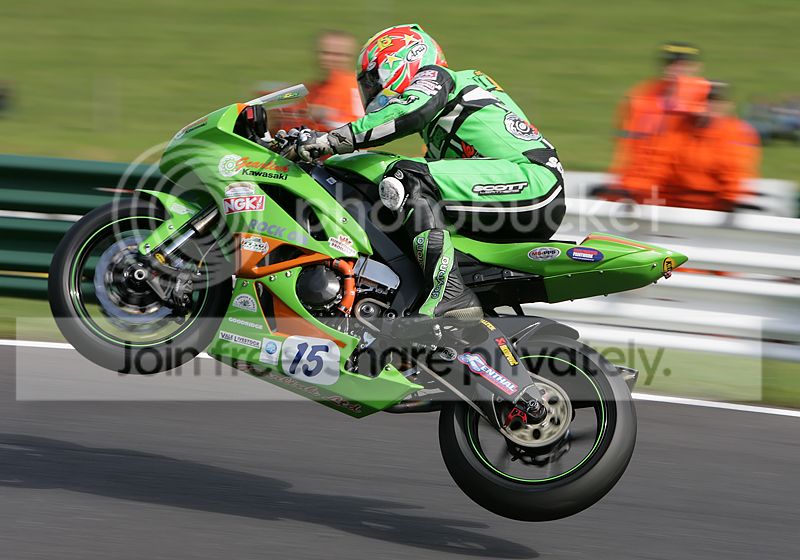
If possible, try to make sure there isn't anything too distracting in the arc of panning - sorry, Pete (Rush) but those marshalls do detract from the images, especially in the first shot you've posted (IMO). I spent ages at one corner at Castle Combe and got loads of great shots, apart from the stinging nettle that I'd not noticed until I spotted it in most of the (otherwise) best shots!

Practise really is the key. As your technique improves, the number of keepers will rise and the more confident you'll be if you want to drop the shutter speed down for more background blur. Shoot loads - after all, it's only the ones that you print that cost you anything.
 
To add a little to the panning advice, I tend to have the camera set to continuous low shooting, with a frame rate of 3 fps. as the subject's coming to the spot I want to catch it at, I shoot a short burst of 3-5 shots. The relatively slow frame rate just gives the mirror enough time to come down so I can make sure I'm following the action as it goes past. I've tried a higher rate and have problems following accurately.

If possible, try to make sure there isn't anything too distracting in the arc of panning - sorry, Pete (Rush) but those marshalls do detract from the images, especially in the first shot you've posted (IMO). I spent ages at one corner at Castle Combe and got loads of great shots, apart from the stinging nettle that I'd not noticed until I spotted it in most of the (otherwise) best shots!

OK a burst of 3 to 5 shots....hmmm (machine gun), most beginner/semi pro camera's XXXD XXD including the 7D don't have fast enough shutter lag times to take a 5 image burst and get everyone of those images in focus and sharp, burst of 2 to 3 shots are better and you'll get more keepers.

The problem is that its all to do with shutter lag and the time it takes for the camera to recompose and take the next shot.

5,6,7,8 fps (frame per second) might be written on the side of the camera, and yes it will take 8 frame per second, but not many of those images will be in focus because of the limitations of the mechanics and algorithm used to get the next shot in focus (or at least where the camera things that will be).

Feet position is important to give you a base from which to pan you body, as describe above, you then need to pick the action up early, panning with the on coming bike/car, then when it fills 2/3 screen start to take your 2 -3 images, recompose and take the next shots, remembering to continue the motion after taking the shots, that's also very important.......
 
Is it ok to use an ND8 filter to get the shutter speed down on sunny days? My Nikon D40 has a base ISO of 200 which produces fast shutter speeds on bright days even at F16-18.
My lens is a Nikon 70-300VR 4.5-5.6.
 
OK a burst of 3 to 5 shots....hmmm (machine gun), most beginner/semi pro camera's XXXD XXD including the 7D don't have fast enough shutter lag times to take a 5 image burst and get everyone of those images in focus and sharp, burst of 2 to 3 shots are better and you'll get more keepers.

The problem is that its all to do with shutter lag and the time it takes for the camera to recompose and take the next shot.

5,6,7,8 fps (frame per second) might be written on the side of the camera, and yes it will take 8 frame per second, but not many of those images will be in focus because of the limitations of the mechanics and algorithm used to get the next shot in focus (or at least where the camera things that will be).

Feet position is important to give you a base from which to pan you body, as describe above, you then need to pick the action up early, panning with the on coming bike/car, then when it fills 2/3 screen start to take your 2 -3 images, recompose and take the next shots, remembering to continue the motion after taking the shots, that's also very important.......

The D700 copes extremely well with focus at 3 fps. Very probably at 5 or more it would struggle, that's why I keep it relatively slow. 3 fps is also slow enough for me to see that I'm following accurately enough. At around 1/125th, the aperture tends to be small enough to give plenty of DoF, especially since the camera to subject distance isn't changing that fast as you pan across a relatively narrow angle.

As you say, foot position is important. I try to get my stance so it's as close to perfect as I can get it for the frames where the car's where I want it to be in the keepers while still being stable and comfortable all through the sequence.

Should have said in my first post "Take plenty of memory". Then you can machine gun all you like and not have to worry about running out or deleting images in the field. Keep an eye on the shots remaining counter and make sure you swap cards well before you run out of room - sod's law dictates that during the 5 seconds or so that a card swap takes, all hell will break loose and you'll miss it!
 
My tips...

#1 Use a monopod for 300mm and above. Don't attach the camera body to the monopod, only via the tripod ring IF the lens has it (if it doesn't, forget the monopod). Maybe try belt mounting it.. see if you get on with it, if you can make it work, its a very stable flexible method.

#2 Fire single shots not a burst, bursts are a waste of time for a plain old panning shot. Yes you might miss the moment when Elvis and ET climb out the sun roof and roof surf around the track to the sound of the Beach Boys, but... Concentrate on getting your timing right.

#3 As you pan round you will find you naturally press the button when the subject is in front of your feet. Point your feet in the direction that you want to take the photo at. If you look at your shots and your framing is wrong (eg you've caught a dustbin in the background), move your feet and magically the framing will change :D

#4 Don't go too silly slow. As a newbie it will dishearten you massively. You need good looking shots to boost your confidence, slow it down a bit next time you go out and keep practising!

#5 Don't shoot into the sun. That amazing corner you (and everyone else with a camera) has discovered where the cars/bikes come inches away from your face is worthless if you are shooting into the sun. Try to work out if/when the sun will have moved off and come back then.

#6 If it is a bright sunny day, consider using a 1 or 2 stop ND filter to get the shutter speed down. Not a problem normally at 1/250th, but as you slow it down you will have problems.

#8 Slow(ish) pans don't work if the vehicle is not on smooth ground. Its generally rubbish for non-tarmac racing as the bumps blur the subject.

#9 Practice. Lots. Post your results up in the motorsport section on here and let everyone else give you some help - the motorsport section is pretty friendly!
 
Back
Top