Another wannabe sparkie question

JonathanRyan

Suspended / Banned
Messages
10,765
Name
Jonathan
Edit My Images
Yes
Anybody know much about electric ovens?

I need to replace an electric oven. It's a single built in oven (not a cooker) and I'm assuming it's hardwired.

All the big firms seem to want 70 - 100 to wire it in but I'm assuming it's just a matter of sliding the old one out, opening the box on the wall, unwire the old, wire the new and slot the new cooker in. Is it any more complicated than that? The ones I'm looking at are 13 amp so it can't be too hard ;)

Local sparkie wants 52 + VAT and I'd far rather pay him but then I'd have to disconnect the old one for the delivery chaps to recycle before he gets there.
 
It MIGHT be as simple as slide old one out, unplug from 13A socket, job done! Or, as complicated as slide old one out, spot that it's hard wired, switch off cooker point on distribution board/remove cooker fuse, unscrew box cover, loosen 3 connector screws, remove tails, job done. (A refinement of the second method would be to disconnect the lead at the cooker end so you and the sparky don't need to crawl into the space behind the oven. Obviously, this refinement would need the supply to stay disconnected until the new oven is installed.)
 
Oh yes, I nearly forgot the bit about turning the power off :D
 
I was looking at ovens a short while ago, it seems some are just a plug in job like mine, my oven came with a 13 A plug already attached. Other oven types require hardwiring. I think so many rules have changed in recent years regarding sparkies (and other trades) some wont fit new electrical appliances unless there is a dedicated RCD or they want to fit one. A electric shower I wanted fitted recently would have needed a new RCD fitted then signed off with a certificate costing a extra £120 above the installation price. So 52 quid +vat doesn't sound so bad for getting a tradesman, I doubt that price would include getting the work certified.
 
It really is that easy Jonathan - and as has been said, most come with a plug these days.
You should have an double pole isolation switch somewhere near if it is hard wired but as always, make sure you are safe..
 
OK....update :)

Oven is wired to a 3 pin plug. This is plugged into a special socket which has an isolator switch for the hardwired hob (not certain if that switch also isolates the socket - socket is switched). Fuse panel has a separate circuit with trip for this circuit.

So it looks like either the oven will come with a plug or I can wire a plug on using a bit of flex and just plug it straight in.

Can anybody see a problem with that?
 
OK....update :)

Oven is wired to a 3 pin plug. This is plugged into a special socket which has an isolator switch for the hardwired hob (not certain if that switch also isolates the socket - socket is switched). Fuse panel has a separate circuit with trip for this circuit.

So it looks like either the oven will come with a plug or I can wire a plug on using a bit of flex and just plug it straight in.

Can anybody see a problem with that?
If it doesn't come with a plug it may because it uses more than 13A at peak current draw. Therefore need hardwiring into a circuit with sufficiently sized cable back to the consumer unit.
I'd imagine you'd be able to find the new oven manual online though, so you check before it arrives.
 
That's a good point - but the one I'm looking at is 0.79 kwh. If I have have my sums right then that's a shade over 3 amps so even if it drew 4 times that in a peak surge then it would be fine on a 13 amp plug.

I suspect the reason they don't come with plugs is so they can charge you 99 quid for wiring one on :D
 
If it doesn't come with a plug it may because it uses more than 13A at peak current draw. Therefore need hardwiring into a circuit with sufficiently sized cable back to the consumer unit.
I'd imagine you'd be able to find the new oven manual online though, so you check before it arrives.

That's a fair comment and the only reason I suggested as I did was that Jonathans first post he stated that he was looking at 13 amp ovens..

I doubt that many new (domestic) single ovens are more than 13 amp these days.
 
That's a good point - but the one I'm looking at is 0.79 kwh. If I have have my sums right then that's a shade over 3 amps so even if it drew 4 times that in a peak surge then it would be fine on a 13 amp plug.

I suspect the reason they don't come with plugs is so they can charge you 99 quid for wiring one on :D


Guessing you mean 0.79kW which is 790W which at 230V is around 3.5A. SHOULD be a simple plug and play job but if you're not 100% confident doing it yourself, lob your tame sparky his £50 - it's tax deductible IIRC!
 
the one I'm looking at is 0.79 kwh.
No it isn't. It might be 0.79kW, ie 790W, which is about 3.5 amps. But that seems remarkably low. A lot of microwaves are 800W or 900W these days, so 790W for an oven? If I were you I'd check and check again, especially if I didn't know the difference between kWh and kW.
 
Ours is hard wired into a wall socket behind the oven, which has an isolator switch before it and a very hefty cable going back to the consumer unit...Other than the that, it's a simple 3 wire connection...
 
OK....update :)

Oven is wired to a 3 pin plug. This is plugged into a special socket which has an isolator switch for the hardwired hob (not certain if that switch also isolates the socket - socket is switched). Fuse panel has a separate circuit with trip for this circuit.

So it looks like either the oven will come with a plug or I can wire a plug on using a bit of flex and just plug it straight in.

Can anybody see a problem with that?

I'd order your oven and see what it comes with, if it's a plug then your fine, if not, then you can make a decision with your local electrician - and yes, I agree about supporting local people...

Might also be worth checking out the size / rating of you existing mains cable that runs from the oven point, to make sure it'll cope with your new oven - if you pop on line to the manufacturers site of your new oven, it should give you the spec and requirements for your oven.
 
Last edited:
A single cavity oven with no hob will draw approx. 2 to 2.5 KW and will be fine with a 13amp plug and flex of 1.25mm or 1.5mm. A cooker circuit installed into the house will be run with 6mm or 10mm cable but that's to cope with a possible double oven and hob running on it or even a full electric range. I've been an appliance repair engineer for the last 30 years. But not much longer now. :)
 
I'd order your oven and see what it comes with, if it's a plug then your fine, if not, then you can make a decision with your local electrician - and yes, I agree about supporting local people...

Might also be worth checking out the size / rating of you existing mains cable that runs from the oven point, to make sure it'll cope with your new oven - if you pop on line to the manufacturers site of your new oven, it should give you the spec and requirements for your oven.

Oh the power socket of the cooker (which also feeds the hob via a hard wired side) has pretty beefy cabling ;) Heavy than normal ring main stuff. I'd say it looks like 30 amp or something.
 
No it isn't. It might be 0.79kW, ie 790W, which is about 3.5 amps. But that seems remarkably low. A lot of microwaves are 800W or 900W these days, so 790W for an oven? If I were you I'd check and check again, especially if I didn't know the difference between kWh and kW.

You're right. It's appalling that people don't know the difference between kW and kWh. Here's what it says on a well known electrical retailer's website....

kwh.jpg
 
Reading through so far I think whats evident is you still dont know for sure whether it will be a straightforward remove the old and wire a new one in. It probably will be, but just might, not. There are a fair few "Assume"s and "It looks like"s rather than hard facts.

If it were me I'd be getting a professional in for peace of mind I think.

Just my 2p.
 
I swapped ours for a new one only last month, and IIRC that's the 4th time I've done it. Never had a problem disconnecting/connecting a built-in oven, but I have had to bodge modify the way in which the new one's screwed into the unit shell due to the poor quality of the latter (horrible cheap chipboard).
 
If the new one comes with a plug, plug it in, if not hard-wire it. Calculating the current from average power is not a good idea, the starting load when the elements are cold will be much higher, just follow the manufacturers installation instructions.
 
That's the one ;)

In that case:
  • Power = 2600 to 2800 Watts
  • Current = 11 to 12 Amps
  • Top element = 1200 Watts
  • Bottom element = 1100 Watts
  • Grill = 1400 or 2600 Watts
(The grill figure of 2600W must be for the top element and grill element together)

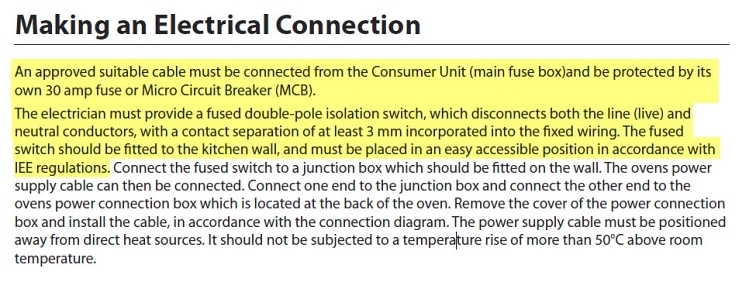
Does your installation comply with the instructions below? (remember your house insurance will be void if something horrible happens and you haven't complied with electrical regs)

14856-1458300951-69b4003d4bb19f9d220457e5a3cfd9a2.jpg
 
Last edited:
PPS. I have no idea why the shop's website doesn't show the real power ratings - it seems downright idiotic to me.

"Power consumption" - what is that supposed to mean? Maximum, minimum, average, or something else?
 
Does your installation comply with the instructions below? (remember your house insurance will be void if something horrible happens and you haven't complied with electrical regs)

14856-1458300951-69b4003d4bb19f9d220457e5a3cfd9a2.jpg

As above - yes is complies.

Don't worry - I don't have any insurance ;)
 
Back
Top