
and help to keep the site free for all
You are using an out of date browser. It may not display this or other websites correctly.
You should upgrade or use an alternative browser.
You should upgrade or use an alternative browser.
Another Sad Goodbye
- Thread starter Marc
- Start date


lindsay
Admin
- Messages
- 8,060
- Name
- Lindsay
- Edit My Images
- Yes
You did well to keep him going with the diabetes for 18 months. Our first cat had that and we were injecting him twice a day for about a year before he developed acute pancreatitis which forced us to pull his plug.
I have the deepest sympathies for you with your loss.
I have the deepest sympathies for you with your loss.


- Messages
- 5,988
- Name
- Heather
- Edit My Images
- Yes
So sorry to hear this Marc, always the hardest but kindest decision.
I lost my beloved Maverick on Friday very suddenly to heart failure ... nothing the vet could do, gone in less than an hour from being perfectly normal.
I lost my beloved Maverick on Friday very suddenly to heart failure ... nothing the vet could do, gone in less than an hour from being perfectly normal.

OP

- Messages
- 34,670
- Edit My Images
- Yes
So sorry to hear this. It's pretty much the same w ay we lost Miki 15 years agoSo sorry to hear this Marc, always the hardest but kindest decision.
I lost my beloved Maverick on Friday very suddenly to heart failure ... nothing the vet could do, gone in less than an hour from being perfectly normal.
View attachment 474055
OP
- Messages
- 34,670
- Edit My Images
- Yes
Thanks for all the kind words. There's an empty feeling this morning.
We have a "catio" (converted aviary) in the garden that he was in when we were having meals. It was heartbreaking having breakfast this morning and not being able to see him.
We have a "catio" (converted aviary) in the garden that he was in when we were having meals. It was heartbreaking having breakfast this morning and not being able to see him.


leaky5
Suspended / Banned
- Messages
- 1,824
- Name
- Richard
- Edit My Images
- Yes
Sorry to hear this Marc.
We lost our 14 YO terrier about 2 weeks ago. Had multiple issues, but probably kidney disease that got her in the end.
Really hit me and the OH hard this time.
Been through it before, but probably had younger kids to take our mind off it then.
Penny
View: https://flic.kr/p/2rDwY7W
We lost our 14 YO terrier about 2 weeks ago. Had multiple issues, but probably kidney disease that got her in the end.
Really hit me and the OH hard this time.
Been through it before, but probably had younger kids to take our mind off it then.
Penny
View: https://flic.kr/p/2rDwY7W
Last edited:

LeeRatters
Suspended / Banned
- Messages
- 7,354
- Name
- Lee
- Edit My Images
- Yes
Sorry to hear this sad news Marc. It's never easy with our furry friends 
We had to say goodnight to our Millie last Monday. She was 17 [last October] and a fighter through several health issues the past few years, but enough was enough. Very tough, but correct, decision.
Here she is in Llyn Idwal last September.

*** by Lee, on Flickr
We had to say goodnight to our Millie last Monday. She was 17 [last October] and a fighter through several health issues the past few years, but enough was enough. Very tough, but correct, decision.
Here she is in Llyn Idwal last September.
*** by Lee, on Flickr

JohnC6
Suspended / Banned
- Messages
- 11,799
- Name
- John
- Edit My Images
- Yes
A very sad thread. Quite often people feel more over the loss of their pets than family and can take longer to get over it than with family. The experience can sometimes cause mental health issues such was the bond. Relationships are always good with pets which isn't always the case with family. Does a wife/husband/partner sit at the window like a dog or even sometimes cats ,looking out waiting for you come home ? No. Do they run to the front door like dogs do when you do arrive home ? No. Do they exhibit joy and excitement like a dog does ? No.
When we get a pet we know, at the back of our minds what we're going to go through one day but the joy and companionship overides that.
We've had two Retrievers and four cats. Two of the cats were rescue and two turned up on the doorstep....how do they know ? One came to us at about 2/3 years old and lived to 24.
When we get a pet we know, at the back of our minds what we're going to go through one day but the joy and companionship overides that.
We've had two Retrievers and four cats. Two of the cats were rescue and two turned up on the doorstep....how do they know ? One came to us at about 2/3 years old and lived to 24.
- Messages
- 5,988
- Name
- Heather
- Edit My Images
- Yes
There isn't a suitable emoji for this post ... need a hug one.


Seagull Shooter
Suspended / Banned
- Messages
- 73
- Name
- Stephen Pook
- Edit My Images
- Yes
Sorry to hear that Marc. I lost my old Burman a couple of years ago. You do get very attached to them! He looks like he was a characterful boy...Today, we said goodbye to Jacob after 14 years. We had to make the decision after 18 months with feline diabetes.
View attachment 474026
leaky5
Suspended / Banned
- Messages
- 1,824
- Name
- Richard
- Edit My Images
- Yes
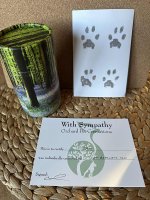
We have the same scatter tube as you.
Once the weather is better we will scatter them at one of her favourite walks.
Off the path slightly and not smack in the middle like someone did last year.
The vets also gave us a small pouch of poppy seeds.
We will mix them in and go back occasionally to see if the took.
Once the weather is better we will scatter them at one of her favourite walks.
Off the path slightly and not smack in the middle like someone did last year.
The vets also gave us a small pouch of poppy seeds.
We will mix them in and go back occasionally to see if the took.
OP
- Messages
- 34,670
- Edit My Images
- Yes
He's currently on the dresser. We're about to put the house on the market as we need to move to a bungalow. We've decided to take him with us and possibly bury the tube in the corner of the garden.We have the same scatter tube as you.
Once the weather is better we will scatter them at one of her favourite walks.
Off the path slightly and not smack in the middle like someone did last year.
The vets also gave us a small pouch of poppy seeds.
We will mix them in and go back occasionally to see if the took.
JohnC6
Suspended / Banned
- Messages
- 11,799
- Name
- John
- Edit My Images
- Yes
He's currently on the dresser. We're about to put the house on the market as we need to move to a bungalow. We've decided to take him with us and possibly bury the tube in the corner of the garden.
We have the first Retriever in an urn..a box ...buried in the back garden My wife wanted that.

footman
Suspended / Banned
- Messages
- 4,914
- Name
- Laurence
- Edit My Images
- No
We lost our 12 year old miniature schnauzer Archie just before Christmas 2025.
After he became ill early in December we spent our entire pet insurance allowance of £3000 over a period of 2 weeks just for the vets to keep him alive without giving us a diagnosis, no test results showed infection only that his vital signs were deficient.
They suggested that he should be taken to an animal hospital for further tests at a cost of £2000 per night which could have cost us a further £7,000 at least.
When I suggested that perhaps his symptoms meant that he’d reached the end of his natural life, their life span being 12-14 years, and that it was unfair on him to keep him alive and still suffering they seemed quite shocked but eventually agreed with us and then he went to sleep.
We’ve always liked our vets both on a professional and personal level but the whole experience was traumatic to us and we felt that we had been in the grip of a commercial enterprise rather than a clinical one.
Oddly I don’t really miss Archie, I feel that he had a good life and gave us much pleasure and companionship but I really miss just having a dog.
We won’t have another dog because of our advancing age and also the cost but I spend too much time watching doggy videos on YouTube!
After he became ill early in December we spent our entire pet insurance allowance of £3000 over a period of 2 weeks just for the vets to keep him alive without giving us a diagnosis, no test results showed infection only that his vital signs were deficient.
They suggested that he should be taken to an animal hospital for further tests at a cost of £2000 per night which could have cost us a further £7,000 at least.
When I suggested that perhaps his symptoms meant that he’d reached the end of his natural life, their life span being 12-14 years, and that it was unfair on him to keep him alive and still suffering they seemed quite shocked but eventually agreed with us and then he went to sleep.
We’ve always liked our vets both on a professional and personal level but the whole experience was traumatic to us and we felt that we had been in the grip of a commercial enterprise rather than a clinical one.
Oddly I don’t really miss Archie, I feel that he had a good life and gave us much pleasure and companionship but I really miss just having a dog.
We won’t have another dog because of our advancing age and also the cost but I spend too much time watching doggy videos on YouTube!
JohnC6
Suspended / Banned
- Messages
- 11,799
- Name
- John
- Edit My Images
- Yes
On my iPad I can't highlight your comment re being subject to the financial aspect of treatment rather than the clinical one but I'm sure you're aware that a high percentage of vet surgeries have been sold to private investment companies.We lost our 12 year old miniature schnauzer Archie just before Christmas 2025.
After he became ill early in December we spent our entire pet insurance allowance of £3000 over a period of 2 weeks just for the vets to keep him alive without giving us a diagnosis, no test results showed infection only that his vital signs were deficient.
They suggested that he should be taken to an animal hospital for further tests at a cost of £2000 per night which could have cost us a further £7,000 at least.
When I suggested that perhaps his symptoms meant that he’d reached the end of his natural life, their life span being 12-14 years, and that it was unfair on him to keep him alive and still suffering they seemed quite shocked but eventually agreed with us and then he went to sleep.
We’ve always liked our vets both on a professional and personal level but the whole experience was traumatic to us and we felt that we had been in the grip of a commercial enterprise rather than a clinical one.
Oddly I don’t really miss Archie, I feel that he had a good life and gave us much pleasure and companionship but I really miss just having a dog.
We won’t have another dog because of our advancing age and also the cost but I spend too much time watching doggy videos on YouTube!
It used to be that only qualified and licensed vets could own a veterinary practice, meaning that vets tended to be independent practices or maybe small local chains. It was the norm for veterinary surgeons to work in a practice, buy into the partnership and end up as a partner at their own practice, That was until deregulation at which point private equity companies started buying up practices...offering the partners a deal they couldn't refuse. So, by 2013, only 10% of vet practices were owned by a handful of these businesses. Today 60% are owned by them in England and Wales and 40% in Scotland. It's not only the practices they buy but the leading venture capitalists..that's in effect what they are, aren’t just buying veterinary practices, but diagnostic laboratories, referral centres, out-of-hours suppliers, crematoriums, pharmacies, locum agencies and veterinary nursing schools. They’re also involved in MRI scans, oncologists, behavioural experts. In reality, the whole gamut. I studied social and economic history years ago and, it seems to me...from memory, that what we have here is a model of vertical integration. Maybe someone with more knowledge of the subject could confirm or reject that notion.
There have been quite a few radio phone-ins on it very recently and I heard some horror stories re costs...ten of thousands of pounds..nothing short of emotional blackmail and exploitaion. One anonymous vet, who works for one of the largest IVCs , said that the company has introduced a new monitoring system that could encourage vets to offer pet owners very expensive tests and treatment. Another, who is in charge of an IVC -owned practice, also anonymous for fearing losing his job, passed on an internal company document, to a Panorama investigation, that uses a colour code to compare the company's UK-wide tests and treatment options and states that it is intended to help staff improve clinical care. ....yet...it lists key performance indicators in categories that include average sales per patient, X-rays, ultrasound and lab tests.
In most cases, deregulation opens the door to exploitation by those who have no experience in a business..just experience in enriching their investment vehicles and consequently themselves and their investors.
The CMA is currently conducting an inquiry.

gman
Suspended / Banned
- Messages
- 11,100
- Name
- Graham
- Edit My Images
- Yes
He's currently on the dresser. We're about to put the house on the market as we need to move to a bungalow. We've decided to take him with us and possibly bury the tube in the corner of the garden.
We buried our previous Beagle at a pet cemetery and we visit every year on Boxing Day. It's out in the countryside and has Highland Cows grazing in the next field that often come over to say hello. It's nice having somewhere you can go to to remember, whether it's in the garden or somewhere else. We had a tree planted at his grave and every year we see it growing a little more. It's nice to see a new life grow in his place.