Advice please: flash

skullfunkerry

Suspended / Banned
Messages
1,814
Name
Kerry
Edit My Images
Yes
I’m a bit of a noob when it comes to flash photography, but I’ve been thinking for a while that I should learn about it.

I have a Fuji EF-X8 which I have played with a little bit, and that’s pretty much the extent of my experience.

I was looking at the Viltrox site today and they have a couple of flashes which aren’t much money but look like they might be a bit more feature-rich than the Fuji flash:


So my question is: is it worth getting one of these, or will the EF-X8 do just to learn about how to use a flash well?

(yes, I realise that this is a gear forum so I’m supposed to buy first and ask questions afterwards. Sorry about that!) :D
 
The answer as always is:
What exactly do you want to do?

The Fuji flash you have is the worst of what I’d want in a flash, and the Viltrox flashes you’ve posted don’t appear to offer any improvement. But that’s for MY needs.

So - what do you want to do.
 
The answer as always is:
What exactly do you want to do?

The Fuji flash you have is the worst of what I’d want in a flash, and the Viltrox flashes you’ve posted don’t appear to offer any improvement. But that’s for MY needs.

So - what do you want to do.
Good point, I haven’t really thought about that Phil. I haven’t really got any idea, apart from “I should learn how to use a flash”.

I think I need to do some reading before I go any further :)
 
I’ve a couple of flash beginner tutorials knocking about in my head that I promise I will get to write one day.

But generally, the mistake most photographers make when contemplating flash is that it’s just for adding light when there’s not enough.

But adding a point light source on camera axis, doesn’t solve that problem, it creates another one. You’ve supplemented natural looking light that wasn’t bright enough, with awful light that’s brighter.

The easiest (cheapest) way to make flash look more natural is to bounce it.

The best way is to get it off camera and use a modifier to create whatever ‘look’ you want.

Let’s start with ‘natural light’ means the sun, of which there is one, and it’s in the sky.
 
As with most things "Flash" can be as simple or as complicated as you like...but again as with most things it comes down to a few basic principles.
One of the most basic, and possibly first principles to understand is that you are dealing with two exposures...the ambient (The illumination that is all around you at the time.) and the light from the flash. It's how you mix and balance the two that makes the difference.
 
Last edited:
I’m a bit of a noob when it comes to flash photography, but I’ve been thinking for a while that I should learn about it.

I have a Fuji EF-X8 which I have played with a little bit, and that’s pretty much the extent of my experience.

I was looking at the Viltrox site today and they have a couple of flashes which aren’t much money but look like they might be a bit more feature-rich than the Fuji flash:


So my question is: is it worth getting one of these, or will the EF-X8 do just to learn about how to use a flash well?

(yes, I realise that this is a gear forum so I’m supposed to buy first and ask questions afterwards. Sorry about that!) :D
'Feature rich' flashguns can be a mixed blessing, esp if you don't use them very often. I sold the one where I had to refer to the manual every time I used it.

It might help your learning process if you don't think about learning to use a flash well. Instead, think of learning to use light well. Learn where to create light - and more importantly how & where to positions shadows and how to control their density.

As Phil said it depends on what you want to shoot but for most people a secondhand mains head, a stand, a trigger & a couple of modifiers will get you further and cost less than a fancy hotshoe-mounted flash.
 
A good place to start learning flash lighting is an online free program called "The Strobist 101" , but there is far more to learning how light behaves and how to make good use of it for photography. Learning the "Inverse Square Law", not the actual math, but how it works both to your advantage, as well as disadvantage as you learn what flash, as well as constant light is all about when applied to photography.

I picked up my first camera in 1951 and I had a flash gun on it, but it was little more than a bright short term flashlight. Flash photography and flash lighting have come a very long ways since then. Having flash lighting that you can shape, soften, and control the level of is an amazing boost to the quality of your photos, but you also need to become a bit of an artist to know what makes a photo interesting and where some well lit as well as shadows enhance the result of the photo taken. That said, I've been learning lighting for photography since 1951. Though Sunlight hasn't changed, artificial light for photography has been changing rapidly since the beginnings of Digital Photography. Manufacturers have come up with ways to better control the amount of light from our artificial and flash, offering means of controlling the levels as well as the color temperature. Digital Camera technology has been rapidly improving too as the manufacturers come up with ways of controlling the flash lighting with the camera electronic. TTL (Through The Lens) and HSS (High Speed Sync) as well as the electronic shutters in the cameras so we can control the shutter speed to unbelievably high speeds over the old mechanical shutters. There is always something new to learn and new ways to use it, both with our digital cameras and the lighting designs being made better nearly every day now.

Learn the basics of flash photography with Strobist, then practice what you have learned. It's a bit outdated, but will get you started well. Learn what is available and how it all works is something that the manufacturers fall a bit short on, but we now have Youtube. Adorama, one of the largest photo equipment stores in NY City
have been a great source of videos made by several talented photographers and there are many of their videos to watch and learn from. I like the Mark Wallace, Daniel Norton, and Gavin Hoey videos and they each keep coming up with new ideas and ways to get better at using the photography products now available on the market, and frequently are first to introduce new products and show how they work. You can learn to do "Still Life" photography very well by watching "Camera Club Live", also on Youtube. Each of his videos demonstrate step by step, how to photograph small objects, usually on a table top, how to get the lighting just right, and even a bit about using Photoshop or similar photo editing program to enhance your photos. Doing "Still Life" photography is a great rainy or otherwise no fun day to learn photography. You don't need a big studio like his, nor do you need his expensive cameras or lights. DIY alternates can save a lot of money and produce great results. I used the center of my living room, pushing all of the furniture out of the way as my studio for many years, but every piece of gear and cameras had to be pulled from the closet, set up

Garry's Book is good, but it is a bit advanced for someone just beginning. Learn the very basics from Strobist and experimenting with your camera, and maybe your first flash, before you will be able to understand much of what is in his book. It's a great book, but doesn't get you off the ground with the very basics all that well.
Become an active member here and on the photography websites, ask questions here and everywhere that you think someone might be able to help, and you will become proficient with flash photography very quickly, but then there is the "Artist Factor" and learning how to get light and shadows in your photos to create interest in them. Flat, perfectly lit photos aren't as interesting as those that are shadowed in the right places too.

Charley
 
Totally agree on Gerry's guide having a massive amount of information & good guidance.

But, don't forget to apply it to what interests you (photographically) and don't be afraid to break the "rules"...

I dabble around the edges, but before the last couple of years I'd probably fired the flash (I always had one, just in case) fewer than half a dozen times in the prior three decades. Last night multiple flashes fired multiple dozens of times.

Purists would probably have an embolism at my "technique" but my badger pics are now in the main technically acceptable (or rather not utter garbage), the ones that I chuck (and there are many per session) are generally compositional failures because it's a wild animal and therefore uncooperative.
 
A good place to start learning flash lighting is an online free program called "The Strobist 101" , but there is far more to learning how light behaves and how to make good use of it for photography. Learning the "Inverse Square Law", not the actual math, but how it works both to your advantage, as well as disadvantage as you learn what flash, as well as constant light is all about when applied to photography.

I picked up my first camera in 1951 and I had a flash gun on it, but it was little more than a bright short term flashlight. Flash photography and flash lighting have come a very long ways since then. Having flash lighting that you can shape, soften, and control the level of is an amazing boost to the quality of your photos, but you also need to become a bit of an artist to know what makes a photo interesting and where some well lit as well as shadows enhance the result of the photo taken. That said, I've been learning lighting for photography since 1951. Though Sunlight hasn't changed, artificial light for photography has been changing rapidly since the beginnings of Digital Photography. Manufacturers have come up with ways to better control the amount of light from our artificial and flash, offering means of controlling the levels as well as the color temperature. Digital Camera technology has been rapidly improving too as the manufacturers come up with ways of controlling the flash lighting with the camera electronic. TTL (Through The Lens) and HSS (High Speed Sync) as well as the electronic shutters in the cameras so we can control the shutter speed to unbelievably high speeds over the old mechanical shutters. There is always something new to learn and new ways to use it, both with our digital cameras and the lighting designs being made better nearly every day now.

Learn the basics of flash photography with Strobist, then practice what you have learned. It's a bit outdated, but will get you started well. Learn what is available and how it all works is something that the manufacturers fall a bit short on, but we now have Youtube. Adorama, one of the largest photo equipment stores in NY City
have been a great source of videos made by several talented photographers and there are many of their videos to watch and learn from. I like the Mark Wallace, Daniel Norton, and Gavin Hoey videos and they each keep coming up with new ideas and ways to get better at using the photography products now available on the market, and frequently are first to introduce new products and show how they work. You can learn to do "Still Life" photography very well by watching "Camera Club Live", also on Youtube. Each of his videos demonstrate step by step, how to photograph small objects, usually on a table top, how to get the lighting just right, and even a bit about using Photoshop or similar photo editing program to enhance your photos. Doing "Still Life" photography is a great rainy or otherwise no fun day to learn photography. You don't need a big studio like his, nor do you need his expensive cameras or lights. DIY alternates can save a lot of money and produce great results. I used the center of my living room, pushing all of the furniture out of the way as my studio for many years, but every piece of gear and cameras had to be pulled from the closet, set up

Garry's Book is good, but it is a bit advanced for someone just beginning. Learn the very basics from Strobist and experimenting with your camera, and maybe your first flash, before you will be able to understand much of what is in his book. It's a great book, but doesn't get you off the ground with the very basics all that well.
Become an active member here and on the photography websites, ask questions here and everywhere that you think someone might be able to help, and you will become proficient with flash photography very quickly, but then there is the "Artist Factor" and learning how to get light and shadows in your photos to create interest in them. Flat, perfectly lit photos aren't as interesting as those that are shadowed in the right places too.

Charley
I agree with most of what you say.

Since I started in photography, flash has become either incredibly easier or incredibly more complex, depending on viewpoint, and I think it may be the complexity that puts most people off.

Back in the day, all that we had was flashbulbs - very expensive single-use flashes that could only fire at full power, so the simple bit was that all we had to know was that we had to divide the distance from flash to subject into the guide number to get the theoretical f number, e.g. guide number 80, distance from flash to subject 10', so f/8. Modern technology has brought about massive improvements but with a lot of complications. But although the lazy (and sometimes best) approach is to use the inbuilt computer to calculate the best exposure, it also works to divide distance into guide number to get the starting point.

As a general rule, flashguns have all the clever stuff, studio flashes are much more basic.

I agree, Strobist 101 is a great resource, even though it's now a bit outdated. The only issue I had with it was its stated belief that flashguns can do everything, whether they can or not isn't the point, studio flash is often the better and easier option, and nearly all experienced photographers use both, and often in the same shot.

As for "Garry's Book is good, but it is a bit advanced for someone just beginning." I have 2 separate books specifically on lighting, both are on Amazon. "Product Photography Magic" is specialised and can be a bit advanced, "Lighting Magic" less so. It does go into some advanced techniques, but it covers the absolute basics too and, if it sounds advanced then I've probably just explained things badly:(.

As an illustration, if I was to write a book that explains the very simple task of reversing a small car into a parking bay (for people who want to pass their driving test) but then went on to explain how to back a 42-tonne Artic into a very tight space, or how to back an off-road car with a large trailer into a tight space, in low transfer, 4WD in a muddy field, people who just want the basics for their driving test could just use the basic info, people who had progressed further could use the other bits to improve their knowlege, it's really just a case of trying to make the book as complete as I can.

But, since those days, I've retired and my life has changed. I no longer have a 400sq m pro studio with all the gear, so I've changed my approach and have gone for very simple lighting that works with a minimum of gear in my small living room, this limits WHAT I can photograph, but the principles are the same. The Lighting Challenges cover various discrete techniques that form the basis or pretty much all lighting, and each one uses just one light. I stopped the series because not enough people joined in, but most of the people who did join in achieved great results and massively improved their work, so I think that the idea itself was OK. Those challenges are, of course, still open.

I've also tried to tackle individual techniques (for example the Inverse Square Law) in the "Resources" tab, and recently I've posted basic tutorials on food photography https://www.talkphotography.co.uk/tutorials/food-photography-—-shooting-in-a-small-home-studio.167/ and a remembrance day project, https://www.talkphotography.co.uk/tutorials/lest-we-forget.168/, each of which involve just two lights. In each case, I used studio flash because it was easier for me, but flashguns would have worked too.

As is normal, these have been largely ignored by the membership but this doesn't matter.

So, overall, just learn and understand the basic principles, and the rest will slot into place over time
 
.....

As is normal, these have been largely ignored by the membership but this doesn't matter.

....
I can't speak for anyone else, but in my case I have read/watched all these with interest, then the demands of day to day life, work, etc, have left me without the time I want to actually do the tasks :(
 
One of the issues with modern flash guns is the almost total lack of information provided. I've got a lot of flashes, Godox, MCOplus, Yonguo etc,. They come with more warning about getting it wet or taking it apart than how to work it.
Theres so many features, zoom, first or second curtain, HSS, wireless and loads more, the flimsy bit of paper that passes as instructions leaves a lot to be desired. Some have more instructions online, but if your out of signal thats no help (if you can actually find the right one) To make matters worse the models will vary even in the same make. Buy the new model and guess what, the wireless system is totally different, why?
The old simple guns had a chart on the side, and it worked, now I need Stephen Hawking to find the wireless set-up! ;)
 
@Johnathan, and others who wish to have their own studio. You aren't alone in this situation.

My whole adult life, before I finally retired, I had wanted badly to do photography of any kind, but the demands of my wife and family of 4, plus the crazy long periods of extensive overtime at my job, all but kept me away from photography. But I did manage to take snap shots of the kids, especially when I took them somewhere.

I became a photographer in about 1952 when I received the gift of a Kodak Brownie camera with flash gun. I fell in love with this new hobby and my dad helped me build a small darkroom in our basement. A year later my dad let me have his Argosy 35 mm camera, so the quality of my photos went up significantly. One day a few years later, I was showing my friends some of the photos that I had brought to school and one of the teachers saw what them and asked if he could look at them too. I let him and a few moments later, he said " these are very good". Would you be interested in taking yearbook photos with the school's camera? Well, I then got to haul the school's big Graflex Press Camera with a 5 D cell flash, a bag of flash bulbs, and a bag of flat film packs around the school whenever I had the time.

I shot mostly the school club groups and the sports for the last three years that I was in high school. Again, with the need for getting my education, and the clubs that I was part of, My available time for taking yearbook photos was quite short, as I was involved in the stage club, so helped with the lighting and set builds. I also showed all of the feature movies in the auditorium. The art teacher had worked in one of the NY theaters on Broadway, knew lighting and set design, so helped me learn stage lighting and set design quite well. So well that near the end of my senior year the principal called for me to come to his office. All the way I kept thinking "What did I do now?", but he had a smile on his face as he welcomed me in. There was another gentleman there with us, but the principal's first question was "Have you found a job for the Summer?" and I replied "Not yet, but I'm looking".

Then he introduced me to this other man, saying "He owns an Off Broadway Summer Theater and needs a stage manager". Really, it was a one man operation, with a helper when I needed help. I asked about what he wanted me for, and he described what I would need to do, then asked If I wanted the job, telling me how much he would pay me. I accepted the job immediately, since it was way higher pay than minimum wage and what many of my friends were finding for their first jobs.

There were shows 6 nights a week with a feature movie one night, an Off Broadway entertainer or group another night, and a dance one night with a group or band that had a recent pop record. The other three nights were local talent, sometimes including a local short play, other nights musicians, etc. There were occasional afternoon shows too, sometimes cartoons and kids movies.

I became an electrical engineer and after college, and I ended up working on a special camera for NASA, to take mapping photos of the Moon from an orbiting rocket. At the time we didn't know why they wanted to do this, but then the Apollo Moon Missions provided the "why". The maps were in case the Astronauts didn't land where they were supposed to, and these maps would help them navigate on this strange new place. My photography experience and the fact that I was now an Electrical Engineer, got me that job quickly, and without much searching. After this project I ended up developing, and sometimes building electrical controls for high speed high precision manufacturing machinery, and I did this almost until my first retirement. All through my career and marriage, and then while raising four children, I rarely had the time or money for photography, but did push aside all of the living room furniture, and drag what photo gear that I had out of the closet and set it up. An ironed bed sheet was hung over the French Doors, some of those reflector lights with the spring clips attached and many sizes of standard light bulbs were my lights. Changes in bulb Wattage (hot, so needed leather gloves) and distance got the light level that I wanted. For light stands I made them out of wood, with a base and a long vertical piece, then clipped the reflector lights at whatever level that I wanted. Onion skin paper was placed over the lights to diffuse the light, but it didn't work very well. I took photos with this DIY pile of cheap junk, but it worked well enough for the B/W shots that I was taking. But then everything had to be packed up and put back in the closet "For the next time". With 4 kids wanting to watch the TV, I was rushed the whole time. I did rent a studio a couple of times, but it was very expensive, so I didn't do it much. The owner did give me a break on his usual price, and I had to schedule my shoot to when the studio wasn't going to be used by anyone else, but did manage to do it a couple of times. Back when I was the stage manager, if the stage was clean of everything and not scheduled, I did use it with all of the curtains closed too, but only a couple of times.

So I had always wanted a studio so where I could have good lights, good backdrops, and good cameras that I could leave set up and ready for the next time that I had the chance to use it all, but in my life I never had the chance to own one, and raising 4 kids I had almost no time left to get serious about photography. Then Digital photography got started. I had always hated working with the chemicals, so this raised my interest in digital photography very quickly. At first the cameras, even the best were terrible. Then I finally had the money for a good camera and in 2000 I bought good camera, a Sony MVC-FD98. It had a whole 2.1 megapixels and a pretty good lens, but used 3 1/2" floppy disks for recording, and 4 376 K high resolution photos was all that a floppy disk could hold in Jpeg format. But it could take some really nice photos and they still looked good when printed 8 X 10". I still had kids in the house, but over the next few years each moved out. So 5 1/2 years ago I realized that there was a 2nd Master Bedroom Suite upstairs in my present house and the bedroom was 19 X 26', so it would make a small, but acceptable studio for me. So I worked on the kids to get their stuff out of it, and then began creating the very first studio of my own. The 8' ceiling has been my only significant problem, and changing the roof line to fix this is not going to happen, so I'm discovering that it does make a pretty good studio anyway. There is a full double bathroom and a walk-in closet off the shooting room, and I've transformed the large hallway at the top of the stairs to work as the "hair, makeup, and break area, but the break supplies are out there, but we usually end up taking the breaks in the shooting room.

I've set it up for Portraits, Small Groups, Still Life, Product, and as a small video studio. It had to be capable of switching relatively easily and quickly from one type of use to another, and I managed to figure that out and build it to suite me. Then COVID hit, and my studio saw almost no use for two years. My plan had always been to take professional photos for close friends and family at little to no cost to them. I don't need the money, so this studio is mostly only for me to experiment with light and take the best photos that I can, mostly for just my enjoyment, but then 3 1/2 years ago my wife fell in our laundry room and broke both her back and her pelvis. My youngest son developed Muscular Dystrophy, so now can't work and is an electric wheelchair, so he is back living with us and I am the caregiver for both of them. So again, but this time I have everything set up in an almost perfect studio, just one flight of stairs away, and I have very little spare time to use it. I do have a grand daughter coming over two times a week to help me with the laundry and floor cleaning, but has a 3 yo daughter, my great grand daughter that has to come with her mom. So the efficiency of this extra help tends to be considerably inefficient because of mom's need to take care of both my house and her daughter. Still, they are both wonderful to have visiting, and anything that does get done is something that I don't have to do. So I get a little more time to spend upstairs in the studio, but so many breaks taken that I keep forgetting what I was doing before I needed to go downstairs. I'm cooking most meal for us, picking up the trails of drops that all leave behind, and doing whatever else is needing to be done, and I still can't use my studio that way that I had wanted for my whole lifetime.

I'm 83 now, and with considerable health problems of my own. I just had heart surgery #9 back in August and I'm not really back up to speed yet, and even when doing well I am considerably slower than when I was young. I had knee replacements 15 years ago, but they aren't as good as the originals, but they don't hurt though, and that's a plus. I've had Cancer twice, and I think I've beat it. I also have a pacemaker now, so I have an internal clock to keep me running on time. I consider myself to be "Bionic" now, as I have a lot of metal and plastic scattered all through me from other situations and accidents in my life too, but I'm still going. I've had a "Still Life" flowers in a vase shoot that I started to do back in May that I'm still working on. Fortunately this time, they are artificial flowers, so they are waiting for me. I now have the three lights that I think I will need all in position, but haven't set their levels or their final accurate position, yet. Maybe I can do this this afternoon, but probably not. I keep hoping.

Well, that's the story of my long wanted photo/video studio. It's taken me most of my life to get here, but I still can't enjoy it as I had planned. It's all set up, with 6 motorized 10' wide backdrops, power on the ceiling on both sides of a ceiling lighting support grid with 8 LED light panels semi-permanently up their in a wide leg "U" shape for doing videos, and they are high enough so I can set up and do my other kinds of flash photography below them. With the power available up there, and my ceiling lighting support grid, I can hang a light anywhere in about a 10 X 19' area, so I power my lights from above, even if they are on C Stands below. This way, there are no power cables on the floor, and very few light stands to trip over. Even my tether cables runs up to the ceiling grid and then over to the center of the area where I usually use the still or video cameras. with enough extra hanging down to let me move freely around with the camera, yet have no tether cable on the floor either. I have a wireless control system for every light and a remote on each camera stand that allows me to turn on and off the power to each kind of lights that I want to use, without ever needing to climb the ladder to turn them on or off. I power my studio strobe with one button pair, my LED light panels on or off with the second button pair, the third controls a 500 watt focusing halogen theater spot light located on the ceiling grid camera left, the fourth button pair controls power to the second 500 watt focusing spot light located on the ceiling grid camera right, and the fifth button pair on the remote controls power to 4 UV LED light panels that are also on the ceiling grid. I bought these in the hope of doing some Halloween shots and have iridescent paint and make-up designed for this, but I didn't quite get all this set up for last Halloween, maybe this year will see some use out of them. I have also remotely controlled the ceiling (work light) in the center of the ceiling. This was the old bedroom light location, and for the shots that require low F-Stop settings I need to turn this ceiling light off for the shot, but then back on so I can see to move around. With only the light switch at the door for this light, I had to go there when needing to turn it off and then back on after the shot, so now there is a wireless switch at each camera stand, one by my computer, and another on on the wheeled toolbox that I use as a place to set my camera when I need to change something. It's always near me and camera left.

My walk-in gear closet is now full. My soft boxes that I use most are stored on wall hooks along the studio wall camera left. To camera right along that wall are three windows and they are Southeast facing, so a lot of Sunlight comes in through them during the morning hours. Just below these windows are computer tables for my printers, battery charging, second computer and display, etc. So I have installed sliding closet door tracks on the ceiling, running along side of the ceiling light grid. There are four tracks running parallel to each other, and on three of them I have 4' X 7' insulation panels painted white and hanging one per track on them. I can shove these toward the East wall and stacked next to the background roller system, or pull them out so that each slightly overlaps the one next to it and they block the Sunlight from the windows. These serve to give me a second backdrop at 90 degrees to the main backdrop system to use as well, and they block the view of the computer tables and contents from the rest of the studio, giving me a less cluttered looking studio and better light control when I'm shooting in the mornings.

Well, a long story, but I hope you can gain from it. You aren't the only one wishing that you could have your own studio. Don't hesitate to ask questions about any of this, and I'll answer them as best as I can. Do what you can with where you can, even if it's as temporary as my living room studio setup. Life never seems to give us much fun time, and you aren't alone here. Maybe some of my studio dreams and then finally getting one will give you at least something to dream about. I have a friend who came here because he's starting to build his own studio in his basement. He has the basics now, and is adding to it gradually, but he frequently calls with questions. I know he'll be back, because his memory is fading a bit since his last visit, but he is getting there, however slowly. If you can DIY and improvise, you won't need to spend a lot of money. Buy what you need as you can afford it, and DIY what you want if the money isn't there for the good stuff. I don't recommend those spring clip lights from Home Depot though. There is much better stuff at reasonable prices out there. Another friend made a soft box from an aluminum disposable turkey roasting pan and a white pillow case. He says that it works, but I haven't seen the results. Improvise when you need to. It will keep your brain busy to help you with what you need.

Charley

 
I got a Nissin i40 for my first flash and it's done everything I've needed it to. It's not the most powerful, it doesn't have wireless support (other than optical), and takes AA batteries, but for my very occasional use, it's been great. Best of all, it's small!

As others have stated - the biggest upgrade you'll ever get for the flash is to bounce it or move it off camera, everything else is just "nice to have". I was blown away at how much more natural the light looked the first time I bounced it.

I believe the i60 is the updated version, with 2.4ghz wireless built in.
 
@Johnathan, and others who wish to have their own studio. You aren't alone in this situation.

My whole adult life, before I finally retired, I had wanted badly to do photography of any kind, but the demands of my wife and family of 4, plus the crazy long periods of extensive overtime at my job, all but kept me away from photography. But I did manage to take snap shots of the kids, especially when I took them somewhere.

I became a photographer in about 1952 when I received the gift of a Kodak Brownie camera with flash gun. I fell in love with this new hobby and my dad helped me build a small darkroom in our basement. A year later my dad let me have his Argosy 35 mm camera, so the quality of my photos went up significantly. One day a few years later, I was showing my friends some of the photos that I had brought to school and one of the teachers saw what them and asked if he could look at them too. I let him and a few moments later, he said " these are very good". Would you be interested in taking yearbook photos with the school's camera? Well, I then got to haul the school's big Graflex Press Camera with a 5 D cell flash, a bag of flash bulbs, and a bag of flat film packs around the school whenever I had the time.

I shot mostly the school club groups and the sports for the last three years that I was in high school. Again, with the need for getting my education, and the clubs that I was part of, My available time for taking yearbook photos was quite short, as I was involved in the stage club, so helped with the lighting and set builds. I also showed all of the feature movies in the auditorium. The art teacher had worked in one of the NY theaters on Broadway, knew lighting and set design, so helped me learn stage lighting and set design quite well. So well that near the end of my senior year the principal called for me to come to his office. All the way I kept thinking "What did I do now?", but he had a smile on his face as he welcomed me in. There was another gentleman there with us, but the principal's first question was "Have you found a job for the Summer?" and I replied "Not yet, but I'm looking".

Then he introduced me to this other man, saying "He owns an Off Broadway Summer Theater and needs a stage manager". Really, it was a one man operation, with a helper when I needed help. I asked about what he wanted me for, and he described what I would need to do, then asked If I wanted the job, telling me how much he would pay me. I accepted the job immediately, since it was way higher pay than minimum wage and what many of my friends were finding for their first jobs.

There were shows 6 nights a week with a feature movie one night, an Off Broadway entertainer or group another night, and a dance one night with a group or band that had a recent pop record. The other three nights were local talent, sometimes including a local short play, other nights musicians, etc. There were occasional afternoon shows too, sometimes cartoons and kids movies.

I became an electrical engineer and after college, and I ended up working on a special camera for NASA, to take mapping photos of the Moon from an orbiting rocket. At the time we didn't know why they wanted to do this, but then the Apollo Moon Missions provided the "why". The maps were in case the Astronauts didn't land where they were supposed to, and these maps would help them navigate on this strange new place. My photography experience and the fact that I was now an Electrical Engineer, got me that job quickly, and without much searching. After this project I ended up developing, and sometimes building electrical controls for high speed high precision manufacturing machinery, and I did this almost until my first retirement. All through my career and marriage, and then while raising four children, I rarely had the time or money for photography, but did push aside all of the living room furniture, and drag what photo gear that I had out of the closet and set it up. An ironed bed sheet was hung over the French Doors, some of those reflector lights with the spring clips attached and many sizes of standard light bulbs were my lights. Changes in bulb Wattage (hot, so needed leather gloves) and distance got the light level that I wanted. For light stands I made them out of wood, with a base and a long vertical piece, then clipped the reflector lights at whatever level that I wanted. Onion skin paper was placed over the lights to diffuse the light, but it didn't work very well. I took photos with this DIY pile of cheap junk, but it worked well enough for the B/W shots that I was taking. But then everything had to be packed up and put back in the closet "For the next time". With 4 kids wanting to watch the TV, I was rushed the whole time. I did rent a studio a couple of times, but it was very expensive, so I didn't do it much. The owner did give me a break on his usual price, and I had to schedule my shoot to when the studio wasn't going to be used by anyone else, but did manage to do it a couple of times. Back when I was the stage manager, if the stage was clean of everything and not scheduled, I did use it with all of the curtains closed too, but only a couple of times.

So I had always wanted a studio so where I could have good lights, good backdrops, and good cameras that I could leave set up and ready for the next time that I had the chance to use it all, but in my life I never had the chance to own one, and raising 4 kids I had almost no time left to get serious about photography. Then Digital photography got started. I had always hated working with the chemicals, so this raised my interest in digital photography very quickly. At first the cameras, even the best were terrible. Then I finally had the money for a good camera and in 2000 I bought good camera, a Sony MVC-FD98. It had a whole 2.1 megapixels and a pretty good lens, but used 3 1/2" floppy disks for recording, and 4 376 K high resolution photos was all that a floppy disk could hold in Jpeg format. But it could take some really nice photos and they still looked good when printed 8 X 10". I still had kids in the house, but over the next few years each moved out. So 5 1/2 years ago I realized that there was a 2nd Master Bedroom Suite upstairs in my present house and the bedroom was 19 X 26', so it would make a small, but acceptable studio for me. So I worked on the kids to get their stuff out of it, and then began creating the very first studio of my own. The 8' ceiling has been my only significant problem, and changing the roof line to fix this is not going to happen, so I'm discovering that it does make a pretty good studio anyway. There is a full double bathroom and a walk-in closet off the shooting room, and I've transformed the large hallway at the top of the stairs to work as the "hair, makeup, and break area, but the break supplies are out there, but we usually end up taking the breaks in the shooting room.

I've set it up for Portraits, Small Groups, Still Life, Product, and as a small video studio. It had to be capable of switching relatively easily and quickly from one type of use to another, and I managed to figure that out and build it to suite me. Then COVID hit, and my studio saw almost no use for two years. My plan had always been to take professional photos for close friends and family at little to no cost to them. I don't need the money, so this studio is mostly only for me to experiment with light and take the best photos that I can, mostly for just my enjoyment, but then 3 1/2 years ago my wife fell in our laundry room and broke both her back and her pelvis. My youngest son developed Muscular Dystrophy, so now can't work and is an electric wheelchair, so he is back living with us and I am the caregiver for both of them. So again, but this time I have everything set up in an almost perfect studio, just one flight of stairs away, and I have very little spare time to use it. I do have a grand daughter coming over two times a week to help me with the laundry and floor cleaning, but has a 3 yo daughter, my great grand daughter that has to come with her mom. So the efficiency of this extra help tends to be considerably inefficient because of mom's need to take care of both my house and her daughter. Still, they are both wonderful to have visiting, and anything that does get done is something that I don't have to do. So I get a little more time to spend upstairs in the studio, but so many breaks taken that I keep forgetting what I was doing before I needed to go downstairs. I'm cooking most meal for us, picking up the trails of drops that all leave behind, and doing whatever else is needing to be done, and I still can't use my studio that way that I had wanted for my whole lifetime.

I'm 83 now, and with considerable health problems of my own. I just had heart surgery #9 back in August and I'm not really back up to speed yet, and even when doing well I am considerably slower than when I was young. I had knee replacements 15 years ago, but they aren't as good as the originals, but they don't hurt though, and that's a plus. I've had Cancer twice, and I think I've beat it. I also have a pacemaker now, so I have an internal clock to keep me running on time. I consider myself to be "Bionic" now, as I have a lot of metal and plastic scattered all through me from other situations and accidents in my life too, but I'm still going. I've had a "Still Life" flowers in a vase shoot that I started to do back in May that I'm still working on. Fortunately this time, they are artificial flowers, so they are waiting for me. I now have the three lights that I think I will need all in position, but haven't set their levels or their final accurate position, yet. Maybe I can do this this afternoon, but probably not. I keep hoping.

Well, that's the story of my long wanted photo/video studio. It's taken me most of my life to get here, but I still can't enjoy it as I had planned. It's all set up, with 6 motorized 10' wide backdrops, power on the ceiling on both sides of a ceiling lighting support grid with 8 LED light panels semi-permanently up their in a wide leg "U" shape for doing videos, and they are high enough so I can set up and do my other kinds of flash photography below them. With the power available up there, and my ceiling lighting support grid, I can hang a light anywhere in about a 10 X 19' area, so I power my lights from above, even if they are on C Stands below. This way, there are no power cables on the floor, and very few light stands to trip over. Even my tether cables runs up to the ceiling grid and then over to the center of the area where I usually use the still or video cameras. with enough extra hanging down to let me move freely around with the camera, yet have no tether cable on the floor either. I have a wireless control system for every light and a remote on each camera stand that allows me to turn on and off the power to each kind of lights that I want to use, without ever needing to climb the ladder to turn them on or off. I power my studio strobe with one button pair, my LED light panels on or off with the second button pair, the third controls a 500 watt focusing halogen theater spot light located on the ceiling grid camera left, the fourth button pair controls power to the second 500 watt focusing spot light located on the ceiling grid camera right, and the fifth button pair on the remote controls power to 4 UV LED light panels that are also on the ceiling grid. I bought these in the hope of doing some Halloween shots and have iridescent paint and make-up designed for this, but I didn't quite get all this set up for last Halloween, maybe this year will see some use out of them. I have also remotely controlled the ceiling (work light) in the center of the ceiling. This was the old bedroom light location, and for the shots that require low F-Stop settings I need to turn this ceiling light off for the shot, but then back on so I can see to move around. With only the light switch at the door for this light, I had to go there when needing to turn it off and then back on after the shot, so now there is a wireless switch at each camera stand, one by my computer, and another on on the wheeled toolbox that I use as a place to set my camera when I need to change something. It's always near me and camera left.

My walk-in gear closet is now full. My soft boxes that I use most are stored on wall hooks along the studio wall camera left. To camera right along that wall are three windows and they are Southeast facing, so a lot of Sunlight comes in through them during the morning hours. Just below these windows are computer tables for my printers, battery charging, second computer and display, etc. So I have installed sliding closet door tracks on the ceiling, running along side of the ceiling light grid. There are four tracks running parallel to each other, and on three of them I have 4' X 7' insulation panels painted white and hanging one per track on them. I can shove these toward the East wall and stacked next to the background roller system, or pull them out so that each slightly overlaps the one next to it and they block the Sunlight from the windows. These serve to give me a second backdrop at 90 degrees to the main backdrop system to use as well, and they block the view of the computer tables and contents from the rest of the studio, giving me a less cluttered looking studio and better light control when I'm shooting in the mornings.

Well, a long story, but I hope you can gain from it. You aren't the only one wishing that you could have your own studio. Don't hesitate to ask questions about any of this, and I'll answer them as best as I can. Do what you can with where you can, even if it's as temporary as my living room studio setup. Life never seems to give us much fun time, and you aren't alone here. Maybe some of my studio dreams and then finally getting one will give you at least something to dream about. I have a friend who came here because he's starting to build his own studio in his basement. He has the basics now, and is adding to it gradually, but he frequently calls with questions. I know he'll be back, because his memory is fading a bit since his last visit, but he is getting there, however slowly. If you can DIY and improvise, you won't need to spend a lot of money. Buy what you need as you can afford it, and DIY what you want if the money isn't there for the good stuff. I don't recommend those spring clip lights from Home Depot though. There is much better stuff at reasonable prices out there. Another friend made a soft box from an aluminum disposable turkey roasting pan and a white pillow case. He says that it works, but I haven't seen the results. Improvise when you need to. It will keep your brain busy to help you with what you need.

Charley

In the UK very few people have the space available for a permanent studio space in their homes - our houses are simply much smaller, and relatively more expensive than in the USA.

I do have a fairly large lounge, compared to many, abut 11' x 22', but that is a main room in the house, with furniture, TV, etc. so to use it I need to first move things around, then set up backdrop, stands, etc. Then I can do the photography, then I need to put everything back - which all takes time, and while I'm doing that the rest of the family don't have use of that room.
So I need to find a time when I have several hours free, and the rest of the family don't need the room.
 
My advice FWIW, would be to pick up a basic manual flash (something like a Godox TT600) and pair it with one of their wireless triggers, both of which can be picked up pretty cheaply new and used. When I first started with flash, this is what I did, and basically spent my spare time experimenting with it. TTL is nice to have, and a lot of beginners will default to this as it takes some of the guesswork out of the situation, but I honestly think you would benefit from learning on a manual unit; it definitely helped me gain more of an understanding of it. There are obviously people on here vastly more experienced than myself, so you can take what ive said with a pinch of salt. This is just how I learned :)
 
@Faldrax said -

"In the UK very few people have the space available for a permanent studio space in their homes - our houses are simply much smaller, and relatively more expensive than in the USA.

I do have a fairly large lounge, compared to many, abut 11' x 22', but that is a main room in the house, with furniture, TV, etc. so to use it I need to first move things around, then set up backdrop, stands, etc. Then I can do the photography, then I need to put everything back - which all takes time, and while I'm doing that the rest of the family don't have use of that room.
So I need to find a time when I have several hours free, and the rest of the family don't need the room."


Do you have a garage? A single car garage is most likely large enough to make it into a small studio, and still get the car in there when you aren't using it as a studio. True, you won't be able to keep your setups while using it for the car, but backdrops on rollers can be raised to the ceiling, photo gear stashed in storage space, or even a rope lifted platform to hold everything high above the engine or trunk, etc. Add a ceiling mounted heat source so you can warm it up for your shoot, a wooden or folding chair borrowed from the house, and some photo lighting, like the Godox Ad200 and newer models or even a couple of speedlites on a couple of light stands, and you have a useable photo studio for portraits that will take less than 30 minutes to unpack and set up. Do your shoot and then put everything away, likely also in about a half hour, so you can put the car back into the garage. Not quite ideal, but it should work for you. Nobody will see what is hanging on the side walls, except for you and your subject. A 2 car garage would make an amazing studio. Do some thinking "Outside the box" that you mentally put yourself into when you think photography. Many ways exist to use things for photography that aren't in the photography books or real photo studios. Figure out how you can "Make Do" to convert something into what you need. Actually, my present photo studio in my house was a former master bedroom. It had been in use every night while two of my boys were living at home. It was only after they had become adults and moved away that I was able to make a photo studio from it. Even now I sometimes want to use a longer lens and need to back myself through the bathroom door to get the distance that I need to use that lens, but something less, like a 24-70 lens or even a 50 mm lens would allow shooting inside a garage without the car in it. A basement that's high enough to stand straight up in could also work if your subjects are always sitting or lying down. For portraits, they make 5 X 7 and smaller spring wire edge backdrops that become very small when folded. If only waist up shots will be taken, something not much bigger than a pillow case would do as a backdrop, and it doesn't need to be on a roller when not being used. The only real advantage of a roller system is that the backdrop item of your choice will likely need to be folded for storage, and then need to be ironed to look good to use as a backdrop. You might want to consider paper backdrops that come on a roll. You could just tear off the used part and trash it after the shoot ended, and use a CStand arm to support it when doing the shoot. Even some hooks and a broomstick or piece of pipe to hold the roll of paper up near the ceiling while using it, then taken down and put away after the photo shoot. Think about alternatives when you don't have what you need. Back near the camera and it's tripod, you only need space about the width of a doorway that widens as you move toward the subject and backdrop. Outside this viewing area, many things can be stored and they won't be seen in the shots that you take. With a printed backdrop your shots will look like they were taken wherever the backdrop appears. Movie studios are masters at this and you can be too, if you think about alternatives that you can use.

Charley
 
@Faldrax said -

"In the UK very few people have the space available for a permanent studio space in their homes - our houses are simply much smaller, and relatively more expensive than in the USA.

I do have a fairly large lounge, compared to many, abut 11' x 22', but that is a main room in the house, with furniture, TV, etc. so to use it I need to first move things around, then set up backdrop, stands, etc. Then I can do the photography, then I need to put everything back - which all takes time, and while I'm doing that the rest of the family don't have use of that room.
So I need to find a time when I have several hours free, and the rest of the family don't need the room."


Do you have a garage? A single car garage is most likely large enough to make it into a small studio, and still get the car in there when you aren't using it as a studio. True, you won't be able to keep your setups while using it for the car, but backdrops on rollers can be raised to the ceiling, photo gear stashed in storage space, or even a rope lifted platform to hold everything high above the engine or trunk, etc. Add a ceiling mounted heat source so you can warm it up for your shoot, a wooden or folding chair borrowed from the house, and some photo lighting, like the Godox Ad200 and newer models or even a couple of speedlites on a couple of light stands, and you have a useable photo studio for portraits that will take less than 30 minutes to unpack and set up. Do your shoot and then put everything away, likely also in about a half hour, so you can put the car back into the garage. Not quite ideal, but it should work for you. Nobody will see what is hanging on the side walls, except for you and your subject. A 2 car garage would make an amazing studio. Do some thinking "Outside the box" that you mentally put yourself into when you think photography. Many ways exist to use things for photography that aren't in the photography books or real photo studios. Figure out how you can "Make Do" to convert something into what you need. Actually, my present photo studio in my house was a former master bedroom. It had been in use every night while two of my boys were living at home. It was only after they had become adults and moved away that I was able to make a photo studio from it. Even now I sometimes want to use a longer lens and need to back myself through the bathroom door to get the distance that I need to use that lens, but something less, like a 24-70 lens or even a 50 mm lens would allow shooting inside a garage without the car in it. A basement that's high enough to stand straight up in could also work if your subjects are always sitting or lying down. For portraits, they make 5 X 7 and smaller spring wire edge backdrops that become very small when folded. If only waist up shots will be taken, something not much bigger than a pillow case would do as a backdrop, and it doesn't need to be on a roller when not being used. The only real advantage of a roller system is that the backdrop item of your choice will likely need to be folded for storage, and then need to be ironed to look good to use as a backdrop. You might want to consider paper backdrops that come on a roll. You could just tear off the used part and trash it after the shoot ended, and use a CStand arm to support it when doing the shoot. Even some hooks and a broomstick or piece of pipe to hold the roll of paper up near the ceiling while using it, then taken down and put away after the photo shoot. Think about alternatives when you don't have what you need. Back near the camera and it's tripod, you only need space about the width of a doorway that widens as you move toward the subject and backdrop. Outside this viewing area, many things can be stored and they won't be seen in the shots that you take. With a printed backdrop your shots will look like they were taken wherever the backdrop appears. Movie studios are masters at this and you can be too, if you think about alternatives that you can use.

Charley
Yes, I do have a garage, but it is full of rack shelving storage, so the option to make a studio space is not available.
Using the living room as a shooting space does work - it's just a bit time consuming in terms of setup and put away, which means with all the other draws on my time, I don't do it very often.
 
" Yes, I do have a garage, but it is full of rack shelving storage, so the option to make a studio space is not available.
Using the living room as a shooting space does work - it's just a bit time consuming in terms of setup and put away, which means with all the other draws on my time, I don't do it very often."

That's exactly what I was doing for much of my life, while my kids were growing up, but lighting technology has improved so much that using those reflectors and changing bulb wattages makes me laugh at myself when I think about it. I would use a couple of speedlites on stands if I was in that situation and using the living room now. My field kit now contains the new bigger version of speedlites for more versatility. They are Godox AD200 Pro II now, nut I used regular Godox TT600 speedlites in the kit for years before getting the AD200.

Your living room studio description sounded much like what I had been doing while raising my kids. It was only after they were adults ,and had left the nest, that I had space to build my studio. Though I consider what I have to be small I do realize that most homes, even here in the USA don't have rooms that large. It is possible to build and use a smaller room, like an extra bedroom, but only you can test the possible space with your camera and lenses to see if you can make it work. What you need to do is to get someone to pose for you, in a room that you are considering using, and try different lenses while you take shots of them. Actually, just looking through the viewfinder should let you see if it will work or not. If the room layout is such that you and the camera can back out through a door into the next room, you may have found the lens to use and how to make it work. I know, this is less convenient, but certainly better than re-arranging the living room furniture and taking your gear out, using it, and then back into the closet after each shoot, but you will have found the space that you can make work. I have a friend that uses his center hallway as his studio. At least there is less furniture to move and replace when using it. If the room has a closet, you have a place to store gear that you aren't using. The bathroom adjacent to my studio has it's door about centered on the shorter West wall of my studio, and on a couple of occasions that I have wanted to use a longer lens that required more distance than my studio length, using the bathroom and doorway for the additional distance worked. It put me in the bathroom with me shooting through the open doorway with the subject at the far end of my studio for the shot that I wanted, but it worked.

Start with a 50 mm lens and see if you can use a room that you think might work. Lower lens mm sizes will allow you to get closer to your subject, but it can distort the subject's face if too close, so it's a trade-off to find the combination that will work well in that space, or extended space partially using that room and doorway into the next room to let you get far enough away for the lens and shot that you want. You won't know until you try it. I was initially doubting that this former bedroom would work for me, so I did this as a test before I decided that it would work. I found that I now frequently use a 24-70 mm lens for almost everything, but I also have a 50 mm and a 24 mm that I can use too. The 24 mm is a manual focus shift/tilt, but it works well straight too, when I'm doing "still life" and "product" shoots on a 3' square table. The only type of shoot that actually requires a a larger room is the Portrait type of shoot. The still life and product shoots could be done in a square or nearly square room less than half the size of my studio, with the table in the center and the camera and lights 3' or less from the center of the table and around the table. Going the other way I have a 75-300 mm and a Tamron 18-400 mm lens. While the 75-300 forces me into the bathroom, the 18-400 works well in the studio at it's lower settings, but I like to keep it on one of my Canon 77D cameras in my field kit. I like it because I can easily shoot near and very far with it and it eliminates my need to carry several lenses when out using the field kit. I do carry a second lens "just in case" a problem arises with the Tamron lens and it's on my other 77D camera that I always take as backup.. It's a 50 mm. At least I will still be able to shoot with it and not end the day and go home because of a failure. Many old film cameras had 50 mm lenses and we took all of our film shots with it, because most of the old film cameras didn't have changeable lenses.

Where there's a will, there is a way, and you can find it if you look hard enough.

Charley
 
@skullfunkerry looking at the flash you linked, take a look at a godox it30pro. It’s great for an easy to use flash. It’s ttl, which is basically an auto setting. You can use ttl and also override it by turning a dial to increase or decrease the flash power. You’ll soon start to figure out how to use it manually too. There’s lots of YouTube instructions and reviews for it.

It doesn’t adjust its angle so it gives a direct flash look, if that’s what you’re after. Godox also sells a small hot shoe riser to fit the flash, this also tilts so you can angle the flash and bounce off ceilings etc. to give a more pleasing light. The riser also helps to stop some lenses casting shadows, riser is also better for a bit of macro flash. I think you can use it as a trigger for off camera flash too but I’ve not tried it yet.

Just buy the flash and riser (available in black or silver) for your camera brand, it’ll have an ‘f’ in the title for Fuji. Got mine cheap from aliexpress but I’ve seen them on Amazon too.
 
" Yes, I do have a garage, but it is full of rack shelving storage, so the option to make a studio space is not available.
Using the living room as a shooting space does work - it's just a bit time consuming in terms of setup and put away, which means with all the other draws on my time, I don't do it very often."

That's exactly what I was doing for much of my life, while my kids were growing up, but lighting technology has improved so much that using those reflectors and changing bulb wattages makes me laugh at myself when I think about it. I would use a couple of speedlites on stands if I was in that situation and using the living room now. My field kit now contains the new bigger version of speedlites for more versatility. They are Godox AD200 Pro II now, nut I used regular Godox TT600 speedlites in the kit for years before getting the AD200.

Where there's a will, there is a way, and you can find it if you look hard enough.

Charley
That’s a very important point. Go back not-so-many years to when we all shot on film. Most of us used medium and large-format camera, shooting at small apertures compared to today, and we needed lots of flash power to do that.

Yes, 35mm cameras had their place, they were used for sports and press photography, and often street, but ignoring the marketing claims of “professional” the image quality just wasn’t good enough for most applications. The only decent image quality came from using Kodachrome, at 10 iso, or later Velvia, at 25 iso, and most people didn’t want to shoot on tranny film, so even those who did needed loads of flash power.

This limitation carried on for years after digital, early digital cameras could only be used at very low iso settings, just like film. At one point I had a “professional” full-frame camera, the Kodak DCS14-N, very good at its native iso of 80, horrible above that and totally useless at its maximum of 400 iso.

That’s all ancient history now, modern digital cameras can be used at incredibly high iso settings, which has made powerful flashes irrelevant. People are beginning to realise that now, but just a few years ago people were arguing on this forum about power, 300 watt-seconds was about the norm, some people still thought that more was needed.

Of course, when we’re shooting outdoors in bright sunlight and want to overpower the sun, we still need at least 600 watt-seconds, and there can never be too much power when we’re shooting indoors in a warehouse, but in the normal home studio, less power is more.

Take my latest offering
View: https://youtu.be/-wP3F2-lMXE?si=bA6Vqmzv6lAEw9eW


Shot in my small living room (to prove that small spaces can be used) Visico 5 flash head at the minimum power setting of 1/128th power (just 3.125 watt-seconds) at my minimum iso of 100,and I still needed to use a 3-stop ND filter to shoot at f/2.8

Flashgun manufacturers tend to be economical with the truth about power; they concentrate on guide numbers instead, possibly dreamed up out of thin air and enhanced by the zoom function and the mirror-like reflector, but the better ones are around 60-60 iso, and that’s more than enough for home studio use with a digital camera.

Also of course, flashguns take up far less physical space than studio flash, so despite their complexity and their horrible fixed reflectors, they make photography in a home studio easy.
 
Garry's Book is good, but it is a bit advanced for someone just beginning. Learn the very basics from Strobist and experimenting with your camera, and maybe your first flash, before you will be able to understand much of what is in his book. It's a great book, but doesn't get you off the ground with the very basics all that well.
Become an active member here and on the photography websites, ask questions here and everywhere that you think someone might be able to help, and you will become proficient with flash photography very quickly, but then there is the "Artist Factor" and learning how to get light and shadows in your photos to create interest in them. Flat, perfectly lit photos aren't as interesting as those that are shadowed in the right places too.

Charley
I've seen lots of Garry's work but I don't think I've seen any of yours. With all your detailed replies it'd be really helpful to see where you're coming from. Maybe start a separate thread with some of your pics?
 
I've been doing "Still Life" for about 2 years whenever I'm not using the studio for anything else. I no longer take paying jobs and I mostly just "experiment with light" now, but I built the studio so it can handle portrait shoots, Still Life, Macro, and video work and I'm not interested in dealing with customers. It's for me and for taking photos of my closer friends and family, and never charge, but do accept donations if I do a large project for someone and whey want to cover the printing costs, etc. I'm very retired now, after retiring 5 times and each time saying that was "it", but then was offered better and better interesting short term jobs at considerably better and better pay, so I went back to work, for a while. Now I haven't "worked for a living" in 8 years. We are comfortable here, but now considering a significant downsizing. Three of us in a 4,000 sq ft house is ridiculous, but I fear that if we do this I may lose my hard earned studio, so I'm not sure what will happen at this time.

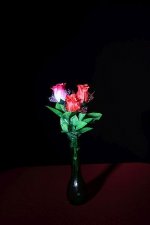
This is the only flower photo that is small enough in digital size to be accepted by this forum. I'll edit a few more to reduce their file size and add them when I can. Most are flower shots much like this, but I'll try to add something on another subject too. I'm 83, and with many health problems, so mostly working in my studio now. I like the dark surroundings, so what I add will likely all look like this photo. I used a studio strobe, with a 7" reflector, and a 10 degree grid to contain the flash so it only lit the flowers, but with enough light spill so you can see the vase and table top. The Inverse Square Law of light keeps you from seeing my light stands and other gear sitting behind the table and about 5' from the roses. The studio strobe was also about 5' from the flowers on a stand located camera left. If I remember right, I used one of my Canon 77D cameras and a Canon 24-70 mm kit lens for this shot.

I've been a photographer since about 1952. I became the high school yearbook photographer for the club group shots and many of the athletic games during my last 3 years of high school. I was also active in the setting up and showing movies and running the lighting for any stage shows while at high school. The art teacher had worked for a On Broadway theater before becoming a teacher, so she taught me much about proper lighting for the shows. I was offered the position of stage manager for an Off Broadway theater during the Summer following my high school graduation, so did that for the Summer before going to college. After college, I became an electrical Engineer and worked on a special camera for NASA to take mapping photos of the entire Moon from an orbiting rocket using 1950 camera technology. The film used was much like Polaroid as it was self developing. The photos were then scanned and sent back to tracking stations for printing. Taking photos of the dark side of the Moon required long shutter open times, but the camera was moving, so a way of locking the camera on a position was necessary for blur free images. There wasn't much light to work with, so a means had to be found to keep the camera aimed at the same position as long as the shutter was open, then jump ahead and repeat the sequence for the next map segment that needed to be photographed. We didn't know why they wanted maps of the Moon, until the Apollo Mission began. They were mostly to be used by the Astronauts in case they didn't land where they had intended.

My job for most of my working career was designing and building large scale automated manufacturing systems, but several projects involved photography and accurately positioning tiny parts using optical technology at high speeds, but I never let go of my interest in photography outside my day job. It was a serious hobby that I used to relax from the stress and pressures of the day job. We raised 4 children, so I was quite limited in what I could invest in photo equipment until the four were grown and leaving the nest. I went fully digital in 1998 and in 2000 I bought a Sony 2.1 megapixel camera, an MVC-FD 98. It allowed me to print my shots up to 8 X 10" with great detail, but there wasn't much left if you did any cropping. I have owned many digital cameras since then. I still have that Sony but Floppy Disks, the readers for them, etc are becoming quite scarce now, but it still works and I keep it more for nostalgia. Since then I have owned many digital cameras of increasing capability. All have ben the popular main brands like Nikon, Canon, Fuji, etc.

5 1/2 years ago I realized that there was a 2nd Master Bedroom Suite upstairs in my home that had held two of my boys, but they were now adults, married, and living their own lives. So I started converting it into my first personal photo/video studio. The bedroom is 19 X 26' with a walk-in closet for my gear, so it made a good shooting room. A double bathroom, and walk-in gear closet are behind the usual camera position. Outside the shooting room in the large hallway is the hair, makeup, and break area, although the breaks usually occur in the shooting room. So out there in the hallway is a short refrigerator for cold drinks, a microwave on top of it with coffee cups and a coffee maker. There are drawers next to the refrigerator for the supplies. The make-up station is my oldest son's desk with a large mirror attached and LED bar lights on both sides and the top of the mirror. The result is very bright and the color temperature of the lights are about 5600 K, so if they look good in that mirror and lights, they will look good during the shoot. The desk drawers contain hair clips, several brushes a hair dryer, combs, Aqua Net hair spray, Makeup sponges, and other things that they might have forgotten. If they use any of it I trash the item and replace it. Oh, a box of sewing supplies threads of many colors etc. are also there in one of the drawers.

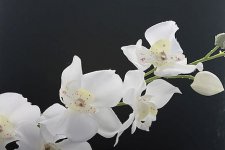
These three flower photos used only one studio strobe light . The Cherry blossoms were lit with a 3' square soft box placed at the rear of the table and facing the camera. A 12 X 16" or so of black felt was hung from a light stand and arm directly in front of the soft box. I used a chemistry stand to hold the branch of flowers in about the center of the table. Light from the soft box came around the top and sides of the black felt to light the back side of the flower pedals. I used two pieces of white foam core clamped to two pieces of wood with small A Clamps so each would stand on it's edge. I positioned these in front of the flowers and off to each side of the camera lens, and angled so as to reflect light from the soft box back toward the flowers to light the front of the branch and flowers. To keep from getting lens flare from the soft box being pointed directly at the camera, I used a large piece of black foam core with a hole cut in it's center slightly larger in diameter than the camera lens. It too had a strip of wood A Clamped to it's bottom edge so it would stand upright at the front edge of the table. The camera and lens were positioned to look through this hole to capture the shot.

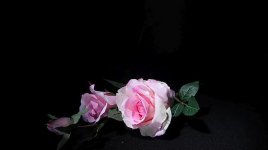
Both of the rose shots had light stands and other gear behind this table and spaced about 5' from the roses. The inverse square law keeps them from being seen in the photos. Both were lit similarly with one studio strobe, a 7" reflector, and a grid (honeycomb) or whatever you call them. I only remember that I used a 10 degree grid for the first shot. The other flower photos were lit the same, but probably with a more open grid.

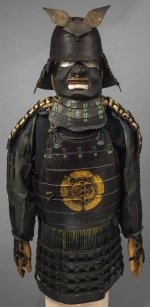
Away from the flower kick, the 4th photo of the "private wine for two" was taken before I started doing the flower shots. A studio strobe with a 14" square soft box was hung from my ceiling lighting support grid and pointed straight down at the table. The bottle of wine has a speedlite mounted on a small floor stand and turned 90 degrees so as to hide behind the wine bottle. I don't remember the setting, but it was just enough to make the wine in the bottle very visible. I tried using grapes, apples, and pears, on the table, but liked the apples best.

So this is the kind of thing that I have been doing in my studio when it's not being used for anything else. It keeps me busy when I have some free time to experiment with light. I hope you like them. Doing still life kinds of shots requires very little space and it's a good way to self teach yourself the basics of lighting for photography that you can apply to portrait shoots or other kings of photo shoots where lighting needs to be added. I started using my living room with all of the furniture pushed aside and a bed sheet backdrop hung on the wall. My lights were the spring clip reflectors from the hardware store with an assortment of bulb sizes that I could change to get the levels that I needed, and DIY light stands made from wood that I clipped the lights to. This was for B/W film shots. Though color film was available, my budget back then didn't allow much use of it. Both I and the photography tools have come a very long way since then.

Charley
 

Attachments

  • IMG_0002 LoRes.jpg
    IMG_0002 LoRes.jpg
    31.7 KB · Views: 12
  • IMG_0298LoRes.jpg
    IMG_0298LoRes.jpg
    44.8 KB · Views: 12
  • IMG_0380LoRes.jpg
    IMG_0380LoRes.jpg
    35.5 KB · Views: 11
  • IMG_0013LoRes.jpg
    IMG_0013LoRes.jpg
    34.9 KB · Views: 12
Last edited:
So, how I set my camera for the best results in my studio with studio strobes or speedlites as the light sources -

It's first necessary to set the F-Stop of your camera 1. for the needed depth of focus 2. For setting it high enough that the ambient lighting in the room does not affect the desired shoot. It's also necessary to set the camera shutter speed for the sync speed of your camera to gain maximum use of the light produced by the flash. My Canon cameras all want a 1/250 th of a second shutter speed setting to make maximum use of the short duration of the flash I usually start at F8 and do a test shot with the house lights on, but with the photo lighting turned off. I look for a completely, or very nearly so, black shot. If it isn't I can bump up the F-stop setting a bit. I do this so that I can leave the house lights on and them not affect the photo shoot lighting. Then any brighter light from the flashes will be the only light that's seen by the camera. If for other reasons I want to use a very low F-stop setting, I will need to turn the house lights off for the shots and then back on for safety. It's unsafe to move around in the dark, so you will need someone else to turn the house lights on or off as needed for the shoot. But like me, I installed a wireless control to operate the house lights from the camera position via one or more wireless switches at convenient locations. I have one of these switches on each light stand, one on the wheeled tool box where I frequently set my camera when making lights or subject adjustments, one at my computer location, and one at the location of the original room light switch at the entrance door. The wired switch needs to be replaced for this all to work properly. Each wireless switch has a small battery, so it's transmitter is self powered. The batteries in these last several years. The receiver that turns the lights on and off gets placed in the electrical box behind the ceiling light, or it could be placed in the electrical box behind the original wall light switch at the door, if a Neutral wire is present in the box.. There is a "learn button" on this receiver and during setup, you press this button and an LED will flash on it. Then you activate one of the wireless switches. The LED will turn off and the light will then turn on and off with this switch. You need to repeat this for each additional switch you will want to use. I think the limit is 8 switches though. The range is about 100' between the farthest switch and the receiver for reliable results.

I then move on to adjusting my light levels one light at a time by taking additional test shots until the light level is what I want. I do this for each light that is set up for the photo shoot one at a time. When all of the lights being used are aimed correctly and their levels now set at the desired levels, I then turn all of the lights on and take my first shot. If it looks acceptable I continue with the photo shoot. The F-stop setting and shutter speeds need to be left alone and only the light levels adjusted, or you will end up back at ground zero and need to start all over again.

I always use ISO 100 unless there is a need to change it. It is a kind of sensitivity adjustment and if taking shots at higher ISO settings, the camera will see better into the shadowed areas of your shots, or make it possible to shoot in very low light conditions, like at night with only a few street lights as an example. Too high will result in noisy/grainy black areas of your shots though just like when using film, but todays digital cameras can work acceptably in very low light at high ISO settings without problems until you get the very highest settings of the camera. My best recommendation is to never use the two highest ISO settings that your camera is capable of, and the lowest setting for most of your well lighted photo shoots. 100 is the usual low setting for most cameras, so with adequate light, this is the setting to use, or a slightly higher number if you want to see into the darker areas of your shots. In film days the film came made for different ISO sensitivities and you couldn't change the ISO setting for the whole roll of film in use. You had to shoot the whole roll and then replace it with the desired higher ISO number for more sensitivity. The film coatings had a kind-of grain in the light sensitive coatings and each roll with higher ISO numbers resulted in grainy photos if you raised the number too high. A low ISO setting, like 100 will produce the clearest shots, but will degrade slightly with each higher setting, although this is no where near as bad of a problem as when working with film. Don't be afraid to use higher ISO settings of your digital camera. Experiment with it to see how it works with the same light levels and you will understand it well.

Most of us more experienced photographers already know all of this, but I hope it will help those with less experience.

Charley
 
I'm not going to address Charley's long posts in detail but . . .
I agree with most of what he says, although his approaches are often very different to mine.
He's just 3 years older than me, it was much more difficult for people of our generation to learn, without the advantage of modern technology and enough money in our pockets to buy even the basics.

In my really young days, my darkroom was my mums' kitchen, I could only use it at night, and could only use it when I could afford the chemicals and paper anyway.

One thing that has jumped out and hit me is his wide range of related experience, this is an enormous benefit. I worked for a while in the Blue Peter studio, it was the most boring and most highly-paid job there was, I had very little to do but I learned an enormous amount about lighting. Later, I worked on lighting TV commercials, we used to, on average, complete 2 1/2 seconds of finished advert per day, everything was unbelievably precise, that's great lighting training!

And I agree that still life photography is a wonderful learning experience. A lot of people regard it as boring, and especially when the subject is a product, but it's only boring for those who think it's easy . . .

I've seen lots of Garry's work but I don't think I've seen any of yours. With all your detailed replies it'd be really helpful to see where you're coming from. Maybe start a separate thread with some of your pics?
Hardly any of my work has been seen. I specialised in product photography and a lot of that was fashion, everything I shot was very strictly embargoed, and even when it wasn't, I would never risk annoying my clients by publishing photos I've done for them. And, sadly, nearly all of my old work has now been lost anyway, due to a hard drive failure and an automated backup that didn't work:(
 
I've been doing some museum archive photography which is probably similar to product photography I would guest except that it's more about record shots. I had very little experience of lighting previously so it has been a challenge all the way through.

My first job was to photograph some Coptic textile fragments, for which I mainly used a ring flash on a copy stand. With experience I can now see some flaws in the setup, here is an example where the lighting isn't even across the frame. At the time I mustn't have clocked the fault. As it happens the photograph serves one of its purposes as it it will be used in the online acquisition catalogue.


The exciting things about this project are that I get to see lots of artefacts of all ages, shapes and sizes which are not on permanent display.

Samurai armour taken with a three speedlight setup. I was quite pleased that I almost managed to eliminate reflections.

Armour_001-232 copy 2.jpg

Netsuke using two speedlights.

20250423-2267 copy.jpg

20250423-2013 copy.jpg
 
Egyptian granite statue, two speedlights.

Textiles_007-080 copy 2.jpg

Some document photography as well, for example this ancient museum display panel, too big for the flatbed scanner. Two speedlights illuminating the panel obliquely. The shadows are the result of bad storage.

20251024-8193 copy.jpg

In the archive I actually found a pair of Interfit flash heads but these proved to be unreliable; I got about 30% misfires so I abandoned them when another museum donated a pair of Bowens Gemini heads (nice to use, I even bought a used pair for myself). I also discovered a pair of Interfit continuous lights but they aren't powerful enough for some jobs. For the small objects the speedlights are the best. I shoot tethered so it's easy to check each shot on a big monitor attached to my laptop and correct the setup. I have the camera set to manual, 100 ASA, 160th shutter speed, RAW and rely on ETTL when using the speedlights with flash exposure compensation to get the histogram centred. With the Bowens I start off with a flash meter reading and adjust the power manually to get the best histogram. Normally the backgrounds are white so, in post processing, I have to stretch the white point in Lightroom and set the black point and tweak highlights and shadows. A little clarity and vibrance and the job is done. Actually the first step is to set white balance with the colour picker sampling the white background.

By the way, the photographs haven't reached the museum web site yet but they will be public domain.
 
I've been doing some museum archive photography which is probably similar to product photography I would guest except that it's more about record shots. I had very little experience of lighting previously so it has been a challenge all the way through.

My first job was to photograph some Coptic textile fragments, for which I mainly used a ring flash on a copy stand. With experience I can now see some flaws in the setup, here is an example where the lighting isn't even across the frame. At the time I mustn't have clocked the fault. As it happens the photograph serves one of its purposes as it it will be used in the online acquisition catalogue.

The exciting things about this project are that I get to see lots of artefacts of all ages, shapes and sizes which are not on permanent display.

Samurai armour taken with a three speedlight setup. I was quite pleased that I almost managed to eliminate reflections.

Netsuke using two speedlights.
You have some great subjects but no, there are enormous differences between product photography and museum archive stuff.

With nearly all product photography, we try to create the right shadows in the right places. With museum photography, we try to avoid or at least to minimise shadows.

With product photography, we try to make the product look better than it is. With museum photography, we try to be truthful.

The one thing that they really do have in common is that lighting is paramount, which is why flashguns are nearly always the worst choice - studio flash is so much better for when precise lighting control is essential. The only studio flashes that are as unsuitable for precise lighting as flashguns are the ones right at the bottom end - inconsistent flash power, inconsistent colour temperature, non-removable reflectors. Flashguns are incredibly useful, not only for many non-studio uses but also as extra effect lights, it's just that they're a very poor choice as the primary lighting in the studio, and that IMO is where the Strobist site has it very wrong.
Strobist 101.. useful, but misleading. Starting with speedlites & umbrellas will just make things harder for yourself. I know 'cos that's what I did ;)
:plus1:
 
Yes, to an extent I agree about speedlight inconsistencies. My cheap Yongnuo ring flash bears testament to that. However, my Canon speedlights are very consistent from the exposure and colour temperature point of view. The Bowens Gemini would be my preference all the time but, for the small artefacts I routinely photograph, say a 15mm long faience amulet, they are simply too clumsy. I have moved up though, in terms of macro capability, from a Sigma 50mm macro lens (very good for the price I must point out) to a Canon 100mm macro lens, which has improved things immeasurably, particularly with the smaller items.

I have to point out here that I am a museum volunteer, unpaid. There is no budget for photographic equipment so I can't requisition anything that might be immediately useful. I've been waiting about four weeks to get a replacement tube for one of the Bowens heads, that's normal. For, example, I wish I could afford a Canon twin light macro flashgun set to replace the cheap ring flash but that isn't going to happen. Or it would be nice to get hold of some Adaptalux LED macro lights maybe. I do a lot of improvising. Luckily I usually have another volunteer to help me, we are jointly responsible for the safety of the objects and I get some instant feedback.

It would be nice to have a permanent studio bigger that the meeting room I use. Every visit I have to bring most of the gear, set it up and break it down at the end of the day.

I don't mind the volunteer status etcetera because I get to handle and photograph things which very few people even know exist, that's my privilege and delight.
 
Yes, to an extent I agree about speedlight inconsistencies. My cheap Yongnuo ring flash bears testament to that. However, my Canon speedlights are very consistent from the exposure and colour temperature point of view. The Bowens Gemini would be my preference all the time but, for the small artefacts I routinely photograph, say a 15mm long faience amulet, they are simply too clumsy. I have moved up though, in terms of macro capability, from a Sigma 50mm macro lens (very good for the price I must point out) to a Canon 100mm macro lens, which has improved things immeasurably, particularly with the smaller items.

I have to point out here that I am a museum volunteer, unpaid. There is no budget for photographic equipment so I can't requisition anything that might be immediately useful. I've been waiting about four weeks to get a replacement tube for one of the Bowens heads, that's normal. For, example, I wish I could afford a Canon twin light macro flashgun set to replace the cheap ring flash but that isn't going to happen. Or it would be nice to get hold of some Adaptalux LED macro lights maybe. I do a lot of improvising. Luckily I usually have another volunteer to help me, we are jointly responsible for the safety of the objects and I get some instant feedback.

It would be nice to have a permanent studio bigger that the meeting room I use. Every visit I have to bring most of the gear, set it up and break it down at the end of the day.

I don't mind the volunteer status etcetera because I get to handle and photograph things which very few people even know exist, that's my privilege and delight.
I haven't explained myself properly.
The problem with flashguns isn't inconsistency; there can be inconsistencies of course, but most of them are reasonably good in terms of both energy and colour temperature.

The problem is the design - tiny reflectors that have a mirror-like surface, unusable unless modified, and difficult to modify well because the reflectors are non-removable, which is the main reason why we use studio flash.

You mention Adaptalux LED macro lights, they would be a massive step in the wrong direction:(
 
The problem is the design - tiny reflectors that have a mirror-like surface, unusable unless modified, and difficult to modify well because the reflectors are non-removable, which is the main reason why we use studio flash.

I think this one is the first problem for most people new to flash.

They think us old farts are averse to speedlights cos they’re ’small and cheap’ which is not true at all.

If you made a speedlight the size of a mains studio light, what you’d have is a focussing spotlight. It’s not the fact that the flash tube is small, it’s that it’s surrounded by a reflector and focussed through a fresnel lens that we can’t remove.

Small is great (to a point), but they’re not ‘cheap’ as a standard Canon / Nikon etc speedlight costs as much as a couple of cheap mains powered lights. And a 3rd party speedlight is comparable to one light.

Speedlights win on versatility, but to be any use as a light source, you need to understand the limitations to work round them. Back to my earlier posts.
 
@ PeterSpencer,

You might want to consider getting some linear polarized film sheets and a linear polarized adjustable filter for your camera. I use this frequently when I get a sharp reflection off one of my studio strobe lights on subjects like a colored glass vase. I place the film in front of the studio strobe's reflector, and then with the modeling light of the strobe turned on, I rotate the linear polarized lens filter until the sharp reflection goes completely away or diminishes sufficiently to get the shot that I want. While not a perfect fix, this has been more than worth it when I can't minimize the sharp reflections any other way. If you have more than one light source, it's usually only one of them causing the trouble, but once the first problem is fixed, this way, you can't use the same technique on the other light source. You need to use another linear polarized piece of film over the second light, except this time you can't rotate the camera linear polarized filter. You will need to rotate this polarized film to adjust this second light source and minimize it's sharp reflection. Circular polarized filters are great for what they do, but you need a linear polarized filter to make this reflection problem work for you. The film sheets and lens filter are available through Amazon, if you can't find local sources. This doesn't work so well if you are using a soft box and getting reflections from it. It's best to just try to use a larger soft box to soften and spread the light more evenly so the reflection will become wider and softer, but eliminating the reflection completely this way isn't likely to happen.

@ Garry Edwards, Thanks for the complement.

Charley
 
For anyone interested in doing some "Still Life" photography, a great place to start is by watching the videos on the Youtube channel called "Camera Club Live". He is one of your fellow countrymen, so there will be no language barrier for you, but being married to a Scottish woman has helped me some with some of the words used that don't translate well.

In his videos, he will first show you the finished setup, then show you step by step how I set up for each shoot, including the "Test Shots" and his light positioning and levels of each light that he uses for the shot.

Don't be intimidated by the value of his equipment, though what he uses is quite impressive. I can do the same thing with one of my Canon 77D or my 90D cameras. He uses a Phase One camera in his newer videos that is 100 megapixels and worth about $4,000 without the lens. It's a great camera, and if I could get one for about the price of my 90D Canon, I would have one. He also uses Profoto lights and soft boxes, but I can get the same results using Godox lights and soft boxes of different sizes or any similar quality and brands. Back several years ago he was using a Canon 1D III camera, and you don't even need one of them for this type of shoot. A good camera of most any brand today that is 16 mega pixel or higher will work just fine, but it will need all of the usual manual adjustment capability. The lenses need to be good quality, but my Canon Kit Lens of 24-70 mm is what I use for most "Still Life" shoots on my 25" square table top.

Notice what he takes these photos of, and his use of black and white matte board small pieces to act as reflectors, and his black felt fabric pieces when he wants to block light from the shot or make a table top covering. Then old bricks, bottles, candles, moldy pieces like bricks brought in from the garden, etc. make up the subjects of his shoots. Less is more when doing most of these shoots. A single flower is sometimes more interesting than a vase full of the same flowers. You can see this in some of the flower shots that I have posted recently. When doing these and you finally get a shot that pleases you, keep going by changing light levels and positions,, moving your matte board pieces, etc to see if you can improve what you already like. Sometimes you will get a better shot after changing something. Make heavy use of the Inverse Square Law, not the math, but the effects that can be created in the light levels and shapes that you can get by trying things.
Pick out your favorite videos of his extensive collection, and then gather the materials needed for a similar shot of his, then try to get the same result that he gets. It will never be identical, because the items that he uses won't likely be exactly what he used, but that isn't the point. You will be learning how he does it from watching him and then doing it yourself.

You don't need a big studio either. A card table or similar in a room large enough to freely move around the table without knocking furniture over or tripping is all you will need in room size. Push aside furniture, darken the room, but have a room light just bright enough to see what you are doing and not tripping over anything, and a light that you can turn off for the shots, and then back on might be needed for some shoots. But most often just raising the F-stop to remove the light from this lamp from affecting your shoot will be all that you need. Watch his videos about shooting needles and threads suspended in front of the camera, then lit properly won't even require a table. Just some king of support for the needle and thread. I have done shots like this in my hallway some years back before I had a studio. Speedlites will work for many of these photo shoots, but sometimes you will need some kind of diffuser material suspended in front of the speedlite to spread and soften the otherwise sharp edged beam of light. You will need to "Think out of the photography box" to find DIY ways to accomplish this kind of shoot sometimes. Having scraps of different sizes of wood handy for lifting up pieces when placed under the table cover, or when clipped with a small A-Clamp to the bottom edge of a small piece of matte board or foam core to form a reflector that takes some of the light from your positioned flash and redirects it to light shadowed portions of your shoot. Improvising is the game, if you learn the tricks from some of his video demonstrations. With a little experience repeating some of his videos yourself will make you a much better photographer, and even help you improve your portraits by using some of the same tricks, but upsized to fit the size of this larger shoot.

Still Life shooting also gives you something fun to do when the Weather outside isn't fit for outdoor shoots, or when it is dark outside, but have the very strong itch to photoshoot something, anything, when it hits you and the idea is something significant. I have had revelational ideas hit me in the middle of the night, and then wanted to try this new idea quickly, before I forgot it, and ended up getting out of bed, up to my studio, and trying it. I have seen the Sunrise from my little studio quite a few times after one of these sessions.

Thinking outside the photography box that we seem to put ourselves in, where sometimes a simple DIY thing will save spending big bucks at the camera store is one of these things. Don't be afraid to put your ideas to work using something simple instead of expensive photo gear. Back in 1960 I didn't have much money... for anything. I had been given an Argosy 35 mm camera by my father, I had a couple of the light sockets with attached aluminum reflectors and with the spring clips to allow attaching them to tables, doors, etc. and I had an assortment of different wattage light bulbs for them. With a pair of leather gloves I could change bulbs if I wanted more or less light. For any level in between, I moved them closer or further away from my subject. I build some wooden bases and each had a vertical piece that was about 6' tall and these clip lights could be attached to them, giving me the equivalent of photography light stands, but very primitive. Things like this worked surprisingly well when all you have is B/W film. Color film and processing, that I couldn't afford, was not used by me back then. I did have a relatively cheap camera tripod though. It had been a Christmas Present on year. Three, three section legs that twist locked at the desired position and a top with a 1/4 - 20 bolt to attach the camera, and this had a sort-of ball head and bolt to position and lock the angle of the camera. My backdrop was a white bedsheet that I ironed on my mom's ironing board before using, then hung it on the wall or over the French double doors to the porch. With the living room furniture pushed aside, this was my first, but very temporary photo studio, until someone wanted to watch TV. When there is the Will to take studio photos, there is a way, if you want to do it bad enough.

Another "Thinking Outside the Photography Box" situation that many of us seem to put ourselves in sometimes, Tight budgets and a lack of real photography gear to suit the need without spending much money for needed additional photography gear, can easily become one of these low budget alternatives. I more recently attached a tripod to my studio ceiling lighting grid upside down and with the legs extended to the ceiling for stability. I mounted the camera to it pointed straight down, and positioned my subjects, (Old Feature Movie Coming Attraction Posters that were once placed in windowed cabinets in front of the movie theaters to show everyone what movie will be shown next or later this week), that a friend of mine collects. Many of these were quite old and brittle, so we didn't want to handle them much. I positioned the camera, and changed the positions of a couple of my GVM LED light panels hanging from the lighting support grid on my studio ceiling, so they pointed down at the poster position, and marked the poster corners on my studio floor with blue tape to create a standard position so we could place each poster in it and aligned the same for each shot. With a wireless trigger and a helper friend changing the posters with me helping, we digitized over a thousand of these posters in about a day and a half. How to do this and make it work was one of those "Thinking Outside the Box" situations, and a bit of DIY included to make it work for this project. Use what you have as much as possible when you don't have camera gear to meet the need, to make it work for the need, even if it isn't pretty black and expensive photo gear. Why spend the money for expensive gear, especially if it's something that you will rarely use again if you can find a way to make it work for you from things that you already have, or can be found or bought cheaply?

Now, go improvise and take great pictures. Remember that "Still Life" and similar photo shoots can be a way to stay busy doing what you love doing, even if it's raining, snowing, or far too hot and uncomfortable to use your camera outdoors. Ask me questions if you need help too. I may have the answer that you need.

Charley
 
Back
Top