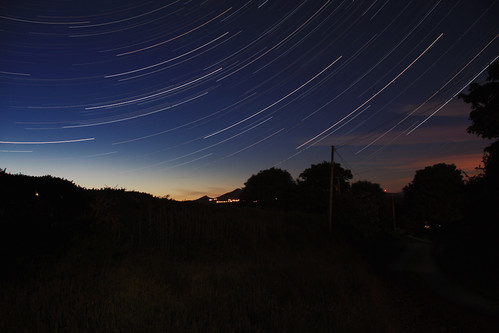
Advice for Night Sky shots......Newbie

Lasher_uk

Suspended / Banned
Messages
4
Name
Lee
Edit My Images
Yes
As it's my first post I guess I should say hi. So there you go...

As I have always had a passion for photography, (especially driving the family mad on holiday by taking up too much time in making the shot a bit more interesting instead of just snap snap) I decided to treat my self to a new digital camera.

After trawling a few forums and keeping an eye on my budget I went for a Fujifilm S8000fd. So far I have had some great results, from simple family shots to some nice views in Derbyshire using an easy to carry monopod and some nice macro shots of wildlife and plants.

I would like to get some nice night shots of the sky. I have taken some of the moon in quater phase on auto and they're not bad at all supporting the camera and using the timer. I'd like to have a crack playing around with the manual settings to see what I can pick up in some Star shots.

I realise that I am limited to 4 sec max exposure so I wont get any star trails but I would be very grateful for some suggestions for the shutter speeds and aperture settings to maybe get some nice clusters etc.

Thx in advance

Lee
 
Hello lee :wave:

Lee for star shots, in dark skies, you want the longest exposure you can get with the smallest F number. When mounted on a static tripod, depending on how zoomed you are, you may well end up with the stars showing as trails. If you are unzoomed, you can get away with between 30 and 60 seconds. I'm no expert, but you can then take a sequence of pictures and merge them together to pull more information in, and taking images with the lens cap on to also merge and this can remove noise and amp glow. The most I have managed is 45 x 30 second frames merged on the Z2. I've yet to try it with the 450d but I plan on doing so in an hour or so when the sky has got darker.

Have a look at this post on my Astro blog, which is one of my earliest attempts. This was a set of 18, 3.5 second exposures at 10x zoom (full) on the z2. This is the 35mm equiv of 380mm. The blobby stars in that image, I think were caused by the zoom.
 
4 seconds is not nearly long enough for stars in the night sky.
 
Yeah as said, you will need much longer exposures. But as you're limited to 4 secs, you will need to have your aperture as wide as possible to get as much light in as you can and a high iso setting (which will cause noise). If thats not getting you any results, you can try increasing the EV values and perhaps some post processing to brighten it up. I think with the camera you've got thats about all you can do unless you can figure out how to prolong your shutterspeed for longer than 4 secs.
 
Although 4 seconds may not be long enough for a single exposure, don't be put off. If you have the ability to use some kind of cable release or something to keep the shutter button down with you can easily stack your images together.

Have a look at this one, it's a series of 30 second exposures (yes I know 30 seconds, but you get the idea) stacked together. Have a play with the ISO, you shouldnt need to go above f/6 to get star shots, so take it from there and take the ISO up to what you're comfortable with without getting too much noise.


Here's a video put together from each seperate frame as well

http://flickr.com/photos/_belial/2583059287/in/photostream/

Then once you have your 100's of images, stack them together using whatever you fancy, a popular choice is deep sky stacker (Free) available here

http://deepskystacker.free.fr/english/index.html.

I have one somewhere I took with my G9 which has a max 15 second exposure which I stacked, i'll dig it out, but again don't be put off, have a go, fiddle with teh ISO's, and have fun :)
 
Many thx for the guidance. I had a go last night, though mostly cloudy I was suprised how much the clouds were lit up from the 4 sec exposure due to light pollution. I will have a go when it's clear and see how I get on. I may get better results concentrating on lunar stuff.

Cheers

Lee
 
You may also want to find a location very, very far away* from built up/urban areas, street lights, and advertising signs to avoid that light pollution. On a moonless night!

*imo 100 miles minimum... (the ocean would be good. Or a desert...).
 
Best keep an eye out for aircraft lights and other moving light sources...

Nikon D70, Sigma 12-24 (@22mm), 230 seconds @ f/3.8.
Looking North from Anissaras beach, Northern Crete, Sept 2007.

2329250624_2e51fa327f_o.jpg


(For the record, I WANTED the plane trail and the fishing boat on the horizon was a bonus!)
 
Many thx for the guidance. I had a go last night, though mostly cloudy I was suprised how much the clouds were lit up from the 4 sec exposure due to light pollution. I will have a go when it's clear and see how I get on. I may get better results concentrating on lunar stuff.

Cheers

Lee

Hi Lee

LP is a pain but it can be removed or filtered (to some extent) Don't think anyone has invented a cloud filter yet :) As others have said you need long exposures at a low F number and a high ISO and lots of practice Here's one of mine

M45

M45-widefield-spikes.jpg
 
Thx again guys. I take on board all you have said. I do have several locals where light pollution drops a bit if I go out towards Sherwood Forest or into Derbyshire Peaks. I think i'll have to wait until the nights draw in a bit. I do know a chap who works at the local observatory with a 2ft reflector, he may be able to get me a good pic or 2 lol.

Thx for the pics too, all very nice.

A bit off topic but here's a nice one I took of my dog, Colin today.......


I'm really getting to like this camera.


Thx

Lee
 
Back
Top